
No rituals selected yet.
Browse Pooja Packages →Key Takeaways
In This Article
[info-banner banner_title=”Garhmukteshwar at a Glance” banner_content=”Location: Hapur District, Uttar Pradesh | Distance from Delhi: ~120 km | Sacred River: Ganga (locally called Garh Ganga) | Famous For: Asthi Visarjan, Pind Daan, Tarpan, Kartik Purnima Snan | Key Ghat: Brijghat | Nearest Railway Station: Garhmukteshwar (Brij Ghat) Railway Station” banner_type=”info” show_icon=”1″]
Garhmukteshwar — the very name carries the weight of liberation. Nestled on the western banks of the holy Ganga in Uttar Pradesh’s Hapur district, this ancient tirthsthal has been receiving pilgrims for more than five thousand years. Devotees arrive carrying the ashes of their departed loved ones, seeking the sacred waters of Garh Ganga to release those souls from the cycle of birth and death. Others come to perform Pind Daan, Tarpan, and Shradh for the peace and elevation of their ancestors.
Garhmukteshwar sits approximately 120 kilometres north-east of Delhi — close enough that countless families from the capital region make this their first and most natural choice for ancestral rites. Its proximity to Delhi, combined with its deep scriptural significance, makes it one of the most visited sacred cities on the Ganga for post-death rituals. Yet beyond the rituals, Garhmukteshwar is a place of breathtaking spiritual beauty — wide Ganga ghats, ancient Shiva temples, and the quiet grandeur of a tirtha that has witnessed the prayers of sages since the Dvapara Yuga.
This complete guide covers everything you need to know before visiting Garhmukteshwar — its history, mythology, religious significance, the sacred Brijghat, the rituals you can perform here, how to reach, and how Prayag Pandits can assist your family through these ceremonies with full honour and authenticity.
The Ancient History and Mythology of Garhmukteshwar
The Name: Garh Mukteshwar
The name Garhmukteshwar is a compound of two Sanskrit roots. Garh means a devotee or a seeker of liberation, and Mukteshwar is one of the names of Lord Shiva — the one who grants Mukti (liberation). Together, the name means “the Shiva who liberates devotees.” The city is also known as Shivallabhpur in the Shiva Purana, named after the Shiva temple that was established here during the Vallabh Dynasty era.
According to tradition, the two doorkeepers of Vaikuntha — Jai and Vijay — were cursed by the sage Narada Muni to be reborn in mortal form. They wandered many sacred tirthas seeking liberation but found no relief. When they arrived at this Ganga tirtha and prayed before Lord Shiva, the Mahadev appeared before them and freed them from the curse, granting them Moksha. From that day forward, this place became known as Garhmukteshwar — the place where devotees attain liberation through Shiva’s grace.
Garhmukteshwar in the Mahabharata
Garhmukteshwar’s historical roots reach back to the Mahabharata period. This region formed part of the ancient Hastinapur Kingdom, the capital of the Kauravas and Pandavas. After the devastating Kurukshetra War, in which countless warriors — brothers, fathers, sons, friends, and foes alike — fell in battle, the victorious Pandavas were consumed by grief and a profound sense of dharmic responsibility toward the souls of the fallen.
Under the guidance of Lord Krishna himself, the Pandavas — led by Yudhishthira — gathered at the Khandvi Forest (the present-day site of Garhmukteshwar) beside the banks of the Ganga. Here, they performed the grand Pind Daan and ancestral yagya for all the warriors who died in the Kurukshetra War, including the Kauravas. This act of dharma was considered so potent that it helped even the fallen enemies attain peace and liberation.
This event established Garhmukteshwar as a place of extraordinary power for ancestral rites — a tradition that has continued unbroken for over five thousand years. When Hindu families today bring the ashes of their loved ones here, they are participating in the same act of love and dharma that the Pandavas performed at Lord Krishna’s direction.
The Garh Mela: Five Thousand Years of Continuity
Every year, Garhmukteshwar hosts the celebrated Garh Mela — one of the oldest fairs in northern India, with an unbroken tradition of more than five thousand years. Held on the occasion of Kartik Purnima (the full moon of the Kartik month, typically in October–November), this week-long mela draws hundreds of thousands of pilgrims from across Uttar Pradesh, Delhi, Haryana, and beyond.
The mela is believed to have its origins in the Pind Daan yagya conducted by the Pandavas after the Mahabharata War. It commemorates that sacred act of ancestral devotion and transforms the entire city into a living tirtha, with ritual bathing, prayers at ghats, and the release of ashes in the Ganga at every hour of the day and night.
The Religious Significance of Garh Ganga
The Ganga at Garhmukteshwar is locally and reverently called Garh Ganga — a name that acknowledges the special sanctity this stretch of the river holds. In Hindu scripture and tradition, not all points on the Ganga are considered equal. Certain tirthas are designated as mahatirtha — great crossing points — where the barrier between the mortal world and the divine realm becomes thinner, and where rituals performed carry amplified spiritual potency.
Garhmukteshwar is one such mahatirtha. The Skanda Purana mentions this location as a place where bathing on the day of Kartik Purnima brings results equivalent to a hundred Ashwamedha Yagyas. The Bhagavata Purana references the region as part of the sacred geography surrounding ancient Hastinapur. The Shiva Purana describes it as Shivallabhpur, where Shiva himself resides in a form that grants liberation to all who approach with a sincere heart.
For families dealing with the death of a loved one, this is not merely a geographical destination — it is a sacred technology. The rituals performed here — Asthi Visarjan, Pind Daan, Tarpan — are believed to directly assist the departing soul in its journey, clearing karmic debts, severing lingering attachments to the physical world, and opening the path toward the next stage of existence.
The Ganga’s flow at this point is believed to carry special purifying qualities. Bathing in Garh Ganga on auspicious days is said to wash away the accumulated sins of seven lifetimes. The water itself — referred to as Gangajal — is used in Asthi Visarjan and Tarpan rituals, carrying the offerings of the living directly to the departed. You can learn more about the broader significance of Ganga snan and its role in Hindu spirituality in our detailed guide on the importance of bathing in sacred rivers.
The 80 Sati Pillars: A Unique Historical Legacy
One of the most unusual and historically significant features of Garhmukteshwar is the presence of approximately 80 Sati Pillars scattered across the town. These stone pillars were erected to commemorate the women who chose to immolate themselves on their husbands’ funeral pyres — the ancient and now-abolished practice of Sati. Each pillar bears inscriptions about the woman it commemorates, creating an extraordinary historical record of lives, families, and religious customs across centuries.
These pillars are now archaeological and historical monuments, standing as silent witnesses to the complex and layered history of this sacred town. They are found near the ghats and in the older parts of the city, adding a dimension of historical depth to what is already a deeply spiritual place.
Asthi Visarjan at Garh Ganga: A Complete Guide
For Hindu families, Asthi Visarjan — the immersion of the cremated bones and ashes of a deceased person in sacred water — is one of the most important post-death rituals mandated by scripture. The Garuda Purana, which describes in detail the journey of the soul after death, prescribes Asthi Visarjan as a necessary rite that helps release the soul from its connection to the physical body and to the earth plane.
Garh Ganga at Garhmukteshwar is one of the most preferred destinations for Asthi Visarjan among families in Delhi and the entire NCR region, Western UP, and Haryana. The reasons are multiple and deeply intertwined — scriptural sanction, geographical accessibility, the sanctity of the Ganga, and the long-standing tradition of learned Teerth Purohits who have conducted these rites at Brijghat for generations.
For a deeper understanding of this ritual and all that it involves, our comprehensive article on Asthi Visarjan — all you need to know covers the scriptural basis, the ritual components, and answers the most common questions families have.
Why Families Choose Garh Ganga for Asthi Visarjan
- Closest sacred Ganga tirtha to Delhi: At just 120 km from the capital, Garh Ganga allows families to fulfil this essential duty within a day trip or a comfortable overnight visit, without the longer journey to Haridwar or Prayagraj.
- Scriptural sanction: The Mahabharata and Puranas specifically mention this location as sacred for ancestral rites, giving the ritual performed here full scriptural validity.
- Experienced Teerth Purohits: Brijghat has a long tradition of trained Teerth Purohits who specialise in post-death ceremonies and know every nuance of the ritual procedures.
- The Ganga’s flow: At this point, the Ganga flows broadly and clearly, making the actual immersion reverent and dignified rather than rushed or constrained.
- Complete ritual environment: All the materials needed for Asthi Visarjan — flowers, sesame seeds (til), Gangajal, clay pots — are readily available at Brijghat, and a boat for the immersion can be arranged through the purohit.
The Asthi Visarjan Ritual: Step by Step
The Asthi Visarjan ceremony typically unfolds across three to four hours, from the initial puja to the final immersion. Here is how the ritual proceeds at Brijghat, Garhmukteshwar:
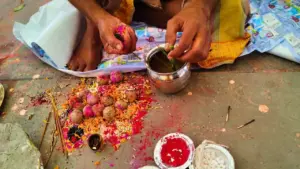
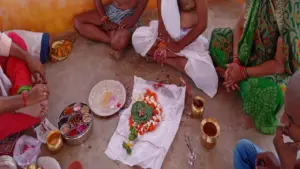
- Arrival and Sankalp: The family arrives at Brijghat with the ashes (stored in a clay pot or the cremation urn). The Teerth Purohit conducts the initial Sankalp — a formal statement of intent in which the name of the deceased, the family’s gotra, and the purpose of the ritual are declared.
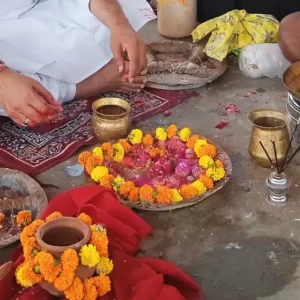
- Puja and Mantras: A puja is performed at the ghat, invoking the blessings of Ganga Mata, Lord Vishnu, and the family’s ancestral deities. Relevant mantras from the Garuda Purana and the Antyeshti Samskara tradition are recited.
- Til Tarpan: Sesame seeds (til) and Gangajal are offered to the soul of the departed, along with recitation of the departed person’s name and gotra. This is the first of the offerings that nourish and guide the soul.
- Boat Ride and Immersion: The family boards a boat on the Ganga. At an appropriate point in the flow, the ashes are reverently immersed in the water. The purohit continues reciting mantras throughout this process.
- Brahmin Daan: After the immersion, offerings are made to learned Brahmins — this act of daan (charitable giving) on behalf of the departed is believed to generate merit that benefits the soul in its onward journey.
- Gau Daan (Cow Worship): Worship of a cow at the ghat is considered particularly auspicious on the day of Asthi Visarjan, especially on the occasion of Kartik Shukla Ashtami.
Best Time for Asthi Visarjan at Garhmukteshwar
While Asthi Visarjan can be performed on any day of the year at Garhmukteshwar, certain dates carry heightened spiritual significance:
- Kartik Purnima (October–November): The holiest day of the year at Garhmukteshwar. The Garh Mela is in full swing, and the spiritual energy is considered at its peak. Bathing and ritual performance on this day are believed to bring liberation to both the performer and the departed soul.
- Pitrupaksha (Shraddh Fortnight): The fifteen days of Pitrupaksha (typically in September–October) are the most powerful annual window for all ancestral rites. Performing Asthi Visarjan during Pitrupaksha at Garh Ganga is considered extraordinarily auspicious.
- Ganga Dussehra (June): The day commemorating the descent of the Ganga from the Himalayas — considered highly sacred for all water-based rituals.
- Any Amavasya (New Moon): New moon days are universally regarded in Hindu tradition as the most potent days for ancestral rituals. Monthly Amavasyas at Garhmukteshwar draw significant pilgrim gatherings.
- Makar Sankranti (January): The solar transit into Capricorn — a major snan date at all Ganga tirthas.
[cta-card cta_icon=”🙏” badge_text=”Most Popular” cta_title=”Asthi Visarjan at Garh Ganga” cta_price=”₹3,100″ price_label=”Starting from” features=”4″ features_0_feature_text=”Experienced Teerth Purohit” features_1_feature_text=”Complete Poojan Samagri included” features_2_feature_text=”Exclusive boat ride on the Ganga” features_3_feature_text=”Brahmin Daan arrangement” primary_btn_text=”Book Asthi Visarjan” primary_btn_url=”https://prayagpandits.com/product/asthi-visarjan-at-garh-ganga-garh-mukteshwar/” cta_theme=”saffron”]
Pind Daan and Shradh at Garhmukteshwar
Beyond Asthi Visarjan, Garhmukteshwar is a major centre for Pind Daan — the offering of rice balls (pinds) to the souls of departed ancestors — and Shradh, the broader category of ancestral memorial rituals that includes offerings of food, water, and prayers for the peace and elevation of the dead.
Pind Daan at Garhmukteshwar carries a lineage that goes back to the Pandavas. When Lord Krishna instructed the Pandavas to perform Pind Daan for the souls of all the warriors who fell in the Mahabharata War, they chose this very location on the banks of Garh Ganga. You can read the full story and significance of this place in our guide to Asthi Visarjan at Garh Ganga. This scriptural precedent means that Pind Daan performed here is considered not merely effective but of the highest order of efficacy — capable of granting liberation (sadgati) even to souls in difficult or inauspicious post-mortem states.
When Should You Perform Pind Daan at Garhmukteshwar?
- During the 13 days following death (Antim Kriya period): If the family is from Delhi or the NCR region, Garhmukteshwar is the most accessible Ganga tirtha for conducting the Dashgatra pind daan and other rituals within the prescribed period.
- Pitrupaksha: The annual 15-day period dedicated entirely to ancestral rites is the most important time for Pind Daan. Every tithi (lunar day) of Pitrupaksha is associated with specific ancestors, and performing Pind Daan on the correct tithi maximises the benefit.
- Death anniversary (Barsi): Many families perform annual Shradh on the anniversary of their loved one’s death. For families who cannot travel, Prayag Pandits offers online Shradh at Garh Ganga conducted on your behalf by our Teerth Purohit.
- Amavasya: Monthly new moon days are considered powerful for ancestral rituals throughout the year.
Tarpan at Garhmukteshwar
Tarpan is the ritual offering of water — mixed with sesame seeds, flowers, or Kusha grass depending on the tradition — to Gods, sages, and departed ancestors. The word comes from the Sanskrit root trup, meaning to satisfy or to please. The purpose of Tarpan is to satisfy the souls of ancestors and ensure that their blessings flow down to the living family.
At Brijghat, Garhmukteshwar, Tarpan is performed standing in the Ganga, facing south (the direction associated with the realm of the departed), while the Teerth Purohit recites the names of the ancestors and the accompanying mantras. The act of offering water directly into the Ganga at this mahatirtha is believed to convey the offerings directly to the souls for whom they are intended, wherever those souls may currently be in their journey.
Prayag Pandits offers dedicated Tarpan at Garh Mukteshwar as a standalone service, conducted by experienced Teerth Purohits who are well-versed in the correct mantras and procedures.
[callout-box box_type=”tip” box_title=”Pind Daan at Garh Mukteshwar” box_content=”Prayag Pandits has performed Pind Daan for over 1,600 pilgrim families at Brijghat. Our Teerth Purohits are resident practitioners with deep knowledge of the correct vidhi (procedure) for post-death ceremonies. View Pind Daan packages at Garh Mukteshwar.” show_icon=”1″]
Brijghat: The Sacred Ghat of Garhmukteshwar
Brijghat is the principal ghat of Garhmukteshwar and the focal point of all religious activity in the city. Situated directly on the banks of Garh Ganga, Brijghat is where pilgrims take their ritual baths, where Teerth Purohits conduct Pind Daan and Asthi Visarjan, where boats set out for the immersion ceremonies, and where the great Garh Mela comes alive every Kartik Purnima.
The ghat is wide, well-maintained, and fronted by a series of temples and dharamshalas (pilgrim rest houses). The stone steps descend gradually to the river’s edge, making it accessible for elderly pilgrims and families. The water here is typically clear and flowing, a characteristic of the upper Ganga before it enters the more congested lower stretches.
Several important temples line the ghat and its surroundings:
The Mukteshwar Mahadev Temple
The most sacred temple in Garhmukteshwar is the ancient Mukteshwar Mahadev Temple, dedicated to Lord Shiva in his form as the giver of liberation. This temple is believed to be the original site where Jai and Vijay attained Moksha through Shiva’s grace, and it is considered the spiritual heart of the entire town. Before or after performing ancestral rites at the ghat, pilgrims invariably offer prayers at this temple, seeking Shiva’s blessings for the departed soul’s liberation.
The Brahma Temple
Garhmukteshwar is notable for housing one of the few temples in India dedicated to Lord Brahma, the creator deity of the Hindu trinity. Brahma temples are extremely rare — the most famous being in Pushkar, Rajasthan — and the presence of one at Garhmukteshwar underscores the extraordinary spiritual standing of this tirtha. Brahma is specifically associated with the creation of life and the regulation of cosmic order, making this temple of particular significance for those performing rituals connected with birth, death, and the soul’s journey.
The Shitala Mata Temple
The Shitala Mata Temple at Brijghat is an important goddess shrine, particularly revered during the Garh Mela. Shitala Mata is associated with healing, protection from disease, and the cooling of afflictions — her name literally means “the cool one.” Pilgrims who come for long journeys or during the hot months often seek her blessings before or after their ghat rituals.
The Parashuram Temple
The Parashuram Temple commemorates the legendary warrior-sage Parashurama, one of the Dashavatara (ten principal avatars) of Lord Vishnu. According to local tradition, Parashurama performed penances at this location after his victories in battle, using the sacred Ganga waters to purify himself. The temple is a reminder of the deep Vaishnava connections of this primarily Shaiva pilgrimage town.
Ganga Dussehra at Garhmukteshwar
Ganga Dussehra, observed on the tenth day (Dashami) of the bright half of the Jyeshtha month (typically in May or June), celebrates the day on which the Ganga descended from the heavens to the earth — the event known as Gangavataran. This is one of the holiest days in the Hindu calendar for any activity involving the Ganga, and Garhmukteshwar observes it with special energy.
On Ganga Dussehra, the Ganga’s waters are believed to be at their most purifying and most sacred. Bathing in the Ganga on this day is said to wash away ten types of sins (dasha papa) — which is the literal meaning of Dussehra in this context. Ritual offerings, Tarpan, and Asthi Visarjan performed on Ganga Dussehra at Garh Ganga are considered to carry a manifold multiplication of their usual spiritual merit.
The ghats at Garhmukteshwar fill with pilgrims on this day, with massive communal bathing, aarti, and ritual activity from before dawn until late in the evening.
Online Asthi Visarjan at Garh Ganga: An Option for Those Who Cannot Travel
For families living abroad or in distant parts of India who wish to have Asthi Visarjan performed at Garh Ganga but cannot travel in person, Prayag Pandits offers a carefully managed Online Asthi Visarjan at Garh Ganga service.
In this service, the family sends the ashes to Prayag Pandits’ address in Prayagraj or ships them directly to our Garh Ganga representative. Our Teerth Purohit conducts the full ceremony at Brijghat on the family’s behalf, with video documentation shared with the family so they can witness and participate remotely. The ritual procedure is identical to an in-person Asthi Visarjan — no steps are abbreviated, no mantras omitted.
This option has been used by hundreds of NRI families in the UK, USA, Canada, Malaysia, Mauritius, and Singapore who wish to fulfil their religious obligations toward their departed family members but face the constraints of distance, work commitments, or travel restrictions. For a broader view of Asthi Visarjan options across India’s major tirthas, see our guide to the best places to do Asthi Visarjan in India.
Gati Deep Daan and Pitra Maha Yagya at Garhmukteshwar
For families who wish to perform a more elaborate and comprehensive set of ancestral rites, Prayag Pandits offers the Gati Deep Daan and Pitra Maha Yagya at Garhmukteshwar.
This extended ceremony includes:
- Gati Deep Daan: The lighting and offering of oil lamps (diyas) dedicated to the soul of the departed, intended to illuminate their path in the afterlife and grant them Gati (onward movement and liberation).
- Pitra Maha Yagya: A fire ceremony (havan) performed specifically for the elevation of ancestral souls, using prescribed materials, mantras, and offerings that the Vedic tradition associates with the highest efficacy for ancestral benefit.
- Full Pind Daan and Tarpan: Combined with the above for a comprehensive ancestral rite session.
This package is particularly recommended for families who feel their ancestors may be suffering from unresolved conditions — whether due to premature death, accidental death, incomplete last rites, or long periods without ancestral observance. The Maha Yagya is considered especially powerful in such circumstances.
How to Reach Garhmukteshwar
Garhmukteshwar’s greatest practical advantage is its accessibility. Situated in Hapur district of western Uttar Pradesh, it is well connected by road and rail from Delhi and the broader NCR region.
By Road from Delhi (120 km)
The most common route from Delhi to Garhmukteshwar is via NH-9 (Delhi–Moradabad Highway):
- Take NH-9 from Delhi towards Ghaziabad
- Continue on NH-9 towards Hapur
- From Hapur, take the state highway towards Garhmukteshwar (approximately 30 km from Hapur)
- Total distance: approximately 120–130 km from central Delhi
- Estimated travel time: 2.5 to 3.5 hours depending on traffic
The route is well-signposted and passes through Ghaziabad and Hapur. Private taxis and cabs from Delhi and Ghaziabad are readily available. Many families hire a car for the day, allowing them to manage their ritual schedule and departure timing flexibly.
By Road from Noida and Ghaziabad
From Noida or Ghaziabad, the journey is even shorter — approximately 80 to 100 km, taking roughly 2 to 2.5 hours. The route goes via NH-9 towards Hapur and then Garhmukteshwar.
By Train
Garhmukteshwar (Brij Ghat) Railway Station is served by local and express trains from Delhi (New Delhi, Anand Vihar, Hazrat Nizamuddin, and Sahibabad stations). Several trains on the Delhi–Moradabad route stop at Garhmukteshwar. The IRCTC website can be used to search for trains on this route. From the railway station, the ghats at Brijghat are a short auto-rickshaw ride away.
By Bus
UPSRTC (Uttar Pradesh State Road Transport Corporation) buses run regularly from Delhi’s Kaushambi, Anand Vihar, and Ghaziabad bus terminals to Hapur, from where connecting buses and shared autos run to Garhmukteshwar. This is the most economical option, though travel times can be longer due to stops.
Nearest Airport
The nearest major airport is Indira Gandhi International Airport, New Delhi (approximately 140–150 km from Garhmukteshwar). From Delhi airport, the most convenient option is to hire a private taxi for the direct journey to Garhmukteshwar, which takes approximately 3 to 4 hours.
Best Time to Visit Garhmukteshwar
Garhmukteshwar welcomes pilgrims throughout the year, but certain periods are significantly more auspicious and comfortable than others.
October to February: The Peak Pilgrimage Season
The winter months from October to February represent the ideal time to visit Garhmukteshwar for both spiritual and practical reasons. The weather is cool and pleasant, the Ganga flows clearly, and the most important festivals fall within this window.
- Pitrupaksha (September–October): The annual ancestral rites fortnight brings thousands of families performing Pind Daan, Tarpan, and Shradh.
- Kartik Purnima (October–November): The Garh Mela — the most important festival of Garhmukteshwar — draws hundreds of thousands of pilgrims.
- Makar Sankranti (January): A major snan festival at all Ganga tirthas.
March to June: Hot but Spiritually Active
The summer months see lower visitor numbers due to the heat, but the period is not without its important dates:
- Ganga Dussehra (May–June): One of the holiest days for Ganga rituals, observed with large gatherings at Brijghat.
- Nirjala Ekadashi (June): A major Vaishnava fast day observed at temples in the town.
July to September: Monsoon
The monsoon season brings heavy rains and the Ganga rises considerably. Ritual bathing and ghat-side ceremonies may be restricted during periods of high water. However, the landscape becomes dramatically beautiful and the spiritual atmosphere remains profound. Families who must visit during this period should check river levels in advance and be prepared to adjust their plans.
Nearby Temples and Attractions in and Around Garhmukteshwar
While Brijghat and the Mukteshwar Mahadev Temple are the primary destinations for most pilgrims, the broader Garhmukteshwar area has several additional sites of religious and historical interest:
- Garh Fort Ruins: The remnants of an ancient fort that once protected the city, associated with the Hastinapur Kingdom and later medieval rulers. The ruins offer a view of the Ganga and the surrounding countryside.
- Kalka Mata Temple: A revered goddess shrine near the ghats, particularly busy on Navratri and during the Garh Mela.
- Ram Ghat: A smaller ghat adjacent to Brijghat, dedicated to Lord Ram, where pilgrims perform Ram Naam japa and aarti in the evenings.
- Hathi Ghat: Named for the elephant sculptures that once stood at its entrance, this ghat is historically associated with the royal bathing traditions of the medieval period.
- Dhruv Tila: A hillock near the river associated with the legend of the child-devotee Dhruva, who is said to have meditated here before attaining the Pole Star.
For those combining a Garhmukteshwar visit with a broader pilgrimage circuit, the city of Haridwar (approximately 180 km north) and Mathura-Vrindavan (approximately 130 km south-west) are accessible as extended journey options.
Practical Information for Pilgrims
Accommodation
Garhmukteshwar has a range of accommodation options suited to pilgrims’ budgets and preferences:
- Dharamshalas (Pilgrim Rest Houses): Several dharamshalas near the ghats offer basic, clean accommodation at very low cost or free of charge for pilgrims. These are typically managed by temple trusts or religious organisations.
- Budget Hotels: A number of small hotels and guest houses in the town proper offer rooms at Rs. 500 to Rs. 1,500 per night with basic amenities.
- Mid-range Hotels: A few better-appointed hotels are available for those who prefer more comfort, typically in the Rs. 1,500 to Rs. 3,500 range.
For most families who come from Delhi for Asthi Visarjan or Pind Daan, the ceremony can be completed within a single day trip, making overnight accommodation unnecessary.
What to Bring for the Ritual
- The asthi (ashes) in a sealed clay pot or the original cremation container
- A change of clothes for after the ghat bath or immersion ceremony
- Flowers (white or yellow marigolds are traditional), sesame seeds (til), and raw rice — though all of these are available at Brijghat if you cannot bring them
- The gotra (ancestral lineage name) of the deceased — the purohit will need this for the Sankalp
- The full name of the deceased and their date of death if known
- Cash for the purohit’s dakshina and for the materials required during the puja
Booking Prayag Pandits for Your Ceremony
Prayag Pandits has been conducting ancestral ceremonies at Brijghat, Garhmukteshwar for over seven years, with more than 10,000 poojas performed here. Our Teerth Purohits are resident specialists who bring scholarly knowledge, ritual accuracy, and genuine compassion to every ceremony. When you book with Prayag Pandits, you can be confident that your family’s ritual will be conducted with complete correctness, dignity, and care.
We recommend booking at least two to three days in advance for regular dates and at least one to two weeks in advance for ceremonies during Pitrupaksha, Kartik Purnima, or other peak festival periods.
[cta-card cta_icon=”🕉️” badge_text=”All Ceremonies” cta_title=”Book Your Ritual at Garh Ganga” cta_price=”₹3,100″ price_label=”Asthi Visarjan starting from” features=”5″ features_0_feature_text=”Asthi Visarjan at Garh Ganga” features_1_feature_text=”Pind Daan at Garh Mukteshwar” features_2_feature_text=”Online Asthi Visarjan for NRIs” features_3_feature_text=”Gati Deep Daan & Pitra Maha Yagya” features_4_feature_text=”Tarpan and Shradh services” primary_btn_text=”View All Packages” primary_btn_url=”https://prayagpandits.com/product/asthi-visarjan-at-garh-ganga-garh-mukteshwar/” cta_theme=”saffron”]
Garhmukteshwar in Context: How It Compares to Other Asthi Visarjan Tirthas
India has several major tirthas where Asthi Visarjan is traditionally performed, each with its own scriptural basis and regional traditions. The most prominent are Haridwar, Prayagraj (the Triveni Sangam), Varanasi, Nashik, and Garhmukteshwar. For families based in Delhi and western UP, the question of which tirtha to choose is one of the most important practical and spiritual decisions they face after a bereavement.
- Haridwar: 250–270 km from Delhi. The most well-known Asthi Visarjan destination in northern India. The Har Ki Pauri ghat is deeply sacred, and Haridwar has an established infrastructure of Pandas (hereditary priests) who maintain detailed family records going back generations.
- Prayagraj (Triveni Sangam): 650 km from Delhi. The confluence of the Ganga, Yamuna, and Saraswati is considered the most powerful Asthi Visarjan location in all of India. The journey is longer but the ritual potency is considered supreme.
- Varanasi: 820 km from Delhi. The city of Lord Shiva and the most sacred city on the Ganga. Asthi Visarjan at Varanasi is considered to grant automatic liberation to the departed soul.
- Garhmukteshwar: 120 km from Delhi. The most accessible Ganga tirtha with full scriptural validity for Asthi Visarjan. Ideal for families who cannot travel far or need to complete the ceremony within the first 13 days after death.
Many families choose Garhmukteshwar for the immediate post-death ceremonies and then subsequently perform Pind Daan again at Prayagraj or Haridwar during Pitrupaksha for additional spiritual benefit. This layered approach is not only permitted but considered auspicious — each tirtha adds its own dimension of grace to the ancestral rites. For a complete overview of all major Asthi Visarjan destinations with guidance on which to choose, read our detailed guide to the best places to do Asthi Visarjan in India.
[faq-accordion faq_theme=”default” first_item_open=”1″ faq_items=”7″ faq_items_0_question=”What is Garhmukteshwar and why is it sacred?” faq_items_0_answer=”Garhmukteshwar is an ancient Hindu pilgrimage city situated on the banks of the Ganga (locally called Garh Ganga) in Hapur district, Uttar Pradesh, approximately 120 km from Delhi. It is considered one of the most sacred tirthas on the Ganga for ancestral rites — Asthi Visarjan, Pind Daan, and Tarpan. Its religious significance is derived from its mention in the Mahabharata, Shiva Purana, Skanda Purana, and Bhagavata Purana, and from the tradition that the Pandavas performed Pind Daan here under Lord Krishna’s guidance after the Kurukshetra War. The name itself means ‘the Shiva who liberates devotees.'” faq_items_1_question=”Can I perform Asthi Visarjan at Garhmukteshwar instead of Haridwar?” faq_items_1_answer=”Yes, Asthi Visarjan performed at Garhmukteshwar is fully valid and scripturally sanctioned. The Garuda Purana does not restrict Asthi Visarjan to a single specific tirtha — it prescribes immersion in a sacred river, and the Ganga at Garhmukteshwar is explicitly mentioned in multiple Puranas as a mahatirtha suitable for ancestral ceremonies. For families based in Delhi and western UP, Garhmukteshwar is in fact the most recommended option due to its accessibility and the high quality of the Teerth Purohits available there.” faq_items_2_question=”What is the best time to do Asthi Visarjan at Garh Ganga?” faq_items_2_answer=”The most auspicious times for Asthi Visarjan at Garh Ganga are: Kartik Purnima (October-November, during the Garh Mela), Pitrupaksha (the 15-day ancestral rites fortnight in September-October), Ganga Dussehra (May-June), and any Amavasya (new moon day) throughout the year. However, Asthi Visarjan can be performed on any day — there is no inauspicious time for completing this sacred obligation to a departed family member. The scripture prescribes that it should ideally be done within 10 days of death, but this timeline can be extended for practical reasons.” faq_items_3_question=”How do I reach Garhmukteshwar from Delhi?” faq_items_3_answer=”Garhmukteshwar is approximately 120 km from central Delhi, accessible via NH-9 (Delhi-Moradabad Highway) through Ghaziabad and Hapur. By road, the journey takes approximately 2.5 to 3.5 hours depending on traffic. By train, multiple daily trains run on the Delhi-Moradabad route with a stop at Garhmukteshwar (Brij Ghat) Railway Station. Bus services are available from Kaushambi, Anand Vihar, and Ghaziabad bus terminals to Hapur, with connecting services to Garhmukteshwar.” faq_items_4_question=”What should I bring for Asthi Visarjan at Brijghat?” faq_items_4_answer=”The essential items to bring are: the ashes (asthi) in a sealed container; the gotra (ancestral lineage) and full name of the deceased; a change of clothes; and cash for the purohit’s dakshina. Flowers, sesame seeds (til), raw rice, and other puja materials are all available for purchase at Brijghat itself, so you do not need to source them in advance. If you are booking through Prayag Pandits, our package includes all puja samagri.” faq_items_5_question=”Can Pind Daan be performed at Garhmukteshwar during Pitrupaksha?” faq_items_5_answer=”Yes, Garhmukteshwar is one of the most important places for Pitrupaksha Pind Daan in the Delhi-NCR region. During the 15-day Pitrupaksha period, thousands of families perform Pind Daan at Brijghat. Each of the 15 tithis (lunar days) of Pitrupaksha is associated with specific ancestors, and Pind Daan performed on the correct tithi carries maximum scriptural validity. Prayag Pandits provides full-service Pind Daan at Garh Mukteshwar during Pitrupaksha — it is recommended to book at least one to two weeks in advance for this period.” faq_items_6_question=”Does Prayag Pandits offer online Asthi Visarjan at Garh Ganga for NRI families?” faq_items_6_answer=”Yes. Prayag Pandits offers a dedicated Online Asthi Visarjan service at Garh Ganga for families who cannot travel to India — whether due to distance, visa restrictions, work commitments, or health. The family sends the ashes to our address and our Teerth Purohit performs the full ceremony at Brijghat on the family’s behalf. The complete ritual — Sankalp, puja, Tarpan, boat immersion, and Brahmin Daan — is conducted without abbreviation. Video documentation of the ceremony is provided to the family. This service has been used by hundreds of NRI families across the UK, USA, Canada, Malaysia, Mauritius, and Singapore.”]
Book Asthi Visarjan at Garh Ganga
Our pandits perform Asthi Visarjan at the sacred Garh Ganga ghat in Garhmukteshwar. Complete ritual with all samagri and arrangements.
Starting ₹5,100
Book Now →2,263+ families served since 2019 · Trusted by pilgrims across 11 cities
Book Your Sacred Ritual
Authentic ceremonies performed by Veda-trained pandits with video proof at sacred sites across India.
2,263+ families served
Video proof included
Since 2019
