
अभी तक कोई अनुष्ठान नहीं चुना गया।
पूजा पैकेज देखें →मुख्य बिंदु
इस लेख में
What is Masikam?
Masikam (மாசிகம்) is the monthly ancestral ceremony observed by Tamil Hindu families during the first year after a family member’s death. The word Masikam comes from the Sanskrit masika, meaning “monthly.” It is performed on the same lunar Tithi (பக்ஷ திதி) each month — the Tithi on which the person passed away — for twelve consecutive months, concluding with the first annual Shradh ceremony (Abdika Shradh or Varsha Shradh).

In some Tamil communities the ceremony is called Masigam (மாசிகம் with regional vowel variation) or Monthly Thithi. In North Indian tradition, the corresponding rite is called Masik Shradh or Masikashtami Shradh. The purpose is identical: to nourish and support the newly departed soul during the critical first year of its journey through the afterlife realms, as described in the Garuda Purana.
For Tamil NRI families in Malaysia, Singapore, Australia, the United Kingdom, and elsewhere, performing Masikam abroad — or arranging for it to be performed at a sacred tirtha in India — is both spiritually important and practically achievable with the right guidance.
Why is Masikam Performed for the First Year?
The Garuda Purana — the primary scriptural source for Hindu death rites — describes in detail the soul’s journey during the twelve months following death. During this first year, the soul is believed to be in a liminal state called the Preta Avastha (the state of the recently departed, before formal acceptance among the ancestors / Pitru Loka). The soul is still closely connected to the world it just left — it can sense the grief of the family, and it depends on the family’s ritual support to proceed on its journey.
Each monthly Masikam provides the departed soul with:
- Spiritual nourishment through the Pinda (rice ball) offerings
- The merit generated by the family’s prayers and the Brahmin/Vadhyar’s mantras
- A formal remembrance and invocation that eases the soul’s separation from earthly ties
- The satisfaction of the Pitru debt (Pitru Rin) by which descendants honour their ancestors
After the twelve months end, the Abdika Shradh (first annual Shradh) formally marks the completion of the Preta period. From that point forward, the soul is counted among the established ancestors (Pitru), and annual Shradh on the same Tithi each year suffices — though families may also observe Masikam-style monthly Tharpanam on Amavasya throughout the year as an additional expression of devotion.
Masikam vs. Annual Shradh: Key Differences
| Aspect | Masikam (Monthly) | Annual Shradh (Abdika) |
|---|---|---|
| Frequency | Once per month for 12 months | Once per year, on the same Tithi |
| When it begins | One month after death (on the same Tithi) | One year after death (on the same Tithi) |
| Soul’s state | Soul in Preta Avastha (transitioning) | Soul has joined Pitru Loka (settled) |
| Scale of ceremony | Modest — Tharpanam, Pinda, one Brahmin meal | More elaborate — multiple Brahmins, Gau Daan often included |
| Primary purpose | Sustain and support the soul during transition | Annual remembrance and continued nourishment |
| Brahmin/Vadhyar required? | Yes — mantras must be recited correctly | Yes — full Shradh Karm requires a priest |
The Masikam Procedure: What Happens
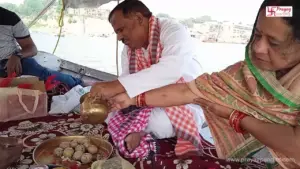
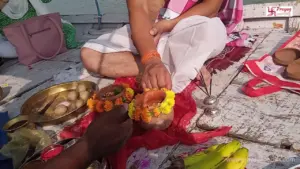
Masikam follows the general structure of a Shradh ceremony, adapted for the monthly context. While the full procedure should be followed under the guidance of your family Vadhyar, here is what the ceremony generally involves:
Preparation
- Identify the correct Tithi for each month — the lunar date on which the person died. Your Vadhyar will calculate the correct dates for the entire 12-month calendar at the time of death.
- The Karta (eldest son or designated male heir) observes a simple fast or eats only once on that day
- Bathe early in the morning before sunrise if possible; wear clean, preferably white clothes
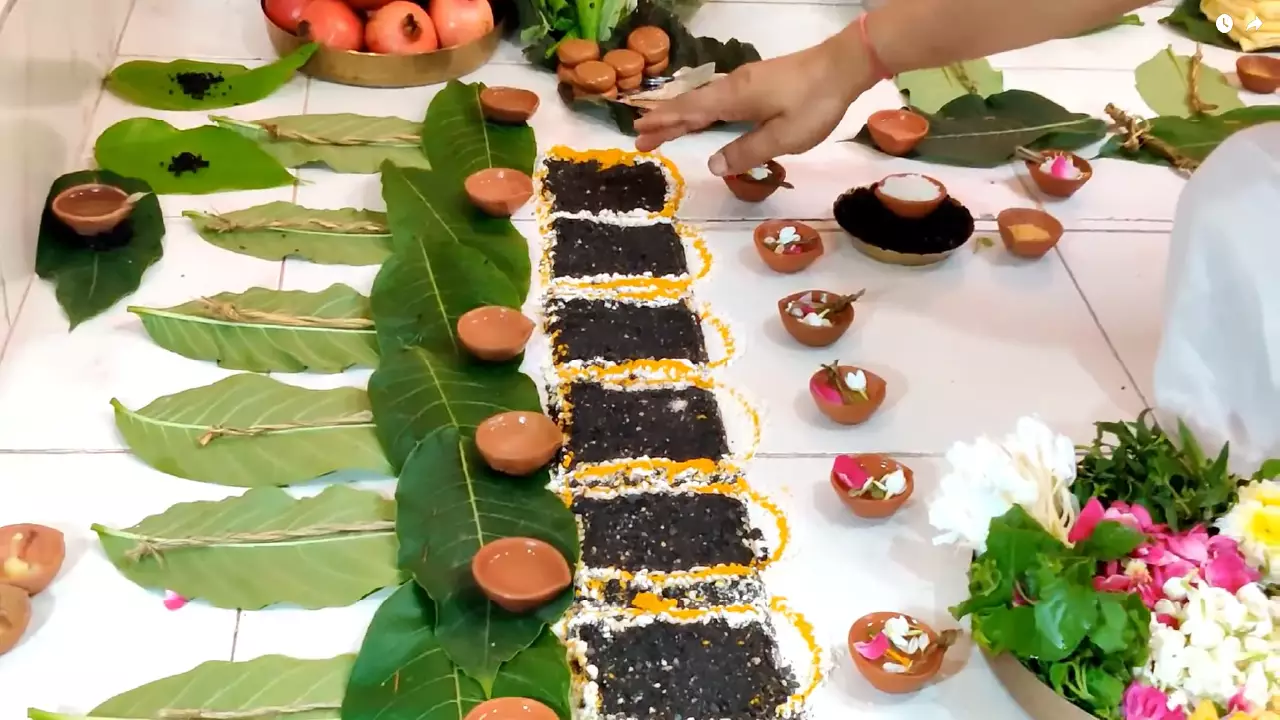
- Gather the materials: dharba grass, black sesame (ellu), rice flour for Pinda, a banana leaf or copper plate, fresh flowers, a lamp (deepam), and incense (agarbatti)
Sankalpa (Declaration of Intent)
The ceremony opens with the Sankalpa — the formal declaration stating your name, gotra (lineage), the current Tithi, and the name of the ancestor for whom the rite is being performed. This is spoken aloud in Sanskrit, guided by the Vadhyar. The Sankalpa is the most important element — it formally dedicates the merit of the ceremony to the specific soul.
Pinda Pradana (Rice Ball Offering)
Cooked rice is mixed with black sesame, ghee (clarified butter), and sometimes honey to form three Pinda balls. These are placed on dharba grass on a banana leaf or copper plate. The Vadhyar recites the Pinda Pradana mantra, invoking the soul of the departed to accept the offering.
In Tamil tradition, three Pindas are made: one for the deceased, one for the paternal grandfather, and one for the paternal great-grandfather — mirroring the three-generation structure of Tharpanam. For the first year Masikam, the primary Pinda for the newly departed receives special additional attention.
Tharpanam (Water Offering)
After the Pinda offering, Tharpanam is performed — water mixed with black sesame is offered through the fingers, facing south, for the soul and the ancestral line. This follows the same procedure as the monthly Amavasya Tharpanam (see our complete guide to Pithru Tharpanam).
Brahmin Bhoj (Feeding the Vadhyar)
A key element of Masikam is feeding a Brahmin (Vadhyar) a full meal. In the Tamil tradition, this meal — the Shradh Sadhya — is served on a banana leaf and includes rice, sambar, rasam, kootu, payasam, and other items as per tradition. The Vadhyar represents the ancestor and the ancestors of all departed lineages; by feeding him respectfully, the family sends nourishment to the departed soul in a spiritually direct way.
For families performing Masikam at home abroad, feeding a local Brahmin or Vadhyar (if available in the community) is appropriate. If no local Brahmin is available, a symbolic feeding can be performed with an intention to donate to a temple or charitable cause in lieu.
Daan (Charitable Giving)
Daan — charitable giving — on the day of Masikam is strongly encouraged. The Garuda Purana identifies Daan as one of the three pillars of ancestral welfare (alongside Tarpan and Shradh). Suitable Daan items include: food for the poor, clothing, money to a temple, feeding cows (Gau Daan), or sponsoring a lamp in a temple. The merit of this Daan is offered to the ancestor.
How to calculate the correct Tithi for Masikam
The Tithi for Masikam is the lunar date (Tithi) of the month in which the person died — not the Gregorian date. For example, if the person died on Tritiya (third day) of the Krishna Paksha (waning fortnight) of Bhadrapada month, then Masikam is performed on Tritiya Krishna Paksha of every subsequent month. Your Vadhyar will typically give you a list of all 12 Masikam dates at the time of the Sapindikarana ceremony. If you don’t have this list, share the death date with us (Gregorian) and we will calculate the correct Tithi schedule for you.
Materials Required for Masikam
| Item | Tamil Name | Quantity / Notes |
|---|---|---|
| Cooked white rice | Sadam | Enough for 3 Pinda balls; cook without salt |
| Black sesame seeds | Karuppu ellu | 2-3 tablespoons; used in both Pinda and Tharpanam |
| Ghee (clarified butter) | Nei | 2-3 tablespoons; mixed into Pinda and used for lamp |
| Dharba / Kusha grass | Dharba pullu | A small bundle; placed under Pinda and used in Tharpanam |
| Banana leaf | Vazhai ilai | For placing the Pinda offerings |
| Copper vessel (lota) | Tamba paathram | For Tharpanam water |
| Flowers | Pushpam | White flowers preferred (jasmine, white lotus, vilvam) |
| Incense sticks | Agarbatti / Sambrani | Light before starting |
| Deepam (oil lamp) | Vilakku | Keep lit throughout the ceremony |
| Honey | Thaen | Small amount; optional, added to Pinda in some traditions |
The Role of the Vadhyar in Masikam
The Vadhyar (வாத்யார்) — the Tamil term for a trained Brahmin priest — plays an essential role in Masikam. While family members perform supporting roles (gathering materials, preparing the rice, assisting with Tharpanam), the Vadhyar recites the Sanskrit mantras, guides the Karta through the Sankalpa, and ensures the ceremony follows the correct procedure for the family’s specific sutra (Aapasthamba, Bodhayana, etc.) and gotra.
In Tamil Nadu, most families maintain a relationship with a family Vadhyar who knows the family’s kula (lineage), gotra, and ritual traditions. For Tamil diaspora communities abroad, finding a qualified Vadhyar familiar with Tamil Brahmana procedure can be challenging. In Malaysia, Tamil Hindu temples often have Shaivite priests, but not all are trained in the Sanskrit Vedic rites required for Masikam. In such cases, arranging for the ceremony to be conducted remotely by a qualified Vadhyar in India — via live video — is a fully accepted alternative.
Masikam for NRI Tamil Families: Performing it Remotely
Many Tamil NRI families in Malaysia and Singapore ask: can Masikam be done from abroad? The answer is yes, with the right support. Here is how Prayag Pandits facilitates remote Masikam for NRI families:
- Share the death date and time: We calculate the correct Tithi and prepare the full 12-month Masikam schedule for you
- Booking in advance: Book each monthly Masikam date with us — we schedule it on the exact Tithi as per the Hindu Panchang
- You recite the Sankalpa: On the day, join via WhatsApp or video call — our Vadhyar guides you through the Sankalpa (takes about 5 minutes). Even if time zones make it difficult, the Sankalpa can be done the evening before
- Full ceremony at the tirtha: Our Vadhyar performs the complete Masikam — Pinda Pradana, Tharpanam, and Brahmin Bhoj — at Triveni Sangam Prayagraj, Varanasi, or Haridwar
- Video recording sent: You receive a video recording of the complete ceremony
This arrangement follows the accepted Dharmashastra principle of Pratinidhi (proxy representation) — the Vadhyar acts as the representative of the Karta, with the Karta’s intent formally declared through the Sankalpa. The Online Tarpan service for NRIs follows the same principle and has been used by thousands of Tamil NRI families globally.
Our Shradh services at Prayagraj and Varanasi include Masikam as a subset of the full Shradh at Prayagraj package. For families seeking a complete annual observance, we also offer the Shradh at Varanasi / Kashi package, which is a particularly auspicious site for ancestral rites in the Tamil tradition due to Kashi’s status as the city of Moksha.
The Significance of Performing Masikam at a Sacred Tirtha
While Masikam can be performed at home with full validity, the Dharmashastra texts describe multiplied merit when the rite is conducted at a sacred tirtha — particularly at river confluences or Ganga tirthas. The Padma Purana states that Shradh performed at Prayagraj is equivalent to a thousand Shradhs performed elsewhere.
For the first year Masikam — when the soul is in its most critical transition period — performing the rite at Triveni Sangam ensures the maximum possible merit reaches the departed. This is why families who are able to arrange for at least the 3rd-month, 6th-month, and 12th-month (Abdika) Masikam at a tirtha are considered to have fulfilled the rite at its highest level.
For an understanding of how Pitrupaksha and Shradh rites relate to Masikam, read our comprehensive guide on Shradh Karm 101: Types, Rituals, and Philosophy.
Monthly Ritual Support for Tamil NRIs
🙏 Book Masikam at Prayagraj or Varanasi
Masikam Shradh starting price
₹7,100
per person
What to Observe on the Day of Masikam
Beyond the formal ceremony itself, Tamil tradition prescribes certain observances for the Karta and close family on the day of Masikam. These are not arbitrary restrictions but are designed to cultivate the state of mind (bhav) appropriate to ancestral worship — solemn, clean, focused, and free from the distractions of daily life.
- Eat only once: The Karta traditionally fasts until the ceremony is complete, then takes a single meal — simple, vegetarian, without onion, garlic, or non-vegetarian food. The meal is ideally the Shradh Sadhya prepared for the Vadhyar, shared by the family after the Vadhyar is fed.
- No celebrations: Avoid weddings, festivals, or celebratory gatherings on Masikam days. The day is set apart for remembrance.
- Visit the temple: Many Tamil families visit a Shiva temple or their family deity’s temple on Masikam day and light a lamp (deepam) in memory of the departed.
- Feed crows: Crows (Kaka) are considered messengers of the ancestor realm in Tamil and pan-Hindu tradition. Placing cooked rice on the terrace or in the garden for crows before eating is a simple act with deep symbolic meaning — you are sending nourishment to your ancestors via their messengers.
- Light a lamp at home: Keep a lamp burning in the puja room throughout the day. Some families light a lamp at dusk (Sandhyadeepam) specifically in memory of the departed.
Masikam Dates for 2026: Pitrupaksha and Key Amavasya Dates
While your specific Masikam dates depend on the Tithi of the death in your family, certain dates in 2026 carry universal significance for all ancestral rites. Even if your regular monthly Masikam falls on a different date, observing additional Tharpanam on these dates carries multiplied merit:
| Date (2026) | Occasion | Significance |
|---|---|---|
| March 29, 2026 | Chaitra Amavasya | New moon of Chaitra month — auspicious for Tharpanam |
| April 27, 2026 | Vaisakha Amavasya | New moon of Vaisakha — strong for ancestral rites |
| September 26 – October 10, 2026 | Mahalaya Paksha / Pitrupaksha | The 16-day ancestral fortnight — most important of the year |
| October 10, 2026 | Sarva Pitru Amavasya (Mahalaya Amavasai) | Universal Tharpanam — covers all ancestors regardless of Tithi |
For Tamil families observing Masikam, the Mahalaya Paksha period (September 26 – October 10, 2026) is especially significant — during this 16-day period, performing Masikam at a sacred tirtha like Triveni Sangam Prayagraj is considered equivalent to several years of monthly Masikam in terms of the merit it generates for the departed soul.
Pitru Dosha and the Importance of Not Missing Masikam
Pitru Dosha (பித்ரு தோஷம்) — the affliction caused by neglect of ancestral duties — is taken seriously in Tamil astrological and religious tradition. When Masikam is consistently missed during the first critical year after a death, or when Shradh rites are omitted for years, the unsettled soul of the ancestor can create disturbances in the family’s wellbeing. Tamil astrologers often identify Pitru Dosha in a birth chart when the native and siblings experience obstacles in marriage, delays in progeny, or recurring unexplained health difficulties.
The remedy prescribed in both Dharmashastra and Tamil temple tradition is consistent, sincere ancestral worship — monthly Tharpanam, regular Masikam during the first year, and annual Shradh thereafter. If the first year has already passed without Masikam being observed, a compensatory Tripindi Shradh is recommended before resuming the regular annual cycle. Our priests guide families through this process — contact us to discuss your situation.
For related reading, see our overview of the significance of Pitrupaksha and our guide on what to eat during Pitrupaksha and Shradh periods.
अक्सर पूछे जाने वाले प्रश्न
What is the meaning of Masikam in Tamil Hindu tradition?
Masikam (from Sanskrit "Masika" meaning monthly) is the monthly ancestral offering performed by Tamil Hindu families for 12 months following the death of a close relative. Each month, on the tithi corresponding to the death, a Masikam ceremony is conducted to provide spiritual sustenance to the departed soul during its one-year transitional journey to the ancestral realm (Pitru Loka). The ritual involves offering rice balls (pindas), water, sesame seeds, and darbha grass while reciting Vedic mantras. Masikam is considered equivalent to the North Indian "Masik Shradh" but follows Tamil Shakha traditions with specific Dravida procedures and mantras. After 12 completed Masikams, the soul is believed to merge with the ancestors during the Sapindikarana ceremony.
What is Oona Masikam and how is it different from regular Masikam?
Oona Masikam (literally "deficient monthly") is a special additional monthly ceremony performed in Tamil tradition when the death date and the regular monthly Masikam dates do not align with specific tithis — typically the 3rd, 5th, 7th, or 9th month. Oona Masikam is performed to "complete" or rectify the monthly sequence and ensure the soul receives continuous spiritual support during its Preta state. Tamil Vedic pandits determine Oona Masikam dates through careful tithi calculation based on the exact nakshatra of death. Our Tamil-speaking pandits include Oona Masikam in the complete 12-month ceremony package, ensuring the family observes the scripturally-correct sequence without gaps.
Is Masikam the same as Masik Shradh in North Indian tradition?
Yes and no. Both Masikam (Tamil) and Masik Shradh (North Indian) refer to the same concept — the monthly ancestral offering for 12 months following death. However, the specific procedures, mantras, and calendar interpretation differ between the Tamil Dravida tradition and the North Indian tradition. Tamil Masikam follows the Krishna Yajurveda Taittiriya Shakha with specific mantras from the Taittiriya Aranyaka, while North Indian Masik Shradh often follows the Shukla Yajurveda tradition. Both traditions culminate in the Sapindikarana (or Sapindi Shradh) ceremony after 12 months. Our pandits can perform Masikam in the specific tradition of your family — just share your gotra and Shakha, or Vedic lineage, for authentic regional observance.
Can a daughter perform Masikam if she is the only child?
Yes, in Tamil tradition, daughters can perform Masikam when no son exists or when the daughter is the only child. Modern Tamil Vedic pandits acknowledge the practice of daughters performing monthly ancestral rites, especially when they are the sole surviving child. The ritual retains full spiritual efficacy. The daughter performs the Sankalpa in her own name, invokes her parents' gotra, and offers the pindas with the correct Dravida mantras. Our Tamil-speaking pandits regularly assist daughters through the complete 12-month Masikam sequence, culminating in the Sapindikarana ceremony at the end of the first year.
Does Masikam need to be performed at a river or temple?
Traditionally, Masikam should be performed near a source of flowing water — a river, a sacred pond, or at minimum a clean well — because water offerings (Tarpan) are central to the ritual. In Tamil Hindu practice, major sites for Masikam include the banks of the Kaveri at Tiruvarur, the Mahamagham tank at Kumbakonam, the Rameshwaram shore (for the final months), and the Chidambaram temple complex. For families who cannot travel to a sacred site, the ritual can be performed at a clean spot in the home with a vessel of Ganga water or water from a local river — provided the proper sankalpa acknowledges the substitution. Our pandits can arrange Masikam at major Tamil tirthas or at home depending on family preference.
What happens after the 12 months of Masikam are complete?
After 12 completed Masikams (plus any required Oona Masikams), the family performs Sapindikarana (called Sapindi Shradh in North India) — the ceremony on the 12th-month anniversary that merges the newly-departed soul into the collective ancestral line. At this ceremony, the single pinda offered for the deceased is merged with the pindas offered for the father, grandfather, and great-grandfather (Pita, Pitamaha, Prapitamaha). After Sapindikarana, the soul is believed to transition from the Preta state (wandering ghost) to the Pitri state (ancestral realm) and joins the lineage of liberated ancestors. From this point onwards, monthly Masikam is no longer required — only annual Shraddha on the death tithi and during Pitrupaksha are observed.
अपना पवित्र अनुष्ठान बुक करें
भारत भर के पवित्र स्थलों पर वेद-प्रशिक्षित पंडितों द्वारा वीडियो प्रमाण सहित प्रामाणिक अनुष्ठान।
2,263+ परिवारों की सेवा
वीडियो प्रमाण शामिल
2019 से
