No rituals selected yet.
Browse Pooja Packages →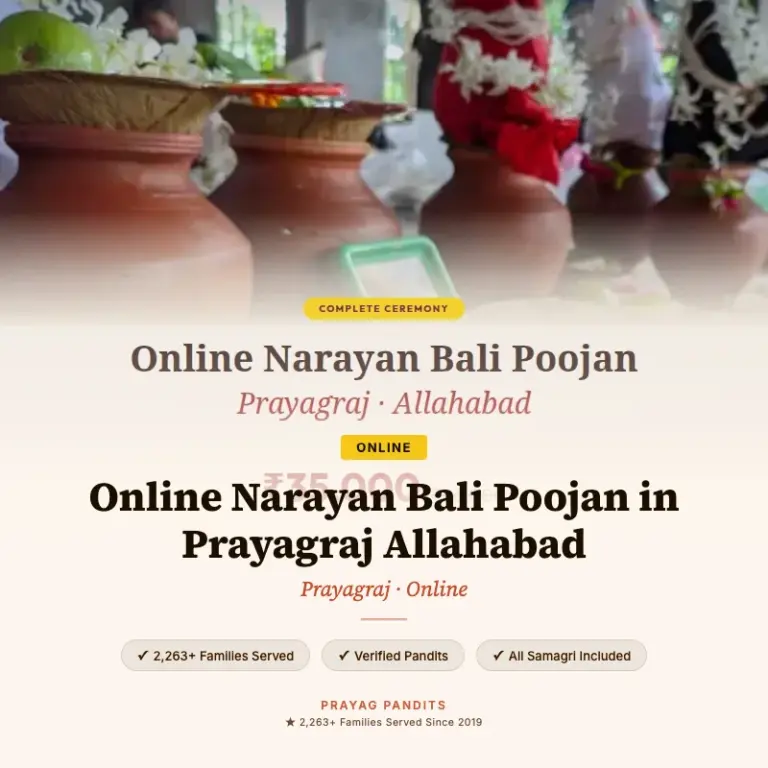 Save 24%
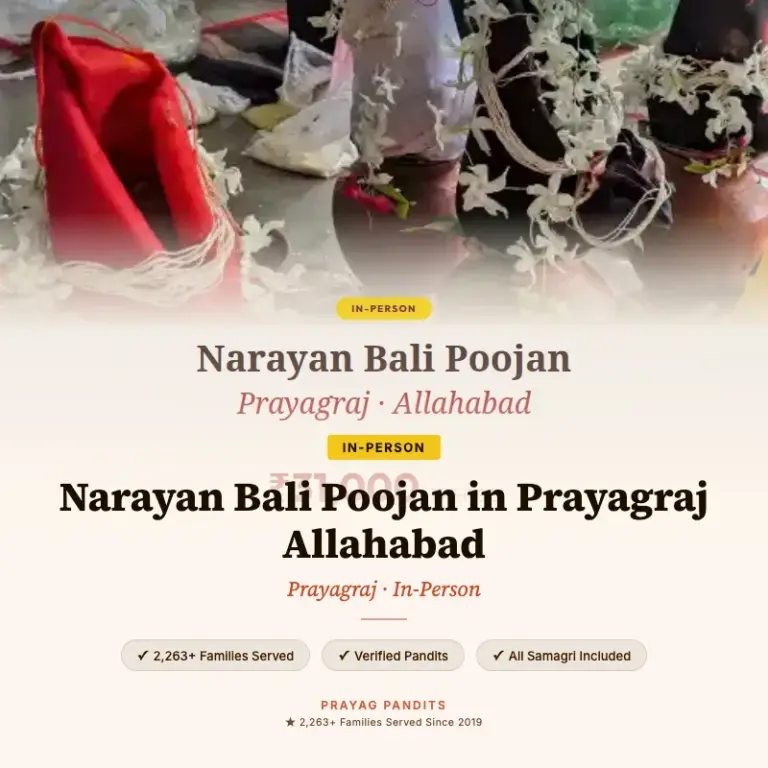
Narayan Bali Poojan
Online Narayan Bali Poojan in Prayagraj Allahabad
Online Narayan Bali Poojan at Triveni Sangam, Prayagraj (live video, 4–5 hours)...
from
₹35,000
₹46,000
The Padma Purana prescribes Narayan Bali — invoking Vishnu Narayan to complete the death rites for ancestors who died unnatural deaths (akal mrityu). Trimbakeshwar is the canonical tirtha per the Skanda Purana; at Prayagraj, the Sangam is named Tirtharaj — the King of Tirthas where the Mahabharata Vana Parva places Sangam-rites among the most meritorious.

Tell us your situation — we will suggest the package that fits the family. No booking pressure; we will explain the choice on WhatsApp first if needed.
Every package includes an experienced Vedic pandit and the required puja samagri. The difference is in boat, location, stay, and tradition.
Save 24%
Online Narayan Bali Poojan at Triveni Sangam, Prayagraj (live video, 4–5 hours)...
 Save 24%
Complete Narayan Bali Poojan at Triveni Sangam, Prayagraj Experienced qualified pandit (full...
No packages match this filter. Talk to a family advisor →
What's included
We've seen too many families face hidden boat fees, samagri costs, and "dakshina" pressure on the day. Here's exactly what's covered, and what isn't.
Included
Vedic Tirth Purohit qualified in the Narayan Bali vidhi at Triveni Sangam, with gotra-pravara verified and the specific mantras drawn from the Padma Purana and Garuda Purana Pretakalpa for akal-mrityu ancestral remediation.
Included
Darbha (kusha) grass for the prescribed human-effigy, gold pieces, ghee, milk, honey, til, jau (barley), gangajal, samidha (sacred wood), kalash, white cloth — all the materials the Padma Purana names for the Narayan Bali procedure, prepared in advance.
Included
Optional upgrades: Nag Bali paired-rite (the Padma Purana prescribes Narayan Bali + Nag Bali as the doctrinally complete remediation), online format with live video proof for NRI families, combined Narayan Bali + Pind Daan at the Sangam packages on request.
Included
One person on WhatsApp through your entire booking — fluent in Hindi, English, and major regional languages — before and after the multi-day rite.
Included
WhatsApp message from the Tirth Purohit after each stage completes — Sankalpa, effigy creation, full death-rite recitation, second-cremation, and tirtha-shradh — with the final report on the evening the multi-stage rite concludes.
Included*
Narayan Bali at the Triveni Sangam — the confluence of Ganga, Yamuna, and the mystic Saraswati that the Padma, Skanda, and Matsya Puranas name Tirtharaj, the King of Tirthas. The Mahabharata Vana Parva names Sangam-rites among the most meritorious of pitru-rites, extending naturally to the Narayan Bali remediation as the Tirtharaj alternative to Trimbakeshwar.
Not included
Train, flight, or road travel. Prayagraj Junction + Bamrauli airport well-connected; we can recommend trusted operators. Narayan Bali typically requires a 2-3 day visit for the complete rite plus the recommended Nag Bali pair.
Not included*
Not bundled with the base packages; stay-inclusive bundles available on request for the typical 2-3 day Narayan Bali visit.
Not included
The Padma Purana prescribes Narayan Bali + Nag Bali as the doctrinally complete pair. The base package covers Narayan Bali only; add the Nag Bali pair on request — many families perform both together at Prayagraj during a single Pitrupaksha visit.
Step 03 · How it works
From your first call to same-day confirmation — we handle every coordination, so the family can focus on what matters.
Choose a package and complete payment online. Our team calls within 2 hours to confirm details and explain the multi-stage Narayan Bali procedure.
~ 5 minutes
Provide gotra, names of departed ancestors (with focus on those who died unnatural / untimely deaths — akal mrityu), the death tithi if known, preferred date — the annual Tithi or a Pitrupaksha day — and any special vidhi requirements.
~ 10 minutes
Tirth Purohit performs the complete multi-stage Narayan Bali vidhi — Sankalpa, creation of the prescribed darbha-grass human-effigy, recitation of the full Antyeshti (death rites) the Padma Purana prescribes invoking Vishnu Narayan, second-cremation of the effigy, and tirtha-shradh at the Triveni Sangam to complete the remediation.
4–6 hours (multi-stage)
Tirth Purohit sends a same-evening WhatsApp confirmation with offerings detail across all rite stages. Photos and video available as opt-in add-ons (default for the Online variant).
Same day
When to perform
Narayan Bali is the remediation rite that the Padma Purana, the Nirnaya Sindhu, and the Smriti Kaustubha tradition prescribe for ancestors who died unnatural, untimely, or violent deaths (akal mrityu). Trimbakeshwar at Nashik is the canonical Narayan Bali tirtha per the Triambakeshwar Mahatmya tradition and centuries of continuous practice; Prayagraj is a major alternative site through the Padma, Skanda, and Matsya Puranas naming the Triveni Sangam as Tirtharaj, the King of Tirthas. The Mahabharata Vana Parva names Sangam-rites among the most meritorious of pitru-rites. Pitrupaksha (Sep 26 → Oct 10, 2026) is the peak window; the death tithi of the akal-mrityu ancestor is primary; the rite is valid year-round outside sutaka periods.
Performed by Tirth Purohits at Triveni Sangam since 2019
Two ways to perform
Performed by your own hands at the Triveni Sangam under a hereditary Sangam Tirth Purohit — boat ride to the confluence point for the Sankalpa, darbha-effigy creation, full second-cremation invoking Vishnu Narayan, and tirtha-shradh at the joined waters. The 2-3 day visit typically pairs with Nag Bali; combined-pair pricing is determined during pre-booking based on lineage count, Brahmin-bhojan scale, and samagri elections.
Starts at ₹31,000
For families abroad or unable to travel. Sankalpa recited remotely; Tirth Purohit performs the multi-stage Narayan Bali at the Sangam with live video proof through the effigy-creation, second-cremation, and tirtha-shradh stages; gangajal couriered after the rite.
Starts at ₹35,000
Complete guide
An editorial reference covering the ritual, the place, eligibility, timing, and what to keep ready — written for families weighing the decision.
Select your package and complete booking. Our team calls within 2 hours to confirm details.
Provide your gotra, departed soul's name, and any special requirements.
Experienced pandit performs the complete ceremony at the sacred site.
The family receives ceremony updates on WhatsApp after completion.
Narayan Bali is the remediation rite that the Padma Purana, the Nirnaya Sindhu, and the Smriti Kaustubha tradition together prescribe for ancestors who died unnatural, untimely, or violent deaths — accident, suicide, sudden illness, drowning, fire, or death in a foreign land — where the standard cremation (Antyeshti) could not complete its prescribed stages. The rite invokes Vishnu Narayan to receive the death rites on behalf of the ancestor; a human-effigy is created from darbha grass and the prescribed materials, the full Antyeshti is recited over the effigy, and the effigy is then cremated as a "second cremation" completing the original. The rite is doctrinally distinct from Tripindi Shradh (three-pindas within the shradh rite-family) and from Pind Daan (pinda offering for moksha-release).
Trimbakeshwar at Nashik is the canonical Narayan Bali tirtha per the Triambakeshwar Mahatmya tradition and centuries of continuous practice (see our Trimbakeshwar Narayan Nagbali guide for the canonical-site detail). Prayagraj is a major alternative site through the Padma, Skanda, and Matsya Puranas naming the Triveni Sangam — confluence of Ganga, Yamuna, and the mystic Saraswati — as Tirtharaj, the King of Tirthas. The Mahabharata Vana Parva, in its Tirthayatra section, names Sangam-rites among the most meritorious of pitru-rites — extending naturally to the Narayan Bali remediation. The rite at Prayagraj is performed on a boat at the confluence point itself for the Sankalpa and effigy stages, with the closing tirtha-shradh offered into the joined waters. For families who cannot travel to Trimbakeshwar, or who are already performing other ancestral rites at Prayagraj (asthi-visarjan, pind-daan, tarpan, shradh), the Sangam-anchored Narayan Bali is the doctrinally valid Tirtharaj alternative.
The eldest son or designated karta of the deceased holds the authority. After marriage, the son performs the rite with his wife. If the eldest son is deceased, the younger son carries out the rite. In the absence of a son, the grandson (son's son); in the absence of male issue from the deceased, the brother; if the departed had only daughters, the daughter's son holds the right. In modern practice, when no male issue is available, daughters and daughters-in-law perform the rite under Tirth Purohit guidance and the rite is fully valid.
Narayan Bali is performed whenever the family is ready for the remediation. Four windows carry intensified Mahatmya merit: (1) Pitrupaksha (Sep 26 — Oct 10, 2026), with Ghata Chaturdashi (Oct 9) as the akal-mrityu primary day and Mahalaya (Oct 10) as the universal-ancestors closing day. (2) The death tithi of the akal-mrityu ancestor. (3) Monthly Amavasya. (4) The Magh Mela (January-February) — the Sangam-Tirtharaj pilgrim window for ancestral rites. The rite is valid year-round at the Sangam through the Tirtharaj Mahatmya.
Three doctrinally distinct rites. Narayan Bali is the remediation rite (Padma Purana) — a human-effigy is created, the full Antyeshti is recited invoking Vishnu Narayan, and the effigy is cremated as a "second cremation" completing the death rites the original cremation could not complete. Tripindi Shradh is a special shradh subtype (within the shradh rite-family) — three pindas offered to specific deity-groups for akal-mrityu ancestors; no effigy, no second-cremation. Pind Daan is the moksha-release pinda offering. At Prayagraj, many families perform Narayan Bali + Tripindi at the Sangam during a single Pitrupaksha visit on different days, plus separate Pind Daan as the moksha-release component.
The Nirnaya Sindhu and the Triambakeshwar tradition that the Padma Purana corroborates prescribe Narayan Bali + Nag Bali as the doctrinally complete pair. Nag Bali is the remediation rite for curses related to harming serpents (Naga) — many lineages carry a Naga-related pitri-dosha from a real or transmitted offense. The two rites are typically performed together over 2-3 days. We offer Nag Bali as an add-on to the Narayan Bali base package; the combined-pair pricing is determined during pre-booking consultation based on three factors: (1) the lineage count (how many ancestors and which side of the family), (2) the Brahmin-bhojan scale (how many Brahmins fed on the closing day), and (3) any additional samagri elections. Most Prayagraj families opt for the pair — the Sangam ghat is well-suited to the multi-day combined rite.
Yes. Online Narayan Bali is performed by a Sangam Tirth Purohit at the Triveni Sangam with live video proof through all the multi-stage rite components — the Sankalpa, the darbha-effigy creation, the full Antyeshti recitation, the second-cremation, and the closing tirtha-shradh at the confluence. The karta recites Sankalpa remotely (over Zoom or WhatsApp); names and gotra are confirmed remotely before sankalpa; the complete recording is shared within 48 hours. The Parashar Smriti and Yajnavalkya Smriti both describe Pratinidhi Karma (rite performed by an authorised pandit on the family's behalf, anchored on the karta's sincere Sankalpa) — the Sankalpa and the offering define the rite, not physical presence. Online Narayan Bali at Prayagraj is priced at ₹35,000.
Yes — the full Prayagraj rite-set. Prayagraj is the first city on our v4 platform to offer all 5 ancestral rites: Asthi Visarjan (cremation ashes at Sangam), Pind Daan (moksha-release pinda offering), Tarpan (daily water libation), Shradh (annual ancestral sustenance), and Narayan Bali (akal-mrityu remediation). Many families perform Narayan Bali for their akal-mrityu ancestors, Pind Daan for moksha-release of all ancestors, Shradh for the annual Tithi observance, and Tarpan daily through the Pitrupaksha fortnight. See our Asthi Visarjan, Pind Daan, Tarpan, and Shradh pages for the standalone rites.
Drawn from puranic references and pandit consultations — for families who want to understand the ritual's meaning before booking.
Voices from families
We performed Narayan Bali Poojan on the advice of our family pandit. The ceremony took the full day but Prayag Pandits managed everything perfectly. The senior pandit was very knowledgeable about this complex ritual.
We are settled abroad and wanted to perform the puja in Prayagraj. Prayag Pandits made it possible. Grateful.
Thoroughly impressed with the professionalism. The pandit ji was punctual and well prepared with all the samagri.
The Narayan Bali Poojan was conducted exactly as described in the Garuda Purana. All the required materials were arranged by the team. The 4-5 hour ceremony was performed with full devotion.
Narayan Bali is a very specific ritual and finding the right pandit was our main concern. Prayag Pandits connected us with an experienced purohit who had performed this poojan many times. Very satisfied. Jai Shri Ram.
Frequently asked
Compiled from 2,263+ family conversations on WhatsApp and over the phone.
The main goal is the liberation (Moksha) and pacification of souls who died unnaturally, fulfilling their lingering desires. Performing it at Prayagraj leverages the unique spiritual power of the Triveni Sangam to effectively cleanse any negative karmic influences (Pitru Dosha) affecting the living descendants and ensures the ancestor's soul attains peace in the ancestral realm, bestowing blessings upon the family.
Families experiencing persistent problems believed to be caused by Pitru Dosha stemming from an ancestor's unnatural death should perform this puja. Typically, the eldest son or a male descendant performs the main rites. However, any family member (male or female, though some traditions state women cannot perform it independently) whose ancestor suffered such a death can initiate or participate. It's undertaken for those facing issues like delays in marriage/childbirth, financial instability, chronic illness, or recurring negative events.
While specifics can vary, the core procedure involves:
Costs vary based on duration, number of priests, inclusion of Daan (like Gau Daan), and the service provider. Search results provide ranges:
Pind Daan: A general rite for all departed ancestors, usually performed annually (especially during Pitru Paksha) or after death, to nourish and satisfy them. It's a fundamental duty.
Narayan Bali: A specific ritual targeted towards souls who died unnaturally or whose final rites were improper. Its primary focus is liberation from a troubled state (Pret Yoni) and resolving the specific Pitru Dosha caused by such deaths. While Pind Daan is often part of Narayan Bali, the latter addresses a very specific type of death and its consequences.
Yes, several platforms now offer online Narayan Bali Puja services. The rituals are performed by pandits physically present at Triveni Sangam, Prayagraj, on your behalf. This usually involves video conferencing or recordings of the puja, allowing you to participate remotely.
The core benefits (peace for the soul, removal of Pitru Dosha, resolution of family problems) are significantly amplified due to the sacredness of Prayagraj:
Absolutely. If a family continues to experience difficulties attributed to Pitru Dosha from an ancestor's unnatural death, regardless of how long ago it occurred, performing Narayan Bali is recommended. Conducting the ritual in the supremely potent kshetra of Prayagraj is believed to be highly effective in providing relief and liberation to the ancestor's soul even after a long time
Free consultation
We’ll listen, understand your family’s situation, and recommend the right package — never push. Reply within 10 minutes on WhatsApp, every day.