






What’s included
Included in your package
- Tarpan at Phalgu River, Gaya Pitrupaksha 2026
- Experienced Gaya-based pandit
- All samagri sesame, kusha, barley flour, flowers
- Tarpan with three-generation ancestral invocation
- Sankalp with family name, gotra & ancestor names
- Pre-ceremony consultation
Not included in your package
- Travel to Gaya
- Accommodation
- Station / airport pickup & drop
- Pind Daan / Shradh / Asthi Visarjan (separate services)
- Photography / videography
- Extra Dakshina/Gifts/Donations made to the Priest/Pandit
How it works
Choose your pooja
Review your package and any available additions, then add it to your booking.
Share your preferences
Enter your contact details, preferred date and time. Add ancestral details if you wish.
We coordinate with you
Our team confirms the arrangements and shares your coordinator’s details 24 hours before the pooja.
Participate in your pooja
Follow the participation and joining arrangements described in your package and shared by your coordinator.
What families say after the rite
From families who booked Tarpan in Gaya Pitrupaksha 2026.
Rated 4.8 out of 5
500+ reviews · Prayag Pandits
This poojarated 4.6 out of 519 reviews
Our pandits






- 2,263+ families served
- Serving since 2019
- GST registered
Families on video
The player loads only when you press play.



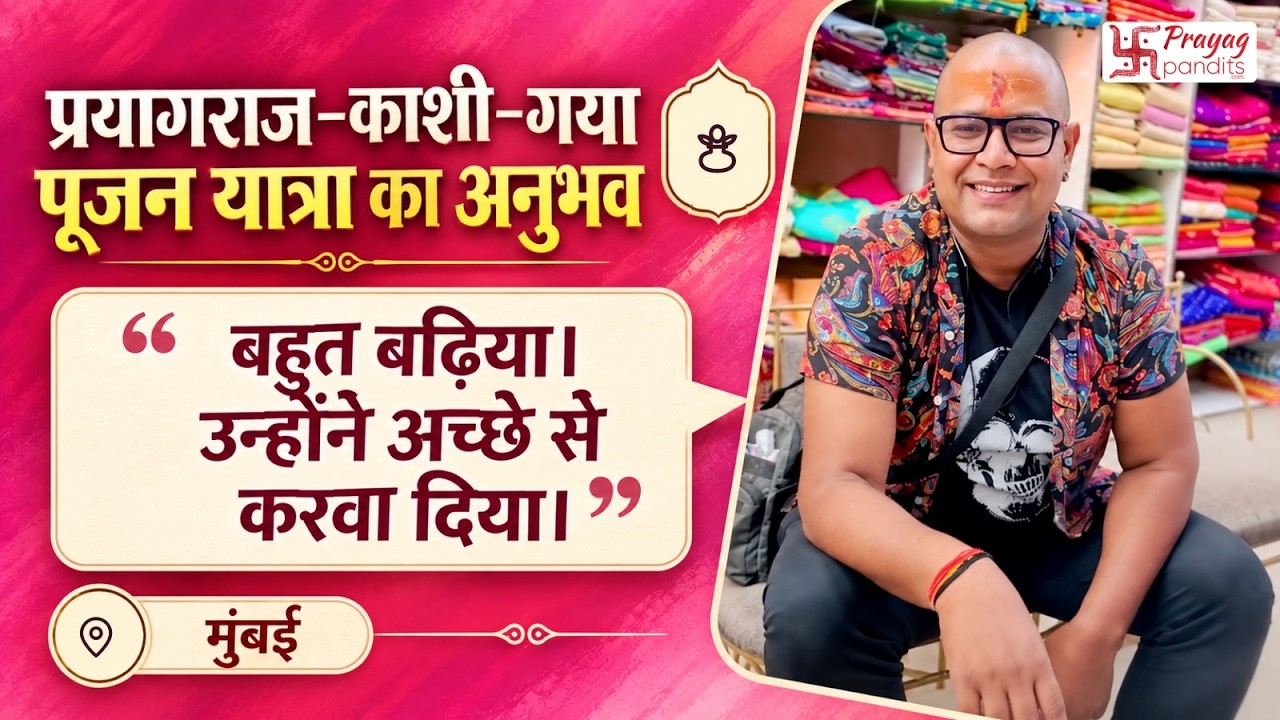
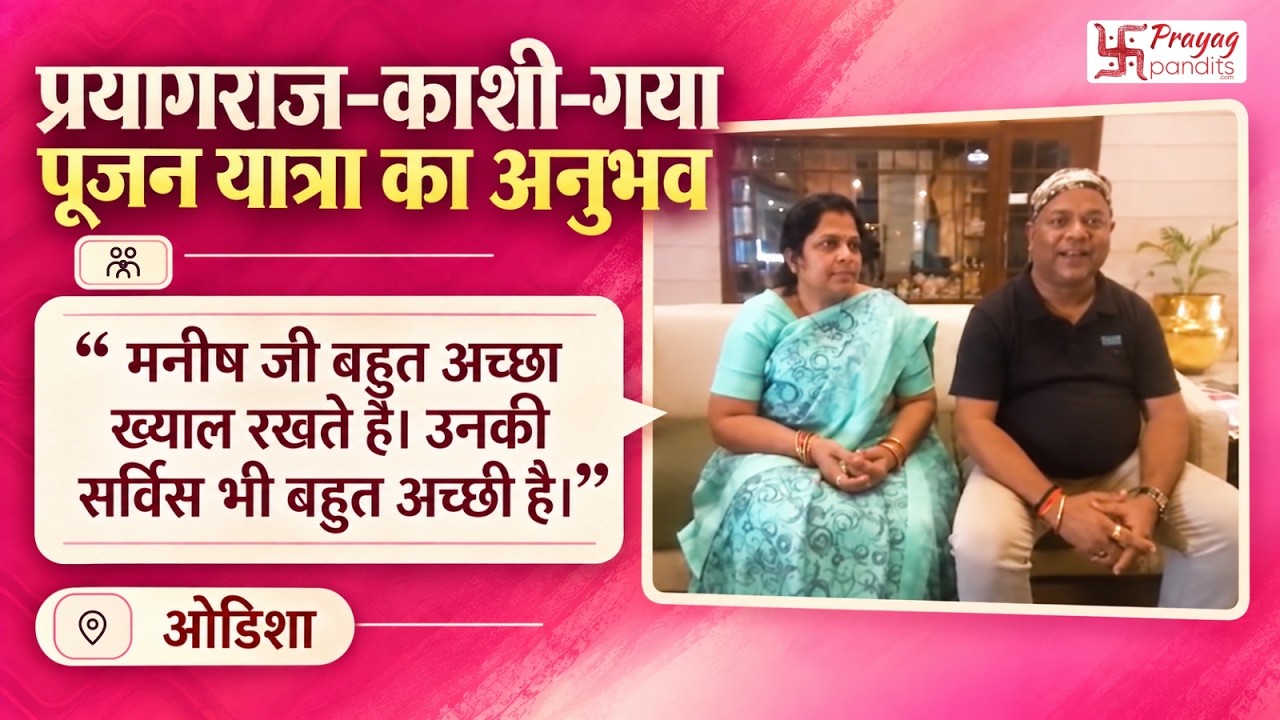

In their words
Booked this for my mother-in-law's teerth yatra. The arrangements were perfect from pickup to drop. The pandit performed all mantras correctly and with devotion. The poojan materials were all arranged by them. Very satisfied with the service. Jai Shri Ram.
We booked Pind Daan for our late father's shradh ceremony. The pandits were very knowledgeable and performed all rituals with proper Vedic mantras. The whole family felt at peace after the poojan. Highly recommended for anyone looking for authentic rituals. Jai Shri Ram.
बहुत संतोषजनक सेवा। पंडित जी का वेद-शास्त्र का ज्ञान अद्भुत था। उन्होंने गरुड़ पुराण के श्लोकों का पाठ किया जो बहुत मार्मिक था। पूरा परिवार भावुक हो गया।
पितृपक्ष में पिंडदान करवाया। पूरी व्यवस्था उत्तम थी। पंडित जी समय पर आए और सभी विधि-विधान पूर्ण भक्तिभाव से सम्पन्न करवाए। प्रसाद वितरण भी अच्छा था।
Very professional service. The pandit ji explained every step of the ritual which helped us understand the significance. Everything was arranged well including the samagri. We are grateful to Prayag Pandits for making this spiritual journey meaningful.
Booked for my mother-in-law's shradh. The entire ceremony was conducted with great reverence. Thank you.
Review your ceremony
Tarpan in Gaya Pitrupaksha 2026
Please check 1 thing
Questions families ask
Gaya's paramount importance stems from Hindu mythology, particularly the story of Gayasur, a pious demon. Lord Vishnu subdued him by placing his foot on his chest, transforming him into the sacred landscape of Gaya. Gayasur was granted a boon that anyone performing ancestral rites like Pind Daan and Tarpan here would ensure the liberation of their ancestors. Lord Vishnu's presence (as Pitrudev) and the historical performance of rites by figures like Lord Rama make Gaya uniquely potent for Tarpan
Yes, Tarpan, like Pind Daan, can be performed in Gaya on any day of the year. While Pitru Paksha is the most potent period, the sacredness of Gaya ensures that performing Tarpan here at any time is beneficial for the ancestors. Many pilgrims perform these rites whenever they visit Gaya
The Vishnupad Temple, housing Lord Vishnu's footprint, is the spiritual epicenter of Gaya. While Tarpan itself is mainly performed by the Phalgu river, the overall Shraddha ceremony, of which Tarpan is a part, often culminates or includes rites within or near the Vishnupad temple complex. It signifies performing the rituals directly in the presence of Lord Vishnu, enhancing their efficacy
Under the guidance of a Gayawal Panda (priest), the performer (Karta), after a purificatory bath (often in Phalgu) and wearing clean attire, faces south (direction of ancestors). They take water mixed with black sesame seeds, barley, and sometimes milk, using Kusha grass. Reciting mantras and the names/gotra of ancestors, they offer the water (anjali) from specific parts of the hand (between thumb and forefinger for Pitrus) into the river or designated spot, praying for the ancestors' satisfaction and peace.
Yes, some key points include:
- Maintain purity (physical and mental). Take a bath before the ritual.
- Follow the instructions of the Gayawal Panda diligently.
- Perform rituals with faith (Shraddha) and devotion.
- Face the correct direction (South for Pitrus).
- Use the prescribed materials (like black sesame for Pitrus, Kusha grass).
- Offer water using the correct hand gestures.
- Observe any dietary restrictions if applicable (like avoiding non-veg, onion, garlic during Pitru Paksha).
- Be respectful of the sacred sites and maintain decorum.
- It's often recommended (though not always mandatory) for men performing the rites to get their heads shaved (Mundan).
Completely. Our Gaya pandit is experienced in guiding first-time pilgrims as well as lifelong practitioners. He will explain each step before asking you to do it, translate the meaning of the mantras, and move at a pace that is comfortable for you. Many of our clients come with no prior experience of Hindu ritual, and every single one has found the experience deeply meaningful. You do not need to know Sanskrit. You do not need to have performed rituals before. You just need to show up.
If the gotra is unknown, the pandit will use Kashyapa gotra — this is the established traditional fallback for unknown gotra, and it is fully valid. Many families in urban settings have lost track of their gotra over generations. You are not alone in this, and it does not diminish the ritual in any meaningful way.
Yes. The standard Tarpan sequence includes offerings for both the patrutrayi (paternal grandmother, great-grandmother) and the matrutrayi (maternal grandmother, great-grandmother). You can name individuals from both sides of the family. The pandit will organize the offering sequence correctly.
Traditionally, yes. The tithi on which an ancestor died corresponds to the tithi within Pitrupaksha on which their Tarpan is most auspicious. So if your father died on a Panchami, Tarpan is ideally performed on Panchami of Pitrupaksha. If you do not know the tithi, Sarva Pitru Amavasya — the last day — is always acceptable for all ancestors regardless of when they died.
Absolutely — and in fact, for most families, we recommend combining both. Tarpan (the water offering) and Pind Daan (the offering of rice balls) together constitute the complete Shradh ceremony at Gaya. We offer combined packages. Please contact us after booking to discuss how to structure both on your visit.
Still have a question?
Ask our team on WhatsApp and we will help you plan the ceremony.
We reply on WhatsApp within 1–2 hours.
Ask a pandit (opens WhatsApp)Know your ceremony
There is something that cannot be replicated by proxy. The feel of the Phalgu River’s cold water against your palms in the early morning. The smell of wet earth and marigolds on the ghat. The sound of your own voice reciting your grandfather’s name in a place where thousands of generations have done the same before you. The Garuda Purana says it plainly: each step a person takes toward Gaya is a step toward heaven. That is not metaphor. It is the gravity of what Gaya represents in the Hindu sacred landscape.
This package is for those who choose to make that journey themselves. You travel to Gaya during Pitrupaksha 2026 (September 26 to October 10), and you stand at the Phalgu River bank with our experienced Gaya pandit beside you. You take the sankalpa in your own voice. You cup the water in your own hands. You offer each anjali to your ancestors yourself. The pandit guides you through every step — the correct mantras, the correct gestures, the correct sequence — so you do not have to memorize anything in advance. But the act itself is yours.
For families where someone truly cannot travel, we do also offer an online Tarpan service where a pratinidhi performs on your behalf. But if you can come to Gaya, come.
Gaya is not simply a pilgrimage town. It is the site where Lord Vishnu, moved by the piety of the demon king Gaya, granted a boon that any ancestor whose Shradh is performed here will attain Moksha — liberation from the cycle of rebirth — regardless of what karma they carried in life. This is not a minor scriptural footnote. It is the theological foundation of an entire tradition that has continued for over two thousand years.
Three sacred sites within Gaya are particularly important for Tarpan and Pind Daan:
- Vishnupad Mandir: The temple built over the footprint of Lord Vishnu impressed into rock. This is the spiritual epicenter of Gaya. Performing Tarpan in proximity to Vishnupad carries the highest merit according to the Vayu Purana.
- Phalgu River: The sacred river flowing through Gaya where the water offering is made. The Phalgu is considered to flow with hidden streams of sacred water even when the surface appears dry. The Ramayana mentions that Sita performed Pind Daan here for King Dasharatha — and the river itself bore witness.
- Akshaywat: The immortal banyan tree near the Phalgu bank, mentioned in the Mahabharata and considered indestructible. Offerings made near Akshaywat are said to yield inexhaustible (akshay) merit — merit that does not diminish over time.
Our pandit will take you to these sites in the correct sequence, ensuring your Tarpan and any associated offerings capture the maximum sanctity of Gaya’s sacred geography.
Tarpan is one of the Pancha Maha Yagyas — the five great ritual offerings that the Vedic tradition considers a householder’s fundamental duty. The word comes from the Sanskrit root tarp: to satisfy, to nourish, to make content. You offer water mixed with sesame seeds, barley, and flowers — cupped in both palms and allowed to flow outward — while speaking your ancestors’ names and gotra. The intention is to nourish the departed in whatever realm they presently inhabit.
Pitrupaksha — the fifteen days of Ashwin Krishna Paksha — is the single most auspicious time for Tarpan. During this fortnight, the sun transits into Virgo (Kanya Rashi), and Vedic tradition holds that this opens the Pitru Dwar: the channel between the world of the living and Pitru Loka, the realm where ancestors reside. Offerings made during this period reach ancestors with particular directness and potency.
The Brahma Purana’s promise is specific: Tarpan performed at Gaya during Pitrupaksha grants liberation not only to the ancestor being remembered, but to the entire lineage — seven generations in both directions. It removes the burden of Pitru Dosha, clears generational karmic obstacles, and opens the path of progress for the family.
The Tarpan ritual at the Phalgu River bank follows the sequence prescribed in the Brahma Purana. Your pandit will guide you through each step. Here is what the offering structure looks like:
- Tarpan for Devas (gods): 1 anjali (palmful of water) for each deity, offered while facing east, sacred thread worn in standard position
- Tarpan for Rishis (sages): 2 anjali for each sage being honored, facing north
- Tarpan for Pitrus (paternal ancestors — father, grandfather, great-grandfather): 3 anjali for each, facing south, sacred thread shifted to apasavya position (over right shoulder)
- Tarpan for Matrutrayi (mother, maternal grandmother, maternal great-grandmother): 3 anjali for each, also facing south
For each ancestor, the pandit recites: their name, their gotra, their relationship to you, and the specific mantra associated with Tarpan. You repeat the sankalpa and perform the physical water offering as directed. The Tarpan pooja typically takes 30 to 40 minutes. The coordinator confirms the exact start and any additional arrangements for larger family requirements.
Pitrupaksha 2026 runs from September 26 (Purnima, the day of the full moon) to October 10 (Sarva Pitru Amavasya). These fifteen days are among the busiest in Gaya’s annual calendar. A few practical preparations will make your trip smoother:
When to Arrive
Plan to arrive in Gaya at least one day before your scheduled Tarpan tithi. The ceremony happens in the morning — ideally before noon — so arriving the previous evening gives you time to rest and prepare. If you plan to perform on Sarva Pitru Amavasya (October 10), expect Gaya to be at peak capacity and book accommodations well in advance.
What to Wear
- White or light-colored cotton clothing is traditional and appropriate
- Men performing the ritual wear a dhoti — our pandit can advise on draping if you are unfamiliar
- Avoid leather footwear at the ghat; rubber sandals or bare feet are standard
- Women typically wear a white or cream saree or salwar for the occasion
What to Bring
- The names, gotra, and relationship of all ancestors for whom Tarpan is to be performed (written down clearly)
- A clean change of clothes for after the water offering
- Small cotton towel
- Any offerings you wish to make personally — flowers, fruits
- All ritual materials (sesame, barley, flowers, kusha grass) are provided by the pandit as part of this package
How to Reach Gaya
- By train: Gaya Junction is on the main Howrah-Delhi line with excellent connectivity. Book well ahead for Pitrupaksha dates.
- By air: Gaya Airport has limited direct flights; Patna Airport (140 km) has broader connectivity with cab transfers available.
- By road: Gaya is approximately 120 km from Patna and well-connected by NH road.
The Dharmashastra tradition designates the eldest son as the primary karta (ritual performer) for Tarpan. If the eldest son has passed away, the next eldest son performs. If there are no living sons, the wife of the deceased may perform. If neither a son nor wife is living, a daughter, grandson, or sapinda family member may step in.
The important thing is that someone from the lineage makes the offering. Even an imperfect karta — someone who is not the traditional first choice — is better than no offering at all. The Garuda Purana is compassionate on this point: sincerity of intent carries weight alongside technical correctness of lineage.
If multiple family members wish to come to Gaya together, that is encouraged. The eldest performs as the primary karta while others may observe and participate in a supporting capacity.
Pitru Dosha is an astrological configuration in the birth chart where specific planetary combinations — typically involving Rahu, Ketu, or Saturn in relation to the Sun, Moon, or the 5th and 9th houses — indicate unresolved karma with ancestors. Its effects in a family can show up as repeated financial struggles, obstacles in progeny, health patterns that seem to recur across generations, or a persistent sense of stagnation despite effort.
Tarpan at Gaya during Pitrupaksha is one of the principal remedies for Pitru Dosha. It does not erase karma arbitrarily — rather, it creates a sincere act of acknowledgment and nourishment that, performed consistently over time, gradually dissolves the accumulated karmic debt. For stronger Pitru Dosha, Pind Daan in Gaya is typically performed alongside Tarpan, and Pitru Dosha Puja may also be recommended.