
अभी तक कोई अनुष्ठान नहीं चुना गया।
पूजा पैकेज देखें →मुख्य बिंदु
इस लेख में
Shashthi Shradh — the sixth day of ancestral reverence during Pitru Paksha — falls on Thursday, October 1, 2026. Known in many regions as Chhath Shradh, this sixth tithi (Shashthi) of the dark fortnight (Krishna Paksha) in Bhadrapada month is specifically designated for performing Shradh for ancestors who departed this world on a Shashthi date. If you have a parent, grandparent, or other revered ancestor who passed away on the sixth lunar day of any month, Shashthi Shradh during Pitru Paksha 2026 is the sacred occasion to honour their memory, offer nourishment to their soul, and seek their eternal blessings for your family’s well-being and prosperity.
What is Shashthi Shradh?
Shashthi Shradh is one of the sixteen Parvan Shradhas observed during Pitru Paksha, the fortnight dedicated to ancestral worship in the Hindu calendar. The term Shashthi refers to the sixth tithi (lunar day), and on this specific day, the spiritual bridge between the world of the living and Pitru Loka (the ancestral realm) is considered especially accessible for those whose ancestors departed on this tithi.
Also popularly called Chhath Shradh (Chhath meaning six in Hindi), Shashthi Shradh is commonly observed across North India, especially in Uttar Pradesh, Bihar, Madhya Pradesh, and Rajasthan. The day holds significance not just as a tithi-specific Shradh but also as a general day of ancestral remembrance for families whose forebears’ exact death dates are uncertain.
According to the Garuda Purana, the ancestral souls who departed on Shashthi Tithi are nourished and liberated through the Shradh ritual performed on this day. The offering of pindas (rice balls), tarpan (water libation with sesame), and brahmin bhojan (feeding of a qualified Brahmin) collectively satisfy the ancestors and accumulate spiritual merit for the performing family. Understanding our ancestral debt (Pitru Rin) is the first step toward fulfilling this sacred obligation.
Shashthi Shradh 2026 Date and Muhurat
In 2026, Pitru Paksha runs from September 26 (Purnima Shradh) through October 10 (Sarva Pitru Amavasya). Shashthi Shradh in 2026 falls on Thursday, October 1, 2026.
The auspicious time windows for performing Shashthi Shradh are:
- Kutup Muhurat — approximately 11:36 AM to 12:24 PM. This is the primary and most sacred time window for all Shradh rituals during Pitru Paksha.
- Rohina Muhurat — approximately 12:24 PM to 1:12 PM. The secondary auspicious period, equally valid for Shradh karma.
- Aparahna Kala — the broader afternoon period from approximately 1:12 PM to 3:36 PM, during which Shradh may be performed if the earlier windows were missed.
Exact muhurat timings vary slightly by geographical location. For Prayagraj-specific timings, consult your Prayag Pandit or refer to a local Panchang for precise sunrise-based calculations.
Shashthi Shradh follows directly after Panchami Shradh (September 30) and precedes Saptami Shradh (October 2). Families performing multiple-day Shradh rituals during Pitru Paksha often arrange back-to-back ceremonies through qualified pandits in Prayagraj.
Who Should Perform Shradh on Shashthi Tithi?
The primary obligation to perform Shashthi Shradh belongs to those who have ancestors — fathers, grandfathers, great-grandfathers, mothers, grandmothers, and other family members — who departed this world on the sixth lunar day (Shashthi Tithi) of any Hindu month in any year. This includes both Shukla Paksha Shashthi and Krishna Paksha Shashthi across all twelve months.
Beyond the tithi-based rule, the Dharmashastra tradition also recognises several secondary categories of people for whom Shashthi Shradh is especially relevant:
- Families where the eldest son has passed away before the father — their Shradh is traditionally linked to the sixth tithi in some regional traditions
- Those performing Shradh for ancestors who were devoted to Skandamata or Shashthi Devi (the sixth day goddess) during their lifetime
- Families from Bengal, Odisha, and eastern India where Chhath observances have deep traditional roots and ancestors connected to Chhath worship are honoured on this day
As with all Shradh tithis, if you are uncertain which specific day your ancestor died, performing Shradh on Sarva Pitru Amavasya (October 10, 2026) covers all tithis. However, if you know your ancestor passed away on a Shashthi tithi, honouring them specifically on Shashthi Shradh is the most effective and scripturally mandated approach.
Performing these rituals at a sacred confluence like Prayagraj amplifies their merit significantly. The Prayag Mahatmya in the Matsya Purana states that a single Shradh performed at the Triveni Sangam is equivalent to many hundreds performed at ordinary locations.
Shashthi Shradh Rituals and Procedures
The complete Shashthi Shradh ceremony follows the standard Parvan Shradha format established in the Dharmashastra texts. Here is the full sequence of rituals:
1. Purification and Morning Rituals
The day begins before sunrise with a purifying bath. At sacred tirthas like Prayagraj, this means a holy dip at the Triveni Sangam — the confluence of the Ganga and Yamuna rivers. The spiritual significance of bathing here on a Shradh day is immense; the combined energy of the two sacred rivers is believed to purify both the performer and the ancestral soul being honoured.
2. Sankalpa (Declaration of Intent)
The Shradh begins formally with the sankalpa — a Sanskrit declaration in which the performer states their own name, gotra (clan lineage), location, the current tithi and nakshatra, and the names of the ancestors being honoured. The sankalpa is the binding commitment that anchors the ritual’s intention and directs the spiritual merit to the correct recipients.
3. Tarpan (Water Offering)
Tarpan involves offering water mixed with black sesame seeds (kala til), barley (jau), and Kusha grass through cupped hands into a river or vessel, while reciting the names of specific ancestors. The Garuda Purana explains that this water, sanctified by mantras and devotion, travels through subtle channels to nourish the ancestral soul directly. The sesame seeds are considered especially sacred to the ancestors and are mandatory for Shradh tarpan.
4. Pind Daan (Ancestral Food Offering)
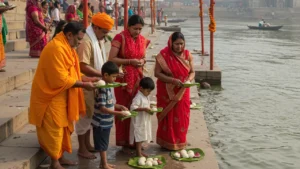
Pind Daan is the offering of rice balls (pindas) shaped and presented at the riverbank. The pindas are made from boiled rice mixed with sesame seeds, ghee, honey, and sometimes barley flour. As each pinda is placed, the performer recites the ancestor’s name and the relevant mantras. The sacred significance of Pind Daan lies in its role as direct physical nourishment for the ancestral soul — providing the subtle body of the ancestor with sustenance in the intermediate realm between death and rebirth.
अक्सर पूछे जाने वाले प्रश्न
Why is Shashthi Shradh called Chhath Shradh?
Shashthi means sixth in Sanskrit, and Chhath means six in Hindi. Shashthi Shradh is therefore simply the Shradh of the sixth tithi. The popular name Chhath Shradh is used in North India and Bengal. It should not be confused with the Chhath Puja festival (dedicated to the Sun God), which is an entirely separate observance in Kartik month.
What if Shashthi Tithi falls on the same day as another tithi in the Panchang?
Sometimes two tithis can fall within the same calendar day if the lunar tithi begins and ends entirely within a 24-hour period. In such cases, the tithi that overlaps with the Kutup Muhurat (the auspicious midday window) is considered the operative tithi for Shradh purposes. Your Pandit will check the Panchang and advise you accordingly.
Can I perform Shashthi Shradh for my mother if she died on Shashthi Tithi?
Yes, absolutely. Shashthi Shradh can be performed for both male and female ancestors who died on this tithi. However, there is also a separate observance — Matru Navami or Avidhava Navami — on the ninth day (Navami Tithi, October 4, 2026) that is specifically dedicated to deceased mothers and married women. If your mother died on Shashthi Tithi, perform her primary Shradh on October 1 but you may also include her in the general offering on Matru Navami.
How long does the complete Shashthi Shradh ceremony take?
A complete Shashthi Shradh ceremony at Prayagraj typically takes 2.5 to 3.5 hours from start to finish — including the morning bath, sankalpa, tarpan, pinda daan, and Brahmin bhojan. The actual ritual (excluding travel and preparation) takes approximately 1.5 to 2 hours. Prayag Pandits arranges everything so you can complete the full ceremony within the Kutup and Rohina Muhurat window.
Is there a difference between performing Shradh at Prayagraj versus at home?
Both are spiritually valid, but the scriptures are clear that performing Shradh at a sacred tirtha multiplies its merit. The Matsya Purana specifically states that Shradh at Prayagraj (Triveni Sangam) grants ancestors liberation (moksha) and freedom from the cycle of rebirth. At-home Shradh fulfils the obligation but without the amplified tirtha merit.
अपना पवित्र अनुष्ठान बुक करें
भारत भर के पवित्र स्थलों पर वेद-प्रशिक्षित पंडितों द्वारा वीडियो प्रमाण सहित प्रामाणिक अनुष्ठान।
2,263+ परिवारों की सेवा
वीडियो प्रमाण शामिल
2019 से
