
अभी तक कोई अनुष्ठान नहीं चुना गया।
पूजा पैकेज देखें →मुख्य बिंदु
इस लेख में
Every year, as the Bhadrapada month draws toward its dark fortnight, millions of Hindu families across the world pause and ask the same question: what is Shradh, and why does it matter? For some, it is a ceremony received from their grandparents without full explanation. For others, living in cities far from the sacred rivers, it is a tradition they want to honour but do not know how to approach. And for a growing number of families who have missed the rite for several years, it has become a source of quiet worry.
Shradh is the Sanskrit word for the ancestral rite in which the living offer food, water, and prayer to their departed ancestors. The word is rooted in shraddha — faith, sincerity, reverence. What makes Shradh different from ordinary prayer is precisely this: it is not a casual remembrance but a formal act of ancestral nourishment, conducted according to rules laid down in some of the oldest surviving texts of Hinduism.
The Garuda Purana — the most detailed scripture on death, the afterlife, and ancestral rites — describes the realm of Pitru Loka where departed souls dwell between death and rebirth, and states clearly that ancestors who have not yet attained moksha depend on the Shradh offerings of their living descendants for spiritual sustenance. The Manusmriti adds that this is one of the fundamental debts a human being is born with: the Pitru Rina, the debt to one’s ancestors, which can only be discharged through Shradh.
This guide is written for three groups of people: families performing Shradh for the first time who want to understand what they are doing and why; NRI families arranging the ceremony from abroad who need practical guidance; and anyone who has observed this ritual all their life and wants to understand its depth. We have drawn on the Garuda Purana, Vishnu Purana, Brahma Purana, Markandeya Purana, Matsya Purana, Manusmriti, and Vishwamitra Smriti for the scriptural framework, and on two decades of performing these ceremonies at the sacred tirthas of Prayagraj, Gaya, Varanasi, and Haridwar.
What Does Shradh Mean?
The word Shradh is derived from two Sanskrit roots: shrat (faith, truth) and dha (to hold or offer). Together they describe an offering made with complete sincerity — not a ritual performed out of obligation, but an act of genuine love directed toward those who have left the physical world.
In the Manusmriti (Chapter 3, verses 122-286), Manu lists Shradh among the five daily duties of a householder, placing it alongside the worship of gods, care for the household fire, hospitality to guests, and reverence toward all living beings. The Pitru Rina — the debt owed to one’s ancestors — is described as the most fundamental of all human debts, because every person alive owes their body, their lineage, and their very existence to the chain of ancestors stretching back through time.
The Vishnu Purana elaborates the mechanism by which Shradh works: ancestors in Pitru Loka receive nourishment through the offerings made by descendants, transmitted through the Pitras — divine ancestor-deities who act as intermediaries between the mortal and ancestral realms. The pindas and water offered at the riverbank do not dissolve meaninglessly in the water. They reach, through this divine transmission, the ancestor who is named in the Sankalp.
The Garuda Purana is more direct about the consequences of neglect. A soul in Pitru Loka that receives no Shradh from its family experiences what the text describes as severe spiritual hunger — a state of agitation that can translate, through Pitru Dosha, into ancestral afflictions in the living family. These afflictions — recurring health problems, obstacles in marriage or children, unexplained financial blocks — are described in the Markandeya Purana as the consequence of ancestors who have been left hungry and unremembered.
At its heart, Shradh is not a ceremony of grief. It is an act of ongoing relationship — a recognition that the people who gave you life, your grandparents, great-grandparents, and the ancestors beyond living memory, remain connected to your family through the invisible bonds of ancestry. When you perform Shradh, you are saying: I have not forgotten you. I honour you. And I offer you what I can.
Who Should Perform Shradh?
The traditional answer, found in both the Manusmriti and the Garuda Purana, is the eldest son. The eldest son holds primary responsibility for the ancestral rites of both parents because it is his lineage thread — the pitru-vamsha — that continues the family line in the patrilineal tradition. The Garuda Purana goes further, stating that a son who performs Shradh for his parents not only benefits them but protects himself from the Pitru Dosha that would otherwise accumulate.
But Hindu tradition has always been flexible in practice:
- Eldest son — primary responsibility, especially for the annual death anniversary Shradh
- Any son — if the eldest is unable to attend, any son can perform with full validity
- Grandson — if both sons are absent or deceased, the grandson (specifically the son of a son, the dauhitra) can perform. The Vishwamitra Smriti identifies the dauhitra (daughter’s son) as one of the eight sacred Kutapa elements specifically because of his role in ancestral rites.
- Daughter — daughters can and do perform Shradh for their parents when no male heir exists. The Devi Bhagavata Purana and Skanda Purana both explicitly permit this.
- Wife — a wife can perform Shradh for her husband’s ancestors in his absence
- Nephew or other close male relative — when direct descendants are absent
What if no family member can perform in person? A qualified Brahmin can perform Shradh on behalf of the family — a practice fully sanctioned by scripture and one we have arranged for hundreds of families whose surviving children live abroad. The Sankalp (formal vow) at the start of the ceremony names the actual family, and the merit flows to them regardless of who performs the physical actions of the rite.
For the full context of death rituals and who performs each rite, see our guide to Hindu death rituals and last rites.
The Twelve Types of Shradh
One of the most common points of confusion is that Shradh is not a single ceremony — it is a category of ancestral rites, each performed under specific circumstances and with specific rules. The Vishwamitra Smriti and the Bhavishya Purana together enumerate twelve distinct types of Shradh. Knowing which type applies to your situation determines not only the correct timing but also the procedure.
The Matsya Purana offers a simpler classification, grouping all Shradh into three broad categories: Nitya (obligatory daily), Naimittika (occasion-specific), and Kamya (desire-oriented). The Yama Smriti expands this to five types. The Vishwamitra Smriti, the most comprehensive on this topic, gives the full twelve. Here is each type with its purpose:
1. Nitya Shradh (Daily Ancestral Rite)
Nitya Shradh is the daily offering made to the ancestors — at minimum, a water offering (Tarpan) performed during the morning sandhya ritual. The Manusmriti prescribes this as a daily obligation for the householder, stating that even the simplest daily Tarpan keeps the ancestral connection alive and prevents the accumulation of Pitru Rina. It can be performed at any clean water source with sesame seeds and water, with the mantra invoking one’s ancestors by name and gotra.
2. Naimittika Shradh (Occasion-Specific)
Naimittika Shradh is performed on specific occasions when it is specifically required — a death in the family, the completion of the first death anniversary, or events like a solar or lunar eclipse. The word naimittika means “arising from a specific cause.” These Shradhs are not chosen — they are triggered by events.
3. Kamya Shradh (Desire-Fulfilling)
Kamya Shradh is performed with a specific desire or intention — for the birth of a son, for wealth, for the resolution of a long-standing problem. The Bhavishya Purana lists the specific desires for which Kamya Shradh may be performed and the corresponding fruits. The Markandeya Purana states that satisfied ancestors, when properly propitiated through Kamya Shradh, grant the family longevity, health, children, wealth, and ultimately, liberation.
4. Vriddhi Shradh (Nandi Shradh — Auspicious Occasions)
Vriddhi Shradh, also called Nandi Shradh, is performed during auspicious family events: a marriage, the birth of a child, a thread ceremony (Upanayana), a house-warming, or any major celebration. The purpose is to invite the ancestors to share in the family’s joy and to receive their blessings for the new beginning. The Vishnu Purana states that without Vriddhi Shradh before an auspicious ceremony, the event is considered incomplete — the ancestors have not been included in the family’s happiness.
5. Parvana Shradh (Periodic Ancestral Ceremony)
Parvana Shradh is the annual Shradh performed on the death anniversary of the departed — on the same lunar tithi each year on which the person died. The word parvana refers to a parvan, a sacred turning point in the lunar calendar. This is the most common form of Shradh and what most families mean when they say “we are performing Shradh.” It involves the complete sequence: Sankalp, Pind Daan, Tarpan, Brahmin Bhoj, and Daan. The Bhavishya Purana prescribes Parvana Shradh specifically during Amavasya, the new moon, and during Pitrupaksha as especially meritorious occasions.
6. Sapindan Shradh (Uniting the Departed with the Ancestors)
Sapindan Shradh is performed on the 12th or 13th day after death, as part of the complete post-death rite sequence. This ceremony formally merges the newly departed soul — still in the state of preta (newly departed spirit) — with the realm of the ancestors in Pitru Loka. Before Sapindan Shradh, the soul exists in a transitional state. After it, the soul joins the Pitras and is fully received into the ancestral realm. The Garuda Purana describes this as one of the most important ceremonies in the death rite sequence. For a complete description, see our guide to Hindu death rituals.
7. Goshthi Shradh (Group Performance)
Goshthi Shradh is performed collectively by a group — a gathering of family members or a community. The Vishwamitra Smriti identifies this as appropriate when multiple branches of a family come together for a shared ancestral ceremony, such as the annual Kul Shradh performed by an entire lineage. The collective merit of a group ceremony is described as greater than the sum of individual performances.
8. Shuddhyartha Shradh (Purification)
Shuddhyartha Shradh is performed for ritual purification — typically when a family emerges from a period of Ashaucha (ritual impurity following a birth or death in the family) and wishes to re-establish the ancestral connection that was interrupted. The Manusmriti specifies that during Ashaucha, the regular ancestral rites are suspended; Shuddhyartha Shradh marks the formal resumption of those rites.
9. Karmanga Shradh (Part of a Larger Rite)
Karmanga Shradh is performed as a component within a larger ritual or Sanskara. For example, during Upanayana (the sacred thread ceremony), before Vivaha (marriage), or as part of a pilgrimage ritual at a tirtha. It is not a standalone ceremony but an integral piece of the larger rite that, if omitted, leaves the parent ritual incomplete.
10. Daivika Shradh (Offering to Deities)
Daivika Shradh is the offering made to the devas (gods) within the broader framework of ancestral worship. The Bhavishya Purana explains that the gods and ancestors are worshipped in tandem because the gods, when pleased, ensure that the ancestral realm remains accessible and that the offerings made to ancestors are properly received. Daivika Shradh is typically performed as part of the Parvana sequence on Amavasya days.
11. Yatrartha Shradh (Before a Journey)
Yatrartha Shradh is performed before undertaking a long or significant journey — a pilgrimage, a sea voyage, or in the modern context, travel abroad for extended periods. The purpose is to take the blessings of the ancestors before departure and to maintain the ancestral connection during the absence. The Vishwamitra Smriti recommends this particularly before pilgrimage, noting that the merit of a tirtha journey is enhanced when performed with the blessings of satisfied ancestors.
12. Pushtyartha Shradh (For Growth and Prosperity)
Pushtyartha Shradh is performed specifically for growth, prosperity, and the expansion of the family’s wellbeing — for flourishing health, good harvests, and the increase of wealth. The Bhavishya Purana links this to the Kamya category but identifies it separately because its intent is not the fulfillment of a specific desire but the general abundance and flourishing of the family under ancestral blessing.
Beyond these twelve, there are well-known specific types that fall within this taxonomy. Ekoddishta Shradh is the monthly Shradh performed during the first year after a death — directed specifically at the one recently departed rather than all ancestors. Tripindi Shradh, the most powerful remedial ceremony, is performed when a family has missed Shradh for three or more consecutive years, leaving three generations without offerings. We perform Tripindi Shradh at Prayagraj year-round. Book Tripindi Shradh at Prayagraj (from ₹21,000) or choose the online Tripindi Shradh option if you cannot travel.
When is Shradh Performed?
Correct timing is essential. Performing Shradh on the wrong tithi is one of the most common errors families make — the ceremony may be sincere but will not carry the same weight if performed on the wrong date. Here is the complete framework for when each type of Shradh should be performed.
Annual Death Anniversary (Tithi)
The primary time for annual Shradh is the same lunar tithi on which the person died, every year. If your grandfather died on Saptami (7th) of the Krishna Paksha (dark fortnight) in Ashwina, his annual Shradh should be performed on the Saptami of Krishna Paksha in Ashwina each year. The lunar tithi equivalent shifts against the solar calendar, so the correct English date changes every year. A pandit calculates this from the Panchang each year.
Pitrupaksha 2026
Pitrupaksha is the 16-day fortnight dedicated entirely to ancestral rites. During this period, the Garuda Purana says, the gates of Pitru Loka open and the ancestors descend closer to the mortal world, making offerings easier to receive. Every day of Pitrupaksha corresponds to a different tithi. In 2026, Pitrupaksha runs from September 26 (Purnima Shradh) to October 10, 2026 (Sarva Pitru Amavasya).
See our complete Pitrupaksha 2026 dates and ritual guide for the full day-by-day tithi calendar and muhurat timings.
- September 26 — Purnima Shradh (for those who died on Purnima)
- September 27 — Pratipada Shradh
- October 4 — Navami Shradh (Matru Navami — especially for mothers)
- October 9 — Chaturdashi Shradh (for those who died by weapons, accidents, or untimely death)
- October 10 — Sarva Pitru Amavasya (universal — for all ancestors)
Mahalaya Amavasya
Sarva Pitru Amavasya — the Amavasya at the end of Pitrupaksha — is specifically recommended for families who do not know the exact death tithi, whose ancestor died in a distant place without the date being recorded, or who want to honour all ancestors collectively. On this day, offerings made to all ancestors are fully received, making it the most inclusive and universally accessible day for ancestral rites.
Monthly Amavasya
Any Amavasya (new moon day) through the year is considered auspicious for Tarpan and Shradh. For families who cannot perform the full ceremony at each Amavasya, even a simple water offering with sesame seeds on this day fulfils part of the Nitya obligation described in the Manusmriti.
Shradh Puja Vidhi — The Complete Ceremony
We have performed the Shradh ceremony for thousands of families over the years. Here is what actually happens during the ritual — in plain terms, without mystification.
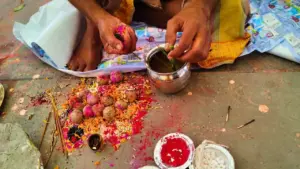
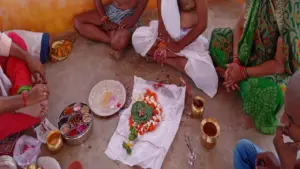
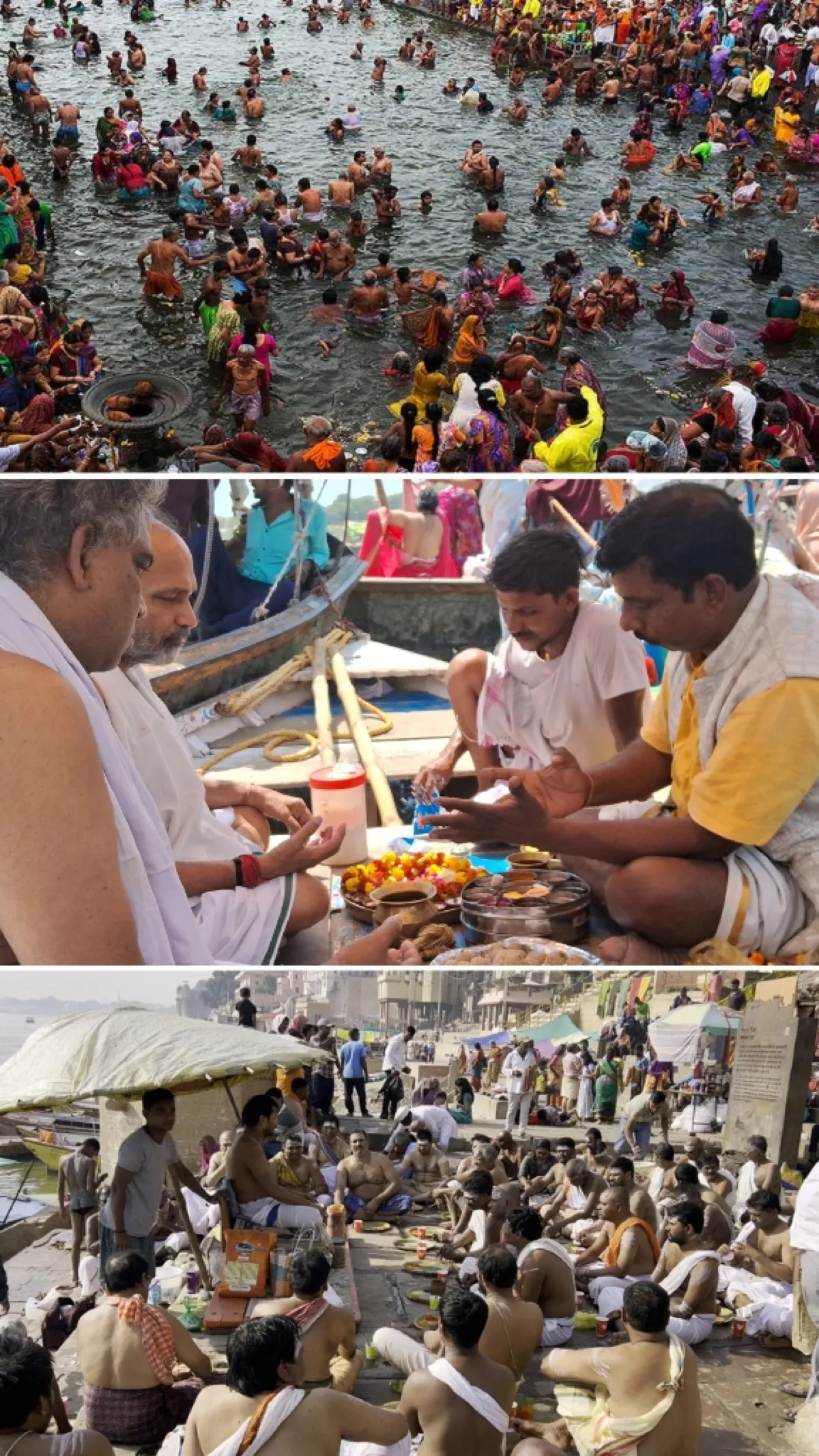
The ceremony takes two to three hours when performed fully. It is conducted near a water body — a river, a ghat, or a sacred kund — by a qualified Brahmin pandit (Teerth Purohit). The family member performing the rite sits with the pandit and participates directly in each step.
Sankalp — The Formal Vow
Every Hindu ceremony begins with a Sankalp, a formal statement of intention. The person performing Shradh holds water in cupped palms and repeats the Sankalp mantra, naming themselves, their gotra, the full name of the departed ancestor, their gotra, and the specific purpose: to perform Shradh for the ancestor’s spiritual benefit and liberation. The water is then released into the river.
This formal naming is what makes the ceremony real. It is not the pandit’s knowledge that directs the merit — it is the Sankalp that directs it toward the specific person. The Vishnu Purana states that an offering made without a proper Sankalp is like water poured onto sand: it disperses without reaching its intended recipient.
Pind Daan — Offering the Body of Nourishment
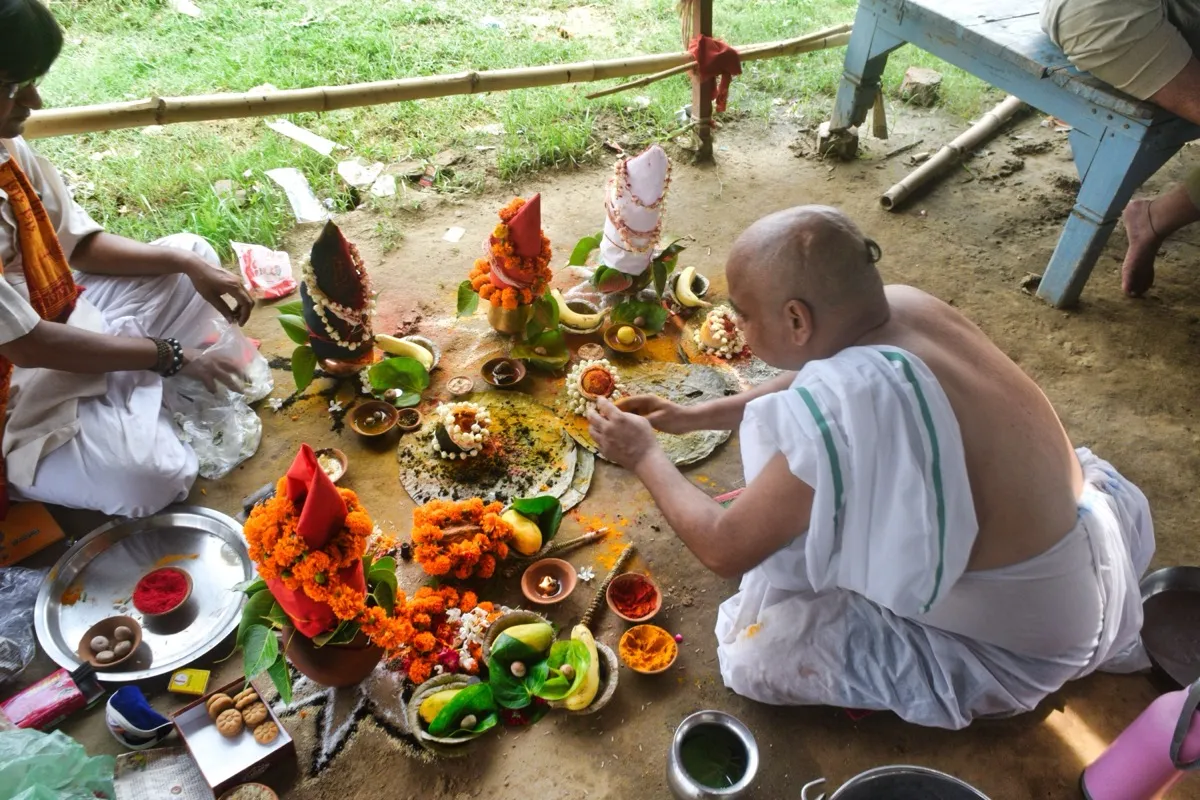
Pind Daan is the central act of Shradh. Pindas are balls of cooked rice mixed with black sesame seeds (til), honey, milk, and ghee. Each pinda represents the ancestor’s subtle body — a vehicle through which nourishment can reach them in Pitru Loka.
Three to sixteen pindas are offered, depending on the type of Shradh. They are placed on kusha grass — the sacred grass of the Rigveda, described as the resting seat of the Pitras — and offered with mantras that name the ancestor and invite them to receive the offering. The pindas are ultimately immersed in the river. The Bhavishya Purana specifies that the correct size for each pinda is the size of an amla fruit (Indian gooseberry) — not too small to be a token gesture, and not so large as to be wasteful.
Black sesame is the most sacred single ingredient in the entire Shradh ceremony. The Vishnu Purana says that sesame was born from the body of Vishnu himself, which is why it carries unique potency as an offering to the ancestors. A Shradh conducted without sesame is considered deficient. The Vishwamitra Smriti places black sesame among the eight Kutapa items — the sacred elements without which a Shradh ceremony cannot be complete (see the Kutapa section below).
For a detailed exploration of Pind Daan as a standalone ceremony, see our complete guide to Pind Daan.
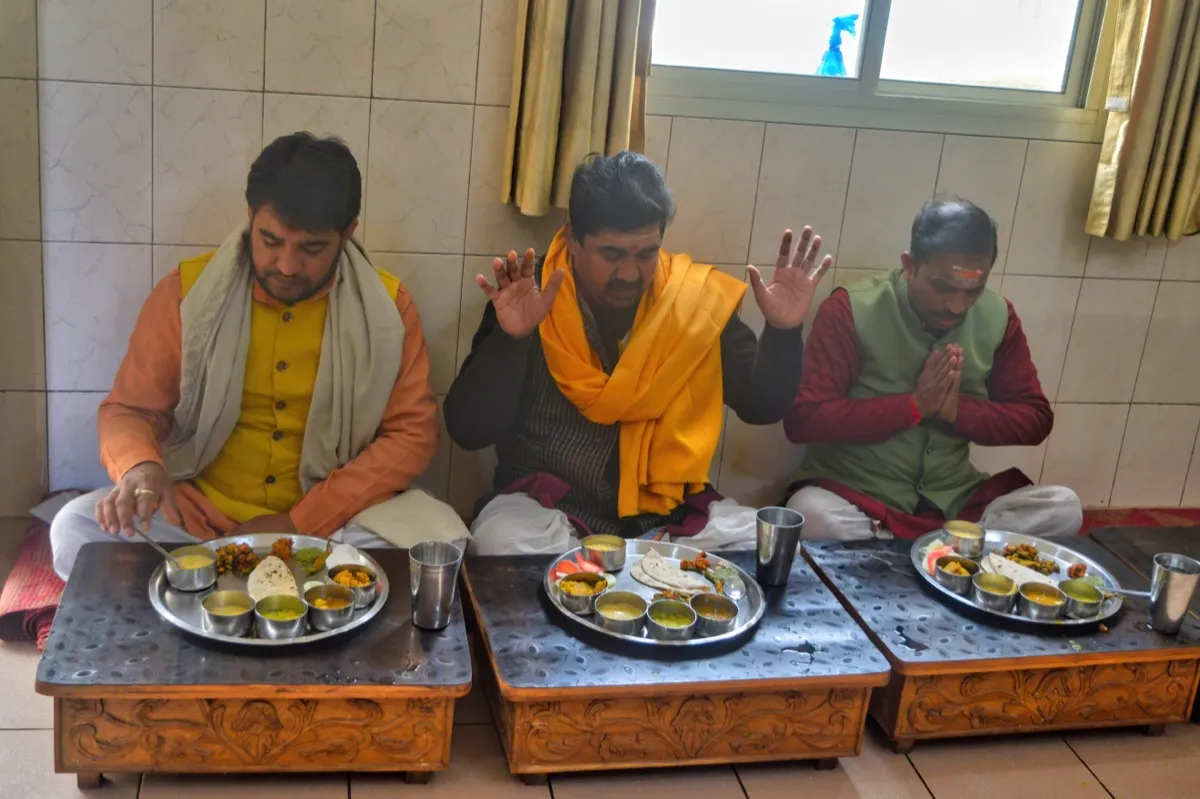
Tarpan — The Water Offering
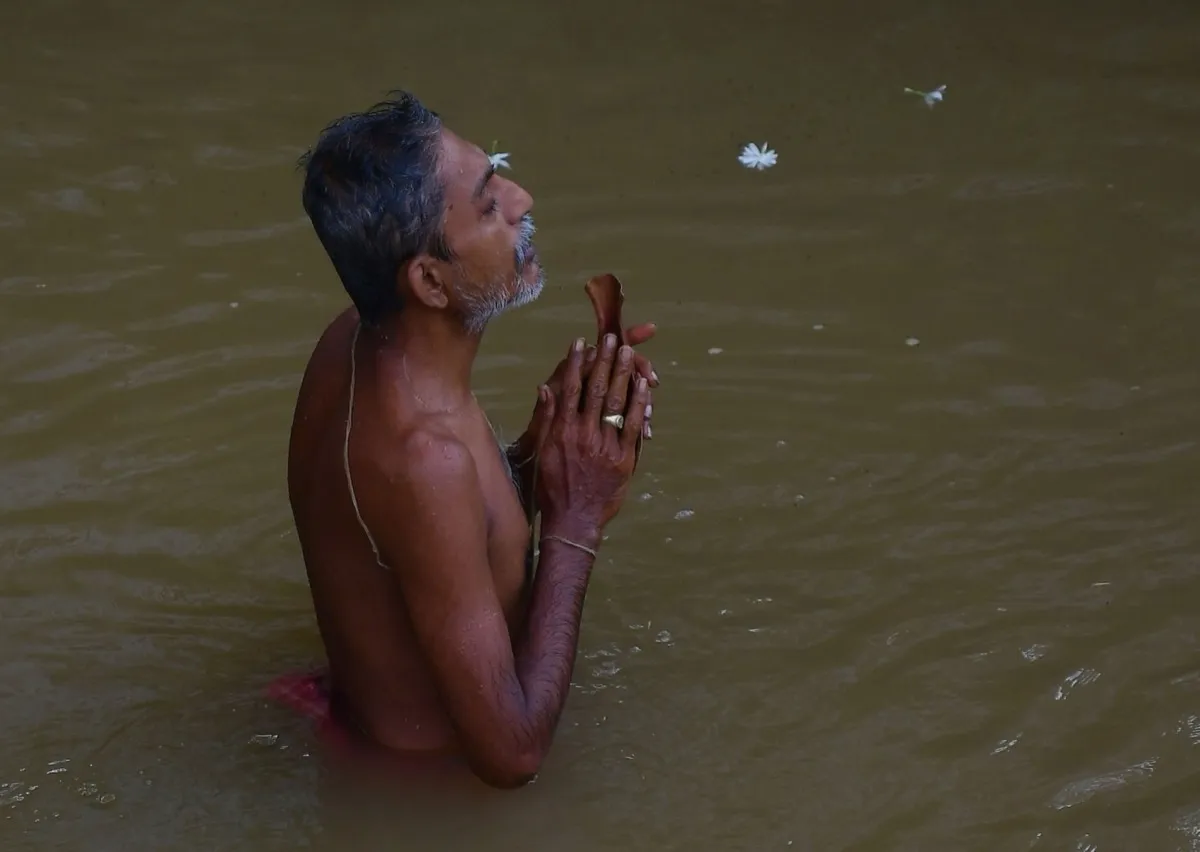
Tarpan is the offering of water to the ancestors, gods, and sages. The word means “to satisfy.” Water mixed with black sesame seeds and sometimes barley and kusha grass is poured from cupped palms into the river while mantras invoke the names of the departed. The most important mantra recited while scattering sesame seeds is: “Om Apahata Asura Rakshamsi Vedishadah” — a protective invocation that purifies the offering space and ensures the ancestors can receive what is being offered without interference.
The Manusmriti prescribes daily Tarpan during Pitrupaksha as a minimum obligation for those who cannot arrange the full ceremony. Even if the full Shradh cannot be organised, going to a river each morning during Pitrupaksha and performing Tarpan with sesame and water is considered meritorious and honours the spirit of the obligation.
For the complete Tarpan ritual and mantras, see our Tarpan Vidhi guide. We also offer Tarpan at Prayagraj as a standalone service.
Brahmin Bhoj — Feeding the Brahmins
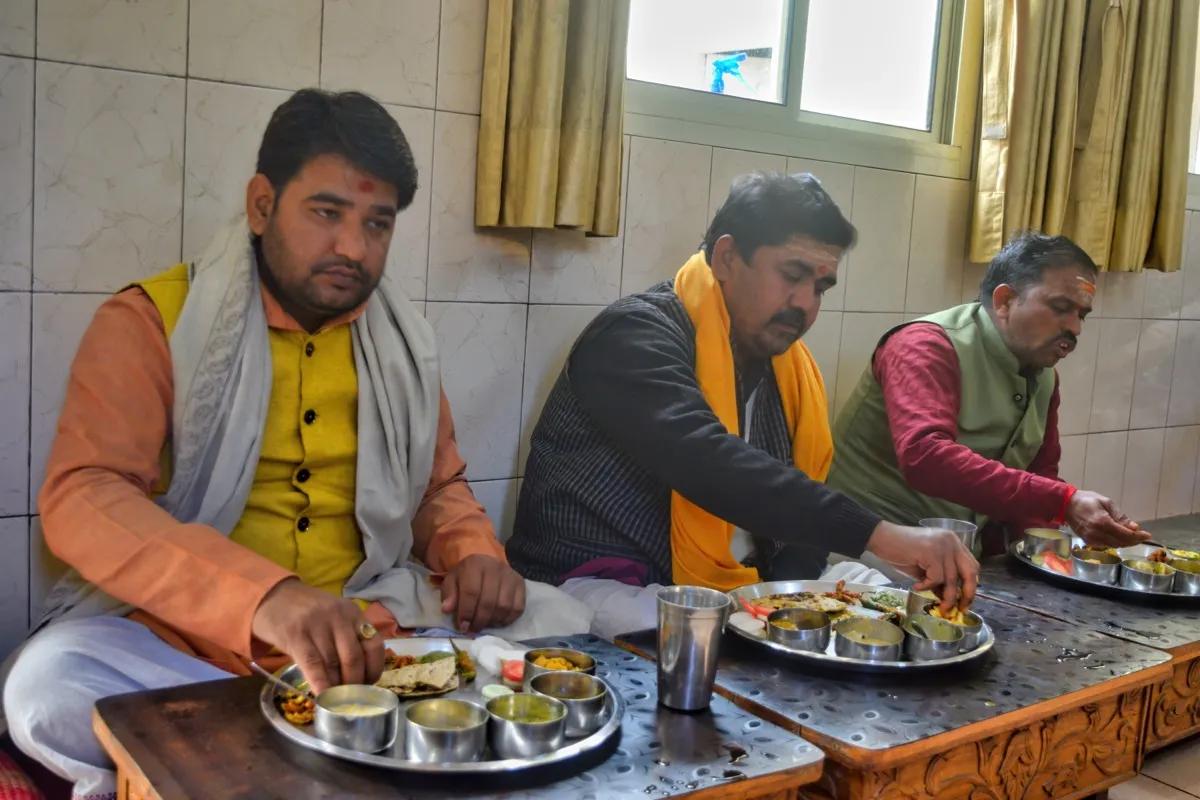
After the main puja, qualified Brahmins are fed a full sattvic meal. The Vishnu Purana is explicit on this point: the food served to a Brahmin during Shradh reaches the ancestors directly through the Brahmin as a divine intermediary — through his body, the offering is received. The text says that feeding one qualified Brahmin during Shradh satisfies all the ancestors of the performer’s lineage more completely than any other single act in the ceremony.
The number of Brahmins to feed is typically one to five for a standard ceremony. The meal must be sattvic in the strictest sense: no onion, garlic, or non-vegetarian food, and prepared by a person who has bathed and is ritually pure. At the end of the meal, the Brahmins receive dakshina (an offering of money or cloth) and bless the family.
Daan — Charitable Offering
The final component of Shradh is Daan — a charitable offering made in the ancestor’s name. The Garuda Purana lists the specific items most beneficial as Daan during Shradh: food grains, sesame, white cloth, silver, or money. The merit of the Daan is credited directly to the ancestor and helps their onward journey in Pitru Loka. The Brahma Purana is sweeping on this point, stating: “A person who performs Shradh with devotion satisfies the entire universe, from Lord Brahma down to a blade of grass.” This is not metaphorical — the scriptural view is that ancestral contentment radiates outward through the entire web of existence.
The Eight Kutapa: Sacred Elements of a Complete Shradh
The Vishwamitra Smriti identifies eight sacred elements collectively called the Kutapa — items whose presence at a Shradh ceremony ensures the rites are complete and maximally effective. This is one of the most detailed and specific passages in the ancestral rite tradition, and it is largely unknown outside of learned pandit circles. Understanding the Kutapa is the difference between a ceremony that checks a box and one that genuinely works.
1. The Eighth Muhurta of the Day (Kutapa Kala)
The Vishwamitra Smriti identifies the eighth muhurta of the day as the most auspicious time for performing Shradh. A muhurta is a 48-minute period, and the eighth muhurta runs approximately from 11:36 AM to 12:24 PM. This is called Kutapa Kala — the sacred time window. The text is specific: Shradh performed within this window carries far greater potency than Shradh performed at other times of the day. In our practice, we schedule the core Pind Daan and Tarpan to fall within this window wherever possible.
2. Khadgapatra (Rhinoceros Horn Vessel)
In the traditional enumeration, the rhinoceros horn vessel is identified as one of the sacred Kutapa because of its purity and the belief that it preserves the sanctity of offerings. In modern practice, vessels of khadgapatra are rare; the principle is upheld through the use of ritually purified vessels of silver or clay, as the underlying requirement is that the vessel through which offerings are made must be pure and uncontaminated.
3. Nepali Blanket (Pavitri)
The Nepali wool blanket or sitting mat (associated with the Himalayan tradition) is listed as a Kutapa item representing sacred material — pure wool from mountain regions, used as the seat of the pandit and the performer during the ceremony. The significance is the principle of pavitrata (ritual purity of the seat from which the ceremony is conducted). In practice, kusha grass woven mats or clean woollen blankets fulfil this function.
4. Silver (Rajat)
Silver holds a unique status in the Shradh tradition. The Vishwamitra Smriti states that silver originated from the eyes of Lord Shiva — it is therefore considered to carry divine light and to give akshaya tripti (imperishable satisfaction) to the ancestors when used in the ceremony. Offering water in a silver vessel, using silver coins as part of Daan, or placing silver in the pinda preparation are all ways of incorporating this Kutapa element. Silver vessels for Shradh are strongly recommended; the same text notes that iron vessels are strictly prohibited because iron is considered inauspicious for ancestral rites — ancestors are believed to flee at the sight of iron.
5. Kusha Grass (Darbha)
Kusha (Desmostachya bipinnata) appears throughout Hindu ritual but holds its most significant role in ancestral rites. The Rigveda describes kusha as the seat of the Pitras, the very surface upon which the ancestors rest when they come to receive offerings. During Shradh, kusha is placed beneath the pindas, woven into rings worn on the ring finger of the right hand by the performer, and used to sprinkle water during Tarpan. A Shradh performed without kusha is considered deficient by every textual authority on this subject.
6. Black Sesame Seeds (Krishna Tila)
Black sesame seeds are the single most important ingredient in the Shradh ceremony. The Vishnu Purana’s statement that til was born from Vishnu’s body accounts for its sacred status. The Vishwamitra Smriti identifies black sesame specifically — not white sesame — as the Kutapa element. Black sesame is used in the pindas, scattered during Tarpan, mixed with the water offering, and placed in the palm before each water offering is poured. The mantra “Om Apahata Asura Rakshamsi Vedishadah” is recited while scattering the seeds as a protective invocation.
7. Cows (Go)
Cows are among the eight sacred Kutapa because the cow is the vehicle of the ancestors in Pitru Loka — the Garuda Purana describes the ancestors travelling through the afterlife realm on or with cows. Traditionally, gifting a cow (Go-daan) as part of the Daan component of Shradh is considered one of the most meritorious acts a person can perform for an ancestor. The Vishwamitra Smriti provides an important compassionate provision here: a family that is too destitute to perform any other Shradh can achieve immense merit simply by feeding grass to a cow. This is the simplest and most accessible form of ancestral offering.
8. Dauhitra (Daughter’s Son)
The eighth Kutapa is the dauhitra — the daughter’s son, or maternal grandson. The Vishwamitra Smriti elevates the presence of the daughter’s son at a Shradh ceremony because he represents a specific thread of ancestral continuity that would otherwise go unacknowledged in the patrilineal system. His presence at the ceremony — or his performance of certain rites — is considered particularly potent for the liberation of the maternal lineage ancestors.
The Flowers and Their Rules
The Vishwamitra Smriti is unusually specific about which flowers may be used in Shradh and which are prohibited. This detail is almost entirely unknown outside of scholarly pandit circles, but it matters for the ritual purity of the ceremony.
Permitted flowers — white and fragrant: Malati (jasmine), Juhi (another jasmine variety), Champa (Magnolia champaca), white Lotus, Tulsi leaves and flowers, and Bhringraj. The principle is that white fragrant flowers carry sattvic purity and are pleasing to the ancestors.
Strictly prohibited: red flowers of any kind, black flowers, and flowers without fragrance. The use of red or black flowers in Shradh is considered inauspicious and may disturb rather than satisfy the ancestors.
Food Rules for Shradh — Complete Scriptural List
The food rules for Shradh are among the most specific and practically important aspects of the tradition. These rules come primarily from the Vishwamitra Smriti and the Manusmriti, and they govern both the food offered in the pindas and the meal served during Brahmin Bhoj.
Prescribed Foods for Shradh
The Vishwamitra Smriti lists specific foods whose use in Shradh is highly meritorious:
- Cow products — cow milk, curd (dahi), and ghee are the three most sacred food substances for ancestral rites. Ghee is used generously in pinda preparation and during the fire offerings.
- Grains — barley (yava), paddy (rice), wheat, and sanwa (a millet variety). The Manusmriti identifies barley as particularly sacred for Shradh offerings.
- Sesame (til) — as detailed above; the most important single ingredient
- Pulses — moong dal (green gram); the Vishwamitra Smriti specifically approves moong
- Kheer (rice pudding) — particularly auspicious; the Vishnu Purana states that offering kheer during Shradh satisfies the ancestors for an entire month
- Fruits — mango, bel (wood apple), pomegranate, amla (Indian gooseberry), coconut, grapes, and parwal (pointed gourd). The amla is notable because it is also the prescribed size for each pinda — the fruit appears in both the food list and the ritual measurement.
- Chironji (Buchanania lanzan) — a native nut considered particularly pure for Shradh
- Mustard oil — for cooking the Brahmin Bhoj meal
Prohibited Foods — Complete List
The Vishwamitra Smriti’s list of prohibited foods is exhaustive and specific. Including any of these in the pinda preparation or the Brahmin Bhoj meal renders the offering ritually deficient:
- Brinjal (eggplant) — specifically prohibited by name in the Vishwamitra Smriti
- Alcohol — any form of fermented or distilled beverage
- Rajma (kidney beans) — prohibited
- Masoor dal (red lentils) — specifically mentioned in the Manusmriti as unsuitable for Shradh
- Arhar dal (pigeon peas/toor dal) — prohibited
- Carrots — listed by name in the Vishwamitra Smriti
- Pumpkin — prohibited
- Turnip — prohibited
- Onion and garlic — strictly prohibited; considered tamasic and deeply inauspicious for the ancestors
- Hing (asafoetida) — prohibited
- Black salt — prohibited (only sendha namak, rock salt, is permitted)
- Black cumin (kala jeera) — prohibited
- Jamun (Java plum) — prohibited
- Kulthi (horse gram) — prohibited
- Flaxseed (alsi) — prohibited
- Gram/chickpeas in their cooked form — prohibited
Beyond specific ingredients, the Vishwamitra Smriti identifies categories of food that are disqualified regardless of ingredient: food that contains insects or hair, stale food (everything must be freshly cooked on the day), food that has been touched by an impure person, food contaminated by the wind of a worn cloth, and any food that a dog has come near or touched.
The underlying principle is sattva — purity of the offering at every level, from ingredient to preparation to the person cooking. The food offered to the ancestors and the Brahmins must be the purest food prepared with the greatest care. This is not ritual pedantry; it reflects the understanding that the quality of what reaches the ancestors depends on the quality of what is offered.
The Destitute Alternative
The Vishwamitra Smriti provides a compassionate provision: a family that is completely destitute and cannot afford any of the above may achieve immense merit simply by going to a cow and feeding her grass. This single act, performed with Shraddha (sincere devotion), is accepted by the ancestors as equivalent to the full ceremony. The principle is that it is the Shraddha — the sincere intention — that determines the merit, and a sincere act within one’s means is never turned away.
Sacred Mantras of the Shradh Ceremony
The Shradh ceremony draws on several Vedic hymns that have been used in ancestral rites for millennia. These are not invented ritual formulae but passages from the oldest layers of the Vedic corpus:
- Purusha Sukta (Rigveda 10.90) — the hymn of the cosmic being; recited to invoke the divine order within which ancestral rites operate
- Pitri Sukta (Rigveda 10.15) — the hymn addressed directly to the ancestors; the primary mantra of the Tarpan and Pind Daan
- Rakshoghna Sukta — the hymn for removing inauspicious forces from the ritual space
- Ruchi Stava — a hymn of praise to the Pitras, asking them to come, receive the offerings, and bestow blessings
- Gayatri Mantra — recited during periods of Ashaucha (ritual impurity) when the other mantras cannot be used; the Vishwamitra Smriti specifically identifies the Gayatri as the permitted recitation during these periods
- Om Apahata Asura Rakshamsi Vedishadah — recited while scattering black sesame seeds; a protective mantra that purifies the offering space
Where to Perform Shradh — Sacred Tirthas
Shradh can technically be performed at any clean location near water with a qualified pandit. But the scriptures are insistent on a point that modern families sometimes overlook: the merit of a Shradh ceremony is not fixed — it varies enormously by location. Performing Shradh at a sacred tirtha multiplies the merit by factors the texts describe in quite specific terms.
Gaya — The Supreme Tirtha for Ancestral Rites
The Garuda Purana, Vayu Purana, and Mahabharata are united in naming Gaya as the supreme tirtha for Pind Daan and Shradh. The scriptural basis is the story of the demon Gaya, who performed such intense austerities that Lord Vishnu granted him the boon that anyone who performs Shradh at his sacred body (the city of Gaya) will liberate their ancestors. Lord Vishnu’s footprint — the Vishnupad — is worshipped at the Vishnupad Temple in Gaya to this day. Shradh at Gaya is believed to grant liberation to ancestors across seven generations in both directions. We offer Shradh at Gaya (from ₹10,999) during Pitrupaksha and year-round.
Prayagraj — Triveni Sangam, the Tirthraj
Prayagraj holds the title of Tirthraj — king of all tirthas. The Triveni Sangam, where the Ganga, Yamuna, and the invisible Saraswati converge, is described in the Padma Purana as a place where a single Shradh ceremony equals many thousands performed elsewhere. The Kumbh Purana states that Shradh at Prayagraj grants liberation not just to the departed ancestor but to the entire lineage. As practitioners based at Prayagraj, we perform Shradh at the Triveni Sangam year-round.

Shradh at Prayagraj starts from ₹7,100. You can also book Pind Daan at Prayagraj as part of a combined ceremony.
Varanasi (Kashi)
Varanasi is the city of Lord Shiva and is believed to grant moksha to all who die within its boundaries. For Shradh, the most significant sites are Manikarnika Ghat — where the funeral fire has burned continuously for centuries — and Pishach Mochan Kund, a sacred tank specifically for liberating trapped spirits. The Kashi Khanda describes Varanasi Shradh as one of the most powerful means of freeing an ancestor who died in difficult circumstances or who carries heavy karma. We offer Shradh at Varanasi (from ₹10,999).
Haridwar
Haridwar, where the Ganga first descends from the mountains onto the plains, is among the holiest cities for ancestral rites. Har Ki Pauri — the ghat where Vishnu’s footprint is imprinted in the stone — is the primary location for Shradh and Tarpan. We offer Shradh at Haridwar (from ₹7,100), including the online option for families who cannot travel.
Badrinath — Brahmakapal
For families combining a Char Dham pilgrimage with ancestral rites, Brahmakapal in Badrinath is a deeply sacred tirtha. Located near the main temple on the banks of the Alaknanda river, Brahmakapal is the only place in the Himalayas specifically designated for Pind Daan. The Skanda Purana mentions Brahmakapal as especially powerful for the liberation of ancestors who died in the Himalayan region.
What the Brahma Purana and Markandeya Purana Say About Consequences
The scriptural texts do not shy away from describing what happens when Shradh is performed and when it is not. These passages are not meant to frighten — they are meant to explain the mechanism at work.
The Brahma Purana’s statement is one of the most expansive in the entire corpus of ancestral rite literature: “A person who performs Shradh with devotion satisfies the entire universe, from Lord Brahma down to a blade of grass.” This is not hyperbole in the context of the text’s cosmology — it reflects the understanding that ancestral contentment is not private or contained but radiates outward through the interconnected web of all living beings.
The Markandeya Purana describes the positive chain: ancestors who are satisfied through Shradh bless their descendants with longevity, good health, children, wealth, and ultimately, liberation (moksha). These are not abstract spiritual rewards — the Markandeya Purana identifies them as the tangible consequences flowing into the lives of families that maintain the ancestral rites with sincerity and regularity.
On the other side, the Garuda Purana and Markandeya Purana are direct about what happens when Shradh is withheld. Ancestors in Pitru Loka who receive no offerings are driven by agonizing hunger. Without the nourishment of Shradh, they have nothing. The Markandeya Purana states that neglected ancestors, in their hunger and distress, cast severe curses upon the living family — resulting in lifelong hardships, disease, childlessness, and blocks in every area of life. The Garuda Purana describes, in its characteristically visceral style, ancestors reduced to a state where they suck the blood of their own relatives in desperation.
This is why the tradition treats Shradh not as optional but as obligatory — not merely as a spiritual nicety but as a maintenance of the fundamental relationship between living and departed members of the same family.
Shradh for NRI Families
Over the past decade, arranging Shradh from abroad has become one of the most common requests we receive. Families from Malaysia, Singapore, the UK, USA, Canada, Australia, and UAE reach out every year — many having missed Shradh for years because they did not know how to arrange it remotely.
Here is how the online Shradh ceremony works:
- You share the details of the departed ancestor (name, gotra if known, date of death, and your relationship to them)
- We identify the correct tithi and assign an experienced Teerth Purohit at your preferred tirtha
- On the day, the pandit conducts the full ceremony — Sankalp, Pind Daan, Tarpan, Brahmin Bhoj — at the tirtha
- You join via WhatsApp video call (or receive a recorded video if you are in a difficult time zone)
- We send you photos of the completed ceremony
The online Shradh ceremony is scripturally valid. The Sankalp names you as the yajmaan — the person for whom the ceremony is performed — and the merit flows to your family regardless of physical location. The Vishnu Purana’s description of how merit transmits through the Sankalp makes no distinction based on the geographic distance between the yajmaan and the tirtha.
Online Shradh starts from ₹5,100. For full details and booking, see our NRI puja services page or visit our online puja booking page.
Common Mistakes During Shradh
After working with thousands of families, we have seen recurring mistakes that reduce the effectiveness of the ceremony. Here are the most common ones:
Performing on the Wrong Tithi
The most common mistake is performing Shradh on the English calendar date of death rather than the correct Hindu lunar tithi. The lunar calendar does not align with the solar calendar, so the correct tithi falls on a different English date every year. Always calculate the tithi first — or ask a pandit to do it for you. If you are unsure, share the English date of death and we will calculate the correct tithi.
Using Prohibited Ingredients
Using onion, garlic, masoor dal, arhar dal, brinjal, or any of the ingredients listed in the prohibited list above renders the offering ritually deficient. The food must be sattvic in the strictest sense of the word.
Using Iron Vessels
As the Vishwamitra Smriti notes, iron vessels are strictly prohibited in Shradh ceremonies. The text states that ancestors flee at the sight of iron. Use brass, bronze, silver, or clay vessels for all offerings, water, and food preparation connected to the ceremony.
Skipping Multiple Years
Missing Shradh for three or more consecutive years creates accumulated Pitru Rina that the regular annual ceremony cannot discharge. The prescribed remedy is Tripindi Shradh — a more elaborate multi-pandit ceremony that addresses the missed generations simultaneously. See our complete guide to Pitru Dosha and Tripindi Shradh.
Omitting Tarpan
Many families perform Pind Daan but skip Tarpan, thinking they are the same rite. They are closely related but distinct. Pind Daan nourishes the ancestor’s subtle body; Tarpan satisfies their thirst. The Manusmriti treats them as two separate obligations within the same ceremony. A complete Shradh includes both. See our Tarpan Vidhi guide for the full practice.
Skipping Brahmin Bhoj
Some families perform the puja and Tarpan but skip Brahmin Bhoj due to time or cost. The Vishnu Purana is clear: without feeding qualified Brahmins, the ancestors do not receive the full nourishment of the offering. At minimum, feed one Brahmin a complete sattvic meal with dakshina.
Ignoring Narayan Bali When Required
If an ancestor died an untimely or accidental death (akal mrityu), standard Shradh alone may not be sufficient. The Garuda Purana prescribes Narayan Bali — a specific ceremony for liberating souls in a stuck state due to violent or sudden death. See our Narayan Bali complete guide for when this is required and how it is performed.
Book Shradh Ceremony
Performed by Experienced Teerth Purohits at Sacred Tirthas
From ₹5,100
- Available at Prayagraj, Varanasi, Gaya, Haridwar & Badrinath
- Live video ceremony for NRI families worldwide
- All samagri, Brahmin Bhoj, and Tarpan included
- 2,263+ families served since 2019
Frequently Asked Questions
Shradh is the overall ancestral ceremony, encompassing multiple components: Sankalp (the formal vow), Pind Daan (rice ball offerings), Tarpan (water offerings), Brahmin Bhoj (feeding Brahmins), and Daan (charitable giving). Pind Daan is one component within the Shradh ceremony. You can perform Pind Daan as a standalone rite at a specific tirtha, but a complete Shradh ceremony encompasses all these elements. When people say they are going to Gaya for Pind Daan, they typically mean the full Shradh ceremony performed at Gaya — Pind Daan being the central and most visible act within it.
The Vishwamitra Smriti and Bhavishya Purana together enumerate twelve types of Shradh: Nitya (daily), Naimittika (occasion-specific), Kamya (desire-fulfilling), Vriddhi or Nandi (for auspicious occasions like births and marriages), Parvana (annual death anniversary), Sapindan (uniting the soul with the ancestors on the 12th-13th day), Goshthi (group performance), Shuddhyartha (purification), Karmanga (part of a larger sanskara), Daivika (for deities), Yatrartha (before a journey), and Pushtyartha (for prosperity and growth). The Matsya Purana simplifies these into three broad categories — Nitya, Naimittika, and Kamya — while the Yama Smriti identifies five. Each type has specific rules for timing, procedure, and the number of Brahmins to be fed.
Yes. While the traditional primary responsibility falls to the eldest son, daughters can and do perform Shradh for their parents, especially when no male heir exists or the male heirs are unable to perform. The Devi Bhagavata Purana and Skanda Purana both explicitly permit daughters to perform ancestral rites. A wife can perform Shradh for her husband’s ancestors in his absence. In our practice, we regularly arrange Shradh ceremonies for daughters and granddaughters of departed parents, and the ceremony is fully valid. If you are a woman performing Shradh without male family support, please reach out to us and we will guide you through the correct procedure.
The Garuda Purana and Markandeya Purana describe ancestors who receive no Shradh as being in a state of severe hunger and distress in Pitru Loka. The Markandeya Purana states that neglected ancestors cast severe curses on the living family, resulting in hardships, disease, childlessness, and blocked progress. After three or more missed years, the prescribed remedy is Tripindi Shradh, which addresses three or more generations of missed ceremonies simultaneously. We perform Tripindi Shradh year-round at Prayagraj. The important thing is that no gap is permanent — the tradition provides a remedy at every stage.
The Vishwamitra Smriti identifies eight sacred Kutapa elements: (1) the eighth muhurta of the day (approximately 11:36 AM to 12:24 PM, the ideal time window); (2) Khadgapatra (ritually pure vessel); (3) a Nepali or pure woollen sitting mat; (4) silver, which originated from Shiva’s eyes and gives imperishable satisfaction to ancestors — iron vessels are strictly prohibited; (5) kusha grass, the seat of the Pitras; (6) black sesame seeds; (7) cows (or at minimum, feeding grass to a cow for those unable to afford the full ceremony); and (8) the dauhitra (daughter’s son), whose presence carries special potency for the maternal lineage. The presence of all eight elements ensures the ceremony is maximally complete.
Pitrupaksha 2026 runs from September 26 to October 10, 2026. September 26 is Purnima Shradh (the first day) and October 10 is Sarva Pitru Amavasya (the final and most universally significant day). The 16-day period covers every tithi, so families can perform Shradh on the day that corresponds to their ancestor’s death tithi. October 4 is Matru Navami, especially significant for mothers. For the complete day-by-day calendar with muhurat timings, see our Pitrupaksha 2026 complete guide.
Yes. We perform online Shradh ceremonies for NRI families in Malaysia, Singapore, UK, USA, Canada, Australia, UAE, and other countries regularly. The ceremony is conducted in full by our pandits at the tirtha (Prayagraj, Gaya, Varanasi, or Haridwar as per your preference), while you join via WhatsApp video call. The Sankalp names you as the yajmaan, directing the full merit of the ceremony to your family. The Vishnu Purana’s description of how merit transmits through the Sankalp makes no distinction based on geographic distance. Online Shradh starts from Rs. 5,100. Contact us on WhatsApp at +917754097777 to arrange.
Yes. Brahmin Bhoj is not optional — it is a core component of Shradh. The Vishnu Purana explicitly states that food served to a qualified Brahmin during Shradh reaches the ancestors through the Brahmin as a divine intermediary. A ceremony that includes Pind Daan and Tarpan but skips Brahmin Bhoj is considered incomplete by every scriptural authority on this subject. At minimum, one qualified Brahmin should be fed a complete sattvic meal and offered dakshina. All our Shradh packages include Brahmin Bhoj as a standard component.
अपना पवित्र अनुष्ठान बुक करें
भारत भर के पवित्र स्थलों पर वेद-प्रशिक्षित पंडितों द्वारा वीडियो प्रमाण सहित प्रामाणिक अनुष्ठान।
2,263+ परिवारों की सेवा
वीडियो प्रमाण शामिल
2019 से
