Key Takeaways
- Raja Harishchandra
- The ghat today
- Why Asthi Visarjan matters
- The rite, step by step
In This Article
Harishchandra Ghat is one of Varanasi’s two cremation ghats, the other being Manikarnika, and it is where many families come to perform Asthi Visarjan — the immersion of collected ashes — whether or not the cremation happened here. It takes its name from Raja Harishchandra, and the story is the reason the place carries the weight it does.
Raja Harishchandra
Harishchandra was an Ikshvaku king of Ayodhya, an ancestor of Rama, and the Markandeya Purana holds him up for his adherence to satya and dharma. Sage Vishwamitra set out to test it.
Harishchandra gave away his kingdom and everything he owned. To meet a further promise of dakshina he sold his wife, Queen Shaivya, and his son Rohita into servitude. Then he sold himself, as a slave to a chandala working the cremation grounds at Kashi.
His work was to collect the fee for every cremation. And then his son died of a snakebite, and Shaivya — by then destitute — carried the body to the cremation ground where his father was employed. She had nothing to pay with. Harishchandra, bound by the duty he had taken on, could not let his own son be cremated without the fee, and asked her to sell her mangalsutra or a piece of her saree to cover it.
At that point the gods appeared with Vishwamitra and revealed the whole thing as a test. Rohita was restored, and the kingdom with him.
The tradition holds that the ground where he served is this ghat, and some accounts call it Adi Manikarnika, the original Manikarnika, on the grounds that it is the older cremation site of the two. Our note on Manikarnika covers the other ghat and the Dom community who conduct the cremations at both.
The ghat today
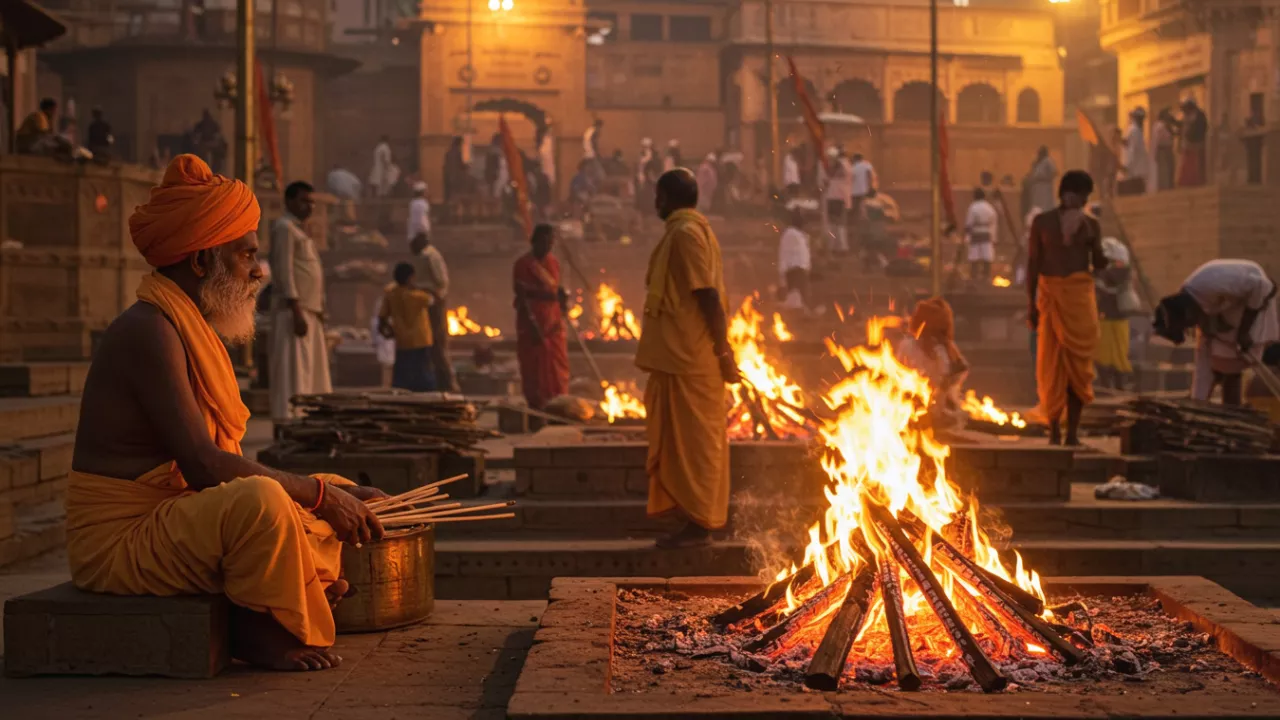
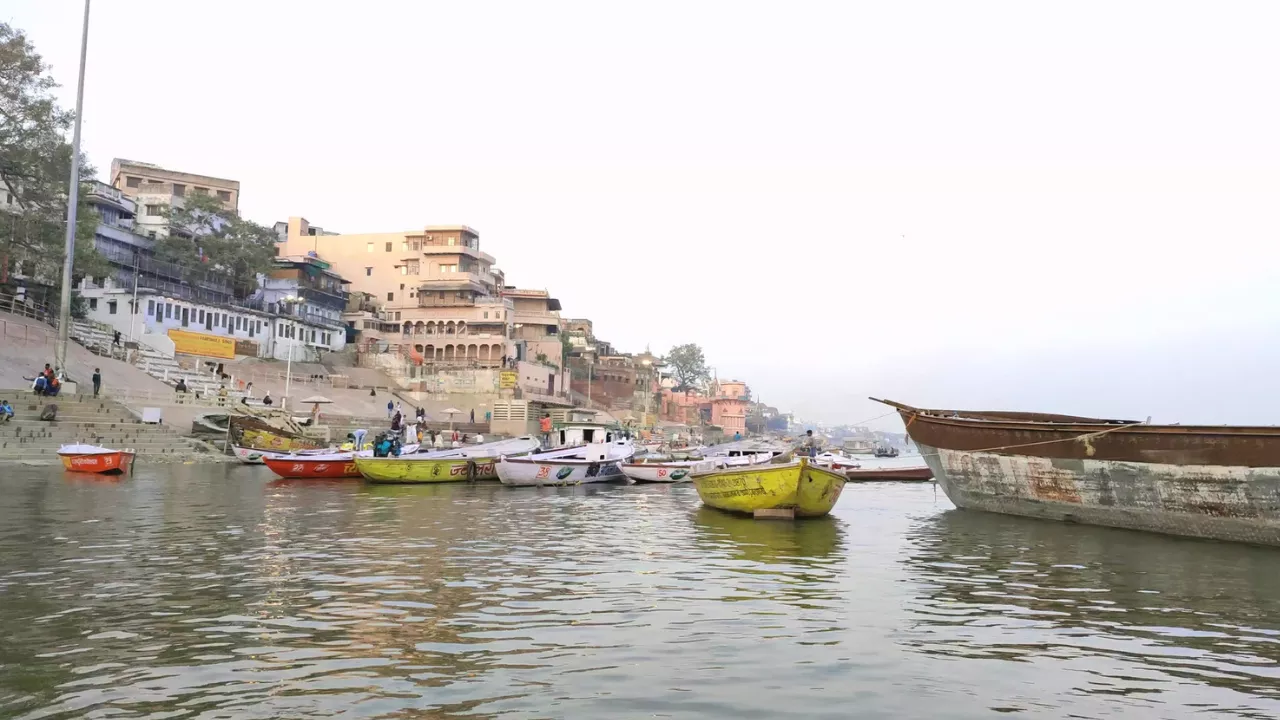
Less internationally known than Manikarnika, and the pyres burn continuously here too. Families arrive with their dead, priests chant, and the air carries burning wood, incense and marigolds. Grief is not hidden here, and neither is the matter-of-factness of people doing what they believe is required.
The ghat has been renovated over the centuries — notably by Narayana Dikshit, a guru of the Peshwas, in the eighteenth century. An electric crematorium was added in the 1980s and runs alongside the wood pyres, which is the practical difference between the two ghats: it is quicker, often cheaper, and it answers some of the environmental objection to wood. Traditional cremation continues beside it, and most families still choose it.
Why Asthi Visarjan matters
Asthi is the bone fragments and ash left after the cremation; visarjan is immersion. It is normally the last of the major funeral rites, and the tradition gives several reasons for it.
- Release. The belief is that the soul stays tied to its earthly attachments while the physical remains are undispersed, and that immersion in a sacred river lets it detach and move on.
- Return to the elements. The body is held to be made of the five mahabhutas. Cremation returns it to fire, air and ether; the immersion returns what is left to water, and through it to earth. The cycle is only closed by both.
- Completion. It is the rite that ends the sequence, and families describe a closure in it that the cremation alone does not give.
The Ganga is the river the scriptures single out, and Varanasi — Shiva’s city, on its bank — is among the most auspicious places to perform it.
The rite, step by step
Asthi Sanchayan — collecting the remains
Usually on the third, seventh, ninth or eleventh day after the cremation, though circumstances move it. The remains are gathered, washed with milk and water, and placed in an earthen kalash or a cloth bag, normally white or red, with a cloth over it.
Carrying the urn
The chief mourner carries it, and the convention is that the urn is not set down directly on the ground at any point in the journey.
Sankalpa
At the ghat, the pandit takes the family through the formal declaration — the name of the deceased, the gotra, and the purpose of the rite.
Puja and tarpan on the bank
A purifying bath in the Ganga for whoever is performing the immersion, then the offerings — pinda, black sesame, barley flour, flowers, ghee, milk and Gangajal — made to the deceased and to the ancestors. The pandit recites the mantras to Vishnu, to Yama and to the pitrus.
The immersion
The chief mourner carries the urn into the river to about waist depth, faces south — the direction of the ancestors and of Yama — and lets the asthi into the current. Where the urn is biodegradable it goes in too. Flowers, milk and the remaining offerings follow, with the prayers for the soul’s passage.
Afterwards
Another dip for the mourners, further prayers or a small havan on the bank, the dakshina to the pandit, and often an act of charity in the deceased’s name — feeding brahmins or the poor — which the tradition counts as part of the rite.
Harishchandra or Manikarnika
Both promise moksha to those cremated there, and both serve for Asthi Visarjan. What differs is the lore and the facilities.
Manikarnika’s story is a cosmic one — Shiva, Sati, Vishnu’s kund. Harishchandra’s is a human one: a king who kept his word when keeping it cost him everything. Manikarnika has historically taken the larger volume of cremations; Harishchandra has the electric crematorium, which matters to families who want it for cost, speed or environmental reasons.
For Asthi Visarjan specifically, either works, and the ghat does not need to be the one where the cremation took place.
What we charge
| Rite | Price | What it covers |
|---|---|---|
| Asthi Visarjan in Varanasi | ₹5,355 | Ghat-side immersion with sankalpa and tarpan. A second tier at ₹13,125 |
| Asthi Visarjan at Varanasi | ₹7,100 | The fuller arrangement, was ₹13,000 |
| Pind Daan in Varanasi | ₹7,100 | Pinda offered in your gotra at the ghat |
| Asthi Visarjan, 2 days 1 night | ₹12,500 | With Pind Daan and Kashi Vishwanath darshan |
| Online Asthi Visarjan | ₹7,100 | Performed on your behalf with a live video link |
🙏 Book Asthi Visarjan at Varanasi
- Immersion in the Ganga with sankalpa and tarpan
- Pandit through each stage of the rite
- Pind Daan on the same visit if you want it
- Live video option for families who cannot travel
Our step-by-step guide to Asthi Visarjan at Varanasi has the full procedure, and our FAQ covers when to perform it, where, what it costs and the rules to follow.
Common questions
Why is it called Harishchandra Ghat?
For Raja Harishchandra, who was sold into service at a Kashi cremation ground during Vishwamitra’s test and would not cremate his own son without the fee.
Is this the older of the two cremation ghats?
Some traditions say so, and call it Adi Manikarnika — the original Manikarnika. It is a claim worth knowing rather than settling.
When should Asthi Visarjan be performed?
Soon after the remains are collected, usually within days. If travel is not possible, keep the urn respectfully and perform it when you can — within a year is the usual guidance, and Pitru Paksha is the period most families choose.
Does the immersion have to be at the ghat where the cremation happened?
No. Families come to Varanasi for the immersion regardless of where the cremation took place.
Arranging the rite
Tell us the gotra, the name of the deceased and when you can travel — or that you would rather it were performed on your behalf — and we will confirm the pandit, the ghat and the total before anything is paid.
Book Your Sacred Ritual
Authentic ceremonies performed by Veda-trained pandits at sacred sites across India.