Key Takeaways
- Does a rite performed without you count?
- What a remote rite actually looks like
- Tamil and South Indian families
- Carrying ashes on a flight
In This Article
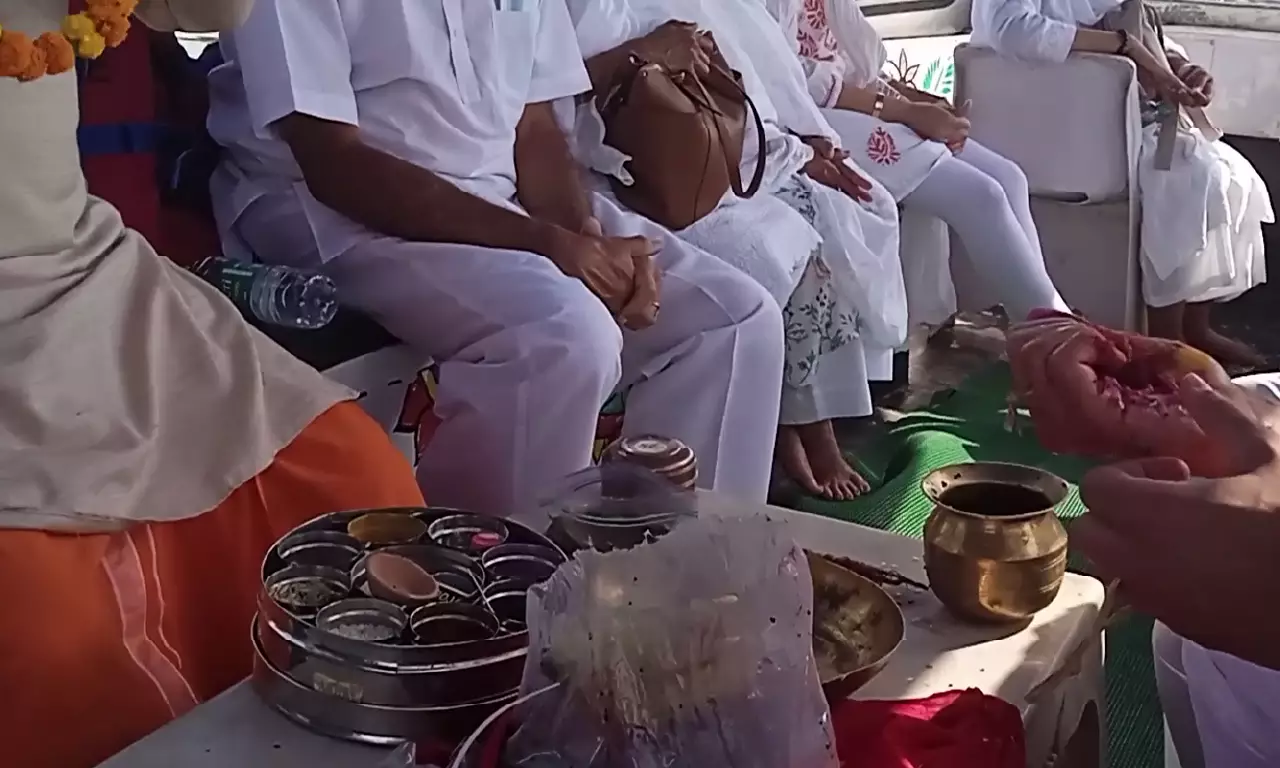
You have two ways to do this from abroad. Travel to Prayagraj and perform the rite yourself, or have it performed at the Sangam in your name while you join by video. Both are valid, and the reason the second one is valid is the Sankalp, the declaration that names you, your gotra and your ancestors at the moment of the offering. If you cannot travel, an online Pind Daan at the Sangam starts at ₹7,100.
Does a rite performed without you count?
Yes, and this is the question every family abroad asks first, so it is worth answering properly rather than reassuringly.
What binds a rite to a person is the Sankalp. The pandit states the date by the Hindu calendar, the place, your name, your gotra, the names of the ancestors the rite is for, and the purpose. That declaration is what directs the merit. It is the same mechanism that lets a son perform shradh for a father he was not present at the death of, and the same mechanism the tradition has always used for people who could not reach the tirtha.
Being there matters for you, not for the rite. Families who can travel usually should, because standing at the water is not the same as watching it. But a rite performed correctly in your name at the Sangam is complete, and nobody should carry guilt about a distance they cannot close.
What a remote rite actually looks like
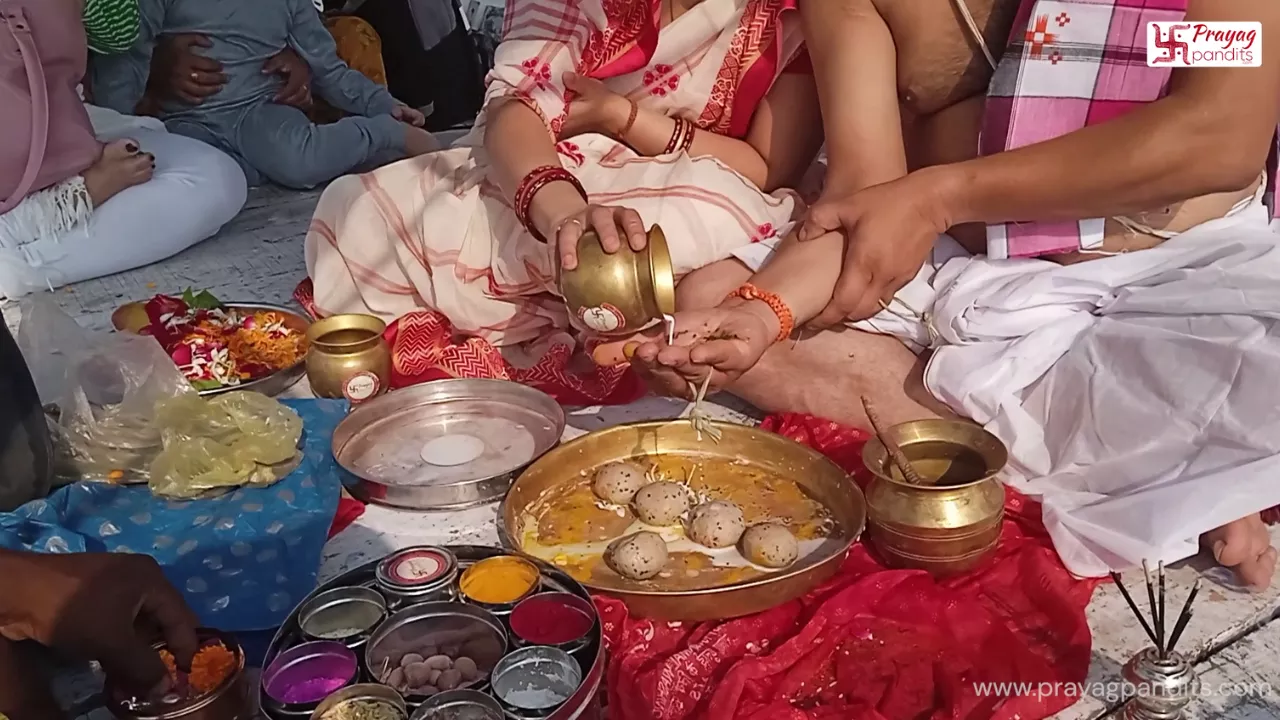
Not a recording sent afterwards. You are on a video call while it happens, on WhatsApp or Zoom, and a full recording follows.
- Before the day. A pandit calls you to fix the tithi, take the names and gotra, and confirm which rite you need. All samagri is arranged in Prayagraj.
- The Sankalp. Said aloud with your name, your gotra and your ancestors’ names. You hear it. If a name is mispronounced, say so then.
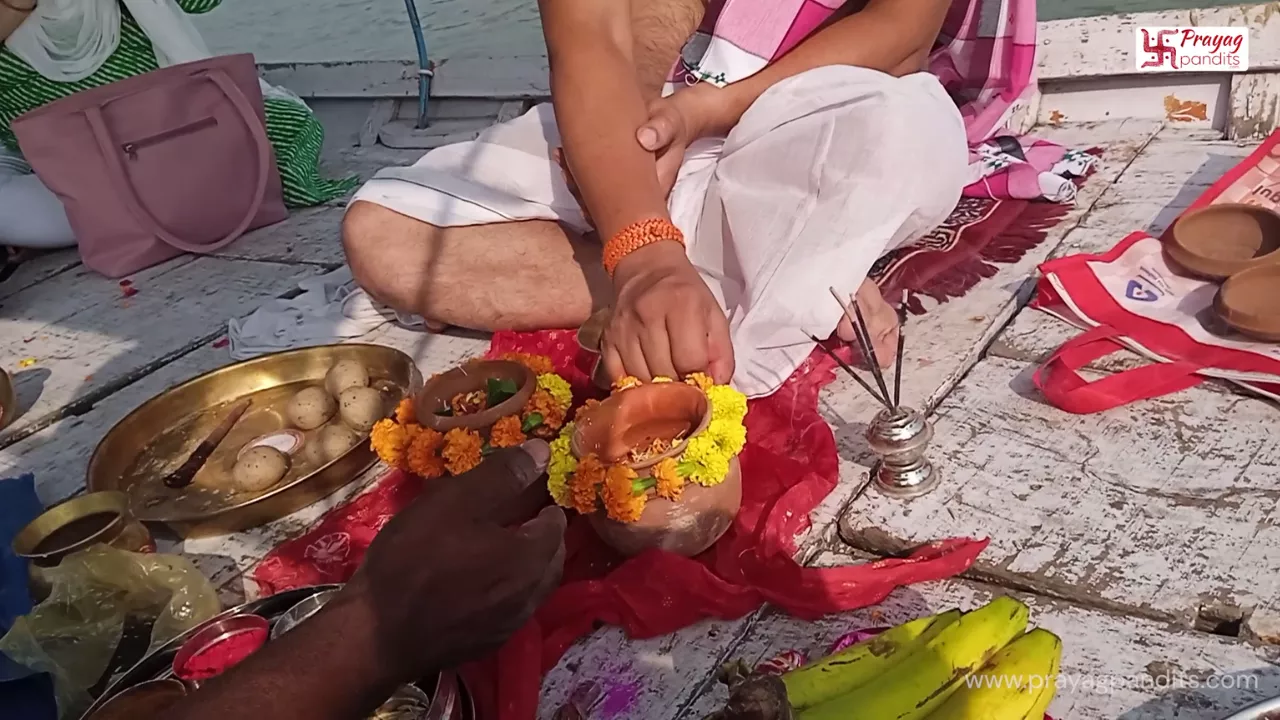
- The rite. Performed in full at the ghat or from a boat at the confluence, depending on the rite and the package.
- Afterwards. Photographs and the recording. For a gau daan or an anna daan, confirmation of who received it.
Tamil and South Indian families
A large part of the Hindu diaspora in Singapore, Malaysia and the Gulf is Tamil, Telugu or Kannada speaking, and the sampradaya differs from the north Indian practice a Prayagwal pandit performs by default. Tell us before the booking and we arrange a pandit who can conduct the rite in your tradition and explain each step in your language. Odia families are served the same way, and we keep Odia-speaking pandits at Prayagraj for that reason.
What changes between traditions is the order of steps, some of the mantras, and the offerings. What does not change is the gotra, the tithi and the place. Bring the details you have and the pandit will work to your family’s practice rather than to a standard script.
Carrying ashes on a flight
If you are bringing a relative’s ashes to the Sangam yourself, this is the part that causes the most anxiety, and it is manageable if you prepare the paperwork before you book.
- The container. A sealed, non-opaque urn in metal, wood or ceramic, wrapped and carried in hand luggage. Screening staff need to be able to scan it. Do not check it in.
- The documents. Airlines and immigration generally ask for the death certificate, the cremation certificate, and a letter from the funeral home or temple confirming what the container holds. Carry originals and copies.
- Declare it. At check-in, at security and at customs. It is a routine matter when declared and a difficult one when found.
- Confirm with your airline first. Requirements vary by carrier and by country of departure, and they change. Ask before you book the ticket, not at the desk.
If carrying the ashes is not possible, they can be sent and the immersion performed without you. The timing rules are the same either way, and we set them out in our guide to when to perform Asthi Visarjan in Prayagraj.
If you are travelling: visa, timing and what to wear
Most nationalities need an Indian e-Tourist Visa, applied for online at the government portal well before departure, with a passport valid for at least six months. Apply at indianvisaonline.gov.in and carry the printed approval letter. Requirements and processing times change, so check the portal rather than a blog, including this one.
There is no airport at Prayagraj with international service. Fly to Delhi, Mumbai, Chennai or Kolkata and take a domestic flight to Prayagraj (IXD), or fly to Varanasi (VNS) and drive the three hours. Two nights is enough for one rite done without hurry.

Wear cotton and keep it simple: a kurta and dhoti for men, a saree or salwar for women. You will get wet. Bring a change of clothes, a towel, and slippers you can walk in on wet stone. Leather belts and bags are best left at the hotel.
Paying from outside India
Prices on this site are in rupees. International cards work at checkout, and your bank converts at its own rate on the day, so the figure that leaves your account will not match a conversion you did yesterday. Currency conversion is your bank’s, not ours, and we do not add a charge on top of the listed price.
One thing worth knowing: the rate you are quoted is the whole rate. Nothing is collected at the ghat, and no dakshina is added on the day. If anyone in Prayagraj tells you otherwise while presenting themselves as our pandit, they are not.
Which rite, and what it costs
Most families abroad need one of these. All can be performed with you present or with you joining by video.
| Rite | In person, from | Remote, from | What it is for |
|---|---|---|---|
| Pind Daan | ₹7,100 | ₹7,100 | The core ancestral offering |
| Asthi Visarjan | ₹5,100 | ₹9,999 | Immersing the ashes after a death |
| Tarpan | ₹5,100 | Included in Shradh | Water offering to three generations |
| Shradh | ₹7,100 | ₹21,000 | The full ancestral ceremony |
| Three cities in one | By arrangement | ₹21,000 | Pind Daan at Prayagraj, Varanasi and Gaya |
Every booking includes a Shastri-qualified pandit, the boat where the rite needs one, all samagri, the Sankalp with your gotra and your ancestors’ names, and photographs afterwards. It does not include your travel, accommodation, or a second ceremony such as Narayan Bali or Tripindi Shradh, which are booked separately. A pandit calls you within two hours of booking.
🙏 Online Pind Daan at the Triveni Sangam
- Live on WhatsApp or Zoom, with a full recording after
- Sankalp said in your name, gotra and ancestors' names
- Tamil-speaking pandit available on request
Common questions
We do not know our gotra. Can the rite still be done?
Yes. Where the gotra is genuinely unknown the tradition provides for it, and the pandit uses the Kashyapa gotra, under which all lineages without a recorded one are included. Tell us rather than guessing at a name.
Can a daughter perform these rites?
Yes. The older Smriti texts give the rite to male heirs, but daughters, wives and granddaughters perform Pind Daan, Tarpan and Shradh at the Sangam regularly, and our pandits conduct the full ceremony with the same vidhi.
How many years after a death can this be done?
There is no limit. Rites are performed at the Sangam for ancestors several generations back, and for deaths that happened decades ago. The traditional windows are the preferred time, not the only time.
Can several family members in different countries join the same call?
Yes. Tell us when booking and we set the call up for everyone rather than one household. The Sankalp can name more than one person where the family is performing the rite jointly.
Distance is a logistics problem, not a religious one. Send us the names, the gotra if you have it, and the city you are in, and we will tell you the tithi and the local time: book an online Pind Daan at the Sangam.

Book Your Sacred Ritual
Authentic ceremonies performed by Veda-trained pandits at sacred sites across India.



