No rituals selected yet.
Browse Pooja Packages →Key Takeaways
In This Article
Every year, thousands of Hindu families living in Malaysia feel the quiet weight of an unfulfilled sacred duty — the Shradh ceremony for their departed ancestors. Distance, work schedules, and the sheer complexity of organizing a pilgrimage from Kuala Lumpur can make this feel daunting. Yet in Hindu dharma, performing Shradh — offering nourishment and peace to the souls of your forefathers — is among the most profound obligations a householder carries. Scriptural tradition strongly emphasizes this duty and describes neglected Shradh as a cause of unrest for the ancestors.
If you are a Malaysian Hindu family — Tamil, Telugu, Malayalam, or Sindhi — wondering about the true Shradh package cost from Malaysia, this guide covers everything: the ritual itself, costs by city, travel logistics from Malaysia, online Shradh options for those who cannot travel, and a transparent breakdown of what your total investment looks like. Prayag Pandits has been organizing these ceremonies for NRI families for years, and everything here reflects real, current pricing as of 2026.
What is Shradh? Understanding the Sacred Duty of Ancestral Rites
The word Shradh (also written as Shraddha) derives from the Sanskrit root Śraddhā, meaning deep faith and devotion. It is the collective name for Hindu ancestral rites in which the living offer food, water, prayers, and pindas (balls of cooked rice or barley) to nourish the souls of deceased family members — primarily the father, grandfather, and great-grandfather, along with maternal lineage ancestors.
The scriptural basis is extensive. The Manusmriti dedicates an entire chapter to the correct performance of Shradh. Traditional texts recognize sacred tirthas (pilgrimage sites) where Shradh yields greater punya (merit). Prayagraj, Varanasi (Kashi), Gaya, and Haridwar are consistently named among the most important locations. Learn more about the deeper significance in our detailed post on Shradh karma and the debt to our ancestors.
The Four Main Types of Shradh
Understanding which type of Shradh applies to your family’s situation helps you choose the right package and location.
- Parvana Shradh — The most common form, performed on specific lunar dates during Pitrupaksha (the fortnight of ancestors) or on the death anniversary (tithi) of the deceased. It involves Pind Daan, Tarpan, and Brahmin Bhoj. This is what most Malaysian Hindu families perform.
- Ekoddishta Shradh — Performed specifically for one recently deceased individual (within the first year of death). It is a focused ceremony to help the soul of a newly departed family member begin its onward journey.
- Sapindikarana Shradh — Performed on the 12th day after death or at the end of the first year. This ritual formally merges the soul of the recently deceased (preta) into the collective body of ancestors (pitrs), releasing it from the intermediate state. It is a vital rite that should not be skipped.
- Tripindi Shradh — A specialized remedy performed when Shradh has not been done for three consecutive years, or when a family is troubled by pitru dosha (ancestral affliction). Varanasi (Kashi) is the pre-eminent location for Tripindi Shradh, and the ceremony is more elaborate and longer than standard Shradh.
For a complete procedural guide, see our post on how to perform Pind Daan and Shradh correctly.
Shradh Package Cost from Malaysia: City-by-City Breakdown
Each of the four major Shradh pilgrimage cities has its own spiritual significance, ritual variations, and pricing. Here is a transparent, itemized breakdown of what the ceremony costs at each location — these are the exact prices from Prayag Pandits’ WooCommerce store as of 2026.
1. Shradh at Varanasi (Kashi) — The City of Liberation
Varanasi holds the supreme position in all Shradh-related scriptures. The Kashi Khanda of the Skanda Purana declares that Shradh performed at the Manikarnika Ghat or the Pishach Mochan Kund in Kashi grants moksha (liberation) not just to the departed soul but to the entire lineage. Lord Shiva himself is said to whisper the Taraka Mantra into the ear of every soul that departs in Kashi — making it the most sought-after location for NRI families.
The Shradh at Varanasi package from Prayag Pandits includes: experienced Tirth Purohit guidance, all Pooja Samagri (ritual materials), Pind Daan at the ghat, Tarpan, Ganga Pooja, 84 Daan, Gau Daan, and boat charges. Duration is typically 3–4 hours in the early morning.
Package Title
Starting from
₹00,000
per person
For families planning Shradh in Varanasi, we have a dedicated guide covering the complete process: Shradh in Varanasi from Malaysia.
2. Shradh at Gaya — The Land of Pitru Tarpan
Gaya, in Bihar, is the most directly named Shradh location in the Hindu scriptures. Lord Vishnu himself blessed the land at Gaya, and the Vishnu Pada temple here — housing the sacred footprint of Vishnu — is central to the Pind Daan ritual. Narada Purana and Gaya’s sthala-parampara preserve traditions of Lord Rama’s family performing Pind Daan for King Dasharatha at Gaya. For Malaysian Hindu families, especially those with Tamil roots where the Gaya pilgrimage is deeply embedded in tradition, this is often the destination of first choice.
The 45 Vedis (ritual offering spots) at Gaya — including Phalguni River, Akshaya Vat (the immortal banyan tree), and the Pretshila hill — provide a uniquely complete ancestral rite. Our complete guide to Shradh in Gaya from Malaysia covers the full procedure and logistics.
Package Title
Starting from
₹00,000
per person
3. Shradh at Prayagraj (Triveni Sangam)
Prayagraj — the ancient Prayag — is where the Ganga, Yamuna, and the invisible Saraswati converge. The Triveni Sangam is one of the most sacred spots in all of Hinduism, and performing Shradh at the confluence carries the blessing of three rivers simultaneously. The Prayag Mahatmya section of the Matsya Purana states that a single Pind Daan at Prayag is equal in merit to performing it at hundreds of other sacred locations.
The Prayagraj Shradh package includes: ceremony at the Triveni Sangam by boat, experienced local Tirth Purohit, all ritual materials, Pind Daan, Tarpan, Ganga-Yamuna Pooja, 84 Daan, and Gau Daan. The ceremony takes approximately 2–3 hours in the early morning at the confluence.
Package Title
Starting from
₹00,000
per person
4. Shradh at Haridwar — Where the Ganga Enters the Plains
Haridwar (literally “the gateway to Hari”) is where the Ganga descends from the Himalayas onto the plains of India, and the Har Ki Pauri ghat is considered one of the most sacred spots on Earth. Shradh performed at Haridwar — particularly at the Asthi Pravah Ghat and Kankhal’s Daksha Mahadev temple area — is especially potent for families who wish to perform the ceremony in the Ganga before she enters the plains. For Malaysian families traveling from Delhi or combining with a North India tour, Haridwar can be a more accessible option.
Package Title
Starting from
₹00,000
per person
Total Trip Cost from Malaysia: A Realistic Budget Breakdown
The ritual package is just one part of your total Shradh package cost from Malaysia. Here is a realistic, transparent breakdown of what a family of two adults should budget for the full pilgrimage trip.
Local Tip
| Cost Component | Per Person (INR) | Per Person (MYR approx.) | Notes |
|---|---|---|---|
| Return Airfare (KUL to nearest airport) | ₹35,000 – ₹52,000 | RM 1,850 – RM 2,750 | No direct flights. Routes via Bengaluru or Hyderabad. Book 6–8 weeks ahead for best rates. |
| Ritual Package (ceremony fee) | ₹5,100 – ₹10,999 | RM 270 – RM 580 | Depending on city and package chosen. Varanasi packages are more comprehensive. |
| Hotel Accommodation (2 nights) | ₹4,000 – ₹10,000 | RM 210 – RM 530 | Good mid-range hotels near the ghats. Book directly or ask Prayag Pandits to recommend. |
| Local Transport (airport + ghats) | ₹3,000 – ₹5,000 | RM 160 – RM 265 | AC vehicle from arrival airport to city and to ceremony location. |
| Food & Meals (2 days) | ₹2,000 – ₹3,500 | RM 110 – RM 185 | Vegetarian meals near ghats are inexpensive. Budget extra for restaurant dining. |
| Brahmin Bhoj (optional) | ₹2,000 – ₹5,000 | RM 110 – RM 265 | Feeding Brahmins is an important part of Shradh. Many families include this. |
| Miscellaneous (tips, offerings, shopping) | ₹2,000 – ₹3,000 | RM 110 – RM 160 | Dakshina to the pandit, boatman tip, flowers, personal shopping. |
| TOTAL ESTIMATED PER PERSON | ₹53,100 – ₹89,499 | RM 2,810 – RM 4,735 | For a couple, budget RM 5,600 – RM 9,500 total for the entire trip. |
Flight Routes from Kuala Lumpur to India
There are no direct flights from Kuala Lumpur International Airport (KUL) to any of the four Shradh cities. All routes involve at least one stopover. Here are the practical options depending on your chosen city.
- For Prayagraj (IXD) — Fly KUL to Bengaluru (BLR) or Lucknow (LKO) with a connecting domestic flight. IndiGo, Batik Air, and AirAsia are common carriers. Total travel time: 12–18 hours. Estimated return fare: ₹35,000 – ₹50,000 per person.
- For Varanasi (VNS) — Fly KUL to Bengaluru or Hyderabad (HYD) with a connection to Varanasi. IndiGo, AirAsia, and Malindo Air operate this route. Total travel time: 12–16 hours. Varanasi airport (Lal Bahadur Shastri International Airport) has good domestic connectivity.
- For Gaya (GAY) — The Gaya airport has limited flights. Best to fly to Patna (PAT) or Varanasi (VNS) and take ground transport (2–3 hours) to Gaya. Patna airport has better Air India and IndiGo connectivity from major Indian hubs.
- For Haridwar — Fly to Delhi (DEL) — the largest hub with the most options from KUL. From Delhi, take a train or taxi to Haridwar (5–6 hours by road, or 4 hours by Shatabdi Express train). Delhi to Haridwar is an easy leg to plan.
Local Tip
Online Shradh Options for Malaysian Families Who Cannot Travel
We understand that not every Malaysian NRI family can make the physical journey to India — visa schedules, elderly family members, work obligations, or young children at home can make travel impossible. Prayag Pandits offers fully authentic online Shradh services where a dedicated pandit performs the complete ceremony on your behalf at the sacred site, while you participate via live video call.
This is not a diminished or symbolic service. The scriptures recognize proxy performance of Shradh (Pratinidhi Shradh) when the family member cannot be physically present — provided the ceremony is performed correctly at a genuine Tirth (sacred site) by a qualified pandit, and the sponsor participates in spirit and intention. The live video stream ensures you witness every step, receive the blessing, and provide your family’s Gotra and ancestor details directly to the pandit.
Package Title
Starting from
₹00,000
per person
Package Title
Starting from
₹00,000
per person
Tripindi Shradh — For Families with Accumulated Pitru Dosha
If your family has not performed Shradh for three or more years, or if you have experienced recurring difficulties that elders attribute to pitru dosha (ancestral affliction), Tripindi Shradh is the prescribed remedy. It is a longer, more elaborate ceremony performed over 3 consecutive days at Varanasi, specifically designed to address the accumulated spiritual debt to three generations of ancestors. The ceremony involves Kush grass rituals, specific mantras for each of the three forefathers, and Brahmin Bhoj.
Package Title
Starting from
₹00,000
per person
The Importance of Brahmin Bhoj in Shradh
The Brahmin Bhoj — the feeding of qualified Brahmin priests as part of the Shradh ceremony — is not an optional addition. The Manusmriti (Chapter 3, verses 122–286) is emphatic that no Shradh is complete without feeding the Brahmins. The belief is that through a qualified Brahmin, the food offerings actually reach the ancestors in their spiritual realm. The act of feeding Brahmins (Brahmin Bhojan) is the vehicle by which the nourishment you offer crosses from the material world to the ancestral realm.
Prayag Pandits can arrange for qualified Brahmins to receive the Bhoj at Prayagraj or Varanasi on your behalf. For families doing online Shradh, the Brahmin Bhoj is included in the Online Brahmin Bhoj + Shradh at Prayagraj package listed above, with live video of the Bhoj included.
Local Tip
Best Times to Perform Shradh from Malaysia
While Shradh can be performed on any suitable lunar date throughout the year, three periods carry the greatest significance and maximum spiritual benefit. Planning your Malaysia trip around these dates ensures both scriptural correctness and, for Prayagraj visitors, the grandeur of the full pilgrimage season. Learn more about the spiritual significance of Pitrupaksha.
- Pitrupaksha (Mahalaya Paksha) — The ancestor fortnight in the Hindu month of Bhadrapada (typically September–October). This is the most auspicious period for Shradh in the entire year. All four sacred cities see enormous NRI pilgrim presence. In 2026, the main Shradh dates run from September 27 to October 10. Book flights and rituals at least 2–3 months in advance for this window.
- Amavasya (New Moon Day) — Every month’s Amavasya is considered auspicious for Tarpan and Shradh. Many Malaysian NRI families prefer to plan their trip around an Amavasya if Pitrupaksha timing is not possible. Shradh on Amavasya is perfectly valid and accepted in the scriptures.
- Death Anniversary (Tithi) — The lunar anniversary (tithi) of the ancestor’s death is the most personally specific date. Performing Shradh on the exact same lunar date each year is highly recommended. Your pandit can calculate the exact tithi from the Gregorian death date.
Step-by-Step Booking Process with Prayag Pandits
Prayag Pandits has designed its booking process specifically with overseas NRI families in mind. Here is how it works from first contact to ceremony completion.
- Initial Consultation (WhatsApp/Phone) — Contact Prayag Pandits via WhatsApp with your details: the city you wish to travel to (or whether you prefer online), the ancestor’s details (name, Gotra, date of death), and your preferred dates. The team responds within a few hours.
- Package Selection — Based on your family’s situation, the team recommends the correct package type: Parvana Shradh, Ekoddishta, Sapindikarana, or Tripindi. They will confirm what is included, what the total ceremony duration is, and answer any questions about procedure.
- Online Payment — All packages are available on the Prayag Pandits website and can be purchased securely online. International credit/debit cards and PayPal are accepted. Payment in Indian Rupees is processed by the secure WooCommerce checkout.
- Pre-Travel Coordination — Once booked, the team sends you a preparation guide: what to bring (white dhoti/saree, sesame seeds, flowers), what to avoid before the ceremony (alcohol, meat, certain foods), and the exact time and location to meet the pandit.
- Arrival and Ceremony — On the day of Shradh, you are received at the ghat by the dedicated pandit. The ceremony typically begins in the early morning (Brahma Muhurta) for maximum auspiciousness. The pandit guides you through every step, explaining each ritual action and mantra so you understand its meaning. Total duration: 2–4 hours depending on package type.
- Post-Ceremony Guidance — After the ceremony, the pandit provides guidance on any follow-up observances, suggested annual dates for future Shradh, and any additional remedies if Pitru Dosha was identified during the ceremony.
For the complete guide covering every aspect of this pilgrimage, including visa requirements, packing lists, and what to expect at each city’s ghats, read our comprehensive Pind Daan and Shradh from Malaysia: Complete 2026 Guide.
In-Person vs. Online Shradh: Which is Right for Your Family?
Both options are spiritually valid. The choice depends on your family’s circumstances, budget, and the urgency of the Shradh. Here is a direct comparison to help you decide.
| Factor | In-Person Shradh | Online Shradh |
|---|---|---|
| Spiritual Merit | Maximum — direct participation at sacred Tirth | High — valid proxy Shradh; scripturally accepted |
| Total Cost | ₹60,000 – ₹1,00,000 (incl. travel) | ₹10,999 – ₹21,000 (ceremony only) |
| Time Required | 4–6 days travel including journey | 2–3 hours on ceremony day (video call) |
| Your Participation | Full physical presence at the ghat | Live video call; you observe and give consent |
| Best For | First-time Shradh; major ancestral rites (Sapindikarana); Pitrupaksha | Annual Shradh maintenance; when travel is not possible; elders at home |
| Prasad | Received in person at the ceremony | Dispatched by courier to your Malaysia address |
| Brahmin Bhoj | Can be arranged at additional cost | Included in Online Brahmin Bhoj package |
| Booking Lead Time | 2–3 months (for Pitrupaksha) | 1–2 weeks |
Local Tip
What to Expect During the Shradh Ceremony
For many Malaysian NRI families, this is their first time performing Shradh at a sacred Indian Tirth. Knowing what to expect helps you arrive prepared and fully present in the ritual rather than feeling anxious about the unfamiliar. Here is a typical morning during an in-person Shradh at Prayagraj or Varanasi.
- 4:30 – 5:00 AM: Purificatory bath — You arrive at the ghat in the predawn darkness. The pandit guides you to take a holy dip in the river (the Ganga or the Sangam). Even if you cannot fully submerge, symbolic purification is acceptable. Bring a change of clothes in a waterproof bag.
- 5:00 – 5:30 AM: Sankalpa (Statement of Intent) — The pandit leads you through the Sankalpa — a formal declaration in Sanskrit that names you, your Gotra (ancestral lineage), the specific ancestors you are performing Shradh for, and your purpose. This is the ritual equivalent of addressing an envelope before sending it to the spiritual realm.
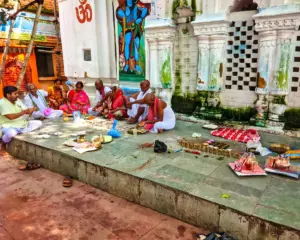
- 5:30 – 7:00 AM: Main Ceremony — The pandit performs the Pind Daan (offering of rice/barley pindas), Tarpan (water libations with sesame and flowers), relevant mantras, and specific offerings depending on the package (84 Daan, Gau Daan, etc.). At Prayagraj, this is done from a boat at the Sangam. At Varanasi, it is performed at the designated ghat steps.
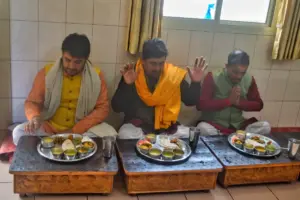
- 7:00 – 7:30 AM: Brahmin Bhoj (if included) — If your package includes Brahmin Bhoj, qualified Brahmins are fed at this point. You offer food, fruits, and Dakshina (monetary offering) as an extension of the feeding of your ancestors.
- 7:30 AM onwards: Closure and blessings — The pandit gives you the aarti tika (sacred mark) and distributes Prasad. He provides verbal guidance on the significance of what was just performed and answers your questions. You are then free to visit adjacent temples, take rest, or proceed with your travel itinerary.
Frequently Asked Questions
Why Malaysian Hindu Families Trust Prayag Pandits
Prayag Pandits was founded specifically to bridge the gap between ancient Vedic traditions and the practical needs of modern NRI families. Here is what distinguishes the service for Malaysian pilgrims.
- Qualified, vetted pandits — Every Tirth Purohit associated with Prayag Pandits is a qualified, lineage-holding priest who has performed these rituals hundreds of times. We do not use temporary or untrained priests for NRI services.
- English-language coordination — The booking team communicates fluently in English and Hindi. All pre-ceremony preparation materials are available in English so that families who do not speak Hindi can fully understand and participate.
- Transparent pricing — The prices shown on the website are what you pay. There are no hidden fees, no surprise charges at the ghat. All Pooja Samagri (ritual materials) are included in the package price.
- Live video for online services — Unlike some services that send a post-ceremony video recording, Prayag Pandits conducts a live WhatsApp video call during the ceremony so you can participate in real time, speak directly to the pandit, and witness the offering as it is made.
- NRI experience — We have served NRI families from Malaysia, Singapore, the UK, the USA, Australia, and Canada. We understand the specific practical concerns — visa timing, airport logistics, halal vs. vegetarian meal needs near ghats, and the emotional sensitivity involved in performing ancestral rites far from home.
Fulfilling this sacred duty — regardless of the distance, the cost, or the complexity of travel — is one of the most meaningful acts a Hindu family can undertake. If your ancestors gave you the values, the language, and the identity that you now carry in Malaysia, this ceremony is your way of saying: we remember you, we honor you, and we have not forgotten the way home.
Contact Prayag Pandits today on WhatsApp or through the booking links above to begin planning your Shradh ceremony. Our team is available 7 days a week and responds to Malaysian families in the IST evening hours, which aligns with Malaysian Standard Time (MST = IST – 2.5 hours).
Book Your Sacred Ritual
Authentic ceremonies performed by Veda-trained pandits at sacred sites across India.
2,263+ families served
Clear package details
Since 2019
