
Key Takeaways
- Why Ayodhya
- What the Puranas say about lamp donation
- What the tradition says it is for
- Deep Daan for ancestors
In This Article
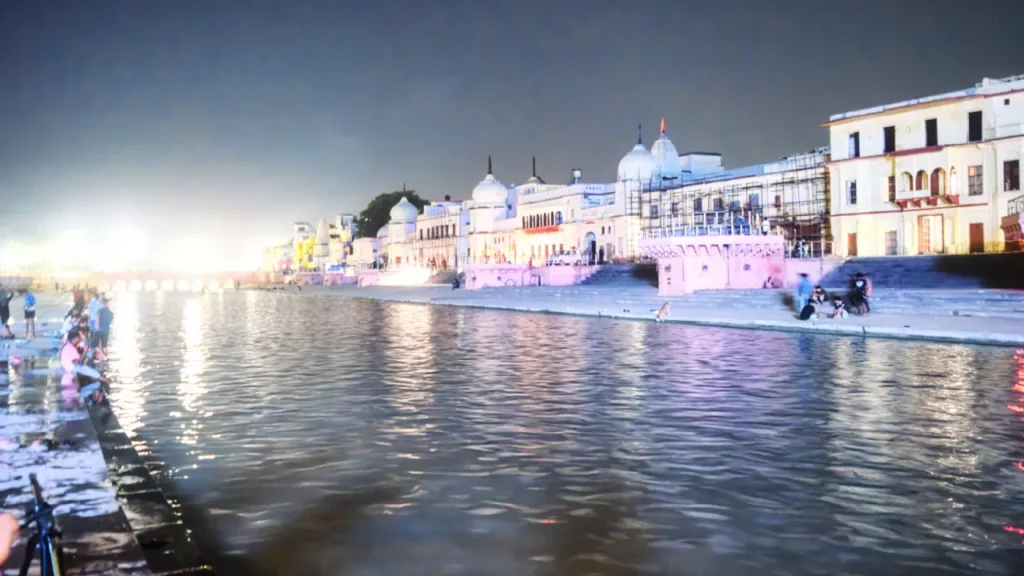
Deep Daan is the donation of a lamp, and at Ayodhya it is performed on the Saryu — most often at Ram ki Paidi, at Pradosh Kaal around sunset. Two clay diyas, ghee or sesame oil, a cotton wick and a seat of rice grains are all it takes. The practice is named in the Agni Purana and the Padma Purana, and at Ayodhya it carries the association of the lamps lit to welcome Ram home from exile.
Why Ayodhya
Ayodhya is the janmabhoomi, the birthplace of Ram, and one of the seven Sapta Puri cities — alongside Mathura, Haridwar, Kashi, Kanchi, Ujjain and Dwarka — held to be capable of granting liberation. Of the seven it is the one directly associated with Vishnu in human form.
The Saryu runs through the middle of it, and the tradition treats the river as witness to the whole of Ram’s life: his birth, his departure for the forest, his return, and finally his mahasamadhi into its water. Lamps on the Saryu are not a general devotional act here; they are tied to a particular homecoming.
That is also why the Deepotsav is not a modern invention. The Valmiki Ramayana has the citizens of Ayodhya lighting the whole city — every house, every road, the riverbank — to welcome their king back. The festival repeats it.
What the Puranas say about lamp donation
The Agni Purana treats the donation of a lamp to a temple as among the complete offerings — which in a city of Ram and Hanuman temples covers most of what a visitor to Ayodhya would do.
The Padma Purana holds that Lakshmi is pleased by lamps donated at temples and riverbanks, which the Saryu bank satisfies twice over — a sacred river, and a site associated with Vishnu. It also treats lamp donation at a remote or hard-to-reach sacred site as particularly meritorious.
The Kartik Mahatmya, the part of the Padma Purana in praise of the month of Kartik, holds Deep Daan during Kartik at a Vishnu site to carry the merit of the major yagnas together. Ayodhya is among the principal Vishnu tirthas, so Kartik is the month families choose.
What the tradition says it is for
Stripped of the promises, the practice has a few recognised purposes, and families generally come with one of them in mind.
- For the departed. A lamp lit in a relative’s name and floated on the Saryu is the commonest reason families perform it, and the one the ancestral rites build on.
- As an offering to Ram and Lakshmi, Ayodhya being Vishnu’s birthplace in the Ram avatar.
- At Pradosh Kaal, against the fear of untimely death — akal mrityu — which is the association the tradition gives the twilight offering.
- As part of Kartik observance, which is when the merit is held to be concentrated.
Deep Daan for ancestors
The Saryu is counted among the rivers at which Pind Daan and ancestral tarpan may be performed, and during Pitru Paksha many families travel to Ayodhya to do both — the Pind Daan at Ram ki Paidi and the lamp on the river afterwards.
The Garuda Purana’s instruction for a lamp offered on behalf of a departed person is that the name be spoken aloud, with the gotra and the names of the parents, at the moment the lamp is lit. That spoken invocation is what the tradition treats as making the link, so it is the part not to leave out.
Our Pind Daan in Ayodhya service includes the option of adding Deep Daan, so the lamp is offered in the same sitting as the pinda.
| Rite | Price | Where |
|---|---|---|
| Pind Daan in Ayodhya | ₹7,100 | Ram ki Paidi, on the Saryu. Deep Daan on request. Was ₹11,000 |
| Online Pind Daan in Ayodhya | ₹11,000 | Performed on your behalf with a live video link. Was ₹15,000 |
🪔 Book Pind Daan at Ram ki Paidi
- Performed on the Saryu at Ram ki Paidi
- Sankalp in your family gotra
- Deep Daan added on request
- All puja samagri included
How to perform it
1. Buy the lamps
Clay diyas are sold at every market near the ghats. Two is the usual minimum — one for Ram and one for the ancestors.
2. Gather the materials
Pure cow ghee or sesame oil, cotton wicks, a handful of rice or wheat, flowers — marigold or white lotus traditionally — incense, and a light. If the lamp is for an ancestor, have the gotra written down to hold during the invocation.
3. Arrive at Pradosh Kaal
The twilight hour around sunset is the prescribed time. Touch or bathe in the Saryu first if you can — even touching the water while reciting Ram’s name is held to count.
4. Make the lamp a seat
Not directly on bare stone or earth. Build a small mound of rice on the ghat step, in your palm or on a metal plate, and rest the lamp on it. Fill it, and set the wick so one end stands slightly above the oil.
5. Invoke, and light it
Hold the unlit lamp in both hands and recite: Om Ram Ramaya Namah. Deepo jyoti parabrahma. Idam deepam [name] -ya namah. Then light it. For an ancestor’s lamp, say the name, the gotra and the parentage aloud as the flame catches.
6. Float it, or set it down
On the river, set it gently into the current. At a temple, place it in the designated area with a flower. Then watch the flame for a moment before you move — the tradition treats the watching as part of it.
The Deepotsav
On Diwali night the Uttar Pradesh government runs the Deepotsav at Ram ki Paidi, which has grown from devotees lighting lamps on the ghats into one of the largest lamp-lighting events anywhere. In 2022 more than fifteen lakh earthen diyas were lit together on the Saryu banks, setting a Guinness World Record; the count has been pushed higher in the years since.
- Mass Deep Daan at Ram ki Paidi, beginning at Pradosh Kaal
- Tableaux of Ramayana scenes across the city
- Laser and light projection onto the Saryu
- The Ram Mandir opened for midnight darshan on Diwali night
- A re-enactment of Ram, Sita and Lakshmana’s arrival on the main stage
- A Saryu aarti at sunset, before the lamps are lit
Deep Daan at the Ram Mandir
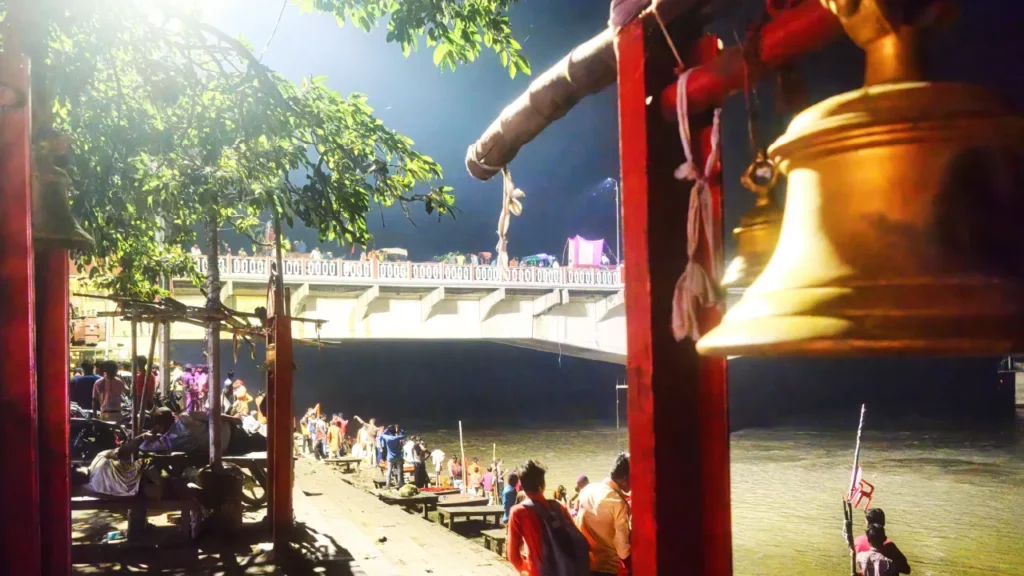
Since the consecration of the Ram Mandir at Ram Janmabhoomi in January 2024, the complex has designated areas for devotee lamp offerings. Pandits at the temple will tell you the protocol — which form of Ram or Sita the lamp is directed to, and the mantra for each. The temple is about 800 metres from Ram ki Paidi, so both can be done in an evening.
Kartik Purnima
Diwali is the famous occasion, but Kartik Purnima matters as much. The Skanda Purana names the Trayodashi, Chaturdashi and Purnima of Kartik as Ati Pushkarini — the most meritorious days of the year for bathing and for lamp donation — and holds that bathing in the Saryu before sunrise on Kartik Purnima carries the merit of bathing in every sacred river.
On that night the Saryu at Ayodhya does what the Ganga does at Varanasi: it becomes a river of light. Ayodhya also keeps the Akash Deepa tradition — lamps hung high above doorways and temples so they can be seen from a distance, which the Padma Purana attributes to the Pandavas lighting sky-lamps for the fallen of Kurukshetra. Our notes on Kartik Purnima and Dev Deepawali at Varanasi cover the wider observance.
Ayodhya or Prayagraj
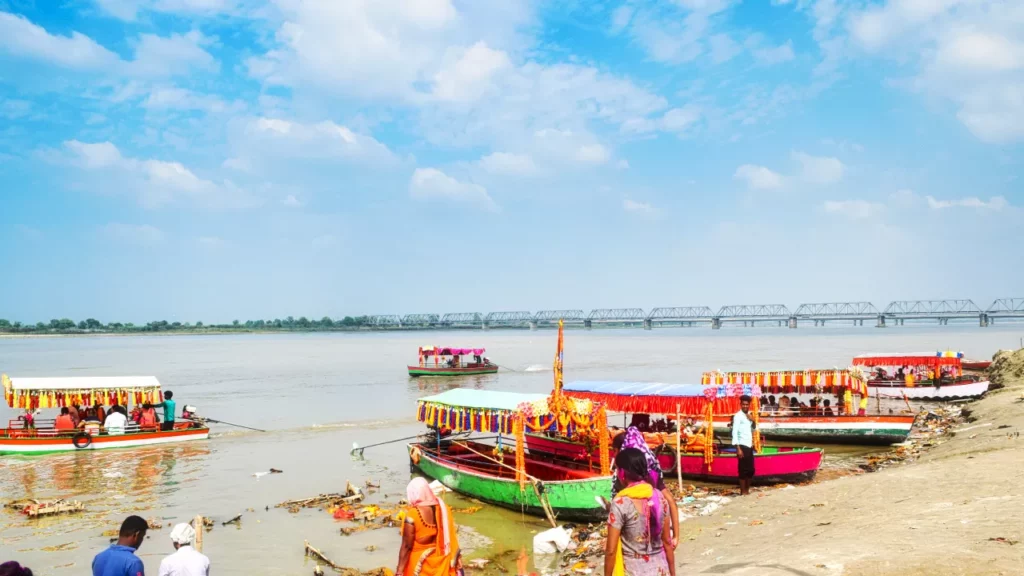
Both are counted among the best sites for lamp donation, for different reasons. Ayodhya’s is Ram — the grace associated with liberation, which is why ancestral lamps on the Saryu are held in particular regard. Prayagraj’s is the confluence: the Skanda Purana holds Deep Daan at a sangam to multiply the merit of a single-river offering many times over, which makes the Triveni Sangam the strongest site on that reckoning.
Families who care about the distinction tend to do both across a lifetime — Ayodhya for Ram’s blessing and the soul’s liberation, Prayagraj during Pitru Paksha. Our complete guide to Deep Daan covers the practice beyond Ayodhya.
Getting there, and when
Ayodhya Dham airport has flights from Delhi, Mumbai and Bengaluru. Ayodhya Junction is on the Lucknow–Varanasi line, an hour from Lucknow and two and a half from Prayagraj. By road it is 135 km from Lucknow and 185 km from Prayagraj on the Purvanchal Expressway.
Ram ki Paidi is a ten-minute walk or a short e-rickshaw ride from the main bazaar, with the Ram Mandir about 800 metres away.
Common questions
What time should the lamp be offered?
Pradosh Kaal, the twilight hour around sunset. That is the prescribed time, and it is also when the ghats are at their best.
How many lamps?
Two is the usual minimum — one for Ram, one for the ancestors. There is no requirement beyond that.
Can it be done on someone’s behalf?
Yes. We perform Deep Daan at Ayodhya for families who cannot travel, usually alongside the Pind Daan, with the name and gotra spoken in the invocation.
Which is better, Diwali or Kartik Purnima?
Diwali is the spectacle; Kartik Purnima is the one the Skanda Purana singles out for bathing and lamp donation. For a ceremony rather than an occasion, Kartik Purnima is the quieter choice.
Arranging it
If you want Deep Daan performed at Ayodhya on your behalf, or a Pind Daan and Deep Daan together at the Saryu during Pitru Paksha, tell us the gotra and the ancestors it is for and we will confirm the pandit and the total before anything is paid. Our note on Pitru Paksha explains the fortnight, and snan covers the bathing that precedes the rites.
Book Your Sacred Ritual
Authentic ceremonies performed by Veda-trained pandits at sacred sites across India.



