No rituals selected yet.
Browse Pooja Packages →
Asthi Visarjan
Asthi Visarjan in Gaya
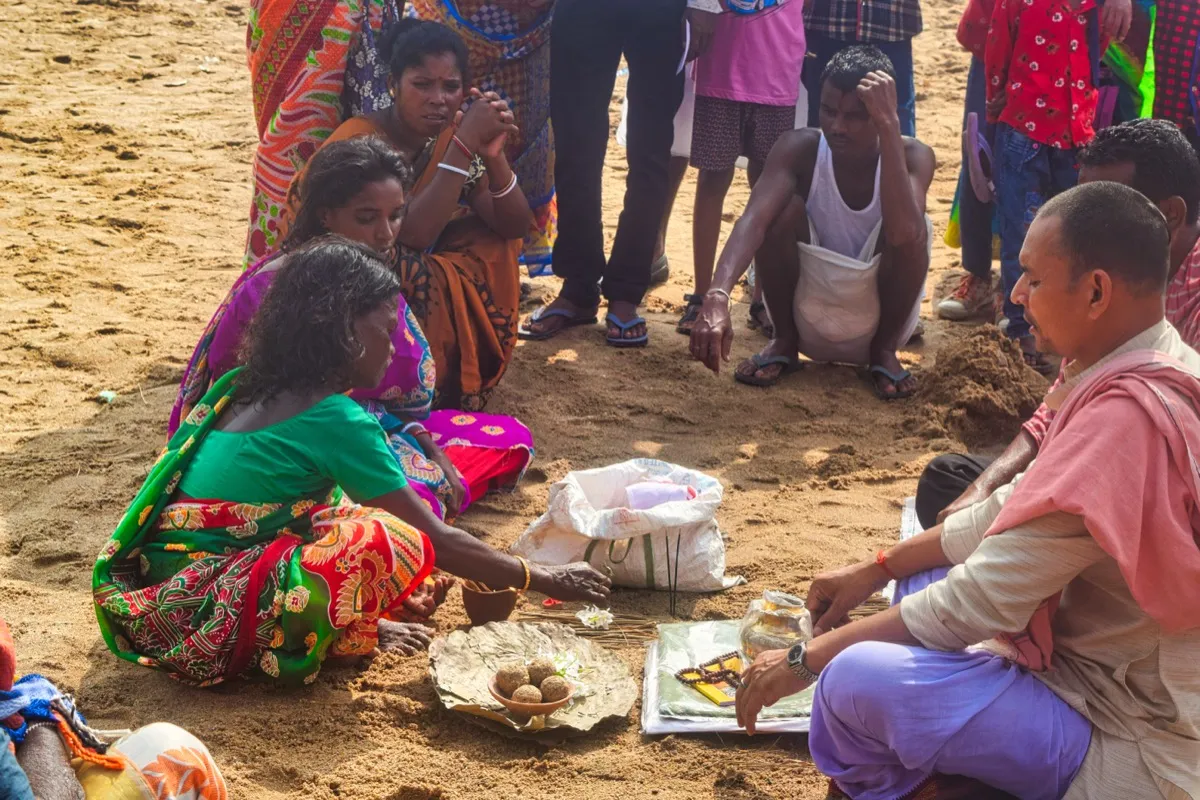
Asthi Visarjan at the sacred Falgu (Phalgu) river, Gaya Experienced Gaya Teerth-Purohit...
from
₹7,100
Get clear help choosing the right vidhi, package and arrangement before you book.
Share the family situation, preferred date, city, and whether the family will attend in person or remotely. We will help you choose the right next step.
Tell us the family situation and preferred date.
We help identify the suitable vidhi and package.
Book only after the arrangement is clear.
Families have a duty to pay honour to ancestors and follow the intentions of their dearly departed loved ones, according to Hindu faith. Asthi Visarjan is a Hindu religious rite that helps the soul achieve redemption and serenity in the afterlife, thereby fulfilling the aspirations of the departed. It is the responsibility of the living family to do the Asthi Visarjan rite for their dearly departed family member. As specified by Hindu holy texts and sacred customs, this is accomplished by immersing and dispersing the cremated ashes and bones of the departed relative or family member in any of India’s flowing holy rivers. This is also a way for Hindus to pay respect to their forefathers and mothers. The holy waters are thought to cleanse the soul of sins, allowing it to achieve moksha, or salvation, as well as a proper seat in the presence of the Supreme Power.
Immersion of the ashes at the sacred Falgu (Phalgu) river, performed by experienced Gaya Teerth-Purohits with full samagri, sankalpa, tarpan and Vedic mantras.
₹7,100 Book Now →
Cannot travel? We perform it on your behalf with live video. WhatsApp +91‑7754097777 for guidance.
Select your package and complete booking. Our team calls within 2 hours to confirm details.
Provide your gotra, departed soul's name, and any special requirements.
Experienced pandit performs the complete ceremony at the sacred site.
The family receives ceremony updates on WhatsApp after completion.
Asthi Visarjan at the sacred Falgu (Phalgu) river, Gaya Experienced Gaya Teerth-Purohit...
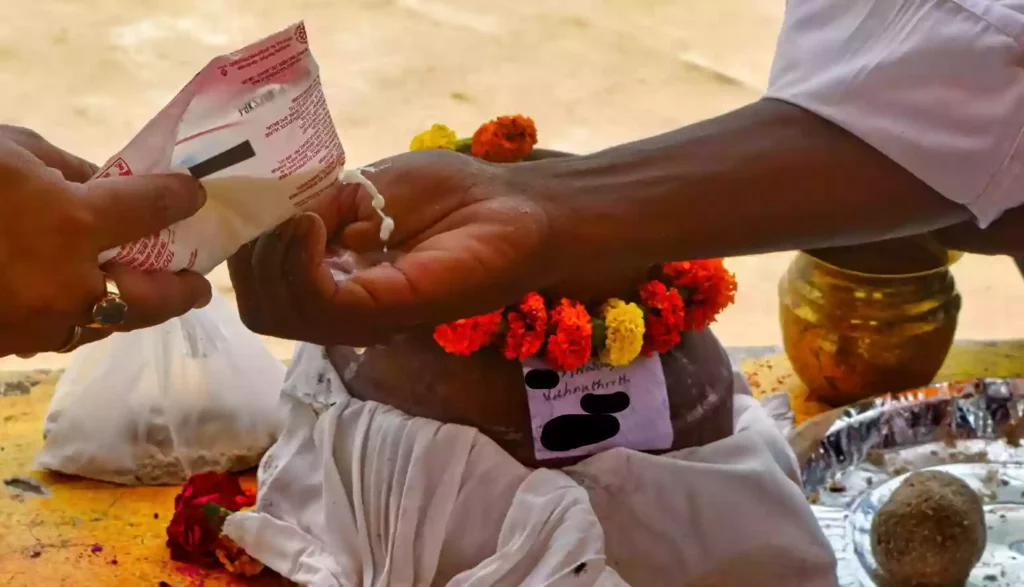
After completing the preparation for the poojan, pandit begins the poojan by reciting all the mantras mentioned in the hindu holy texts and customs. The person performing the asthi visarjan is requested to recite some of the mantras as told by the pandit. During this procedure, poojan samagri is offered to the asthi kalash. Before the immersion of asthis in ganga river, pandit ji asks the almighty to accept the poojan and provide moksha to the departed.
Why to Perform Asthi Visarjan in Gaya?Since the time of the Ramayana, it has been important. Lord Ram is said to have done Pind Daan in Gaya for his father, Raja Dashrath. Gaya is a renowned venue for the Asthi Visarjan ceremony, and additional rituals such as Shraadh Pooja, Pind Daan, and PitruDosh Nivaran Pooja can be performed based on family beliefs and desires.
Who can perform Asthi Visarjan in Gaya?Asthi visarjan can be performed by the son, daughter, brother, sister, wife or husband of the departed soul. In case there is no one available in the family to carry out the poojan, then a friend or a pratinidhi can perform the rituals with the help of pandit. With the growth of digital age, one can perform the asthi visarjan poojan online, without even visiting at the poojan place physically. Prayag Pandits excels in providing online asthi visarjan poojan to anyone from any country.
Where to Perform Asthi Visarjan in Gaya?Gaya is rich in historical significance dating back thousands of years. The Hindu faith considers the Phalgu or Falgu river, which flows through Gaya, to be a holy river. The Phalgu is Vishnu’s manifestation, according to the Vayu Purana. The Lilajan and Mohana streams meet at the mouth of the Phalgu. The site of confluence of flowing sources of water is considered holy in Hindu mythology. Asthi Visarjan, a Hindu religious rite for the dearly departed, is done in such holy rivers because the ritual requires the immersion of the ashen remains and bones in the river’s flowing waters.
On which day asthi visarjan should be done?There are different days in different castes and states. Generally, it is best to perform it as soon as possible. Asthi visarjan laws are different in Orissa, when compared to north india. But as per the holy texts, the asthis must be collected and put in a kalash on the 3rd day, 7th day, 9th day. Before the 10th day, asthi visarjan should be performed.
How long does asthi visarjan takes?The poojan takes anywhere from 45 minutes to 120 minutes.
Where should i keep the asthi of the dead person?You should never keep the asthi inside your home. Rather, you should bury the asthi kalash in your garden, nearby empty land area or a patio.
Which place is best for asthi visarjan?Any nearby place where holy river ganga flows. For people living in or near Delhi, they can go Garh Mukteshwar or Haridwar. For People belonging to Northern India, they can visit Prayagraj, Varanasi or Mathura.
Can asthi visarjan be done only in river ganga?No, although river ganga is considered to be the most preferred when it comes to asthi visarjan, but any flowing water body is suitable for asthi visarjan.
Can i do online asthi visarjan?Yes, if you are unable to visit physically, you can opt for online asthi visarjan. It is completely fine and is considered the preferred choice for many.
Gaya holds a unique position among India's sacred cities for ancestral rites. The Falgu (Phalgu) River, which flows through Gaya, is described in the Vayu Purana as a direct manifestation of Lord Vishnu — making its waters inherently purifying for the departed soul. Lord Rama himself is believed to have performed ancestral rites at Gaya for his father Raja Dashrath, establishing the city's supreme authority for Pitru Karma.
While Gaya is most renowned for Pind Daan (the offering of rice balls for ancestral liberation), Asthi Visarjan in the Falgu River carries exceptional merit because the ritual is performed at the same teerth where Pind Daan provides permanent moksha. Immersing ashes here combines the purifying power of the river with the liberation power of the Gaya Kshetra — a combination no other single site in India offers. Many families perform both Asthi Visarjan and Pind Daan at Gaya in a single pilgrimage for the most comprehensive ancestral rite possible.
Asthi Visarjan in Gaya is performed at the banks of the sacred Falgu River, primarily at the platforms near the Vishnupad Temple. The key locations are:
Falgu River Ghats — Approximately 48 ritual platforms line the banks of the Falgu, built specifically for ancestral ceremonies. The main ghat adjacent to Vishnupad Temple is the most popular site for both Asthi Visarjan and Pind Daan.
Vishnupad Temple Area — The temple complex, built over Lord Vishnu's sacred footprint, is the focal point of all Pitru Karma in Gaya. Rituals are performed both inside the temple precincts and on the riverbank nearby.
Pretshila Hill — A nearby sacred hill where additional Pind Daan rituals are performed. Some families visit Pretshila as part of an extended ancestral pilgrimage.
Our Gayawal Brahmin pandits guide families to the appropriate platform based on tradition, family lineage records, and the specific rites being performed.
Yes — combining Asthi Visarjan with Pind Daan at Gaya is strongly recommended and is how most families approach their Gaya pilgrimage. The traditional 3-vedi circuit at Gaya covers three sacred spots in sequence: the Falgu River (for ash immersion and initial offerings), the Vishnupad Temple (for Pind Daan at Lord Vishnu's footprint), and the Akshay Vat (the immortal banyan tree, for the final sealing offering).
Performing Asthi Visarjan alone — without Pind Daan — at Gaya is valid but misses the primary reason families travel to Gaya. The Gaya Mahatmya sections of the Vayu Purana and Agni Purana specifically describe Gaya's power as lying in the Pind Daan performed at Vishnupad, not in the river immersion alone.
Prayag Pandits offers combined Asthi Visarjan + Pind Daan packages at Gaya starting from ₹7,100, covering the complete 3-vedi circuit in a single day (3-4 hours).
The Falgu River's underground flow is explained by one of Hindu scripture's most poignant stories. When Lord Rama visited Gaya to perform Pind Daan for his father Dashrath, he asked Sita to wait at the riverbank. When the auspicious moment arrived and Rama had not returned, Dashrath's spirit appeared before Sita asking for the offering. Sita performed the Pind Daan herself, using sand from the Falgu riverbed, and called upon the river, a nearby cow, a Tulsi plant, and a Brahmin as witnesses.
When Rama returned and doubted her account, the Falgu River — afraid of Rama's wrath — denied witnessing the offering. Sita, hurt by the betrayal, cursed the river to flow underground forever. This is why the Falgu is called "Antahsalila" — the river that flows beneath the surface.
Despite the underground flow, Asthi Visarjan at the Falgu is fully valid. The sacred waters are present beneath the sand year-round, and during the monsoon and Pitrupaksha season (September-October), surface water is visibly present. The Vayu Purana confirms that the Falgu's sanctity is undiminished regardless of its visible flow.
Asthi Visarjan at Gaya can be performed throughout the year. However, certain periods carry heightened significance:
Pitrupaksha (September–October) — The supreme 16-day period for all ancestral rites at Gaya. During Pitrupaksha, hundreds of thousands of pilgrims gather at the Falgu River and Vishnupad Temple. The Falgu typically has visible surface water during this monsoon-adjacent period, and the spiritual charge of the Gaya Kshetra is at its peak. In 2026, Pitrupaksha runs from 7 to 21 September.
Monsoon (July–September) — The Falgu has the most visible surface water, making the physical immersion experience more tangible. Weather is warm and humid.
October–March — Comfortable weather for travel. The Falgu may be dry on the surface but rituals are performed on the sandy banks with Gangajal brought for the ceremony.
Amavasya days — New moon days throughout the year are considered powerful for ancestral offerings at Gaya.
Book early for Pitrupaksha — qualified Gayawal Brahmins are in extremely high demand during this period.
Prayag Pandits offers Asthi Visarjan services at Gaya with transparent, fixed pricing:
Standalone Asthi Visarjan (from ₹5,100): Includes Gayawal Brahmin pandit, all samagri, the immersion ceremony at the Falgu River ghat, Tarpan, and photo documentation.
Combined Asthi Visarjan + Pind Daan (from ₹7,100): The recommended option. Includes the complete 3-vedi circuit — Falgu River immersion, Pind Daan at Vishnupad Temple, and offering at Akshay Vat. Duration: 3-4 hours in a single day.
Comprehensive package with Brahmin Bhojan (₹11,000–₹16,000): Everything above plus feeding of 5-11 Brahmins, extended Tarpan, Navagraha Puja.
Online/remote Asthi Visarjan (from ₹7,100): For families who cannot travel. Asthi shipped by courier, full ceremony performed, video shared.
All prices are fixed — no negotiations at the ghat, no surprise dakshina demands. Contact us on WhatsApp +91 77540 97777.
Gayawal Brahmins are a hereditary priestly community whose families have exclusively served pilgrims performing ancestral rites at Gaya for generations — in many cases, for over a thousand years. They are the traditional custodians of the Pitru Karma traditions at Vishnupad Temple and the Falgu River ghats.
What makes Gayawal Brahmins distinct from pandits at other tirthas is their maintenance of bahi registers — handwritten family records (sometimes called "Gaya Panda registers") that document the ancestral details of pilgrim families who have visited Gaya over centuries. When a family returns to Gaya after generations, the Gayawal Brahmin can often locate their ancestors' records, providing a remarkable continuity of the family's spiritual history.
For Asthi Visarjan and Pind Daan at Gaya, a qualified Gayawal Brahmin ensures the correct mantras, the proper 3-vedi circuit sequence, and the specific offerings prescribed by the Gaya Mahatmya are followed. Prayag Pandits works with verified, experienced Gayawal Brahmins for all Gaya ceremonies.
Yes. Prayag Pandits offers complete remote Asthi Visarjan services at Gaya for NRI families worldwide. The process:
Step 1: Contact us with your family details — names of departed ancestors, gotra (we help if unknown), and preferred date. We recommend combining Asthi Visarjan with Pind Daan for the full spiritual benefit of the Gaya pilgrimage.
Step 2: Ship the asthi kalash to our Gaya coordination centre. We guide you on international shipping regulations for cremated remains — most countries (USA, UK, Canada, Australia, Singapore, Malaysia, UAE) permit this with a cremation certificate and customs declaration.
Step 3: Our Gayawal Brahmin performs the complete ceremony — Falgu River immersion, Vishnupad Pind Daan, and Akshay Vat offering — with live video call so you can participate in the Sankalpa from anywhere in the world.
Step 4: You receive photographs, video recording, within 3-5 working days.
Remote Gaya packages start from ₹7,100 (combined AV + PD). Contact us on WhatsApp +91 77540 97777.
Share the basic details first. We will help identify whether a simple ceremony, remote coordination, or a fuller support package is suitable.