
Magh Mela 2027 is on until 6 March 2027. Magh Mela 2027 is on See packages & dates See dates
Pitru Paksha 2027 is on until 29 September 2027. Pitru Paksha 2027 is on See packages & dates See dates
Sarva Pitru Amavasya is today. Sarva Pitru Amavasya is on See packages & dates See dates
Prayagraj ritual guidance
Narayan Bali in Prayagraj
Narayan Bali at the Triveni Sangam, the Tirtharaj alternative to Trimbakeshwar.
The Padma Purana prescribes Narayan Bali — invoking Vishnu Narayan to complete the death rites for ancestors who died unnatural deaths (akal mrityu). Trimbakeshwar is the canonical tirtha per the Skanda Purana; at Prayagraj, the Sangam is named Tirtharaj — the King of Tirthas where the Mahabharata Vana Parva places Sangam-rites among the most meritorious.
- Verified pandits
- Clear package details
- Vedic vidhi
- All samagri included
- Rated 4.8/5 · 500+ reviews
- 2,263+ families served
- Serving since 2019

Find your package
Three short questions, the right ceremony
Tell us your situation — we will suggest the package that fits the family. No booking pressure; we will explain the choice on WhatsApp first if needed.
Recommended for you
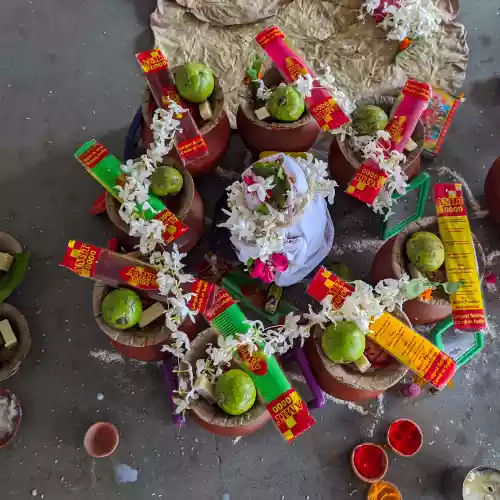
Narayan Bali Poojan in Prayagraj Allahabad
Price ₹31,000
- Complete Narayan Bali Poojan at Triveni Sangam, Prayagraj
- Experienced qualified pandit (full ceremony)
Recommended for you
Narayan Bali Poojan in Prayagraj Allahabad
Price ₹31,000
- Complete Narayan Bali Poojan at Triveni Sangam, Prayagraj
- Experienced qualified pandit (full ceremony)
Recommended for you

Online Narayan Bali Poojan in Prayagraj Allahabad
Price ₹35,000
- Online Narayan Bali Poojan at Triveni Sangam, Prayagraj (live video, 4–5 hours)
- Senior experienced pandit
Choose your package
Choose the arrangement that fits your family
Every package includes an experienced Vedic pandit and the required puja samagri. The difference is in boat, location, stay, and tradition.

Online Narayan Bali Poojan in Prayagraj Allahabad, View & book
- Online Narayan Bali Poojan at Triveni Sangam, Prayagraj (live video, 4–5 hours)
- Senior experienced pandit
- All samagri (flowers, til, kusha, sacred threads, honey, darbha, five grains, aromatic substances)
- Narayan Bali effigy (Vedic prescription)
Price ₹35,000
More rites at Prayagraj
Asthi Visarjan, Ganga Pooja and Prayaschit, Gau Daan, Magh Mela Daan, Pind Daan, Shradh, Tarpan, Tripindi Shradh and Veni Daan, with pandits at Prayagraj.
Narayan Bali Poojan in Prayagraj Allahabad, View & book
- Complete Narayan Bali Poojan at Triveni Sangam, Prayagraj
- Experienced qualified pandit (full ceremony)
- All samagri (flowers, til, kusha, darbha, sacred threads, diya, honey, five grains, cotton for effigy)
- Narayan Bali effigy (constructed & consecrated during ceremony)
Price ₹31,000
Prayagraj
More rites at Prayagraj
Asthi Visarjan, Ganga Pooja and Prayaschit, Gau Daan, Magh Mela Daan, Pind Daan, Shradh, Tarpan, Tripindi Shradh and Veni Daan, with pandits at Prayagraj.
- 2,263+families served
- 10+ yearspandit experience
Why families choose Prayag Pandits
- Families served
- 2,263+
- Serving since
- 2019
- Average rating
- 4.8/5
- GST registered
- Registered
Sangam Tirth Purohit lineage
qualified in Narayan Bali vidhi + Antyeshti recitation
Padma Purana procedure observed
effigy + second-cremation + Vishnu-Narayan invocation
Narayan Bali at Tirtharaj
Per the Padma Purana & Mahabharata Vana Parva
Stage-by-stage confirmation
WhatsApp updates after each rite stage; the pandit confirms on WhatsApp when the rite is complete
Voices from families
What families say after the rite
Rated 4.8 out of 5
500+ reviews
Our pandits







- 2,263+ families served
- Serving since 2019
- GST registered
सेवा उत्तम है। कोई छिपा हुआ खर्च नहीं। जो बताया गया वही किया गया। पंडित जी बहुत विनम्र और ज्ञानी हैं। दोबारा जरूर बुक करेंगे।
ऑनलाइन बुकिंग आसान थी। व्हाट्सएप पर जवाब तुरंत मिला। पूजा शुभ मुहूर्त में शुरू हुई और सही समय पर पूर्ण हुई। मूल्य भी उचित है। Om Shanti.
We are settled abroad and wanted to perform the puja in Prayagraj. Prayag Pandits made it possible. Grateful.
We performed Narayan Bali Poojan on the advice of our family pandit. The ceremony took the full day but Prayag Pandits managed everything perfectly. The senior pandit was very knowledgeable about this complex ritual.
The Narayan Bali Poojan was conducted exactly as described in the Garuda Purana. All the required materials were arranged by the team. The 4-5 hour ceremony was performed with full devotion.
Thoroughly impressed with the professionalism. The pandit ji was punctual and well prepared with all the samagri.
Narayan Bali is a very specific ritual and finding the right pandit was our main concern. Prayag Pandits connected us with an experienced purohit who had performed this poojan many times. Very satisfied. Jai Shri Ram.
Not sure which package fits?
Talk to a family advisor — free, no obligation. We reply on WhatsApp within 1–2 hours.
What's included
Every package lists exactly what is included no pressure for "extra dakshina" on the day
We've seen too many families face hidden boat fees, samagri costs, and "dakshina" pressure on the day. Here's exactly what's covered, and what isn't.
Included in your package
- Experienced Sangam Tirth Purohit Vedic Tirth Purohit qualified in the Narayan Bali vidhi at Triveni Sangam, with gotra-pravara verified and the specific mantras drawn from the Padma Purana and Garuda Purana Pretakalpa for akal-mrityu ancestral remediation.
- Complete Narayan Bali Samagri Darbha (kusha) grass for the prescribed human-effigy, gold pieces, ghee, milk, honey, til, jau (barley), gangajal, samidha (sacred wood), kalash, white cloth — all the materials the Padma Purana names for the Narayan Bali procedure, prepared in advance.
- Package add-ons available Optional upgrades: Nag Bali paired-rite (the Padma Purana prescribes Narayan Bali + Nag Bali as the doctrinally complete remediation), online format with live video proof for NRI families, combined Narayan Bali + Pind Daan at the Sangam packages on request.
- Family Coordinator One person on WhatsApp through your entire booking — fluent in Hindi, English, and major regional languages — before and after the multi-day rite.
- Completion Confirmation WhatsApp message from the Tirth Purohit after each stage completes — Sankalpa, effigy creation, full death-rite recitation, second-cremation, and tirtha-shradh — with a final WhatsApp confirmation when the whole rite is complete.
- Triveni Sangam coordination Narayan Bali at the Triveni Sangam — the confluence of Ganga, Yamuna, and the mystic Saraswati that the Padma, Skanda, and Matsya Puranas name Tirtharaj, the King of Tirthas. The Mahabharata Vana Parva names Sangam-rites among the most meritorious of pitru-rites, extending naturally to the Narayan Bali remediation as the Tirtharaj alternative to Trimbakeshwar.
Not included in your package
- Travel to Prayagraj Train, flight, or road travel. Prayagraj Junction + Bamrauli airport well-connected; we can recommend trusted operators. Narayan Bali typically requires a 2-3 day visit for the complete rite plus the recommended Nag Bali pair.
- Hotel / Accommodation Not bundled with the base packages; stay-inclusive bundles available on request for the typical 2-3 day Narayan Bali visit.
- Nag Bali paired-rite (standalone, Not included in base) The Padma Purana prescribes Narayan Bali + Nag Bali as the doctrinally complete pair. The base package covers Narayan Bali only; add the Nag Bali pair on request — many families perform both together at Prayagraj during a single Pitrupaksha visit.
How it works
Four steps. We carry the rest.
From your first call to same-day confirmation — we handle every coordination, so the family can focus on what matters.
Book & confirm
Choose a package and complete payment online. We confirm details on WhatsApp within 1–2 hours and explain the multi-stage Narayan Bali procedure.
Share ancestral details
Provide gotra, names of departed ancestors (with focus on those who died unnatural / untimely deaths — akal mrityu), the death tithi if known, preferred date — the annual Tithi or a Pitrupaksha day — and any special vidhi requirements.
Narayan Bali at the Sangam
Tirth Purohit performs the complete multi-stage Narayan Bali vidhi — Sankalpa, creation of the prescribed darbha-grass human-effigy, recitation of the full Antyeshti (death rites) the Padma Purana prescribes invoking Vishnu Narayan, second-cremation of the effigy, and tirtha-shradh at the Triveni Sangam to complete the remediation.
Confirmation & report
Tirth Purohit sends a same-evening WhatsApp confirmation with offerings detail across all rite stages. Online poojas include video delivery (online) within 48 to 72 hours.
- We respond within 1–2 hours · No commitment required
When to perform
When to perform Narayan Bali at the Sangam — Pitrupaksha, the death tithi, or any auspicious day
Narayan Bali is the remediation rite that the Padma Purana, the Nirnaya Sindhu, and the Smriti Kaustubha tradition prescribe for ancestors who died unnatural, untimely, or violent deaths (akal mrityu). Trimbakeshwar at Nashik is the canonical Narayan Bali tirtha per the Triambakeshwar Mahatmya tradition and centuries of continuous practice; Prayagraj is a major alternative site through the Padma, Skanda, and Matsya Puranas naming the Triveni Sangam as Tirtharaj, the King of Tirthas. The Mahabharata Vana Parva names Sangam-rites among the most meritorious of pitru-rites. Pitrupaksha (Sep 26 → Oct 10, 2026) is the peak window; the death tithi of the akal-mrityu ancestor is primary; the rite is valid year-round outside sutaka periods.
Pitrupaksha
Most ideal
Mahalaya
Sarva Pitru
Death tithi
Akal mrityu
Amavasya
Monthly
Year-round
Always valid
Two ways to perform
In-person at the Sangam, or online from anywhere
Travel to the Sangam
Performed by your own hands at the Triveni Sangam under a hereditary Sangam Tirth Purohit — boat ride to the confluence point for the Sankalpa, darbha-effigy creation, full second-cremation invoking Vishnu Narayan, and tirtha-shradh at the joined waters. The 2-3 day visit typically pairs with Nag Bali; combined-pair pricing is determined during pre-booking based on lineage count, Brahmin-bhojan scale, and samagri elections.
- Karta performs Sankalpa & key offerings personally
- Boat to the Sangam confluence point
- Optional Nag Bali paired-rite — pricing on consultation
- Combined with Pind Daan / Shradh on request
from ₹31,000
Online for NRI families
For families abroad or unable to travel. Sankalpa recited remotely; Tirth Purohit performs the multi-stage Narayan Bali at the Sangam with live video proof through the effigy-creation, second-cremation, and tirtha-shradh stages.
- Live Zoom / WhatsApp ceremony across all stages
- Names & gotra confirmed remotely before sankalpa
- Includes video delivery (online) within 48 to 72 hours
- Performed with your family's Sankalp, in your names
from ₹35,000
Complete guide
Narayan Bali in Prayagraj
everything families ask before booking
An editorial reference covering the ritual, the place, eligibility, timing, and what to keep ready — written for families weighing the decision.
About Narayan Bali
Narayan Bali in Prayagraj
Book Online and In person Narayan Bali Pooja in Prayagraj Packages
- 2,263+ Families Served Since 2019
- Pooja Samagri Included
- Experienced Pandits
- 4.8/5 Average Rating
- Online Pooja Available
Common questions about the procedure
What is Narayan Bali and who is it performed for?
Narayan Bali is the remediation rite that the Padma Purana, the Nirnaya Sindhu, and the Smriti Kaustubha tradition together prescribe for ancestors who died unnatural, untimely, or violent deaths — accident, suicide, sudden illness, drowning, fire, or death in a foreign land — where the standard cremation (Antyeshti) could not complete its prescribed stages. The rite invokes Vishnu Narayan to receive the death rites on behalf of the ancestor; a human-effigy is created from darbha grass and the prescribed materials, the full Antyeshti is recited over the effigy, and the effigy is then cremated as a “second cremation” completing the original. The rite is doctrinally distinct from Tripindi Shradh (three-pindas within the shradh rite-family) and from Pind Daan (pinda offering for moksha-release).
Why perform Narayan Bali at Prayagraj?
Trimbakeshwar at Nashik is the canonical Narayan Bali tirtha per the Triambakeshwar Mahatmya tradition and centuries of continuous practice (see our Trimbakeshwar Narayan Nagbali guide for the canonical-site detail). Prayagraj is a major alternative site through the Padma, Skanda, and Matsya Puranas naming the Triveni Sangam — confluence of Ganga, Yamuna, and the mystic Saraswati — as Tirtharaj, the King of Tirthas. The Mahabharata Vana Parva, in its Tirthayatra section, names Sangam-rites among the most meritorious of pitru-rites — extending naturally to the Narayan Bali remediation. The rite at Prayagraj is performed on a boat at the confluence point itself for the Sankalpa and effigy stages, with the closing tirtha-shradh offered into the joined waters. For families who cannot travel to Trimbakeshwar, or who are already performing other ancestral rites at Prayagraj (asthi-visarjan, pind-daan, tarpan, shradh), the Sangam-anchored Narayan Bali is the doctrinally valid Tirtharaj alternative.
Who can perform Narayan Bali in Prayagraj?
The eldest son or designated karta of the deceased holds the authority. After marriage, the son performs the rite with his wife. If the eldest son is deceased, the younger son carries out the rite. In the absence of a son, the grandson (son’s son); in the absence of male issue from the deceased, the brother; if the departed had only daughters, the daughter’s son holds the right. In modern practice, when no male issue is available, daughters and daughters-in-law perform the rite under Tirth Purohit guidance and the rite is fully valid.
When should Narayan Bali in Prayagraj be performed?
Narayan Bali is performed whenever the family is ready for the remediation. Four windows carry intensified Mahatmya merit: (1) Pitrupaksha (Sep 26 — Oct 10, 2026), with Ghata Chaturdashi (Oct 9) as the akal-mrityu primary day and Mahalaya (Oct 10) as the universal-ancestors closing day. (2) The death tithi of the akal-mrityu ancestor. (3) Monthly Amavasya. (4) The Magh Mela (January-February) — the Sangam-Tirtharaj pilgrim window for ancestral rites. The rite is valid year-round at the Sangam through the Tirtharaj Mahatmya.
What is the difference between Narayan Bali, Tripindi Shradh, and Pind Daan?
Three doctrinally distinct rites. Narayan Bali is the remediation rite (Padma Purana) — a human-effigy is created, the full Antyeshti is recited invoking Vishnu Narayan, and the effigy is cremated as a “second cremation” completing the death rites the original cremation could not complete. Tripindi Shradh is a special shradh subtype (within the shradh rite-family) — three pindas offered to specific deity-groups for akal-mrityu ancestors; no effigy, no second-cremation. Pind Daan is the moksha-release pinda offering. At Prayagraj, many families perform Narayan Bali + Tripindi at the Sangam during a single Pitrupaksha visit on different days, plus separate Pind Daan as the moksha-release component.
What is Nag Bali and should I add it to Narayan Bali?
The Nirnaya Sindhu and the Triambakeshwar tradition that the Padma Purana corroborates prescribe Narayan Bali + Nag Bali as the doctrinally complete pair. Nag Bali is the remediation rite for curses related to harming serpents (Naga) — many lineages carry a Naga-related pitri-dosha from a real or transmitted offense. The two rites are typically performed together over 2-3 days. We offer Nag Bali as an add-on to the Narayan Bali base package; the combined-pair pricing is determined during pre-booking consultation based on three factors: (1) the lineage count (how many ancestors and which side of the family), (2) the Brahmin-bhojan scale (how many Brahmins fed on the closing day), and (3) any additional samagri elections. Most Prayagraj families opt for the pair — the Sangam ghat is well-suited to the multi-day combined rite.
Can Narayan Bali be performed online for NRI families?
Yes. Online Narayan Bali is performed by a Sangam Tirth Purohit at the Triveni Sangam with live video proof through all the multi-stage rite components — the Sankalpa, the darbha-effigy creation, the full Antyeshti recitation, the second-cremation, and the closing tirtha-shradh at the confluence. The karta recites Sankalpa remotely (over Zoom or WhatsApp); names and gotra are confirmed remotely before sankalpa; the ceremony includes video delivery (online) within 48 to 72 hours. The Parashar Smriti and Yajnavalkya Smriti both describe Pratinidhi Karma (rite performed by an authorised pandit on the family’s behalf, anchored on the karta’s sincere Sankalpa) — the Sankalpa and the offering define the rite, not physical presence. Online Narayan Bali at Prayagraj is priced at ₹35,000.
Can I combine Narayan Bali with other ancestral rites at Prayagraj?
Yes — the full Prayagraj rite-set. Prayagraj is the first city on our v4 platform to offer all 5 ancestral rites: Asthi Visarjan (cremation ashes at Sangam), Pind Daan (moksha-release pinda offering), Tarpan (daily water libation), Shradh (annual ancestral sustenance), and Narayan Bali (akal-mrityu remediation). Many families perform Narayan Bali for their akal-mrityu ancestors, Pind Daan for moksha-release of all ancestors, Shradh for the annual Tithi observance, and Tarpan daily through the Pitrupaksha fortnight. See our Asthi Visarjan, Pind Daan, Tarpan, and Shradh pages for the standalone rites.
Spiritual depth & scriptural detail
Drawn from puranic references and pandit consultations — for families who want to understand the ritual’s meaning before booking.
What scriptural sources prescribe Narayan Bali?
Narayan Bali is prescribed by a layered tradition spanning Purana + dharmashastra-nibandha texts. The Padma Purana carries the foundational akal-mrityu-remediation framework. The Nirnaya Sindhu (17th-century dharmashastra-nibandha by Kamalakara Bhatta) preserves the detailed procedural text — the human-effigy specification, the prescribed mantras, the second-cremation sequence — that pandits actually use today. The Smriti Kaustubha reinforces the same procedure with regional variations. The Triambakeshwar Mahatmya tradition canonises the rite at Trimbakeshwar; later texts extend it to alternative tirthas including Prayagraj through the Padma/Skanda/Matsya Tirtharaj framework. For the doctrinal purpose: the karta creates a human-effigy from darbha grass and prescribed materials representing the akal-mrityu ancestor; the full Antyeshti is recited over the effigy, invoking Vishnu Narayan; the effigy is cremated as a second-cremation. The same tradition pairs Narayan Bali with Nag Bali (Naga curse remedy) as the doctrinally complete 2-3 day combined rite.
Why is Trimbakeshwar the canonical Narayan Bali tirtha, and how is Prayagraj the alternative?
Trimbakeshwar at Nashik is named the canonical Narayan Bali tirtha by the Triambakeshwar Mahatmya tradition and centuries of continuous practice — the site where the Godavari river’s origin and the Trimbakeshwar Jyotirlinga together provide the doctrinal anchor for the remediation rite. Trimbakeshwar holds the canonical role; the rite has been performed there continuously since the Nirnaya Sindhu codified the procedure. See our Trimbakeshwar Narayan Nagbali guide for the canonical-site detail. Prayagraj is a MAJOR ALTERNATIVE site through the Padma, Skanda, and Matsya Puranas naming the Triveni Sangam as Tirtharaj, the King of Tirthas. The Mahabharata Vana Parva, in its Tirthayatra section, names Sangam-rites among the most meritorious of pitru-rites — extending naturally to the Narayan Bali remediation. For families who cannot travel to Trimbakeshwar, the Sangam-anchored Narayan Bali is the doctrinally valid Tirtharaj alternative.
How is Narayan Bali different from Tripindi Shradh?
Two distinct rite-families commonly confused in popular discourse. Tripindi Shradh is a subtype WITHIN the shradh rite-family — performed for akal-mrityu ancestors, three pindas (rice-flour balls) are offered to three specific deity-groups at the prescribed vedis. No effigy is created; no second-cremation is performed. Narayan Bali is a SEPARATE rite-family — a human-effigy is created from darbha grass, the full Antyeshti is recited over the effigy invoking Vishnu Narayan, and the effigy is cremated. Many families perform BOTH at Prayagraj during a single Pitrupaksha visit for the same akal-mrityu ancestor — they serve different doctrinal purposes (Tripindi = shradh-merit; Narayan Bali = completing the death rite).
What does “akal mrityu” mean, and why does it require remediation?
Akal mrityu — Sanskrit “untimely death” — refers to death that occurs before the natural lifespan completes: accident, suicide, sudden illness in youth, drowning, fire, war, death in a foreign land, or any death where the standard Antyeshti (death rites prescribed in the Manusmriti and Garuda Purana) could not be completed at the proper time. The Garuda Purana Pretakalpa describes the consequence: the soul of an akal-mrityu ancestor remains in the preta state, unable to ascend to the pitri-loka, because the rites that would normally enable the ascent were incomplete. Narayan Bali, per the Padma Purana, is the remediation: the rites are performed over a human-effigy, invoking Vishnu Narayan, completing what the original cremation could not. The soul is then released from the preta state.
Why is the Triveni Sangam called Tirtharaj for ancestral rites?
The Sanskrit Tirtha-raja — “the King of Tirthas” — is the epithet the Padma, Skanda, and Matsya Puranas reserve for Prayagraj alone. The doctrinal logic: the Sangam combines three rivers — Ganga, Yamuna, and the mystic Saraswati — in a single confluence. No other tirtha holds this tri-veni structure. For ancestral rites specifically, the Mahabharata Vana Parva names Sangam-rites among the most meritorious of pitru-rites. The Tirtharaj merit extends to Narayan Bali as the Padma Purana-prescribed remediation: even though Trimbakeshwar holds the canonical-site role for this specific rite, the King of Tirthas carries the meta-merit that makes Sangam-Narayan-Bali a valid Mahatmya alternative.
Are there restrictions on when Narayan Bali should NOT be performed?
Yes — three traditional restrictions to know. (1) Sutaka periods: The Manusmriti chapter 5 prescribes a sutaka (ritual-impurity) window for the family following a recent death (typically 10-13 days for the direct family, varying by relationship-degree per Manusmriti smriti-tables). Narayan Bali should not be performed during the family’s sutaka window for any other deceased member; we schedule after the sutaka concludes. (2) Adhika Maas (intercalary month): The lunar calendar inserts an extra month roughly every 33 months; ancestral rites including Narayan Bali are traditionally avoided during Adhika Maas (Adhika Maas 2026 falls within Jyeshtha — May-June 2026). (3) Specific tithis: Some pandit lineages avoid certain tithis (Chaturthi, Navami) for Narayan Bali specifically; we coordinate the auspicious date during pre-booking based on the family’s ancestral configuration and the akal-mrityu ancestor’s death tithi. If you’re unsure whether your situation qualifies for the rite or whether timing restrictions apply, share the family details on WhatsApp and our team will confirm.
What are the Pitrupaksha 2026 dates and how should families plan Narayan Bali at Prayagraj?
Pitrupaksha 2026 runs from September 26 (Saturday — Purnima Shradh) through October 10 (Saturday — Sarva Pitru Amavasya / Mahalaya). For Narayan Bali specifically: (1) Mahalaya Amavasya (Oct 10) is the universal-ancestors day — best for akal-mrityu ancestors whose death tithi is unknown. (2) Ghata Chaturdashi (Oct 9) is dedicated to those who died violently or by accident — directly relevant for akal-mrityu. (3) The annual death-anniversary Tithi of the specific ancestor is also valid. (4) Outside Pitrupaksha, the Magh Mela window (January-February) carries Sangam-Tirtharaj amplification. We recommend booking 3-4 weeks in advance during Pitrupaksha as the Narayan Bali multi-stage rite requires extended Tirth Purohit time + Sangam ghat coordination across 2-3 days when paired with Nag Bali.
Frequently asked
FAQs
Questions families ask us on WhatsApp and over the phone.
Narayan Bali Puja is a Hindu Vedic ritual performed for the souls of individuals who have died an unnatural or untimely death (Akal Mrityu). This includes deaths by accident, suicide, drowning, snakebite, murder, certain severe diseases, or those whose funeral rites (Shraddha) were not performed correctly. The purpose is to help these souls, who might be stuck in a state of unrest (Pret Yoni) due to unfulfilled desires or trauma, find peace (Shanti) and liberation (Moksha), allowing them to join the realm of ancestors (Pitra Lok).
Families experiencing persistent problems believed to be caused by Pitru Dosha stemming from an ancestor’s unnatural death should perform this puja. Typically, the eldest son or a male descendant performs the main rites. However, any family member (male or female, though some traditions state women cannot perform it independently) whose ancestor suffered such a death can initiate or participate. It’s undertaken for those facing issues like delays in marriage/childbirth, financial instability, chronic illness, or recurring negative events.
Costs vary based on duration, number of priests, inclusion of Daan (like Gau Daan), and the service provider. Search results provide ranges:
- ₹15,000 (approx. 4 hours, 2-3 pandits).
- ₹31,000 – ₹41,000 (3-day elaborate pooja with multiple Brahmins, Gau Daan).
- ₹35,000 – ₹46,000 (Online 3-day package).
Always confirm what’s included in the quoted price (pandit fees, samagri, daan, bhojan).
Yes, several platforms now offer online Narayan Bali Puja services. The rituals are performed by pandits physically present at Triveni Sangam, Prayagraj, on your behalf. This usually involves video conferencing or recordings of the puja, allowing you to participate remotely.
All three locations are highly sacred and recommended for Narayan Bali, each with unique significance:
- Prayagraj: Supreme potency due to Triveni Sangam (Tirthraj), ideal for overall purification and liberation.
- Gaya: Known as Moksha Sthal, especially powerful for Pind Daan and ancestral liberation (Vishnupad).
- Trimbakeshwar: Specifically mentioned in scriptures (like Dharma Sindhu) for Narayan Nagbali (combined ritual) and very potent due to the Jyotirlinga and Godavari origin.
The choice can depend on family tradition, specific astrological indications, accessibility, or the specific aspect needing emphasis (general liberation vs. snake-related issues). However, performing it at Prayagraj leverages the unparalleled power of the Sangam.
Still have a question?
Ask our team on WhatsApp and we will help you plan the ceremony.
We reply on WhatsApp within 1–2 hours.
Ask a pandit (opens WhatsApp)Free consultation
Talk to a family advisor today
We’ll listen, understand your family’s situation, and recommend the right package — never push. We reply on WhatsApp within 1–2 hours.
- Clear package details before you book
- The ceremony in the language you choose
- 2,263+ families served
- Serving since 2019
- GST registered