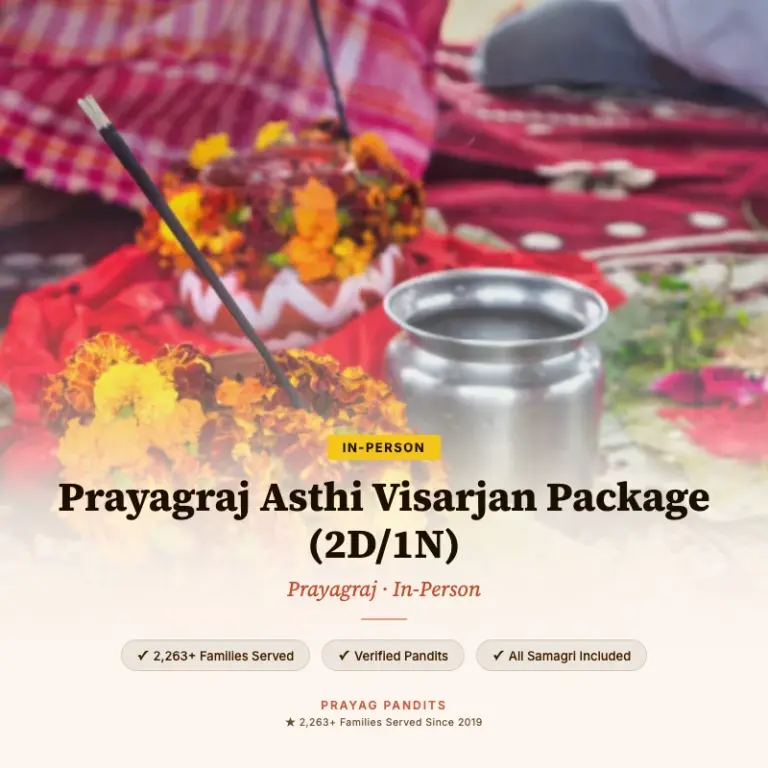
Asthi Visarjan in Prayagraj with Private Boat
Asthi Visarjan at Triveni Sangam, Prayagraj, for one deceased person Experienced Vedic...
Home to Triveni Sangam & King of all Teerths
Choose from our range of ancestral and spiritual services
Pind Daan is a Hindu ritual where devotees offer rice balls (pind) and prayers to honor deceased ancestors, seeking their spiritual…
Asthi Visarjan is the Hindu ritual of immersing cremated ashes in sacred waters to liberate the soul (atman) from rebirth and…
Tarpan in Prayagraj is performed for bringing happiness and relive the performer and his family from any problems or pains…
Veni Daan poojan in prayagraj, a special poojan being done for married couples at Triveni Sangam. The rituals are conducted…
If a family is suffering from untimely or uncertain deaths of their loved ones, or if ancestral rituals like Pind…
For the departed father, grandpa, and great-grandfather, as well as the mother, grandmother, and great-grandmother, the rite is done. Its…
Trusted by thousands of families across India
Asthi Visarjan at Triveni Sangam, Prayagraj, for one deceased person Experienced Vedic...
Odia Vidhi Ceremony by qualified pandit Private boat to Triveni Sangam point...
1 night Deluxe hotel stay (no meals) Airport / station pickup &...
Complete Pind Daan at Triveni Sangam Shastri-qualified pandit Private boat ride to...
Online Pind Daan at Triveni Sangam, Prayagraj (live video) Online Pind Daan...
Senior Brahmin Purohit (Veda-specific mantras & gotra-pravara knowledge) Sankalp with full Gotra-Pravara...
1 night in 3-star hotel with breakfast (1-2pax) Private AC cab for...
Odia Vidhi Ceremony Complete Asthi Visarjan at Triveni Sangam point Private boat...
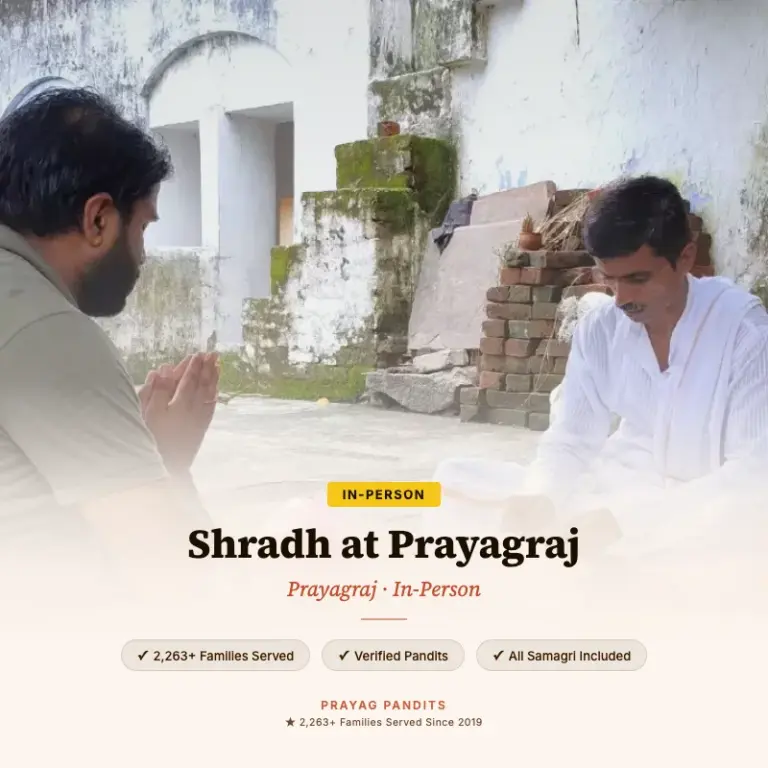
Shradh ceremony at Triveni Sangam, Prayagraj Experienced Prayagraj-based pandit All samagri (sesame,...
Online Asthi Visarjan at Triveni Sangam, Prayagraj Qualified experienced Prayagraj pandit Complete...
Prayagraj, formerly known as Allahabad, is deeply rooted in India’s historical legacy. It has witnessed monumental events, from being a significant administrative center during ancient empires to playing pivotal roles during India’s freedom movement. Emperor Akbar built the majestic Allahabad Fort in the 16th century, symbolizing the city’s strategic importance. Renowned for its cultural and literary heritage, Prayagraj was home to many notable figures, poets, and freedom fighters. Its legacy continues through landmarks such as Anand Bhavan, associated with the Nehru family, highlighting its indispensable role in shaping India’s socio-political landscape.
In Sanatan ancient texts, Prayagraj is revered as one of the holiest places on earth, especially significant for attaining Moksha—liberation from the cycle of rebirth. It is believed that Lord Brahma conducted the first sacred ritual (yajna) here, and that the confluence (Sangam) of the rivers Ganga, Yamuna, and the mythical Saraswati provides a sacred pathway to liberation. Pilgrims flock from across India and beyond to bathe in these holy waters, especially during Kumbh Mela, with faith that it purifies their souls and grants ultimate spiritual freedom.
Prayagraj is a revered city in Hinduism, with several spiritually significant temples. The Triveni Sangam, where the holy rivers converge, is central to its sanctity. The Bade Hanuman Ji Temple, famous for its reclining Hanuman idol, attracts thousands of devotees. Alopi Devi Mandir, one of the Shakti Peeths, holds great importance for devotees seeking blessings of the goddess. Other significant temples include Kalyani Devi Temple, revered for fulfilling wishes, and Mankameshwar Temple, known for its ancient Shiva lingam. These sacred places collectively enhance the spiritual magnetism of Prayagraj.
Performing Pind Daan and Shradh rituals in Prayagraj holds profound spiritual significance, believed to provide lasting peace to the departed souls. The sacred confluence amplifies the rituals’ potency, ensuring ancestors’ smooth passage to higher realms and freedom from worldly attachments. It is considered especially auspicious to perform these rites here, with scriptures emphasizing that ancestors receive blessings and relief more swiftly. Families performing these rituals in Prayagraj often experience spiritual fulfillment, peace, and familial harmony, deeply connecting them with their heritage and lineage.
Triveni Sangam is the confluence itself, reached by boat from Sangam Ghat in about fifteen to twenty minutes. Asthi Visarjan, Pind Daan, Tarpan and the holy snan are all performed out at the meeting point of the rivers.
Sangam Ghat is the bank where the rivers meet. The Sankalp is taken here before the boat leaves, and the closing prayers are said here when the family returns. You can bathe from the ghat without taking a boat at all. Pandit services, ritual-material shops and changing rooms are on the ghat, and most families come between five and eight in the morning.
Akshayavat, the immortal banyan, stands inside Allahabad Fort. A pind offered here is held to grant eternal liberation. The fort is army-controlled and access is limited, so tell us in advance if your family wants to include it.
Patalpuri Temple, the underground temple in the same fort complex, and Nag Vasuki Temple are usually visited alongside it. The Bade Hanuman Mandir near the Sangam, with its reclining idol, is where most families take darshan once the rites are complete.
By air. Prayagraj Airport (IXD) at Bamrauli is twelve kilometres from the city centre, with direct flights from Delhi, Mumbai, Bangalore and Hyderabad. More flights are added during the Magh Mela and Kumbh Mela seasons.
By train. Prayagraj Junction (PRYJ) is the main railway hub, with Prayagraj Chheoki Junction and Prayagraj Sangam Station also serving the city. Trains run from Delhi, Mumbai, Kolkata, Chennai, Varanasi and Gaya.
By road. Delhi is 650 km, around nine to ten hours by the Lucknow Expressway. Varanasi is 120 km and roughly two and a half hours, Lucknow 200 km and about four hours, Gaya 350 km and six to seven hours. NH 19 and NH 30 both serve the city.
When to come. The Sangam is reachable all year and the boats run daily. Magh Mela in January and February carries the greatest merit, and the heaviest crowds. Pitru Paksha in September and October is the ancestor-rites period, busy but pleasant. October to March is comfortable pilgrimage weather. April to June is hot and quiet, and morning rituals are advised. The next Kumbh Mela falls in 2037.
Magh Mela is the annual fair at the Triveni Sangam. In 2027 it runs from 15 January to 6 March, and for every rite performed here it is the most auspicious window in the year.
The six bathing days in 2027 are Makar Sankranti on 15 January, when the Mela opens; Paush Purnima on 22 January, when Kalpavas begins; Mauni Amavasya on 6 February, the largest gathering of the Mela; Basant Panchami on 11 February; Maghi Purnima on 20 February, the principal day for Kalpavasis; and Maha Shivratri on 6 March, the final snan. Our Magh Mela dates guide explains each one and why Makar Sankranti falls on the 15th rather than the 14th.
We arrange camp accommodation through the mela. The peak bathing dates fill early, so book three to four weeks ahead.
Budget. Hotel Prayag, City Hotel and the dharamshalas near the Sangam, roughly ₹800 to ₹1,500 a night. Facilities are basic and service varies. Prices are indicative.
Mid-range. Hotel Milan Palace and Hotel Yatrik, roughly ₹1,500 to ₹4,000 a night, with tented camps added during the mela seasons.
Premium. Hotel Kanha Shyam Grand, The Grand Continental and The Radisson, from about ₹4,000 a night, with luxury tents during Magh Mela. Closer to the water there is Cosy Homestay in Prayagraj, Yatri Nivas at Prayagraj Sangam, Shree Madhav Hotel and Triveni Darshan Hotel.
Our packages can include accommodation, and we work with partner hotels, so booking through us is usually the surer route to a room in a busy season.
What to bring. Light-coloured clothes for the rituals, white or cream by preference. Warm clothes if you are coming between December and February. Footwear you can walk the ghat in. Your ancestors' names, dates of passing and gotra. Cash, because many boatmen and shops take only cash or UPI. A government photo ID.
What we provide. All poojan samagri, the pandit, the boat out to the confluence, tour assistance, cabs and buses from our own fleet, and help arranging vegetarian or South Indian food. Flowers and marigold garlands are optional and easy to buy locally.

Ancient texts mention Prayagraj as an ideal destination for ancestral rites and spiritual liberation
Our pandits have conducted thousands of ceremonies with complete Vedic adherence and care
Our team explains the selected ritual, package inclusions, and next steps before booking
From travel guidance to accommodation and local transport — we handle every detail
The pandits were very knowledgeable and guided us through every step of the ritual. We felt at peace knowing our ancestors' souls were blessed. The entire experience was deeply spiritual and well-organized.
We traveled from Odisha specifically for the ceremony. Everything was arranged perfectly — temple coordination, accommodation guidance, and the pandit was patient and thorough with all the rituals.
The Triveni Sangam is the sacred confluence of three rivers at Prayagraj: the visible Ganga (descending from the Himalayas), the visible Yamuna (from the Yamunotri glacier), and the invisible Saraswati (the mystical underground river from Vedic tradition). "Triveni" means "three braids" in Sanskrit — the three rivers symbolically intertwining. The confluence lies approximately 1 km from the shore, where the distinct colours of the Ganga (clear, greyish-blue) and Yamuna (darker, greenish) visibly merge — a breathtaking sight. The Saraswati is believed to emerge at this exact point from below the earth, completing the trinity. In Hindu cosmology, the Triveni Sangam is the most spiritually charged point in India — the confluence of rivers symbolising the confluence of divine energies.
The Saraswati was historically a major river flowing through North India, celebrated throughout the Rig Veda as the mightiest of rivers. By the late Vedic period (circa 2000 BCE), tectonic shifts and climate changes caused the Saraswati to reduce in flow and eventually vanish underground in what is now Rajasthan. Hindu tradition holds that the Saraswati did not die but became a hidden subterranean river that emerges only at the Triveni Sangam to join the Ganga and Yamuna in their sacred confluence. Modern satellite studies (ISRO) have confirmed paleochannels along the Saraswati's historical course, validating the scriptural tradition. For devotees, the invisibility of the Saraswati is not absence but presence in a subtler, spiritually potent form — the river of wisdom flowing beneath the physical confluence.
The Triveni Sangam is the site for the complete range of Hindu ancestral and purification rituals: (1) Ganga Snan / Triveni Snan — sacred bath at the confluence, (2) Pind Daan — rice ball offerings to ancestors, (3) Tarpan — water offerings with sesame seeds, (4) Shraddha — annual ancestral ceremonies, (5) Asthi Visarjan — immersion of cremation ashes, (6) Kalasha Puja and Argha — offerings to the river goddesses, (7) Mundan ceremonies (first head-shaving for children), (8) Thread ceremony (Upanayana) for Brahmin boys, and (9) Sankalpa-based life vows. During Kumbh Mela and Ardh Kumbh, Shahi Snan by the akhadas is the most famous ritual. Our pandits offer complete packages for any of these observances at Triveni Sangam.
Boat rides at Triveni Sangam range from budget shared boats to private arrangements: (1) Shared public boats — ₹50-150 per person, 15-20 minute wait for the boat to fill up, basic wooden boat, 15-20 minute ride to the confluence and back, (2) Standard private boats — ₹800-1,500 per boat (seats 6-10 people), immediate departure, 30-45 minutes total, better condition boats, (3) Premium private boats — ₹2,000-3,500 per boat, larger boats, cushioned seating, ritual platform, 1+ hour trip with multiple stops. During Kumbh Mela and peak festival days (Mauni Amavasya, Makar Sankranti), prices can surge 3-5x due to demand. Our Asthi Visarjan and Pind Daan packages include private boat arrangement as part of the ceremony package — no separate boat cost for clients.
Prayagraj Junction (station code PRYJ, formerly Allahabad Junction) is the main railway station and is well-connected to all major cities (Delhi, Mumbai, Kolkata, Lucknow, Varanasi). Prayagraj Airport (IXD) has domestic flights from Delhi, Mumbai, and Bangalore. From the station, the Sangam is 8-10 km away. Local transport options: (1) Auto-rickshaw (₹150-250 to Sangam shore), (2) Private taxi (₹400-600), (3) Ola/Uber (₹200-400). Upon reaching the shore (typically Arail Ghat or Sangam Bhata), you board a shared boat (₹50-150/person) or private boat (₹800-2,500 per boat) for the 15-20 minute ride to the confluence. During Kumbh Mela, special shuttle buses and additional ghats operate. Our packages include pick-up from station or airport with dedicated pandit escort.
Our experienced pandits guide you through every step of your spiritual journey — from booking to ceremony completion.