



Veda-Trained Pandits
Experienced pandits guide the ceremony with care for your family’s tradition.
Pooja booking
Original price was: ₹16,000.00.₹12,500.00Current price is: ₹12,500.00.
Per pooja
Applicable taxes are shown in your booking. Optional additions are separate.
Exclusions
Thoughtfully arranged, personally guided
Experienced pandits guide the ceremony with care for your family’s tradition.
Stay in touch with our team for your booking details and ceremony arrangements.
See what your selected package includes. Optional additions are shown separately.
Share the date and timing that suit you. Our team confirms the final arrangements.
Experiences shared by our families
29 family reviews21 for this pooja · 8 from across our services
हमने अपने पिता जी के श्राद्ध के लिए यह सेवा बुक की थी। पंडित जी बहुत अनुभवी थे और सभी विधि-विधान शास्त्रोक्त तरीके से करवाए। सामग्री की व्यवस्था भी उन्होंने ही की। बहुत अच्छा अनुभव रहा। Dhanyavaad.
Watching the pandit perform the rituals in real-time by the Falgu River, mentioning my father's name... it felt like we were truly there. Immense gratitude to the entire team.
Being in the USA, travelling to India just for Tarpan during Pitru Paksha was becoming very difficult. Prayag Pandits offered a well-coordinated solution.
I was skeptical about performing such a sacred ritual online from Canada. But honouring my parents in Kashi was important. They were very patient and answered all my questions.
Living in Singapore, we felt disconnected from these essential rituals. The live stream option for Tarpan at Prayagraj gave us a profound sense of connection and peace.
It was deeply important for us in Australia that the rituals were performed correctly. The ceremony reflected the authenticity we sought and was performed by a knowledgeable priest.
The Pind Daan at Kashi was handled carefully, with the pandit following every step diligently. Very reassuring.
Arranging Asthi Visarjan from Bhubaneswar seemed complex, but Prayag Pandits made it seamless. The pandit called us before the ceremony to explain every step. Very professional.
During Pitru Paksha, we booked Shradh at Prayagraj. The coordination was flawless - from date selection to the pandit assignment. Our family felt at peace after the ceremony.
YOUR EXPERIENCE MATTERS
Tell us about your ceremony and the support you received. Your email address will stay private.
From your first choice to your booking
Review your package and any available additions, then add it to your booking.
Enter your contact details, preferred date and time. Add ancestral details if you wish.
Our team confirms the arrangements and shares your coordinator’s details 24 hours before the pooja.
Follow the participation and joining arrangements described in your package and shared by your coordinator.
There are places in this world where the boundary between the living and the departed grows thin — where the water you touch has been carrying prayers for thousands of years, and where the act of offering something with your hands feels like it truly reaches someone on the other side. The Triveni Sangam at Prayagraj is one of those places. This package brings two family members together to perform Pind Daan at the confluence of the Ganga, the Yamuna, and the invisible Saraswati, carried by boat to the midpoint of the Sangam where the three rivers meet, and guided through the complete ancestral rite by a pandit who has been doing this work with devotion for years.
When two people in a family take the sankalpa together — when the grief is shared, and the love being expressed is shared — something changes in the quality of the ritual. The ancestors receive not just an offering but the evidence that their memory is held by more than one heart. This package is designed for exactly that joint act of remembrance, and everything needed for it — the boat ride to the midpoint of the Sangam, the priest, and all the puja materials — is arranged for both of you.
The Padma Purana devotes extensive verses to the glory of Prayagraj as a tirtha for the liberation of ancestors. It says that a single sesame seed offered with water at the Sangam brings merit that cannot be matched by a hundred yagnas. The Skanda Purana goes further: it declares that Prayag is Tirtharaja — the king of all tirthas — and that its special power lies in its capacity to grant liberation not just to the person performing the rite, but to their ancestors across generations.
What makes the Sangam uniquely powerful for Pind Daan is the convergence of three sacred rivers. The Ganga and the Yamuna are visible; the Saraswati, though invisible to the eye, is described in the Rigveda as flowing beneath the surface and joining the other two at this exact point. Ancient rishis chose this spot — and only this spot — for the most sacred acts of ancestral worship because the combined power of three rivers was believed to carry offerings directly to Pitru Loka.
Lord Brahma himself is said to have performed the first Pind Daan at Prayagraj, and the site has drawn pilgrims seeking ancestral liberation for as long as the tradition of Shradh has existed in Bharatiya culture. The Mahabharata records that the Pandavas performed Pind Daan here during their pilgrimage, and that the merit they earned at the Sangam sustained their lineage even through the trials of the Kurukshetra war.
To understand the full spiritual history of this sacred confluence and what it means for those who come seeking ancestral liberation, read our detailed page: Triveni Sangam — The Land of Moksha.
Most rituals performed at rivers are done from the bank. At the Triveni Sangam, however, the most auspicious location for offering pind is the point in the water where the two visible rivers actually merge — a point that can only be reached by boat. This matters, because the Puranic texts specifically describe this junction as the seat of Pitru Loka’s gateway on earth.
When you are seated on the boat, surrounded by water on all sides, with the river flowing beneath you and the sky open above, the experience of offering pind is qualitatively different from any shore-side ceremony. The continuity of the river — carrying your offering away, dissolving it into the sacred current — becomes viscerally real. Families who have performed this ceremony consistently describe it as deeply moving in a way they did not anticipate.
Our pandit accompanies you on the boat throughout the ceremony, reciting the mantras and guiding both participants through each step, so neither of you feels lost or uncertain in that open water setting.
Your pandit will meet you at the designated ghat (the exact meeting point is confirmed after booking). He will take a few minutes to understand your family’s situation — which ancestors you are honoring, their names and gotra if known, and whether there are specific intentions you wish to include. This unhurried preparation is important; the sankalpa needs to be accurate.
Both participants take a ritual bath in the Sangam before the ceremony begins. The bath is a purification — it creates the ritual clarity needed to enter the space of ancestral communication. The Ganga water at Prayagraj is considered among the most sacred in the country, and even this initial contact with the water carries meaning.
The boat takes you out to the point where the rivers meet. The journey itself — watching the currents of the Ganga and Yamuna begin to blend beneath you — is a moment many pilgrims find unexpectedly peaceful. Your pandit will use this time to begin the preliminary mantras.
Seated in the boat at the Sangam, both participants recite the sankalpa under the pandit’s guidance. You state your name, gotra, the names of your ancestors, and your intention. This formal declaration is what connects the universal ritual to your personal lineage — without it, the pind is an offering without an address.
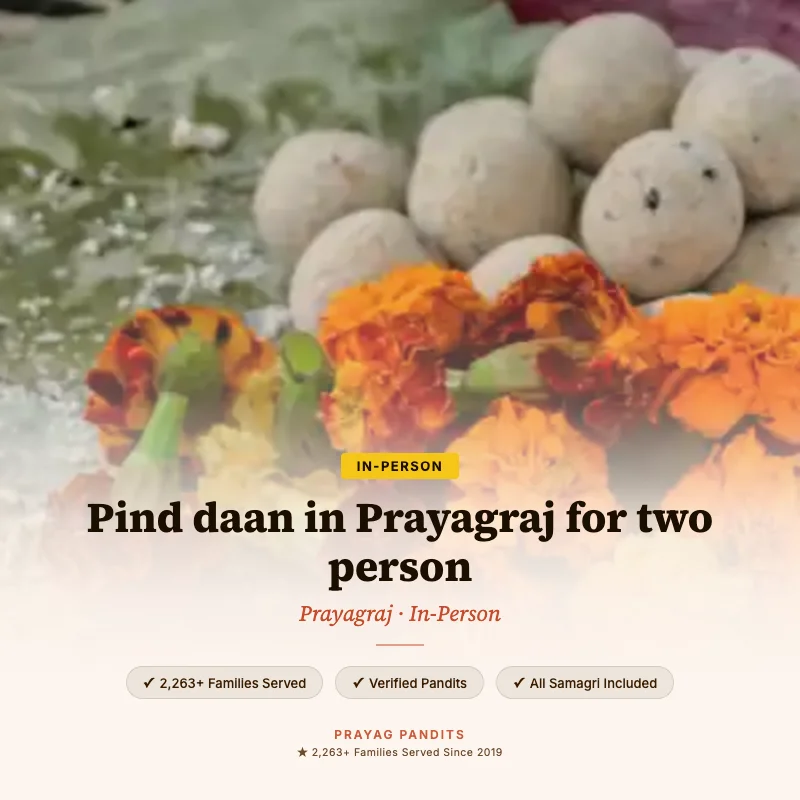
The pind — formed from rice or barley flour mixed with sesame seeds, ghee, and honey — is shaped by hand. Both participants prepare their pind under guidance. The pind is then offered into the Sangam water with the appropriate mantras, each ancestor addressed individually.
Using cupped hands, both participants offer tarpan — water with sesame seeds — while the pandit recites the tarpan mantras. Three offerings are made for each ancestor, addressed in the Vedic formula. This is the core of the ancestral feeding rite, and its sincerity is what carries the offering across.
The ceremony concludes with prayers at the Sangam and, if you wish, darshan at the Akshayavat (the undying banyan tree within the Patalpuri Temple complex, which is considered a seat of ancestral liberation). The boat returns you to the ghat, and the pandit completes the final blessings.
For a complete guide to the city of Prayagraj and everything a pilgrim needs to know before visiting, see: All You Need to Know About Prayagraj.
If you are bringing a larger group and need Pind Daan for more than two participants, please see our single-person Pind Daan in Prayagraj options, or contact us directly to discuss a group arrangement.
Our pandits are from families whose connection to the Prayagraj ghats goes back generations. This is not a service we have added to a travel package — this is our vocation. When you come to us for Pind Daan, you are not booking a vendor; you are asking for the services of a pandit who takes the sanctity of this moment as seriously as you do.
We handle every part of the logistics — the boat, the timing, the puja samagri — so that when you arrive at the ghat, you have nothing to think about except the ceremony itself and the ancestors you have come to honor. In our experience, this matters enormously. Families who are grieving, or who have traveled a long distance to be here, do not need to be worrying about whether the boatman has been paid or whether the sesame seeds are the right kind.
Our pricing is transparent and fixed. What you see at checkout is what you pay — we do not add unexpected charges at the ceremony.
Both Gaya and Prayagraj are among the most sacred tirthas for Pind Daan in Sanatana Dharma, and both are explicitly named in Puranic texts as places where ancestral rites yield extraordinary merit. The Padma Purana declares Prayag as Tirtharaja, the king of all tirthas, and its power for ancestral liberation is unquestioned. Many families perform Pind Daan at both tirthas — at Gaya for the primary rite and at Prayagraj to add to the merit. However, performing the rite at either place alone is fully complete and valid.
Yes. There is no scriptural prohibition on women performing Pind Daan, and at Prayagraj the tradition has always included women as participants in ancestral rites. The example of Sita performing Pind Daan at Gaya, recorded in the Valmiki Ramayana, is the clearest evidence that gender has never been a barrier in this tradition. Both participants in this two-person package — regardless of gender — will be guided through the full ceremony.
For the sankalpa, it is helpful to know the names of the ancestors you are honoring, their gotra (lineage), and approximately when they passed. If you do not know the gotra, the pandit can guide you through a standard formula. Do not let uncertainty about these details prevent you from coming — the pandit will work with whatever information you have.
The complete ceremony, including the private boat journey, takes around 2 hours. This includes the initial bath, the boat ride to the confluence point, the full ritual, and the return. We ask families to plan for a half-day, so there is no sense of hurry at any point.
We use experienced local boatmen who know the Sangam currents well, and the ceremony is conducted seated in the boat with the pandit present throughout. Life jackets are available and can be worn. The ceremony is conducted during daylight hours, and we do not operate during flood conditions or when river authorities restrict boat movement. Your safety is our priority, and we will reschedule without any charge if conditions are unsafe on your chosen date.