
अभी तक कोई अनुष्ठान नहीं चुना गया।
पूजा पैकेज देखें →मुख्य बिंदु
इस लेख में
Tritiya Shradh falls on the third day of Pitrupaksha — Tuesday, September 29, 2026 — and this year it carries a remarkable double significance. In 2026, the Bharani Nakshatra prevails during the daytime hours of September 29, making this also the day of Maha Bharani Shradh, one of the most spiritually potent observances of the entire Pitrupaksha. While the tithi-based Tritiya Shradh honours ancestors who departed on the third lunar day, the Bharani Nakshatra connection elevates all ancestral rites performed on this day to the level of Gaya Shradh — the most powerful form of ancestral worship in the Hindu tradition. Even those who do not have ancestors associated with Tritiya Tithi are strongly encouraged to perform Tarpan and Pind Daan on September 29, 2026, to take advantage of this exceptional convergence.
What Is Tritiya Shradh?
Tritiya (तृतीया) is the third lunar day of any paksha. Tritiya Shradh during Pitrupaksha is the prescribed ancestral rite for those whose family members departed on a Tritiya Tithi — whether Shukla or Krishna Tritiya of any month in any year. In folk parlance, it is known as Teej Shradh, drawing on the same Sanskrit root that gives us the widely celebrated Teej festival.
In the structure of Pitrupaksha, Tritiya holds a particular significance for the female line of the family. The Dharmasindhu notes that Tritiya Shradh is the appropriate occasion for performing rites for:
- Ancestors who departed on Tritiya Tithi of any paksha
- Deceased women in the family — daughters-in-law, daughters, sisters, and aunts — especially those who passed as young women
- Female ancestors whose Shradh has been overlooked because the family only performed rites for male ancestors
This recognition of female ancestors in Tritiya Shradh reflects a deep and often underappreciated aspect of ancestral rites: the women of a lineage — mothers, grandmothers, sisters — are as much a part of the ancestral soul-field as the male line. Neglecting their Shradh is believed to create specific forms of Pitru Dosha — ancestral afflictions — that manifest as difficulties in the health and marriages of female descendants.
The name “Teej” also evokes the goddess Parvati, whose Teej festival celebrates the bond between husband and wife. On Tritiya Shradh, it is customary to offer prayers for the spiritual peace of women in the family who passed away while still in the role of wife, mother, or daughter — those who left behind unfulfilled responsibilities.
Tritiya Shradh 2026: Date and Muhurat
In 2026, Ashwina Krishna Tritiya falls on Tuesday, September 29, 2026. This is Day 3 of Pitrupaksha, and — significantly — the same day as Maha Bharani Shradh, when the Bharani Nakshatra is active.
Auspicious Muhurats for Tritiya Shradh 2026 (approx. for North India):
- Kutup Muhurat: 11:44 AM – 12:31 PM (highest merit)
- Rohina Muhurat: 12:31 PM – 1:17 PM (very auspicious)
- Aparahna Kala with Bharani Nakshatra: 1:17 PM onwards — this is when Maha Bharani Shradh rites are specifically prescribed to be performed
The convergence of Tritiya Tithi and Bharani Nakshatra on the same day in 2026 is astronomically and spiritually significant. Both conditions — the tithi and the nakshatra — need to prevail during the Aparahna Kala (afternoon period) for maximum efficacy, and on September 29, 2026, this alignment is confirmed for the North Indian zone including Prayagraj.
Families who wish to perform both Tritiya Shradh (for their Tritiya-tithi ancestors) and Maha Bharani Shradh (taking advantage of the nakshatra’s special power) can do so in a single extended ceremony on this day, with the pandit incorporating both sets of mantras and intentions. Precise date confirmation for 2026 is available on the DrikPanchang Pitrupaksha calendar.
Who Should Perform Shradh on Tritiya?
Tritiya Shradh is specifically recommended for:
- Those whose ancestors departed on Tritiya Tithi (Shukla or Krishna Tritiya of any month)
- Those performing Shradh for deceased women in the family — mothers, grandmothers, sisters, aunts, daughters-in-law, daughters who have passed away
- Those who missed performing Shradh in previous years — the special power of the Bharani Nakshatra on this day in 2026 makes it an ideal occasion for a comprehensive Kumari Shradh covering omitted years
- Those seeking to resolve Pitru Dosha related to female ancestors — specific conditions like repeated miscarriages, difficult marriages in the family, or unexplained health issues in female descendants are sometimes traced to neglected female-line Shradh
- All devotees on September 29, 2026 — because of the Maha Bharani Nakshatra, any family can perform an enhanced Tarpan on this day regardless of their specific tithi connection, and receive the merit equivalent to Gaya Shradh
Rituals and Procedures for Tritiya Shradh
1. Dawn Preparations and Sacred Bath
The performer rises before sunrise and bathes at the sacred river or with Ganga Jal at home. Tuesday is the day of Mangal (Mars), and the energy of this day, combined with the Bharani Nakshatra (ruled by Yama), creates a uniquely powerful field for ancestral rites. The colour red is associated with Mangal, and wearing a red thread (mouli) on the wrist during the rite is considered auspicious on Tritiya.
2. Extended Sankalpa for Female Ancestors
The sankalpa on Tritiya Shradh includes a specific declaration honouring the women of the lineage. The pandit recites the gotra and names of the female ancestors being remembered — their status (mother, sister, daughter-in-law, etc.) is stated clearly so that the rite’s spiritual energy reaches the correct souls in Pitru Loka.
3. Tarpan with Special Water Offerings
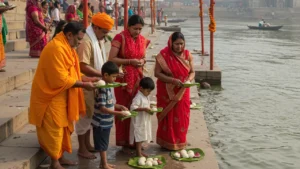
For female ancestors on Tritiya Shradh, the Tarpan is offered with water mixed with white sesame seeds (shwet til) — in contrast to the black sesame used in general Tarpan. The white sesame is considered purifying and is particularly associated with female ancestral souls. The offering is made with cupped hands, with specific mantras for the feminine aspect of the ancestor.
4. Pind Daan with Turmeric and Sindoor
A unique feature of Tritiya Shradh’s Pind Daan for female ancestors is the inclusion of a small pinch of haldi (turmeric) and sindoor (vermillion) in the pinda prepared for female ancestors who were married at the time of their passing. This is a symbolic act of honouring their status as Suhagan (a woman whose husband is living). The Pind Daan procedure at the Triveni Sangam is especially moving on this day.
Special Offering for Female Ancestors on Tritiya
For deceased women in the family — mothers, grandmothers, sisters — add a small piece of red cloth, a glass bangle, and sindoor (vermillion) alongside the pinda offering. These items symbolise the feminine identity of the departed soul and are a beautiful, personalised gesture that the tradition fully endorses. Your pandit will incorporate this into the rite.
5. Brahmin Bhoj Honouring Female Ancestors
When honouring female ancestors, the Brahmin bhoj on Tritiya Shradh ideally includes a female Brahmin (Brahmin kanya or Brahmin woman) alongside the male Brahmin. This is a specific provision in texts like the Hemadri and Smriti Ratnavali that ensures the female ancestral soul receives offerings through an appropriate human vessel.
6. The Bharani Nakshatra Enhanced Ceremony
For those also performing Maha Bharani Shradh on this day, the ceremony extends into the Aparahna Kala when the Bharani Nakshatra is fully active. The pandit performs additional Tarpan and Pind Daan sequences with Yama-specific mantras, invoking the Lord of Death’s grace for the liberation of the ancestor’s soul from all karmic bondages.
Significance in Hindu Scriptures
The Stri Dharma Paddhati (a text on the dharmic duties related to women) and sections of the Smriti Chandrika both address the Shradh of female ancestors. The Stri Dharma Paddhati states: “Streenam tu Tritiyayam shradham kritva sakala-pitrinam prasannatvam jayate” — “By performing Shradh for women on Tritiya, the satisfaction of all ancestors is obtained.”
The Garuda Purana describes the souls of women who died as young wives or mothers as being among the most emotionally attached to the earthly realm — their love for their children and families lingers, and they benefit greatly from personalised remembrance. The text warns that a family that remembers only the grandfathers and fathers while forgetting the grandmothers and mothers will find that the female side of the ancestral blessings remains locked.
The special power of Bharani Nakshatra — Yama’s own star — on this same day makes September 29, 2026 one of the most exceptional days in the entire Pitrupaksha calendar for the year. The Dharmasindhu famously declares that a Shradh performed during Bharani Nakshatra surpasses even the merit of performing Pind Daan at Gaya.
Do’s and Don’ts for Tritiya Shradh
Follow These Practices
- Bring photographs or memories of the female ancestors being honoured — describing their personalities and qualities aloud during the sankalpa creates a strong soul-connection
- Offer garlands of white flowers (jasmine, champa) — these are particularly associated with female ancestral souls
- Light a ghee lamp using a cotton wick — the pure ghee flame is believed to illuminate the path of female ancestral souls
- Chant the Pitru Gayatri mantra: “Om pitru devaya vidmahe jagat dharaya dhimahi, tanno pitru prachodayat”
- If possible, visit the Triveni Sangam for the rite — the sacred feminine energy of the Yamuna (a goddess herself) makes Prayagraj especially resonant for female-line Shradh
Avoid These on Tritiya Shradh
- Do not exclude female relatives’ names from the sankalpa — even if you are unsure of their exact death tithi, naming them in the rite is beneficial
- Avoid serving pungent or heavily spiced food in the Brahmin bhoj — female ancestral rites prescribe lighter, sweeter preparations
- Do not perform the rite without first bathing — the ritual purity requirement is absolute
- Avoid mourning excessively on this day; while Shradh is solemn, it is also meant to be a joyful release — an act of love that brings peace, not grief
Perform Tritiya Shradh with Prayag Pandits
September 29, 2026 is an exceptional day for ancestral rites at Triveni Sangam, Prayagraj. The combination of Tritiya Tithi and Maha Bharani Nakshatra creates a window of spiritual intensity that will not recur for another year. Prayag Pandits offers comprehensive Tritiya Shradh ceremonies that incorporate the female-lineage mantras specific to this tithi, as well as the extended Maha Bharani ceremony for those who wish to maximise the day’s merit.
Our pandits are experienced in both the tithi-specific and nakshatra-specific aspects of this unique day. We conduct ceremonies at Triveni Sangam from sunrise through Aparahna Kala, ensuring every family can access the Kutup, Rohina, and Bharani windows in sequence.
For more context, read our complete Pitrupaksha 2026 guide. The preceding day’s rites are covered in our Dwitiya Shradh article, and the following day’s in our Chaturthi Shradh article. You can also read our dedicated article on Maha Bharani Shradh for more on the nakshatra-specific significance of this day.
Pitrupaksha 2026
🙏 Book Tritiya Shradh at Prayagraj
Starting from
₹5,100
per person
Frequently Asked Questions About Tritiya Shradh
Read our comprehensive Pitrupaksha guide, learn about performing Pind Daan, and discover the significance of Shradh in resolving ancestral debts.
Related Services by Prayag Pandits
- 🙏 Pind Daan in Gaya (Pitrupaksha) — Starting from ₹7,100
- 🙏 Shradh at Prayagraj — Starting from ₹7,100
- 🙏 Tarpan in Prayagraj — Starting from ₹5,100
अक्सर पूछे जाने वाले प्रश्न
Does Tritiya Shradh 2026 also cover Maha Bharani?
Yes. In 2026, the Bharani Nakshatra falls during Ashwina Krishna Tritiya — making September 29, 2026 both Tritiya Shradh day and Maha Bharani Shradh day. This is an exceptional convergence. Rites performed during the Aparahna Kala on this day benefit from both the tithi-specific and the nakshatra-specific spiritual power.
My mother passed away on Tritiya. Should I perform her Shradh only on this day?
Tritiya Shradh is the primary and most meritorious day for performing your mother's annual Pitrupaksha Shradh. Additionally, you should perform Shradh on Sarvapitri Amavasya (the last day), which covers all tithis. Some families also perform a brief Tarpan on the actual death anniversary of the parent outside of Pitrupaksha — all of these layers of practice are valid.
Are there specific mantras for honouring female ancestors in Tritiya Shradh?
Yes. The mantras for Tarpan and Pind Daan for female ancestors differ from those for male ancestors — they use the feminine forms of the lineage names and specific epithets for the deceased woman's role (mother, sister, grandmother, etc.). Your Prayag Pandits pandit is trained in these distinctions and will conduct the rite correctly.
Can Tritiya Shradh be combined with Maha Bharani Shradh in one ceremony?
Yes, absolutely. Since both fall on the same day in 2026, a single extended ceremony at Triveni Sangam can incorporate both — the tithi-specific Tritiya Shradh during the Kutup and Rohina Muhurats, and the Maha Bharani ceremony during the Aparahna Kala when Bharani Nakshatra is active. This is actually the recommended approach for 2026.
My grandmother passed on a day I do not know. Which Shradh should I perform for her?
When the exact tithi of a female ancestor's passing is unknown, Tritiya Shradh is the most appropriate day to honour her within Pitrupaksha, as this is the designated tithi for female-lineage remembrance. Additionally, Sarvapitri Amavasya on October 10, 2026, covers all unknown-tithi ancestors comprehensively.
अपना पवित्र अनुष्ठान बुक करें
भारत भर के पवित्र स्थलों पर वेद-प्रशिक्षित पंडितों द्वारा वीडियो प्रमाण सहित प्रामाणिक अनुष्ठान।
2,263+ परिवारों की सेवा
वीडियो प्रमाण शामिल
2019 से
