Key Takeaways
- The Exact Geographic Location of Gaya
- The Spiritual Significance of Gaya in Hindu Tradition
- Gaya as Pitru Tirtha: The Supreme Site for Ancestral Rites
- How to Reach Gaya: Complete Travel Guide
In This Article
Gaya is situated in the northern part of Bihar, India, resting on the western bank of the sacred Phalgu River — a tributary of the Ganga. Located approximately 100 kilometres south of Patna, Bihar’s state capital, where is Gaya situated is a question answered not just by coordinates on a map, but by centuries of unbroken spiritual tradition. This ancient city stands at the point where the Chota Nagpur plateau meets the Gangetic Plain, giving it a unique geography that has shaped both its climate and its enduring significance as a pilgrimage destination for Hindus worldwide.
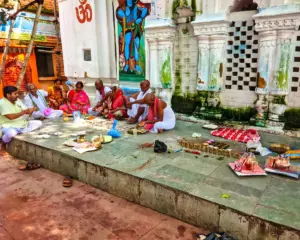
For countless families, the journey to Gaya is far more than a geographical undertaking — it is the fulfilment of a sacred duty. According to the Vishnu Purana and the Vayu Purana, performing Pind Daan at Gaya is among the most meritorious acts a descendant can undertake for the liberation of departed ancestors. The city is revered as Pitru Tirtha — the holiest of all sites for ancestral rites — and draws hundreds of thousands of pilgrims each year during Pitrupaksha and throughout the year. Families seeking to fulfil this duty can book Pind Daan at Gaya with qualified Gayawal Pandits through Prayag Pandits.
The Exact Geographic Location of Gaya
Gaya is located at approximately 24.7955° N latitude and 84.9994° E longitude in the state of Bihar, eastern India. The city serves as both the district headquarters of Gaya District and the administrative centre of the Magadh Division, making it a significant regional hub beyond its religious importance.
The Phalgu River — known in scriptures as the Niranjana — flows alongside the city. Despite being a broad, sandy riverbed for much of the year, the Phalgu holds deep sacred significance. According to Hindu belief, the river possesses a subterranean flow blessed by the divine, which is why priests perform Pind Daan directly on the sandy banks rather than requiring the river to be visibly flowing. The city lies at an elevation of roughly 111 metres above sea level, nestled between low rocky hills that include the famous Pretashila Hill, Ramashila Hill, and Manglagauri Hill — each associated with specific ancestral rites.
Gaya is the second-largest city in Bihar after Patna and functions as an important commercial and administrative centre for the entire Magadh region. Its population today exceeds 470,000, yet the city retains an atmosphere of quiet devotion that sets it apart from other large urban centres.
The Spiritual Significance of Gaya in Hindu Tradition
To understand where Gaya is situated spiritually, one must turn to the ancient Puranas. The city is considered the abode of Lord Vishnu in his form as Pitru Devta — the Lord of Ancestors. The Gaya Mahatmya, a celebrated section of the Vayu Purana, describes Gaya as the place where Lord Vishnu’s footprint is imprinted on the Gayasura rock — a boulder within the Vishnupad Temple compound. This footprint, the Vishnupad, is the very centre of all Pind Daan and Shradh ceremonies performed in this sacred city.
The deep significance of Pind Daan in Gaya is rooted in a powerful scriptural narrative. The demon Gayasura, after years of severe penance, received a boon from Lord Vishnu: that anyone who gazed upon his body would attain moksha. This sent the gods into alarm, as it threatened to empty the heavenly realms. Lord Vishnu resolved the situation by placing his foot on Gayasura to keep him suppressed — thereby concentrating immense liberated spiritual energy at this very spot. It is this divine concentration of energy that makes Gaya uniquely capable of granting moksha (liberation) to departed souls.
Three sacred hills surround the Vishnupad Temple:
- Pretashila Hill (Brahma Kund) — where rites for those who died by accident or misfortune are performed
- Ramashila Hill — associated with Lord Rama’s own performance of Pind Daan for his father King Dasharatha
- Manglagauri Hill — where Sati’s breasts are believed to have fallen, making it one of the 51 Shakti Peethas
Lord Rama himself, according to the Ramayana, performed Pind Daan for his father Dasharatha at the Phalgu River in Gaya. This event, narrated in the Ayodhya Kanda, established a precedent followed by devout Hindus for thousands of years. Even today, pilgrims recite the words attributed to Sita Mata when performing the rites — a tradition preserved intact across generations.
🙏 Planning Your Pind Daan in Gaya?
Gaya as Pitru Tirtha: The Supreme Site for Ancestral Rites
Among all the sacred sites where ancestors’ debts are repaid, Gaya holds the highest rank. The Garuda Purana states explicitly: “Even if a man performs Shraddha at Pushkar, Kurukshetra, Prayag, Gangasagar, Naimisharanya, and all other tirthas combined, the merit he gains does not equal one-sixteenth of the merit obtained by performing Shraddha at Gaya.”
This extraordinary claim is echoed across multiple Puranas and is the reason why Gaya Shraddha — the collective term for all Pind Daan and ancestral rites performed here — is considered the ultimate fulfilment of one’s filial duty. The tradition holds that a person who performs Pind Daan at Gaya liberates their ancestors from the cycle of rebirth, regardless of the nature of their karma.
The 45 sacred Pind Daan Vedikas (altars) spread across the Gaya region — including sites along the Phalgu River, on the sacred hills, and within temple compounds — collectively constitute what is known as the Gaya Kshetra. Each Vedika carries specific significance for different categories of ancestors, and a complete Gaya Shraddha involves performing rites at multiple Vedikas over three to five days.
How to Reach Gaya: Complete Travel Guide
Gaya is well connected to the rest of India by air, rail, and road. Here is a complete guide for pilgrims planning their journey.
By Air
Gaya International Airport (GAY) is the city’s airport, located approximately 10 kilometres from the city centre. It is one of the few airports in Bihar with international connections, primarily serving Buddhist pilgrims from Southeast Asian countries (Thailand, Sri Lanka, Japan, Myanmar) and Hindu pilgrims from across the world. Direct flights operate from:
- Delhi (Indira Gandhi International Airport) — approximately 1 hour 30 minutes
- Kolkata (Netaji Subhash Chandra Bose International Airport) — approximately 1 hour
- Mumbai — with one stop, approximately 3-4 hours total
- Bangkok, Colombo, and other international destinations during peak pilgrimage season
Pre-paid taxis and autorickshaws are readily available at the airport for the journey into the city.
By Rail
Gaya Junction (GAY) is a major railway station on the Grand Chord Line, which is one of the busiest rail routes in India. This makes Gaya exceptionally well connected by train. Key train connections include:
- From Delhi: The Rajdhani Express, Mahabodhi Express, and Gaya Express all serve this route (approximately 9-12 hours)
- From Kolkata (Howrah): Multiple express trains, approximately 6-7 hours
- From Patna: Multiple daily trains, approximately 2-3 hours
- From Varanasi: Multiple trains daily, approximately 3-4 hours
- From Prayagraj: Multiple trains daily, approximately 5-6 hours
For families arriving from Prayagraj — who may have already performed Asthi Visarjan at Prayagraj — Gaya is a natural next destination on the pilgrimage circuit.
By Road
Gaya is connected by National Highways to all major cities in Bihar and neighbouring states. Key road distances:
- Patna to Gaya: 100 km (approximately 2.5 hours by car)
- Varanasi to Gaya: 250 km (approximately 5 hours by car)
- Prayagraj to Gaya: 370 km (approximately 7 hours by car)
- Kolkata to Gaya: 470 km (approximately 9 hours by car)
- Delhi to Gaya: 1,000 km (approximately 16 hours by car or overnight road journey)
State transport buses operate from Patna, Varanasi, and other nearby cities. Private taxis and tour packages from Prayagraj and Varanasi are also popular, as many pilgrims combine Gaya with Prayagraj and Varanasi in a single pilgrimage circuit.
The Vishnupad Temple: Heart of Gaya’s Sacred Geography
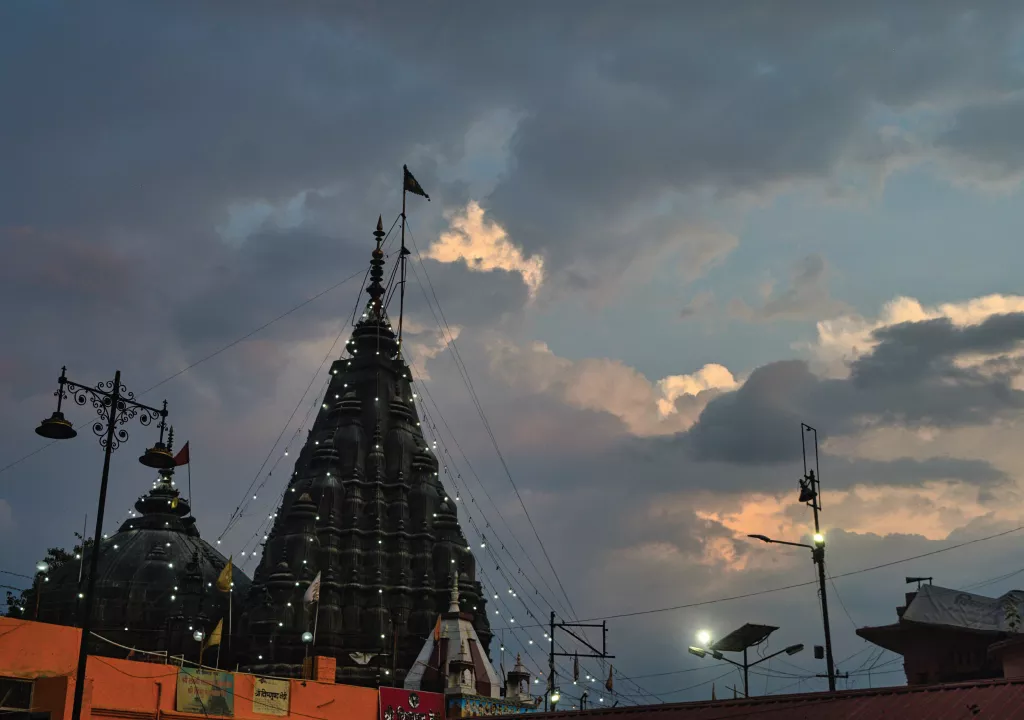
The Vishnupad Temple is the spiritual centre of Gaya and the primary destination for all pilgrims performing Pind Daan. The temple was built in its present form in 1787 by Rani Ahilyabai Holkar of Indore — one of the most devout patrons of Hindu temples in India’s history. The temple rises 30 metres high and features a distinctive octagonal shikhara (spire) typical of the Nagara style of temple architecture.
At the heart of the temple sanctum lies the most sacred object in Gaya: Lord Vishnu’s footprint (Vishnupad) embedded in a rock, measuring approximately 40 centimetres in length. The footprint is set in a silver basin and is bathed with holy water, flowers, and Pind Daan offerings by pilgrims daily. Performing Pind Daan at the Vishnupad is considered the supreme act of ancestral worship in all of Hindu tradition.
Beyond the Vishnupad Temple, other important sacred sites within Gaya include:
- Akshayavat — an ancient banyan tree within the temple compound believed to grant eternal merit to Pind Daan performed in its shade
- Falgu River Ghats — the primary location for all Pind Daan rituals, with multiple named ghats including Brahma Kund Ghat and Ramashila Ghat
- Surya Kund — a sacred tank associated with sun worship and certain ancestral rites
- Manglagauri Temple — one of the 51 Shakti Peethas, visited particularly by women pilgrims
- Dungeshwari Caves — approximately 12 km from Gaya, where the Buddha meditated before attaining enlightenment
Bodh Gaya: The Buddhist Sacred City Adjacent to Gaya
Just 13 kilometres from Gaya city lies Bodh Gaya, where Prince Siddhartha Gautama attained enlightenment under the Bodhi Tree and became the Buddha. This proximity makes the Gaya region uniquely sacred to two of the world’s great religious traditions simultaneously.
The Mahabodhi Temple in Bodh Gaya — a UNESCO World Heritage Site — marks the spot of the Buddha’s enlightenment. The original Bodhi Tree — grown from a cutting of the tree under which the Buddha sat — stands in the temple compound today. Pilgrims visiting Gaya for Hindu ancestral rites often extend their journey by a short distance to visit this extraordinary Buddhist monument as well.
The coexistence of Hindu and Buddhist sacred geography in this region speaks to the deep spiritual energy that has drawn seekers of all traditions to this part of Bihar for more than 2,500 years.
Climate and Best Time to Visit Gaya
Gaya experiences a tropical monsoon climate with three distinct seasons that significantly affect the pilgrim experience:
October to February (Best Season)
The winter months are the most comfortable time to visit Gaya. Temperatures range from 8°C to 28°C, the air is clear, and the Phalgu River has receded from its monsoon levels. Pitrupaksha (September-October) falls at the very beginning of this season — making it the most auspicious and practically comfortable time for Pind Daan. Temperatures during Pitrupaksha range from 25°C to 35°C, warm but manageable with early morning rituals.
March to June (Hot Season)
Gaya’s summers are notoriously harsh. Temperatures regularly reach 44°C-47°C, making extended outdoor rituals physically demanding. If visiting during this period, plan all rituals for the early morning hours (4 AM to 8 AM) and remain indoors during the afternoon.
July to September (Monsoon Season)
The monsoon brings relief from the heat but can make travel difficult. The Phalgu River rises significantly during heavy rains. Rituals continue throughout the monsoon but require more careful planning around weather conditions.
Where to Stay in Gaya: Accommodation for Pilgrims
Gaya offers a wide range of accommodation options specifically designed for pilgrims. From basic dharamshalas (pilgrim rest houses) to comfortable hotels, the city is well equipped to receive the large numbers of pilgrims who arrive throughout the year.
The area around the Vishnupad Temple has the highest concentration of pilgrim accommodations. Many dharamshalas are managed by religious trusts and offer clean, simple rooms at subsidised rates for genuine pilgrims. Booking in advance is strongly recommended during Pitrupaksha, when Gaya receives upwards of 500,000 pilgrims across the 16-day period.
For detailed guidance on where to stay, read our comprehensive guide to accommodation options for Pind Daan at Gaya, which covers dharamshalas, budget hotels, and mid-range options near the Vishnupad Temple.
The Complete Pilgrimage Circuit: Combining Gaya with Other Sacred Sites
Many Hindu families choose to combine Gaya with other sacred pilgrimage destinations to create a comprehensive ancestral rites journey. The three most important sites for Pind Daan — Prayagraj (Triveni Sangam), Varanasi (Kashi), and Gaya — together form a sacred triangle in north India, each associated with distinct scriptural injunctions.
A recommended pilgrimage sequence:
- Prayagraj (Triveni Sangam) — Begin with Asthi Visarjan (immersion of ashes) and initial Pind Daan at the confluence of the Ganga, Yamuna, and Saraswati. Read about the Triveni Sangam, the land of moksha.
- Varanasi (Kashi) — Perform Pind Daan at Varanasi on the ghats of the Ganga. Kashi is where Shiva himself whispers the Taraka Mantra into the ears of those who die here, granting them liberation.
- Gaya — Complete the sacred circuit with the supreme Gaya Shraddha at the Vishnupad Temple and the Phalgu River ghats.
For NRI families who wish to perform these rites but cannot travel to all three locations, Prayag Pandits offers specialised poojan services for NRIs in India that coordinate the complete circuit on your behalf.
You can also learn more about the pilgrimage to Gaya Dham in our dedicated guide, which covers the spiritual significance and logistics in greater detail.
Gaya’s Other Sacred and Historical Significance
Beyond its centrality to Pind Daan, Gaya is a city of extraordinary historical depth. The Magadha region — of which Gaya is the ancient capital — was the seat of the Maurya Empire under Chandragupta Maurya and Ashoka the Great. The city has been continuously inhabited for more than 3,000 years and contains archaeological layers that span the Vedic, Buddhist, Jain, and medieval Hindu periods.
The ancient name of the city, Gayapura, appears in texts dating back to the Mahabharata period. The Mahabharata itself references Gaya as a site of supreme ancestral merit, with the Pandavas and Lord Krishna visiting to perform rites for fallen warriors after the Kurukshetra war.
Gaya also has a significant Jain heritage. The city and its surrounding region contain several ancient Jain pilgrimage sites, including temples associated with the 24 Tirthankaras. This multi-religious heritage gives Gaya an atmosphere of shared sanctity that is rare even among India’s many ancient cities.
Practical Tips for Your Pilgrimage to Gaya
Before you travel to Gaya for Pind Daan or Shraddha, keep these practical points in mind:
- Book a qualified pandit in advance: The most experienced pandits at Gaya are often pre-booked during peak Pitrupaksha season. Our team at Prayag Pandits provides access to professional Pind Daan services at Gaya with advance booking.
- Carry the gotra and departed person’s details: You will need the name, gotra (lineage), and relationship of the deceased person(s) for whom rites are being performed. A local pandit can help if some details are unknown.
- Dress code: Men typically wear dhoti (white or unstitched cloth) during the rituals. Women wear simple sarees without elaborate embroidery during ancestral rites — modest attire is expected at all sacred sites.
- Ritual timings: Most rites begin in the early morning, ideally starting before sunrise. Arrive at the ghats by 5 AM to ensure a calm, unhurried experience.
- Photography restrictions: Photography is not permitted inside the Vishnupad Temple. Maintain respectful conduct at all sacred sites.
- Duration: Plan a minimum of two full days in Gaya for a reasonably complete Pind Daan at the major sites. A thorough 45-Vedika Gaya Shraddha requires three to five days.
Begin Your Ancestral Pilgrimage to Gaya with Confidence
Gaya is situated at the spiritual heart of ancestral devotion in Hindu tradition — a city where geography, scripture, and divine presence converge to create a uniquely powerful site for Pind Daan and Shraddha. Whether you are a first-time pilgrim or returning to fulfil a long-held family tradition, the journey to Gaya is one of the most meaningful acts of love and duty you can undertake for those who came before you.
Prayag Pandits has facilitated Pind Daan at Gaya for hundreds of families from across India and abroad. Our experienced team coordinates with trusted local pandits at Gaya to ensure that your ancestral rites are performed correctly, with full Sanskrit recitation, proper Vedika visits, and the dignity this sacred ceremony deserves.
To learn more about what the Pind Daan ceremony involves before you travel, read our comprehensive guide on how to perform Pind Daan. For families who have recently experienced bereavement and are considering the complete rites circuit, our guide on discharging the ancestors’ debt through Pind Daan and Shradh provides essential scriptural and practical context.
Contact us today to plan your pilgrimage to Gaya with experienced guidance at every step.
Book Your Sacred Ritual
Authentic ceremonies performed by Veda-trained pandits at sacred sites across India.