Key Takeaways
- The Spiritual Significance of Asthi Visarjan: Why Hindus Immerse the Ashes
- Asthi Visarjan in the Scriptures: What the Garuda Purana Says
- The Relationship Between Body and Soul in Hindu Thought
- The Complete Process of Asthi Visarjan: A Step-by-Step Guide
In This Article
Asthi Visarjan, a profound ritual in Hindu culture, embodies a deep spiritual significance. It marks the final homage to a deceased person, completing their journey and aiding the soul’s transition to the afterlife. Let’s understand Asthi Visarjan fully — its meaning, importance, the process involved, where to perform it, and what families across India and the world need to know before undertaking this sacred final act.
The Spiritual Significance of Asthi Visarjan: Why Hindus Immerse the Ashes
Asthi Visarjan is essential for the soul’s journey after death. Hindu sacred texts — the Vedas, the Garuda Purana, the Valmiki Ramayana, and various Dharmashastra treatises — consistently emphasise that the soul’s journey toward liberation remains incomplete without this final act of homage. The ritual symbolises the soul severing its last ties with the physical world and progressing in its spiritual evolution, ultimately moving toward reunion with the divine.
In Hindu cosmology, the human body is a temporary vessel composed of the Panchabhuta — the five great elements: Earth (Prithvi), Water (Jal), Fire (Agni), Air (Vayu), and Ether (Akasha). During life, the soul inhabits this material vessel. At death, the soul departs, and the physical body begins its return to these five elements. Cremation returns the body to fire and air. The remaining bones and ashes — the asthi — retain the residual trace of Earth. Asthi Visarjan, by returning these remnants to the sacred river, completes the dissolution of the physical body back into water and nature, closing the elemental cycle of human existence with grace and ritual completeness.
Beyond the elemental symbolism, the Ganga (and other sacred rivers) hold a unique status in Hindu spirituality as living divine entities — goddesses who carry the prayers, merits, and spiritual aspirations of devotees directly to the divine realm. Immersing the ashes in the Ganga is not merely a symbolic act — it is believed to literally transport the soul’s residual earthly connection into the purifying flow of divine grace, accelerating its liberation.
Asthi Visarjan in the Scriptures: What the Garuda Purana Says
The Garuda Purana is the principal Hindu scriptural authority on death, the afterlife, and the proper performance of post-death rites — the sacred Antyesti (last rites) of the Hindu tradition. It records Lord Vishnu’s teachings to Garuda (the divine eagle) on the journey of the soul after death, the importance of various rituals, and the consequences of performing them or neglecting them.
The Garuda Purana is unambiguous on Asthi Visarjan: it is a nitya karma — a duty that must be performed, not an optional act. The text describes the soul’s journey through various planes after death and explains that each post-death ritual — the cremation rites, the thirteen-day mourning period, the Pind Daan offerings, and the Asthi Visarjan — corresponds to a specific phase of the soul’s transition. Neglecting any of these creates a gap in the soul’s journey, potentially leaving it stranded in an intermediate state or causing it to remain near the earthly plane as a troubled presence.
The Valmiki Ramayana provides perhaps the most famous narrative illustration of Asthi Visarjan’s importance. When King Dasharatha passed away, his sons Bharata and Shatrughna returned from their uncle’s kingdom to find the kingdom in mourning. The text records the elaborate mourning rites, including the immersion of the king’s ashes — presented as an act of filial duty and profound love that every son is obligated to perform for his father.
The Mahabharata similarly records Asthi Visarjan as part of the standard death rites of great warriors and kings, reinforcing its place as a universal Hindu obligation that transcends class, caste, or regional variation.
The Relationship Between Body and Soul in Hindu Thought
To fully understand why Asthi Visarjan is considered so important, one must understand the Hindu conception of what happens to the soul at death. The Bhagavad Gita, Chapter 2, presents Lord Krishna’s teaching that the soul (Atman) is eternal, indestructible, and beyond the physical body: “Na jāyate mriyate vā kadāchin” — “It is never born, nor does it ever die.” The physical body is simply the material vehicle the soul inhabits during one earthly life.
However, the soul’s attachment to the physical body — formed over an entire lifetime of identification with the body, the family, and earthly experiences — does not automatically dissolve at the moment of death. The post-death rituals in Hindu tradition serve the specific function of helping sever this attachment gently and systematically. Each rite creates a formal transition: the cremation destroys the body, the thirteen-day period allows the soul to adjust to its new state, the Pind Daan offerings provide it with sustenance during this transition, and the Asthi Visarjan — by immersing the very last physical remnants of the body — performs the final severance.
Without Asthi Visarjan, the soul may remain bound to these physical remnants — a form of attachment that keeps it close to the earthly plane and delays its movement toward Pitru Loka (the ancestral realm) and beyond. This is why the ritual is treated with such seriousness and why even families in difficult circumstances are urged to perform it as soon as practically possible.
The Complete Process of Asthi Visarjan: A Step-by-Step Guide
1. Collection and Preparation of the Ashes
After cremation, the asthi sanchayan (collection of bone fragments and ashes) takes place. This is done 24–48 hours after the cremation, once the pyre has completely cooled. A family member — traditionally the son who lit the pyre — collects the bones and ashes and places them in an asthi kalash (an earthen or copper urn). In some traditions, the ashes are mixed with sesame seeds and placed on a bed of kusha grass inside the urn before the lid is sealed with cloth. The kalash is kept in a clean place in the home until the family is ready to perform the Asthi Visarjan.
2. Journey to a Sacred Site
The family then travels to a holy river or sacred body of water. In the Hindu tradition, the Ganga is the most sacred river for Asthi Visarjan — her waters are believed to purify all sins and grant liberation to souls whose ashes are immersed in her. Sites of particular significance include:
- Prayagraj (Triveni Sangam) — the confluence of the Ganga, Yamuna, and Saraswati, the most powerful pilgrimage site in Hinduism. Book Asthi Visarjan at Prayagraj with Prayag Pandits for the complete sacred rite at the Sangam.
- Varanasi (Kashi) — the eternal city of Lord Shiva, where death itself is considered an act of liberation. See our guide to Asthi Visarjan in Varanasi.
- Haridwar — the gateway to the Himalayas where the Ganga first touches the plains, considered among the most sacred locations for ancestral rites.
- Garhmukteshwar (Garh Ganga) — the nearest Ganga teerth from Delhi NCR, approximately 90 km from Delhi. See our guide to Asthi Visarjan at Garh Ganga.
- Triveni Sangam, Nashik — where the Godavari, Nandini, and Vaitarini rivers meet, a significant pilgrimage site for families from Maharashtra.
- Puri (Bay of Bengal, Odisha) — significant for Odia families and those who wish to immerse ashes in the ocean.
3. The Sankalp: Declaration of Sacred Intent
Upon arriving at the sacred site, the family is guided by the officiating priest through the Sankalp — the formal declaration of purpose. This is the single most important moment in any Hindu ritual. The performing family member states their full name, gotra (ancestral lineage), the name of the deceased, the deceased’s relationship to the performer, the date and cause of death, and the specific purpose of the ritual: to immerse the ashes and grant the soul liberation and peace. We also have a special Asthi Visarjan package for Odisha pilgrims with private boat and Odia-speaking pandits.
The Sankalp is what directs the spiritual benefit of the entire ceremony to its intended recipient. Without a proper Sankalp, the ritual may be technically performed but lacks the precise spiritual addressing that ensures the merit reaches the correct soul.
4. Performing the Puja
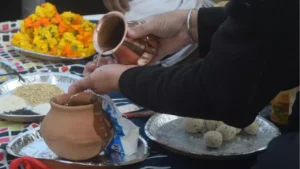
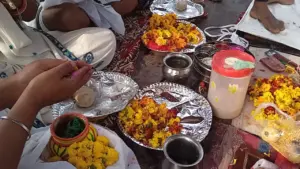
The Sankalp is followed by a puja — a formal worship ceremony. Offerings are made to the sacred river (as a living deity), to Lord Vishnu (as the presiding deity of liberation), to Lord Shiva (as the lord of death and liberation), and to the departed soul itself. These offerings include flowers, sesame seeds, rice, incense, oil lamps, and water offerings (arghya). Mantras specific to Asthi Visarjan and the liberation of the soul are recited by the priest, with the family repeating key phrases.
5. The Immersion of the Ashes
The family member performing the rite descends to the river’s edge and wades into the water to at least waist depth. The asthi kalash is opened, and the ashes and bone fragments are gently released into the flowing river water while the priest recites the final liberation mantras. Flower petals are scattered on the water. This is the central and most sacred moment of the entire ceremony — the actual surrender of the physical remnants to the divine river.
6. Tarpan and Final Prayers
Following the immersion, the performing family member cups water in their hands and pours it back into the river — this is Tarpan, the offering of water to the departed soul and ancestors. The deceased’s name and gotra are spoken as the water is released. Additional Tarpan offerings are made for all known ancestors in the paternal and maternal lines. The ceremony concludes with a final prayer for the soul’s liberation, peace, and swift progress toward the divine realm.
Timing of Asthi Visarjan: When Should It Be Done?
The Dharmashastra texts prescribe specific time frames for Asthi Visarjan:
The Traditional 3-Day and 13-Day Windows
Ideally, Asthi Visarjan should be performed within three days of cremation. This is the most auspicious window, when the soul is still closely associated with its physical remnants and the immersion can have the most direct effect on its transition. If three days is not possible due to family circumstances, distance, or logistical challenges, the ceremony should be performed within the thirteen-day mourning period (the Trayodashi, the 13th day after death).
When the 13-Day Window Is Missed
If the thirteen-day window is missed — which is common for NRI families who cannot travel to India immediately, or when practical circumstances prevent timely performance — the Asthi Visarjan can be performed on any Amavasya (new moon day), which falls once every lunar month. The Amavasya is considered the most auspicious day for all Pitru-related rites. The merit of the ritual on Amavasya is considered equivalent to that of timely performance.
Pitrupaksha: The Annual High Season
The sixteen-day Pitrupaksha period (falling in September-October, in the lunar month of Ashwin) is the most powerful annual window for all ancestral rites, including Asthi Visarjan for souls whose ashes have been preserved pending this occasion. Many families whose relatives passed away during the year make the pilgrimage to a sacred teerth during Pitrupaksha to perform Asthi Visarjan, Pind Daan, Tarpan, and Shradh all together — a comprehensive ancestral care programme. See our guides on Pind Daan at Prayagraj and Tarpan Poojan.
Long-Delayed Asthi Visarjan
Sometimes families find themselves with ashes that have been kept for months or even years — perhaps because a family member passed away abroad, or because the family repeatedly intended to make the pilgrimage but could not, or because the ashes were brought overseas by an NRI family member and have been waiting. In all such cases, the ritual can and should still be performed. There is no scriptural bar on performing Asthi Visarjan after a long delay — the soul benefits from the completion of the rite regardless of when it is performed. The important thing is to perform it with sincere intent and proper Sankalp.
Legal Aspects of Asthi Visarjan in India
Asthi Visarjan is a legally recognised religious practice in India, fully protected under the constitutional right to practise one’s religion. The immersion of human ashes in rivers is specifically allowed for Hindu, Sikh, Buddhist, and Jain religious traditions as part of their post-death rites.
However, there are some practical regulatory considerations worth being aware of:
- Plastic containers should not be immersed in the river — only biodegradable materials like earthen pots, leaf cups, or cloth-wrapped ashes are acceptable from both a religious and environmental standpoint
- Large quantity immersions at certain ghats may require coordination with local temple or ghat authorities — our priests handle all such arrangements
- For overseas travel with ashes: Indian nationals can carry cremated ashes internationally with appropriate death certificates. Most countries allow the import of cremated human remains for religious purposes, though documentation requirements vary. Consult the relevant embassy or consulate for specific requirements
- For the courier of ashes within India, India Post registered post is the standard method, and Prayag Pandits provides detailed guidance on proper packaging and documentation
Asthi Visarjan for NRI Families: Practical Arrangements
For Non-Resident Indian families across the USA, UK, Canada, Australia, Singapore, Malaysia, and other countries, the challenge of Asthi Visarjan is one of the most common situations Prayag Pandits helps with. The scenarios vary: some families have brought ashes overseas and now want to send them back to India for proper immersion; some have a family member who passed away in India during a visit and the ashes need to be handled before the NRI family can return; and some simply want the rite performed properly at a sacred teerth in India and need a trusted service to facilitate it.
Prayag Pandits offers a complete solution for all these scenarios. The key steps are:
- Consultation: Contact us by phone, WhatsApp, or email. Describe the situation and we will advise on the best approach.
- Documentation: We guide you through the death certificate and any documentation required for the transportation of ashes.
- Sending the ashes: Ashes can be sent to our office in Prayagraj via India Post registered post (from within India) or by following international customs regulations for the import of cremated remains (for overseas families sending ashes to India).
- Sankalp details: You provide us with the name, gotra, and family details of the yajmaan (the family member whose name the Sankalp will be taken in) and the deceased.
- Ceremony: Our priests perform the complete Asthi Visarjan at the sacred teerth of your choice — Prayagraj (Triveni Sangam), Varanasi, Haridwar, or another location — with full Vedic rites.
- Prasad is dispatched to your address.
This service model has helped hundreds of NRI families honour their departed loved ones with proper Hindu rites despite being unable to be physically present.
Asthi Visarjan vs. Pind Daan vs. Shradh: Understanding the Differences
These three related but distinct ritual practices are often confused by families who are navigating Hindu ancestral rites for the first time. Here is a clear explanation of how they differ and how they relate:
Asthi Visarjan is the one-time ritual of immersing the physical ashes after cremation. It is performed shortly after the death and is not repeated. It corresponds to the final physical dissolution of the body.
Pind Daan is the ritual offering of rice balls (pinda) to the departed soul, providing it with nourishment and merit for its transition. It is performed during the thirteen-day mourning period (the Sapindi Shradh on the 13th day), during Pitrupaksha, and at any time a family visits a Pitru Teerth. It can be repeated annually.
Shradh is the annual ritual of ancestral remembrance — performed on the death anniversary (tithi) of the ancestor each year and during Pitrupaksha. It involves offerings of food, water, and merit to the ancestors and is a recurring obligation.
The relationship between these three is sequential: Asthi Visarjan first severs the soul’s physical attachment; Pind Daan then provides it with nourishment and merit during the transition; Shradh sustains the ancestors through ongoing annual merit. Together, they form the complete system of Hindu ancestral care that the Dharmashastra traditions prescribe.
🙏 Arrange Asthi Visarjan at Prayagraj, Varanasi or Haridwar
Emotional Healing Through Asthi Visarjan
Beyond its spiritual purpose, Asthi Visarjan serves a profound psychological function for the bereaved family. The act of physically surrendering the ashes — the last tangible remnants of the person who was loved — to the sacred river is one of the most powerful acts of closure that human ritual has devised. It provides a concrete, embodied experience of letting go that words and time alone often cannot provide.
Many family members who have performed Asthi Visarjan report a sense of profound peace and release in the moments after the ashes enter the water — a feeling that something was completed, that a duty was fulfilled, and that the loved one has truly departed to wherever they are going. Grief does not end, but it shifts — from the acute pain of recent loss to the quieter, more sustainable grief of knowing someone beloved is no longer present but is, in the deepest sense, at peace.
This is not coincidental. The ritual is designed precisely to help the living let go. The Sankalp — naming the deceased, speaking their relationship to you, stating the purpose of the ceremony aloud — is an act of acknowledgment that the loss is real and that the ritual response is a loving one. The act of immersing the ashes with your own hands is an act of final, loving service. And the prayers that follow are an act of trust — trusting that the river, the ritual, and the divine order will carry the soul forward into peace.
Arrange Asthi Visarjan with Prayag Pandits
Prayag Pandits has helped hundreds of families — in India and across the world — complete Asthi Visarjan with full Vedic rigour and deep compassion. We understand that arranging these rites is often undertaken in the midst of profound grief and practical complexity. Our role is to make the process clear, supported, and spiritually complete.
We offer Asthi Visarjan services at Prayagraj (Triveni Sangam), Varanasi, Haridwar, Garhmukteshwar (Garh Ganga), and other sacred teerths. All services are available both for families who attend in person and for those who arrange remotely, with the ashes sent by post or courier.
To arrange Asthi Visarjan or to ask questions about the process, contact us through our enquiry form or by phone and WhatsApp. Our team is available to guide you with sensitivity, knowledge, and genuine care for the soul you are honouring.

Book Your Sacred Ritual
Authentic ceremonies performed by Veda-trained pandits at sacred sites across India.