Key Takeaways
- Why Varanasi Holds Supreme Sanctity for Asthi Visarjan: Kashi's Pivotal Role in Moksha
- The Kashi Khand: The Definitive Scriptural Authority
- The Skanda Purana: Six Reasons Kashi is Supreme for Final Rites
- The Linga Purana: Kashi as the Body of Shiva
In This Article
Why Varanasi Holds Supreme Sanctity for Asthi Visarjan: Kashi’s Pivotal Role in Moksha

Imagine a place so beloved by the Divine that Lord Shiva himself declared it his eternal home. That is Kashi. As Mahadev assures Parvati Mata in the sacred texts, including the Linga Purana, He never forsakes this city. This is why we call it Avimukta — ‘the never forsaken’.
To be in Kashi is to be perpetually within the embrace of Mahadev. What greater assurance, what safer harbour could a soul seek on its final journey? The Linga Purana further tells us that any good deed performed here — chanting the Lord’s name, performing austerities, giving charity — yields fruits that never diminish: Akshaya Punya, inexhaustible merit.
Now consider the profound act of Asthi Visarjan — a final service filled with love and prayer. When performed in Avimukta, its spiritual merit is believed to be boundless, directly benefiting the departed soul. The Kashi Asthi Visarjan importance begins here: in the unconditional, eternal presence of Mahadev in this city.
The Skanda Purana — that vast ocean of sacred knowledge, one of the largest of the eighteen Mahapuranas — devotes countless verses to Kashi’s glory. It declares boldly that in all the three worlds — Bhuloka (Earth), Bhuvarloka (intermediate space), Swargaloka (heaven) — there is no city equal to Kashi. Why? Because it was not created by Brahma like other realms; it was manifested by Lord Visveshwara (Shiva, Lord of the Universe) himself. Performing Asthi Visarjan in Varanasi means entrusting the soul’s last earthly connection directly into the hands of its creator, in His own chosen city.
The Kashi Khand: The Definitive Scriptural Authority
The most detailed scriptural account of Kashi’s supremacy comes from the Kashi Khand — a section of the Skanda Purana dedicated entirely to describing the divine geography, sacred power, and spiritual significance of Varanasi. It is one of the most comprehensive treatments of any Tirtha in the entire corpus of Hindu scripture.
The Kashi Khand makes several specific, remarkable declarations about what happens to souls who die within Kashi’s boundaries:
“Jo kashi mein marte hain, unhe Shiva svayam kaan mein Tarak Mantra sunate hain, aur wo mukta ho jaate hain.”
(Those who die in Kashi receive the Taraka Mantra — the mantra of liberation — whispered personally by Lord Shiva into their ears, and they attain liberation.)
This is not merely a poetic claim. The Kashi Khand elaborates that this Taraka Mantra — a sacred syllable-sequence that cuts through the accumulated karma of all previous lives — is Shiva’s personal gift to every soul that departs from within Kashi’s boundary. It operates regardless of the soul’s past actions, regardless of their spiritual attainment in life. This is the grace of Kashi: that the circumstances of one’s final moments can be elevated beyond all earthly karma by the mercy of Mahadev himself.
For Asthi Visarjan, the Kashi Khand’s significance is this: when you immerse the ashes of your loved one in the Ganga at Varanasi, you are placing those remains — the final physical fragment of a person who may or may not have died in Kashi — into the sacred waters of the city that Shiva chose as His liberation ground. The Ganga there carries the accumulated spiritual charge of millennia of liberation. The soul’s connection to the physical world ends in the most auspicious waters on earth.
The Skanda Purana: Six Reasons Kashi is Supreme for Final Rites
The Skanda Purana provides not one but multiple independent reasons why Kashi is unparalleled for the final rites of the departed. Drawing on its Kashi Khand section, these are the six foundational declarations:
1. The City Was Manifested, Not Created
Unlike other Tirthas that arose through specific events — a sage’s penance, a god’s blessing, a river’s descent — Kashi was manifested directly by Lord Shiva as his eternal dwelling. The Skanda Purana states that the very ground of Kashi exists within Shiva’s consciousness at all times, even during the cosmic dissolution (Pralaya) when the universe is absorbed. Kashi alone persists beyond cycles of creation and destruction.
This cosmic permanence means that the merit earned at Kashi — including the merit of Asthi Visarjan performed here — is itself permanent. It does not diminish over time or in subsequent lives.
2. The Northward Flow of Ganga — Uttarvahini
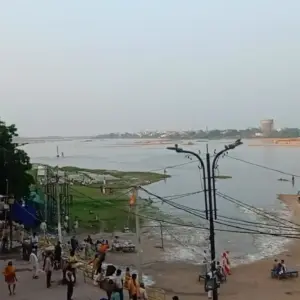
At Varanasi, the Ganga performs a remarkable geographical act: she turns northward, flowing toward the Himalayas — toward the abode of the gods, the direction of liberation in Hindu cosmology. Everywhere else, rivers flow south or east. The Ganga at Kashi reverses, turning back toward her source and the realm of the divine.
The Skanda Purana explicitly notes this Uttarvahini flow and calls it deeply auspicious. When Asthis are immersed in these northward-flowing waters, they are symbolically moving in the direction of liberation — against the pull of samsara (worldly existence) and toward the realm of Shiva, Vishnu, and the divine ancestors.
3. All Tirthas Converge in Kashi’s Ganga
The Skanda Purana shares a beautiful secret: during parvan days (auspicious lunar days, eclipses, and sacred festivals), all the holy Tirthas of India are believed to converge and merge into the Ganga at Kashi. Prayagraj, Haridwar, Rameshwaram, Dwarka, Pushkar, Nashik — the essence of all sacred waters gathers here.
This means that when you immerse Asthis in the Ganga at Varanasi, it is as though all the holy rivers of India simultaneously receive those remains. The Ganga Asthi Visarjan benefits derived here are thus exponentially greater — a comprehensive spiritual cleansing from all sacred sources combined.
4. Liberation Is Granted Even to Those of Accumulated Sin
The Linga Purana makes a bold declaration that sets Kashi apart from all other Tirthas: even those who have committed great sins, who carry heavy karmic burdens, who die in Kashi attain liberation. The Skanda Purana echoes this — the power of Shiva’s Taraka Mantra is not conditional on the deceased’s virtue. It is a gift of grace, freely given.
This is of enormous comfort to families performing Asthi Visarjan for loved ones whose lives were complicated, who may not have followed dharmic paths consistently, or who died under difficult circumstances. Kashi’s liberation is not earned by the deceased — it is given.
5. Ganga Here Purifies What No Other Water Can
The Agni Purana describes the purifying power of Ganga across India. But the Skanda Purana specifies that Ganga at Kashi carries a purifying capacity that surpasses the Ganga elsewhere. This is because she flows through the city of Shiva, carrying his blessings in her current. The accumulated prayers, pujas, aartis, and devotional offerings of thousands of years of continuous worship have charged these waters with extraordinary spiritual potency.
The ashes immersed in these waters receive not just physical dissolution in a sacred river — they receive contact with the concentrated devotional charge of one of the world’s oldest continuously inhabited cities.
6. Manikarnika Ghat: The Most Sacred Cremation Ground on Earth
Among all the 84 ghats of Varanasi, Manikarnika Ghat holds a special place in the tradition of final rites. According to the Puranas, this is where the earring of Maa Sati fell when Lord Shiva carried her body through the cosmos in grief after her sacrifice at Daksha’s yajna. This connection to Sati’s supreme sacrifice makes Manikarnika uniquely charged with the energy of transformation — of a soul passing from one state to another.
The funeral pyres at Manikarnika have burned without interruption for over three thousand years. The Dom community who tend these fires carry a lineage of service to the departing souls of Kashi that is unbroken since ancient times. This continuous flame — agni that has received countless souls — is itself a spiritual presence, a Tirtha of fire alongside the Tirtha of water.
For Asthi Visarjan, performing the ceremony at or near Manikarnika Ghat connects the act to this ancient, unbroken tradition of Kashi’s liberating fire and water working together for the soul’s release.
The Linga Purana: Kashi as the Body of Shiva
The Linga Purana‘s treatment of Kashi goes beyond geography and history into the realm of divine metaphysics. It presents Kashi not as a city that exists within the universe, but as a city that exists within the body of Shiva himself. Varanasi is described as Shiva’s own svarupa — his divine form made manifest in physical space.
The two rivers that bound Kashi — the Varana and the Asi — are described as two of Shiva’s vital channels. The Ganga flowing through Kashi is described as Shiva’s own grace made liquid and poured upon the earth. Every ghat, every temple, every lane of the old city is a point within this divine body.
What does this mean for Asthi Visarjan? It means that immersing the remains of your loved one in the Ganga at Kashi is equivalent, in the Linga Purana’s understanding, to placing those remains within Shiva himself. The departed soul does not merely enter sacred water — it enters the body of the divine. There is no greater act of spiritual protection and liberation that a family can perform for one who has departed.
The Matsya Purana: Why Dying in Kashi is Itself a Blessing
The Matsya Purana contains a section on sacred geography that places Kashi in a category entirely by itself. It states that those who die in Kashi are automatically freed from rebirth — no additional merit is required, no special practice is necessary. The act of dying within Kashi’s boundaries is sufficient for liberation.
For those who did not die in Kashi but whose Asthis are brought there for Visarjan, the Matsya Purana’s underlying principle still holds: Kashi’s liberating power extends to those whose final physical connection to the world — the Asthis — are surrendered there. The city receives those remains as it receives all souls who come within its embrace.
The Matsya Purana also speaks of the Pancha Kashi — the five aspects of Kashi’s sacredness — which include its connection to all five elements (earth, water, fire, air, and ether), each of which is particularly purified and elevated within Kashi’s boundaries. When Asthis are immersed in the Ganga here, they are returned to the earth element through water in a space where both elements carry divine potency.
Manikarnika Ghat: History, Mythology, and Spiritual Significance

No discussion of why Asthi Visarjan in Varanasi is complete without understanding Manikarnika Ghat in depth. This ghat is not simply the most important cremation site in Varanasi — it is considered by many scholars of Hindu tradition to be the most sacred cremation ground in the entire world.
The Mythology of Manikarnika
The Puranas record at least two mythological events that mark Manikarnika as extraordinary. The first involves Maa Sati: when she cast herself into Daksha’s yajna fire and Lord Shiva carried her body in grief across the cosmos, Vishnu sent his Sudarshana Chakra to gradually cut away parts of Sati’s body so that Shiva would be released from his grief. At Manikarnika Ghat, her manikarnika — ear ornament — fell into the waters. This is the most commonly cited origin of the ghat’s name.
The second story involves Lord Vishnu himself. It is said that Vishnu performed a great yajna here, and in deep devotion, perspired so profusely that a lake formed — called Chakrapushkarini or Manikarnika Kund. Lord Shiva, pleased by this devotion, told Vishnu: “I will never abandon this place. Whoever dies here will receive my Taraka Mantra and attain liberation.” This divine promise — recorded in the Kashi Khand — is why Manikarnika holds its unparalleled status.
The Eternal Flame
According to tradition, the funeral pyres at Manikarnika have been burning continuously since the beginning of this cosmic age — over thousands of years. The flame is never extinguished. In the evenings, when the smoke from the pyres mingles with the mist rising from the Ganga, and the lights of oil lamps flicker on the water, Manikarnika presents one of the most profound visual experiences in the Hindu world: life and death, fire and water, grief and liberation, all woven together in a single moment.
For Asthi Visarjan, performing the ritual in proximity to this eternal flame connects the ceremony to a tradition older than recorded history. The soul released through Visarjan here enters the same waters that have received countless souls before — a river not just of water, but of accumulated liberation.
Varanasi Compared to Other Holy Sites for Asthi Visarjan

A thoughtful devotee naturally asks: how does Varanasi compare to the other great Tirthas for Asthi Visarjan? Each sacred site offers genuine spiritual merit. The tradition recognises them all. But the Puranas are clear about which holds supreme status when the specific goal is the liberation of the departed soul.
Haridwar: Where the Ganga descends from the Himalayas to the plains — a threshold of enormous power. Asthi Visarjan at Har ki Pauri in Haridwar is deeply meritorious and the preferred site for many North Indian families. The Ganga here carries the direct blessings of the Himalayan sages and the glacial source at Gangotri. However, the Skanda Purana explicitly states that Kashi surpasses even Haridwar for liberating the souls of the departed.
Prayagraj: The Tirtharaj — king of all Tirthas — where Ganga, Yamuna, and the invisible Saraswati meet. The Asthi Visarjan at Prayagraj at the Triveni Sangam is exceptionally auspicious, particularly during Kumbh Mela and Pitrupaksha. The Triveni Sangam carries a confluence energy that is uniquely powerful for ancestral rites. Many families perform Asthi Visarjan at both Prayagraj and Varanasi.
Gaya: The supreme site for Pind Daan and Shradh — the ancestral feeding ritual that sustains the departed soul on its journey. Gaya is specifically consecrated as Pitru Tirtha by the Vayu Purana. While Gaya is the best place for Pind Daan, Varanasi is the best place for Asthi Visarjan. Together, a Pind Daan at Gaya followed by Asthi Visarjan at Varanasi forms the most complete set of post-death rites that Hindu tradition offers.
Rameshwaram: At the southern tip of India, Agni Theertham on the shore of the Indian Ocean holds great significance for Asthi Visarjan in the Tamil and South Indian Hindu tradition. The Puranas honour all such sacred sites; the specific supremacy of Varanasi is most strongly stated in the northern Puranic tradition, particularly the Skanda Purana and Linga Purana.
A comprehensive comparison of all sacred sites for this rite is available in our guide to best places for Asthi Visarjan in India. For families who can reach Varanasi, or who can arrange the service through a qualified Pandit, the Puranic evidence is unambiguous: Kashi holds the supreme position.
The Spiritual Significance of Rituals Performed in Kashi
Given the sacred nature of the land and the river, any ritual performed in Kashi takes on heightened significance. The Skanda Purana uses the word akshaya phala — inexhaustible fruit — to describe the merit of virtuous acts performed in Varanasi. A small act of charity, a single holy dip, a brief prayer at a ghat — all carry magnified spiritual weight in this city.
For Asthi Visarjan — an act of profound love and dharmic duty performed for a departed family member — the amplification of merit in Kashi is immeasurable. The Skanda Purana says: “Even a small virtuous act — a holy dip, charity, Japa (chanting), Homa (fire ceremony), or Shraddha (ancestral rites) — performed in Kashi yields everlasting merit.”
Consider then the weight of Asthi Visarjan: not a small act of charity, but the final physical act of love a family performs for someone they have lost. When performed with devotion in Kashi, accompanied by proper Vedic mantras and the guidance of a qualified Pandit, this act is charged with the accumulated spiritual power of the city itself. It is, in the Puranic understanding, among the most powerful acts of love and dharma that a human being can perform.
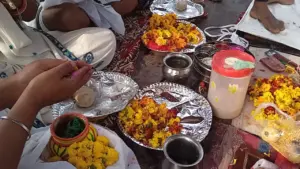
The Asthi Visarjan ceremony in Varanasi includes:
- Asthi Poojan: Consecrating the remains with mantras from the Rig Veda and Atharva Veda, offering flowers, incense, and ghee lamps to the soul’s final physical form.
- Sankalpa: The formal declaration of intent connecting the ritual to the specific departed soul and to the family commissioning it.
- Tarpan: Water libations offered to the ancestors and to the departed soul specifically.
- Visarjan: The final immersion of the Kalash and ritual offerings into the Ganga — the moment of release.
- Pind Daan (optional but recommended): Offering of rice balls to provide the departed soul with nourishment for its onward journey.
Prayag Pandits has been performing these rites at Varanasi for over a decade, serving families from across India and from over 30 countries worldwide. Read about the complete Asthi Visarjan Poojan process here.
The Varanasi Death Hostel: Why People Come to Die in Kashi
The supremacy of Kashi for liberation has given rise to one of the world’s most extraordinary institutions: the Varanasi Mukti Bhawan — the Death Hostel — where terminally ill pilgrims from across India come to spend their final days, hoping to die within Kashi’s liberating boundary.
The existence of Mukti Bhawan and similar institutions is itself a profound testament to the depth of faith in Kashi’s liberating power. Families who save for years to bring a dying parent or grandparent to Varanasi, who sit vigil in a small room while their loved one passes — these families are acting on the scriptural promise of the Kashi Khand, the Linga Purana, and the Matsya Purana. They believe, as their ancestors believed, that dying in Kashi guarantees liberation.
For those who could not die in Kashi, performing Asthi Visarjan here is the next best gift their family can give them. The city’s liberating energy reaches those who come to it even in their ashes.
Conclusion: The Confluence of Grace in Mahadev’s City
The answer to Why Asthi Visarjan in Varanasi? is now clear — and it is not a single answer but a layered, scripturally grounded truth built on the testimony of multiple Puranas:
- Lord Shiva’s Eternal Presence: You are within the embrace of Mahadev in His Avimukta Kshetra, where He personally grants the Taraka Mantra to departing souls.
- Ganga’s Supreme Purity: The Uttarvahini Ganga here is infused with the essence of all Tirthas, making her waters supremely purifying for the soul’s final immersion.
- The Promise of Moksha: As the Skanda Purana, Linga Purana, and Matsya Purana unanimously declare, Kashi grants liberation — freely, unconditionally, even to those of accumulated sin.
- Manikarnika’s Sacred Fire: The eternal flame at the world’s foremost cremation ghat connects every act of final rites performed here to an unbroken tradition of three thousand years.
- Amplified Ritual Merit: Every prayer, every offering, every act of love performed in Kashi carries akshaya phala — inexhaustible, permanent merit — for the family and the departed soul.
The Kashi Asthi Visarjan importance stems from this sacred confluence — of place, river, divinity, and purpose. It is the belief, held firm for thousands of years and echoed in the most authoritative scriptures of Sanatana Dharma, that performing this final rite here offers the departed soul the greatest possible peace, purification, and the clearest path toward liberation.
It is the ultimate act of love and dharma that a family can perform for their beloved departed. And the Ganga at Kashi — as she has for millennia — receives that love and carries it forward.
🙏 Arrange Asthi Visarjan in Varanasi
Book Your Sacred Ritual
Authentic ceremonies performed by Veda-trained pandits at sacred sites across India.