Key Takeaways
In This Article
Of all the places in India where Kaal Sarp Dosh Puja is performed, Ujjain holds a singular position — one that no other city can claim. When Rahu and Ketu have locked all seven planets between them in a birth chart, creating that feared serpentine cage, the sages across our tradition have consistently pointed to Ujjain as the city where that cage can be unlocked. Not because of popular belief or tourism, but because of what Ujjain actually is: the city where the planet Mars was born, where Mahakaleshwar resides as the lord of time, and where the Shipra River carries the power of the original Amrit that fell during the cosmic churning.
I am Acharya Vishwanath Shastri, and over two decades of performing Kaal Sarp Dosh Puja at Ujjain, Prayagraj, Haridwar, and Trimbakeshwar, I have seen this dosha lift from charts where every other remedy had failed. In this guide I will walk you through exactly what the puja involves at Ujjain, which temple to go to, what it costs, how to book, and how Ujjain compares with other sacred centers. This is the complete picture — nothing held back.
If you need a quick orientation to Kaal Sarp Dosh itself — the 12 types, how to identify it in your chart, and its effects — read our complete Kaal Sarp Dosh guide first, then return here for the Ujjain-specific details.

Why Ujjain for Kaal Sarp Dosh Puja?
The question I am asked most often is: why Ujjain specifically? Other sacred cities perform this puja too — Trimbakeshwar, Prayagraj, Nashik, Haridwar. What is special about Ujjain?
The answer has three distinct dimensions: the mythological, the astronomical, and the energetic.
Mythologically, Ujjain is described across the Puranas as the city where the boundaries between the divine and human worlds are thinner than anywhere else. It is one of the seven Moksha-giving cities — Kashi, Mathura, Haridwar, Ayodhya, Kanchi, Dwaraka, and Ujjain. Among these, Ujjain is uniquely associated with Mahakaleshwar, the lord of death and time. Kaal Sarp Dosh is fundamentally a dosha of time and fate — it binds the native’s life force within the serpentine axis of Rahu and Ketu. Who better to dissolve a dosha of time than the lord of time himself?
Astronomically, Ujjain is the original prime meridian of ancient Indian astronomy. For over 2,000 years, Indian astronomers used the meridian passing through Ujjain as the zero longitude for all Jyotisha calculations — an acknowledgement that this city sits at the energetic center of the subcontinent. The Tropic of Cancer passes directly through Ujjain, and specifically through the premises of Mangalnath Temple, which is considered the geographical birthplace of the planet Mars.
Energetically, Ujjain hosts the Kumbh Mela every 12 years (called Simhastha), when Jupiter enters Leo. The city holds residual Amrit energy from the cosmic churning (Samudra Manthan) — the divine nectar that fell at this location imbues the Shipra River and the earth itself with transformative power.
For Kaal Sarp Dosh specifically, two sites in Ujjain are used: Mangalnath Temple (the primary venue) and the Mahakaleshwar Temple complex. Of these, Mangalnath Temple is the first choice because of its direct connection to Mars, the ruling planet whose energy most directly counteracts the serpentine grip of Rahu-Ketu.

Mangalnath Temple — History and Spiritual Significance
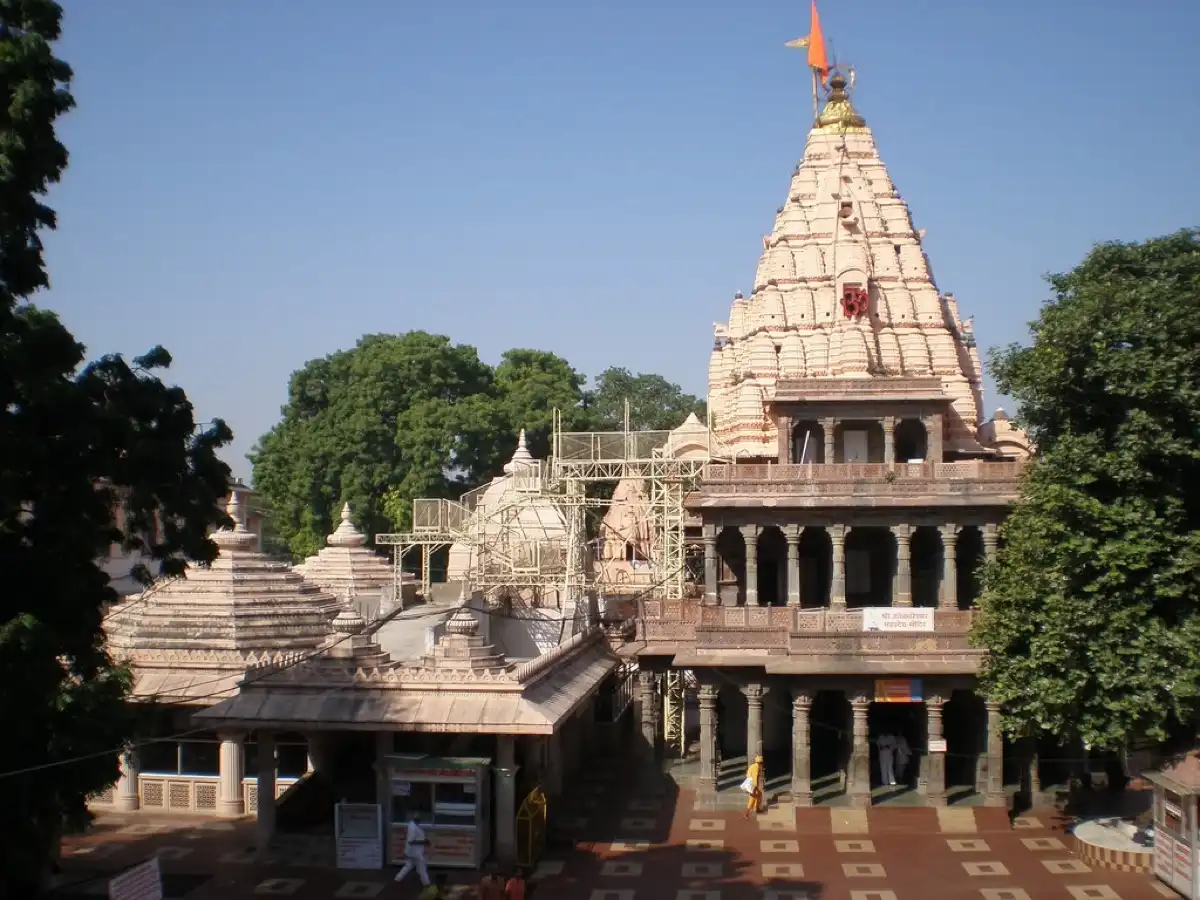
Mangalnath Temple stands on a hillock overlooking the Shipra River, roughly two kilometers from the Mahakaleshwar temple. To understand why this temple is the central site for Kaal Sarp Dosh Puja in Ujjain, you need to understand its origin as described in the Matsya Purana.
The Matsya Purana records that during the great Mahashivratri, when demons were disrupting the cosmic order, Shiva fought a fierce battle to restore equilibrium. In the heat of that battle, a drop of Shiva’s sweat fell to the earth at this precise location. From that drop arose a Shiva Linga — and from the energetic field of that Linga, the planet Mangal (Mars) was born. This is why Ujjain’s Mangalnath Temple is called the janm sthan (birthplace) of Mars.
This mythological foundation has a corresponding astronomical reality. Because Mars is believed to have been born here, the planet’s orbital trajectory means its rays fall with particular clarity and directness on this location. Ujjain’s ancient observatories (the Vedha Shala) confirm this — astronomers stationed here had unusually precise views of Mars compared to observers at other latitudes.
The Tropic of Cancer (Karka Rekha) passes directly through Mangalnath Temple’s premises, placing it at a unique solar position that ancient Indian astronomers recognized as cosmically significant. This is not a modern claim retrofitted to ancient tradition — it is documented in Jyotisha texts that predated modern cartography.
For Kaal Sarp Dosh, the relevance of Mangal’s birthplace is this: Rahu and Ketu are shadow planets — chhaya grahas — that create the serpentine dosha through their opposition. Mars is the planet of courage, action, and forward momentum. When the Kaal Sarp formation freezes a native’s life force in repetitive patterns, a powerful Mars invocation at Mars’s own janm sthan breaks the inertia. The Mangal energy here is not abstract — it is concentrated, direct, and historically validated through thousands of successful pujas.
The temple currently holds a black stone Shiva Linga in the garbhagriha, flanked by the image of Mangal Deva in his traditional red form seated on a ram. The temple trust manages daily worship from 5:00 AM and the sanctum is open for darshan during specified hours (detailed below).
Beyond its specific role in Kaal Sarp Dosh Puja, Mangalnath is also the premier location for Mangal Dosha remedies. Devotees with afflicted Mars in their chart — whether causing Manglik Dosha or other Mars-related problems — come here for Mangal Bhaat Puja, in which cooked rice prepared with ghee and spices is offered to the planet along with red flowers and roasted Chana Dal.
Kaal Sarp Dosh Puja Vidhi at Ujjain
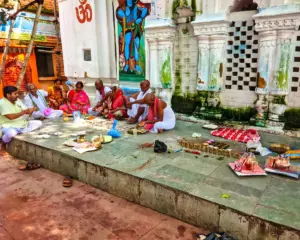
The Kaal Sarp Dosh Puja at Ujjain is a multi-stage ritual that takes between three and five hours to complete correctly. What follows is the sequence as we perform it — step by step.
Preparation Before the Puja
On the day of the puja, the devotee should rise before sunrise, take a bath, and wear clean cotton clothing — preferably in saffron, yellow, or white. Avoid leather items. Maintain a fast (or at minimum avoid non-vegetarian food) from the previous evening. If performing the puja on behalf of a family member who cannot attend, bring a photograph and their full name and birth details.
Sacred Bath in the Shipra River
The puja begins at the Shipra River ghats. The Shipra is one of India’s most sacred rivers, and in the Skanda Purana it is described as possessing the power to cleanse all dosha — both karmic and astrological — from those who bathe in it with the right intention and mantra. The bathing ritual (snan) is not merely symbolic; it is the entry point into the ritual space. The pandit recites the Shipra River invocation mantra as the devotee takes three sanctifying dips.

Ganesh Sthapana and Navgraha Invocation
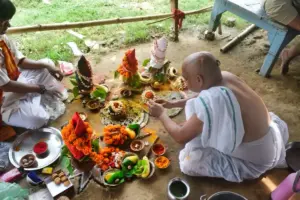
The ritual begins formally at Mangalnath Temple with the installation of Ganesha. No puja in the Vedic tradition begins without first invoking Ganesha — the remover of obstacles — and this is doubly important for Kaal Sarp Dosh, which is itself an obstacle of a fundamental kind. After Ganesha, the nine planets (Navgraha) are invoked through their respective mantras and offerings. Each graha is offered its preferred items: the sun receives red flowers and red sandalwood, the moon gets white flowers and raw milk, Mars receives red lentils and red flowers, and so on through all nine. This comprehensive Navgraha Shanti ensures no planet feels neglected or antagonized during the main Kaal Sarp ritual.
Nag Devta Worship
This is the heart of the Kaal Sarp Dosh Puja and what distinguishes it from a general Navgraha Shanti. Rahu and Ketu are serpentine energies — they manifest as Nag Devtas in the ritual context. Two silver or copper serpent images (Nag and Nagin) are installed on a silver plate dusted with turmeric. The devotee offers milk, sandalwood, white flowers, akshata (unbroken rice), and silver items to the serpents while the pandit recites the Nag Stotra and specific mantras for Rahu and Ketu:
- Rahu Beej Mantra: Om Bhram Bhreem Bhroum Sah Rahave Namah (108 times)
- Ketu Beej Mantra: Om Stram Streem Stroum Sah Ketave Namah (108 times)
- Kaal Sarp Stotra: The full twelve-verse hymn addressing each of the twelve Kaal Sarp configurations
Mahamrityunjaya Havan
The havan (sacred fire ritual) is performed with the Mahamrityunjaya Mantra as the primary offering — 108 to 1,008 ahutis depending on the severity of the dosha and the specific package chosen. The havan materials include sesame seeds, ghee, Samidhaa wood, and specific herbs mentioned in the Atharvaveda for serpentine dosha remedies. The fire transforms the offerings into divine energy and acts as the direct transmission channel to the deities invoked.
Rudrabhishek at Mangalnath Shiva Linga
The puja culminates in a Rudrabhishek — the sacred bathing of the Shiva Linga with panchamrit (milk, honey, sugar, ghee, curd), followed by Ganga water, and finally the recitation of the Sri Rudram. This abhishek is performed directly on the Mangalnath Shiva Linga, completing the circuit from Nag Devta appeasement to Shiva’s blessing. Since Kaal Sarp Dosh involves cosmic serpentine energy, and Shiva himself wears serpents as ornaments — he is the master of serpent energy, not its victim — this final Rudrabhishek is the definitive sealing of the remedy.
Immersion in the Shipra
The ritual closes with the immersion of the Nag-Nagin images, the havan ash, and remaining ritual materials into the Shipra River at the designated ghat. This returns the transformed energy to the river and completes the cycle of the puja.

The Shipra River’s Role in the Ritual
Every major sacred site for Kaal Sarp Dosh Puja has a river at its center: Trimbakeshwar has the Godavari, Prayagraj has the Triveni Sangam, and Haridwar has the Ganga. In Ujjain, the Shipra plays this role — but with a significance that sets it apart from other sacred rivers in the context of this particular dosha.
The Shipra receives repeated mention in the Puranas as the river at which Amrit fell during the Samudra Manthan. This places it in a category with Prayagraj’s Triveni Sangam as a site where divine nectar touched the earth. The nectar was the product of the churning in which both Garuda (the serpent-destroyer) and the serpents themselves participated — meaning the Shipra carries an energy that is simultaneously connected to serpentine forces and their transcendence.
For Kaal Sarp Dosh, this dual energy is precisely what is needed. The dosha is not destroyed by attacking serpentine energy — it is resolved by establishing right relationship between the serpentine forces (Rahu-Ketu) and the cosmic order. The Shipra River, which witnessed and received the fruits of that original cosmic negotiation, is the ideal vessel for this reconciliation.
From a practical ritual standpoint, the bath in the Shipra before the puja is not optional — it is the purification that allows the devotee to enter the sacred ritual space in a state appropriate to receive the puja’s benefit. The river bath, combined with the sanctified ritual space at Mangalnath, creates the complete circuit that makes the Ujjain puja uniquely effective.
Mangalnath Temple Timings and Muhurat 2026
Temple Timings
| Session | Timing | Notes |
|---|---|---|
| Morning Darshan | 5:00 AM – 12:00 PM | Best time for Kaal Sarp Puja |
| Afternoon Break | 12:00 PM – 4:00 PM | Sanctum closed |
| Evening Darshan | 4:00 PM – 9:00 PM | Evening aarti at 7:30 PM |
| Mangal Bhaat Puja | 5:30 AM – 7:30 AM | Tuesday is most auspicious |
Auspicious Muhurats for Kaal Sarp Dosh Puja — 2026
The most auspicious times for Kaal Sarp Dosh Puja are tied to specific lunar phases and planetary positions. For 2026, the following periods are particularly powerful:
- Nag Panchami (August 2026): The single most auspicious day in the year for any serpentine dosha remedy. Devotees travel from across India for this date.
- Amavasya (New Moon) dates: The absence of the moon amplifies Rahu-Ketu energy and the puja’s corrective power. April 20, May 19, June 17, July 16, August 15, September 14, October 13, November 12, December 12, 2026.
- Tuesdays at Mangalnath: Tuesday is Mangalwar — the day of Mars. Performing the puja on a Tuesday at Mars’s birthplace combines two layers of auspiciousness.
- Pradosh (13th lunar day, both Shukla and Krishna paksha): Sacred to Shiva; powerful for Rudrabhishek during the puja.
- Navratri periods (April 2 – April 10 and October 2 – October 10, 2026): The heightened divine energy during Navratri amplifies any puja performed in this period.
If you cannot make one of the major muhurat dates, do not delay the puja indefinitely waiting for one. The puja is effective on any day — the muhurat dates simply provide added amplification. What matters most is performing the puja with correct vidhi and a qualified pandit.

Kaal Sarp Dosh Puja Cost in Ujjain
This is one of the most searched questions about Kaal Sarp Dosh Puja in Ujjain, and it deserves a direct, honest answer. The costs vary significantly based on who performs the puja and what is included. Here is an accurate breakdown of the market range as of 2026:
Market Rate Overview — Ujjain
| Package Type | Price Range | What’s Typically Included |
|---|---|---|
| Basic Puja (local agent) | Rs. 5,000 – Rs. 8,000 | Single pandit, basic materials, 2-3 hours |
| Standard Puja | Rs. 8,000 – Rs. 12,000 | Pandit + assistant, quality materials, full vidhi, 3-4 hours |
| Comprehensive Puja | Rs. 12,000 – Rs. 21,000 | Experienced acharya, havan, Rudrabhishek, prasad, certificate, 4-5 hours |
| Remote Puja (Ujjain) | Rs. 7,100 onwards | Full vidhi on your behalf, live video, prasad courier |
A note of caution: at Mangalnath Temple itself, you will encounter many touts and agents who offer to arrange the puja at low cost but extract additional payments throughout the process. The final bill from such arrangements often reaches Rs. 15,000-25,000 even when you were quoted Rs. 3,000 at the start. Booking through a trusted, established service with transparent pricing avoids this entirely.
Our Kaal Sarp Dosh Puja service at Haridwar starts at Rs. 7,100 (regular price Rs. 9,100) with complete transparency — no hidden charges, full vidhi, live video stream, and prasad couriered to your home. For those who specifically require the Ujjain Mangalnath experience in person, we can facilitate introductions to trusted Ujjain pandits within our network.
We also offer Kaal Sarp Dosh Puja at Prayagraj Triveni Sangam from Rs. 11,000 (regular Rs. 15,000) — another highly regarded sacred center for this dosha.
Best Pandit for Kaal Sarp Puja in Ujjain
Finding the right pandit is arguably more important than finding the right location. A mediocre puja at Ujjain will yield less result than an expert puja at Prayagraj. Here is what to look for:
Qualifications to Verify
- Jyotisha Shastra certification: The pandit should have formal training in Jyotisha, not just ritual knowledge. Kaal Sarp Dosh diagnosis requires understanding the birth chart — a purely ritual pandit cannot adjust the puja sequence for the specific dosha type (Anant, Kulik, Vasuki, etc.) the devotee has.
- Experience with Kaal Sarp Dosh specifically: Ask how many such pujas they have performed and whether they can describe the difference in vidhi for, say, Anant Kaal Sarp Dosh versus Shankhapal Kaal Sarp Dosh. An experienced pandit will know immediately; an inexperienced one will give a generic answer.
- Knowledge of Mangalnath Temple’s specific rituals: The Mangal Bhaat Puja, the Nag-Nagin installation sequence, the specific mantras used at this temple versus other locations — these are markers of genuine Ujjain-based experience.
- Transparency on pricing: A trustworthy pandit quotes the full amount upfront, including materials and temple fees, with no hidden additions during the puja.
Red Flags
- Unsolicited approach near the temple gates offering suspiciously low rates
- Claims that your dosha is “very severe” and requires an unusually expensive special puja — without having seen your birth chart
- Inability to explain the puja sequence when asked
- No references or verifiable track record
For devotees who are NRIs or located outside India, the safest approach is to book through a trusted online service that performs the puja on your behalf with live video documentation. This eliminates the tout problem entirely and ensures you receive a complete, authentic puja.
Ujjain or Trimbakeshwar — Which Is Better?
This is one of the most common questions I receive, and the honest answer is: it depends on your specific chart and life circumstances. Neither Ujjain nor Trimbakeshwar is universally superior — they are different sacred centers with different strengths. Here is a clear comparison:
Trimbakeshwar (Nashik, Maharashtra)
- Primary deity: Trimbakeshwar Shiva (Jyotirlinga) — one of the 12 Jyotirlingas of India
- River: Godavari — considered exceptionally sacred for Pitra rituals
- Primary strength: Pitru Dosh, Kaal Sarp Dosh, and Narayan Bali — the trinity of ancestral and serpentine remedies
- Kaal Sarp Dosh approach: The Kaal Sarp Puja at Trimbakeshwar is performed inside the Jyotirlinga temple itself, using the specific Trimbak system of the Rigveda — considered particularly powerful for chart-level remediation
- Limitation: High footfall, commercial pressure, many unauthorized pandits operating around the temple
- Cost range: Rs. 5,000 – Rs. 21,000 (similar to Ujjain)
Ujjain (Madhya Pradesh)
- Primary deity: Mahakaleshwar (Jyotirlinga) + Mangalnath (Mars birthplace)
- River: Shipra — Amrit-receiving river of the Kumbh Mela
- Primary strength: Mars-afflicted charts, Manglik Dosha alongside Kaal Sarp Dosh, combined Navgraha Shanti
- Kaal Sarp Dosh approach: Mangalnath-centered, with emphasis on Mars appeasement alongside Rahu-Ketu balancing — unique to Ujjain
- Limitation: The Kaal Sarp Puja tradition at Ujjain is somewhat less codified than at Trimbakeshwar — pandits vary more in their approach
- Cost range: Rs. 5,000 – Rs. 21,000
My Recommendation
Choose Ujjain if: your chart shows a combination of Kaal Sarp Dosh with strong Mangal or Mars afflictions (Manglik Dosha, debilitated Mars, Mars in 1st/8th house), or if you also have Pitra Dosh alongside Kaal Sarp Dosh and want to address both in one trip.
Choose Trimbakeshwar if: your Kaal Sarp Dosh is the primary dosha in the chart without Mars complications, and particularly if ancestral (Pitru) issues are prominent — Trimbakeshwar’s Godavari location is the premier site for Narayan Bali and Shradh in the same tradition.
Choose Prayagraj if: you want a combined Kaal Sarp Dosh + Pind Daan + Tarpan — Triveni Sangam allows the full spectrum of Hindu remedial rituals in one location. See our puja booking hub for all available options.
Where Exactly in Ujjain Is the Puja Performed?
Ujjain has two primary locations for Kaal Sarp Dosh Puja:
1. Mangalnath Temple (Primary Location)
Address: Mangalnath Road, near Shipra River, Ujjain — 456006, Madhya Pradesh
Distance from Ujjain Railway Station: Approximately 4 kilometers
How to reach: Auto-rickshaw or taxi from the station (Rs. 80-150 one way). The temple is clearly signposted from the main road.
Mangalnath Temple is the preferred and traditional location for Kaal Sarp Dosh Puja in Ujjain. The puja is typically performed in the open courtyard or the designated havan kund area adjacent to the main temple, not inside the garbhagriha (inner sanctum), which remains reserved for the resident priests’ worship.
2. Mahakaleshwar Temple Complex (Secondary Location)
Address: Jaisinghpura, Ujjain — 456006, Madhya Pradesh
Distance from Railway Station: Approximately 2 kilometers
Kaal Sarp Dosh Puja can also be arranged at the Mahakaleshwar Jyotirlinga complex — specifically at the Kaal Bhairav shrine within the complex and at the Shipra ghats adjacent to the temple. However, the Mahakaleshwar sanctum itself is extremely crowded and the puja arrangements are less streamlined than at Mangalnath. Most experienced pandits recommend Mangalnath as the primary venue.
Shipra Ghats for the Bath
Ram Ghat is the main bathing ghat and the recommended location for the pre-puja snan. It is located approximately 1 kilometer from Mahakaleshwar Temple. The ghat is clean, well-maintained, and has changing facilities. During Simhastha Kumbh years, Ram Ghat hosts the royal bath processions of the Akharas.
How to Book Kaal Sarp Dosh Puja in Ujjain
There are three ways to arrange the puja at Ujjain:
Option 1: Book through a Trusted Online Service (Recommended)
This is the approach I recommend for most devotees, particularly those traveling from outside Madhya Pradesh or from abroad. Book through a verified service that:
- Provides a qualified Ujjain pandit with verifiable credentials
- Charges a transparent, all-inclusive price with no on-site additions
- Provides a live video stream of the puja so you can participate remotely or verify it is being done correctly if you are present
- Couriers prasad to your home
Our remote Kaal Sarp Dosh Puja service starts at Rs. 7,100. For Prayagraj in-person or remote puja, the Triveni Sangam service is available from Rs. 11,000. Call or WhatsApp +917754097777 to discuss your specific chart and requirements.
Option 2: Walk-in at Mangalnath Temple
If you are visiting Ujjain independently, you can approach the temple trust office (located at the temple entrance) to register for a puja slot. The trust arranges officiating priests and charges a standard fee for the basic puja. You will need to supply your birth details (date, time, place) and arrive early morning for a morning puja slot.
Caution: the temple trust arrangement is genuine but basic — the puja may be abbreviated, and you will need to purchase materials separately at temple shops. Budget an additional Rs. 2,000-4,000 for complete materials beyond the trust’s basic fee.
Option 3: Hire a Pandit through Local Referrals
If you are in Ujjain and have a local contact who can provide a verified referral to a reputable pandit, this is a viable option. Ensure the pandit is willing to provide their credentials and an all-inclusive quote before beginning.
Can Kaal Sarp Dosh Puja Be Done Online from Ujjain?
Yes — and this has become one of the most requested formats, particularly for NRI families and devotees who cannot travel to Ujjain in person.
The remote puja format works as follows: you provide your name, gotra, birth details, and the specific concerns you want addressed (career obstacles, health, relationship problems, financial difficulties — whatever is manifesting from the Kaal Sarp Dosh in your life). On the appointed day and muhurat, our pandit performs the complete Kaal Sarp Dosh Puja vidhi at the designated sacred location, with the live video stream shared to you via WhatsApp or Zoom. You can follow along, chant the mantras, and offer virtual participation.
After the puja, the priest’s report (a formal account of what was performed, the mantras chanted, and the offerings made) is shared with you along with the prasad, which is couriered to your address anywhere in India — and internationally for NRI families in the UK, USA, Canada, Australia, UAE, and Singapore.
The question I am asked is whether the remote puja is “as effective” as being present. Shastrically, the puja’s power derives from the mantra, the ritual, the sacred location, and the sincere sankalpa (resolve) of the devotee — not from physical proximity. A correctly performed remote puja at Ujjain is far more effective than a half-heartedly performed in-person puja. What matters is the quality of the ritual and the sincerity with which you engage with it.
For NRI devotees, I would also recommend reading our guide to Hindu death rituals if the Kaal Sarp Dosh is combined with ancestral (Pitru) obligations — these often arise together and can be addressed in coordinated pujas.
Kaal Sarp Dosh Puja — Available Locations
Prayagraj Triveni Sangam
At the confluence of Ganga, Yamuna, and Saraswati — India’s most sacred tirtha. Full Kaal Sarp Dosh Puja with Navgraha Shanti and optional Pind Daan in the same visit.
From Rs. 11,000 (regular Rs. 15,000)
Haridwar / Remote from Ujjain
Performed at Haridwar’s Har Ki Pauri ghat on the banks of the Ganga, or remotely from Ujjain. Live video stream included. Prasad couriered anywhere in India and internationally.
From Rs. 7,100 (regular Rs. 9,100)
Book Your Kaal Sarp Dosh Puja Today
Starting from Rs. 7,100 | Live Video | Prasad Couriered | Expert Pandits
- Complete vidhi with Mangalnath invocation
- Navgraha Shanti included
- Nag Devta worship and Mahamrityunjaya Havan
- Rudrabhishek at the Shiva Linga
- Live WhatsApp/Zoom video stream
- Prasad couriered to your address
After the Puja — What to Expect
One of the most important things I tell every devotee is to have realistic and correctly calibrated expectations about what the puja will do and how quickly.
Kaal Sarp Dosh is not a single-event problem — it is a pattern embedded in the karma of this life. The puja does not “delete” the dosha from the chart; what it does is shift the native’s relationship to that dosha from one of being trapped by it to one of moving through it with greater ease. Think of it as unlocking a door that the dosha has kept closed — you still have to walk through the door yourself.
Most devotees notice changes within 40 days to six months of the puja. The changes are usually not dramatic overnight reversals but a gradual easing of the specific obstacles the dosha was creating. Career blocks that have been stuck for years begin to loosen. Relationship difficulties that seemed intractable become more navigable. Health issues that have had no clear diagnosis begin to respond to treatment. Sleep disturbances and recurring nightmares (a common symptom of active Kaal Sarp Dosh) typically resolve within weeks.
The puja works most powerfully when combined with sustained personal sadhana — daily chanting of the Rahu Beej Mantra and Ketu Beej Mantra, regular fasting on the appropriate lunar days, and conscious attention to the areas of life most affected by the dosha. The puja is the intervention; the sadhana is the rehabilitation.
For those with Pitra Dosh alongside Kaal Sarp Dosh — a combination I see frequently — I recommend performing the Kaal Sarp Puja first, then following it with Pind Daan and Tarpan in the subsequent month. The ancestral dimension of Pitra Dosh requires its own dedicated ritual.
Can we do Kaal Sarp Dosh Puja at Ujjain?
Yes, absolutely. Ujjain is one of the most powerful locations in India for Kaal Sarp Dosh Puja, primarily because of Mangalnath Temple — the mythological birthplace of Mars (Mangal Graha) as described in the Matsya Purana. The puja is performed at Mangalnath Temple on the banks of the Shipra River, typically taking three to five hours. The combination of Mars energy at Mangalnath, Shiva’s blessing from Mahakaleshwar, and the Amrit-charged Shipra River makes Ujjain uniquely effective for serpentine dosha remedies.
Which temple is famous for Kaal Sarp Dosh in Ujjain?
Mangalnath Temple is the primary and most famous temple for Kaal Sarp Dosh Puja in Ujjain. It is located on Mangalnath Road near the Shipra River, approximately 4 kilometers from Ujjain Railway Station. The Matsya Purana identifies this site as the birthplace of the planet Mars — a drop of Shiva’s sweat fell here during battle with a demon, and from that point arose a Shiva Linga from which Mars was born. The Tropic of Cancer passes directly through the temple’s premises, confirming its unique astronomical significance. The Mahakaleshwar Temple complex is a secondary location used for the puja.
How much does Kaal Sarp Puja cost in Ujjain?
Kaal Sarp Dosh Puja costs in Ujjain range from Rs. 5,000 to Rs. 21,000 depending on the package and the pandit. A basic puja with a local agent typically costs Rs. 5,000-8,000 but may involve hidden charges added during the ritual. A comprehensive puja with an experienced acharya, Mahamrityunjaya Havan, and Rudrabhishek runs Rs. 12,000-21,000. Our remote Kaal Sarp Dosh Puja service (performed at a sacred location on your behalf with live video) starts at Rs. 7,100. We recommend avoiding very low-cost offerings arranged by touts near the temple, as the final cost typically escalates significantly.
What is the best muhurat for Kaal Sarp Puja in Ujjain 2026?
The best muhurats for Kaal Sarp Dosh Puja in Ujjain in 2026 are: Nag Panchami (August 2026) — the most auspicious single day of the year for serpentine dosha remedies. Amavasya (new moon) dates: April 20, May 19, June 17, July 16, August 15, September 14, October 13, November 12, and December 12, 2026. Tuesdays at Mangalnath Temple are particularly auspicious because Tuesday (Mangalwar) is the day of Mars, whose birthplace the temple represents. Pradosh tithi (13th lunar day) is also highly recommended for the Rudrabhishek component of the puja.
Is Ujjain or Trimbakeshwar better for Kaal Sarp Puja?
Both Ujjain and Trimbakeshwar are powerful centers for Kaal Sarp Dosh Puja, each with distinct strengths. Ujjain is recommended when the Kaal Sarp Dosh is combined with Mars afflictions (Manglik Dosha, debilitated Mars) or when Pitra Dosh is also present — Mangalnath’s Mars energy addresses both simultaneously. Trimbakeshwar is recommended when Kaal Sarp Dosh is the primary dosha without Mars complications, and particularly when ancestral rituals (Narayan Bali, Shradh) need to be performed alongside — Trimbakeshwar’s Godavari connection makes it the foremost location for Pitru-related rituals in the Deccan tradition. For South Indian families, Trimbakeshwar is often the natural choice; for North Indian families, Ujjain’s Mahakaleshwar tradition is more aligned.
Which Jyotirlinga to visit for Kaal Sarp Dosh?
Two Jyotirlingas are specifically associated with Kaal Sarp Dosh remedies: Trimbakeshwar (Nashik, Maharashtra) and Mahakaleshwar (Ujjain, Madhya Pradesh). Trimbakeshwar has the longest continuous tradition of Kaal Sarp Dosh Puja codified within the Jyotirlinga’s own ritual framework. Mahakaleshwar’s association comes from the adjacent Mangalnath Temple (Mars’s birthplace) and Mahakaleshwar’s own identity as the Lord of Time and Death — making him uniquely suited to dissolve time-binding serpentine doshas. Of the remaining ten Jyotirlingas, none has a specific, tradition-based Kaal Sarp Dosh Puja framework, though puja can technically be performed at any Shiva temple.
Can Kaal Sarp Dosh Puja be done online from Ujjain?
Yes. Remote Kaal Sarp Dosh Puja from Ujjain — where a qualified pandit performs the complete vidhi on your behalf — is a valid and increasingly common format, particularly for NRI devotees. You provide your name, gotra, and birth details. The pandit performs the full puja at the sacred location on your chosen date with live video streamed to you via WhatsApp or Zoom. After the puja, the priest’s report and prasad are sent to you. Shastrically, physical presence enhances the experience but is not required for the puja’s efficacy — the mantra, ritual, sacred location, and devotee’s sincere sankalpa are the operative elements. Our remote service starts at Rs. 7,100.
How long does the Kaal Sarp Dosh Puja take in Ujjain?
A complete Kaal Sarp Dosh Puja at Ujjain takes three to five hours for the full vidhi including the Shipra River snan, Ganesh Sthapana, Navgraha invocation, Nag Devta worship, Mahamrityunjaya Havan, Rudrabhishek at the Shiva Linga, and the final immersion at the Shipra. An abbreviated puja without the full havan can be completed in two to two and a half hours, though this is not recommended for severe dosha cases. If you are combining the Kaal Sarp Puja with a Mangal Bhaat Puja (recommended for Mars-afflicted charts), allow an additional one to one and a half hours. Plan for a full morning — starting at 6:00 AM and finishing by 11:00 AM is typical.
Book Your Sacred Ritual
Authentic ceremonies performed by Veda-trained pandits with video proof at sacred sites across India.