asthi visarjan

Asthi Visarjan in Odisha: Puri, Jajpur and Prayagraj Compared (2026)

Prakhar Porwal · 25 min read
Key Takeaways
    In This Article

    Asthi Visarjan from Odisha — At a Glance

    • Three sacred options: Puri (Swargadwar), Jajpur (Baitarani/Biraja Devi), Prayagraj (Triveni Sangam)
    • Jajpur — the only place in Odisha that liberates 21 generations; no competitor covers this sacred site online
    • Prayagraj — Odia-speaking pandits available; starting ₹5,100 with private boat option
    • Best month: Magh (January–February) at Prayagraj multiplies merit tenfold per the Padma Purana
    • Courier option available — families who cannot travel may send the asthi kalash by registered post

    When a family from Odisha faces the sacred responsibility of performing Asthi Visarjan — the immersion of a departed soul’s ashes in holy waters — the question that arises first is not how but where. Unlike families from many other Indian states who have one traditional choice, Odia families carry the richness of three distinct sacred options, each rooted in its own scriptural authority, its own river, and its own relationship with the ancestors.

    Puri, with the ocean at Swargadwar and the blessings of Lord Jagannath, speaks to the deep Vaishnava tradition of coastal Odisha. Jajpur, on the banks of the Baitarani river with Biraja Devi as witness, calls to the Shaiva families of eastern Odisha and carries the ancient weight of the Gaya Mahatmya. And Prayagraj, at the confluence of the Ganga, Yamuna, and the invisible Saraswati, offers what the Garuda Purana and Padma Purana describe as the highest merit available at any tirtha in the sacred geography of Bharatavarsha.

    This guide — written from the perspective of a teerth purohit who has served Odia families at Triveni Sangam for many years — examines each option honestly, so your family can make a decision that honours both tradition and the specific circumstances of your lineage. We will also address a question many families quietly carry: can the ritual be performed at more than one place?

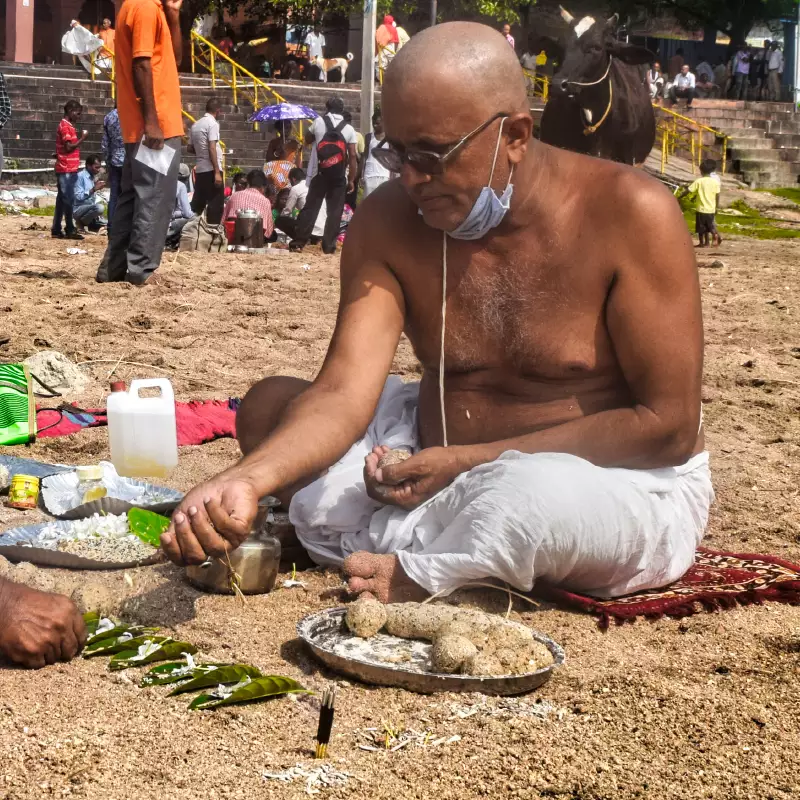
    Asthi Visarjan in Puri — Swargadwar ghat on the shores of Mahodadhi
    Swargadwar, Puri — the cremation and immersion ghat on the shores of Mahodadhi (Bay of Bengal)

    The Three Sacred Places for Asthi Visarjan for Odia Families

    Most Indian families perform Asthi Visarjan at the nearest major tirtha — Haridwar for North Indians, the Ganga ghats in Varanasi, or the Kaveri river for South Indians. Odia families, by contrast, have inherited from their ancestors a triangulated sacred geography that recognises three rivers and three traditions, each valid, each powerful, and each serving a slightly different spiritual purpose.

    The first is Puri, home to the Mahodadhi (Bay of Bengal) and the cremation ghat called Swargadwar — literally “the Gate of Heaven.” This is the Vaishnava choice: families devoted to Lord Jagannath bring the ashes of their departed to the ocean under His gaze, believing that immersion in Mahodadhi near the Dham itself carries the soul directly to Vaikuntha. The Skanda Purana’s Utkala Khanda records Puri among the seven most sacred cities where liberation is assured, irrespective of one’s birth or deeds.

    The second is Jajpur, a city that the rest of India has largely forgotten but that every Odia family from the eastern districts — Jajpur, Kendrapara, Bhadrak, Balasore — knows by another name: Nabhi Gaya, or “the Gaya of the navel.” Here flows the Baitarani river, which is none other than the mythological Vaitarni — the river that a departed soul must cross in the afterlife. Performing Asthi Visarjan in the very river one will one day have to cross is considered the ultimate act of preparation. The presiding deity is Biraja Devi, a form of the Goddess who grants liberation to the ancestors.

    The third is Prayagraj, at the Triveni Sangam, where the Ganga and Yamuna visibly meet and the Saraswati flows invisibly below. This is not an Odia tradition in the same ancestral sense, but it is endorsed by every major Purana as the supreme tirtha. The Garuda Purana states unequivocally: Tirthanam Uttamam Tirtha — Prayagam Paramam Smritam (Among tirthas, Prayagraj is remembered as the highest). For families seeking the maximum scriptural merit, or for those who wish to combine Asthi Visarjan with Pind Daan or Shradh in a single pilgrimage, Prayagraj is the most complete choice.

    The Vaishnava versus Shaiva tradition divide in Odisha is real and worth understanding. Families from coastal and central Odisha — Puri, Cuttack, Khordha, Nayagarh — tend toward the Vaishnava orientation and gravitate to Puri. Families from eastern and northern Odisha — Jajpur, Kendrapara, Bhadrak, Balasore, Mayurbhanj — often prefer Jajpur and the Baitarani. There is no conflict: both are honoured in the sacred texts. And families from either tradition who seek the highest possible merit are increasingly turning to Prayagraj, where Odia-speaking pandits are available to guide the rituals in the Odia paddhati.

    Asthi Visarjan at Puri — Swargadwar and Sweta Ganga

    Puri’s relationship with death and liberation is unlike any other Hindu pilgrimage city. While Varanasi is known as the city where Shiva himself whispers the Taraka mantra into the ear of the dying, Puri makes its promise through Lord Jagannath — the all-seeing, all-encompassing form of Vishnu who looks down with those vast painted eyes on every soul that crosses Swargadwar.

    Swargadwar — the Gate of Heaven — is the cremation ghat on the southern end of Puri town, right on the shore of Mahodadhi, the Great Ocean. The name is not metaphorical. The Skanda Purana’s Utkala Khanda explicitly states that souls cremated or immersed at this ghat pass directly to Swarga (heaven) due to the proximity of the Shri Mandir (Jagannath Temple) and the sanctity of the ocean. For more than a thousand years, Odia families have brought their dead here, and many Hindu pilgrims from across India specifically request that their bodies, or the ashes of their ancestors, reach this ghat.

    The Sweta Ganga is a separate, smaller tank within the Jagannath Temple complex, considered extremely sacred for ritual offerings to ancestors. While most Asthi Visarjan at Puri happens in the ocean at Swargadwar, some families also perform tarpan (water offerings) at Sweta Ganga, which is believed to be connected to the holy waters of the Ganga itself. The combination of immersion in Mahodadhi and tarpan offerings at Sweta Ganga makes a Puri visit deeply complete for Vaishnava families.

    The scriptural foundation for Puri’s sanctity comes primarily from the Skanda Purana, Utkala Khanda, which describes Puri as one of the seven Mukshyatirthas — places where liberation from the cycle of birth and death is granted. The text specifically mentions that the ocean at Puri is not merely salt water but is infused with the spiritual power (shakti) of Lord Jagannath’s presence, making it a vehicle for ancestral liberation comparable to the Ganga itself.

    For Vaishnava families, Puri carries an additional significance: Lord Jagannath is considered the form of Vishnu who presides over salvation. The Garuda Purana, in its description of ancestral rites, notes that immersion near a Vaishnava Dham liberates the pitrus (ancestors) more swiftly than immersion at a tirtha without a major deity presence. Puri, with its Dham status and its ocean ghat, fulfils this in the most complete way possible.

    For booking Asthi Visarjan at Puri with the support of experienced teerth purohits, see our dedicated Puri Asthi Visarjan service page.

    Asthi Visarjan at Jajpur — the Baitarani River and Biraja Devi

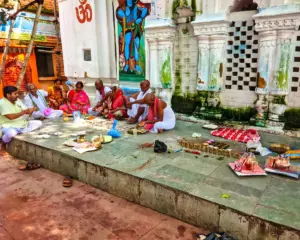
    Odia pilgrims performing ancestral rites — the tradition of sacred rivers in Odisha
    Odia pilgrims at a sacred river ghat — ancestral rites performed in the presence of purohits who understand the regional paddhati

    Among the three options available to Odia families, Jajpur is the one that most of India does not know about. Yet within Odisha, particularly in the Jajpur district and the adjoining coastal belt, this city carries a weight that is spoken of in whispers: Baitarani re bisarjan dile, ekusha pidi mukti pae — “Immerse the ashes in the Baitarani and twenty-one generations find liberation.” No competitor website in the Asthi Visarjan space has written about Jajpur at any depth. What follows is drawn from Odia puranic tradition and the Sanskrit texts that underpin it.

    Jajpur as Nabhi Gaya

    The identity of Jajpur as Nabhi Gaya — the Gaya of the Navel — comes from the Gaya Mahatmya section of the Agni Purana and related texts. According to the legend of Gayasura, when the demon Gayasura was subdued and his body was pressed flat by the feet of Vishnu, different parts of his body became different sacred tirthas. The head became Gaya (in Bihar), and the navel — the seat of the soul — became what is now known as Jajpur in Odisha. Just as Gaya’s Vishnupad is the supreme site for Pind Daan (the scriptural claim being that Pind Daan at Gaya liberates 100 generations), Jajpur’s Baitarani ghat is the supreme site for liberation of the pitrus through water. The number stated in the Odia puranic tradition is 21 generations — far beyond what most ordinary tirthas can offer.

    The Baitarani River and the Vaitarni of the Afterlife

    The Baitarani river that flows through Jajpur district is the same sacred stream described in the Puranas as the Vaitarni — the river of the afterlife. The Garuda Purana, in its detailed description of what a soul experiences after death, repeatedly mentions the Vaitarni river as one of the obstacles the departed must cross. It is a fierce river, and the Purana states that those who donated a cow (go-daan) during their lifetime, or whose families performed the proper post-death rituals, cross the Vaitarni without difficulty, aided by the cow they gifted.

    The Baitarani river of Odisha is identified in local tradition and Odia texts as a physical manifestation of this metaphysical river. Performing Asthi Visarjan — the immersion of a loved one’s ashes — in the very river their soul must one day cross is considered the most powerful protection one can offer. The logic is deeply beautiful: by immersing the ashes in the Baitarani, you are in a sense smoothing the path ahead of them, purifying the river that awaits the soul on its journey.

    Biraja Devi — the Presiding Deity

    The sacred complex at Jajpur is presided over by Biraja Devi, one of the Shakti Peethas of Odisha. The Devi Bhagavata Purana and local Odia texts identify Biraja as the form of the Goddess where a part of Sati’s body fell — specifically, the navel — which corresponds exactly to the Nabhi Gaya identification. Biraja Devi is therefore both a Shakti Peetha and the guardian of the ancestral liberation performed on the Baitarani.

    When an Odia family arrives in Jajpur for Asthi Visarjan, the ritual sequence has two anchors: the Baitarani ghat for the immersion itself, and the Biraja Devi temple for the post-immersion puja and seeking the Devi’s blessings for the departed soul. The combination of Shakti Peetha darshan and sacred river immersion makes Jajpur unique — no other site in the Asthi Visarjan landscape offers both.

    Dasaswamedha Ghat at Jajpur

    The specific ghat at Jajpur where Asthi Visarjan is performed is the Dasaswamedha Ghat on the Baitarani river. The name is significant: Dasaswamedha literally means “ten horse sacrifices” — the same name given to the most famous ghat in Varanasi. In Hindu tradition, a ghat bearing this name is considered to carry the accumulated merit of ten Ashwamedha yagyas. The Jajpur Dasaswamedha Ghat therefore amplifies the sanctity of every ritual performed on its steps.

    The ghat is active throughout the year, but particularly busy during Pitrupaksha (the fortnight of ancestral rites, typically in September), and during the days of solar eclipses (Surya Grahan) when the merit of any ritual performed at a sacred river is multiplied a thousandfold according to the Dharma Sindhu.

    Who Should Choose Jajpur?

    Jajpur is the traditional choice for families from the Shaiva communities of eastern Odisha — particularly those from Jajpur, Kendrapara, Bhadrak, Balasore, and Mayurbhanj districts, where the Baitarani tradition is part of living family memory. It is also the right choice for families who want to combine Asthi Visarjan with Pind Daan at a site that is scripturally equivalent to Gaya but far easier to reach from Bhubaneswar (approximately 120 km, three hours by road on NH16). For those whose ancestors were fishermen, river-workers, or lived in close proximity to the Baitarani basin, this site carries a cultural depth that Puri or Prayagraj cannot replicate.

    A note on practical arrangements: Jajpur has local Odia purohits who handle the rituals in the traditional manner, and no advance booking is typically required for the basic ceremony. The town is smaller than Puri, and accommodation is more basic, but the ritual environment is quiet and deeply concentrated — which many families, exhausted by grief, find more appropriate than a crowded pilgrimage city.

    Jajpur or Gaya? Both are forms of the same sacred body — Gayasura. Gaya liberates 100 generations through Pind Daan; Jajpur liberates 21 through Asthi Visarjan in the Baitarani. Many Odia families perform both on a single pilgrimage: Pind Daan at Gaya followed by Asthi Visarjan at Jajpur, covering both the food-offering and the ash-immersion ritual in a single sacred journey.

    Why Odia Families Also Choose Prayagraj for Asthi Visarjan

    A couple performs Asthi Visarjan from a boat at Triveni Sangam Prayagraj
    Asthi Visarjan at Triveni Sangam — at the point where three sacred rivers meet, the ashes are immersed at the deepest confluence

    Odia families have been coming to Prayagraj — or Teerth Raj Prayag as the texts call it — for centuries. The tradition may not be as immediately visible as the Puri connection, but it is recorded in the Puranas as the supreme option for any Hindu seeking to give their ancestors the highest possible liberation. For Odia families who want to go beyond the regional tradition and offer the fullest possible merit to the departed, Prayagraj at the Triveni Sangam is the answer the scriptures give.

    ଓଡ଼ିଆ ପରିବାର ପାଇଁ ପ୍ରୟାଗରାଜରେ ଅସ୍ଥି ବିସର୍ଜନ — Asthi Visarjan at Prayagraj for Odia families. This is a service that Prayag Pandits has offered with Odia-speaking purohits for many years.

    Scriptural Superiority of Triveni Sangam

    The Garuda Purana, in the Preta Khanda section that deals specifically with post-death rituals, states: “Gangayam cha Prayage cha yat phalam labhet / Tasya koti guna phalam Triveni Sangame bhavet” — whatever merit one obtains on the Ganga, the merit obtained at Triveni Sangam in Prayagraj is a crore (ten million) times greater. This is not unique to the Garuda Purana: the Padma Purana, the Matsya Purana, and the Agni Purana all establish the Triveni Sangam as the single most potent tirtha for ancestral rites.

    The Padma Purana adds a specific instruction for those who cannot attend in person during the most auspicious period: if Asthi Visarjan at Prayagraj cannot be performed during Magh month (the 45 days of Magh Mela), the merit of performing it at any other time of year is still multiplied tenfold compared to an equivalent ritual at any other tirtha. And during Magh month specifically, when the sacred waters of three rivers intensify their confluence, the merit is multiplied a hundred times beyond that base.

    The Triveni Sangam is also unique in that the Saraswati river, invisible to the eye, flows underground to join the Ganga and Yamuna at this precise point. The triple-river confluence is what generates the exceptional spiritual charge at Prayagraj — the visible and invisible meeting in one place, as heaven and earth meet at death.

    Odia-Speaking Pandits at Prayagraj

    One practical concern that every Odia family raises is whether the ritual will be performed correctly in the Odia paddhati — the specific sequence and mantras followed in Odia tradition. The sankalpa (sacred declaration at the start of any ritual) must include the family’s gotra, the name of the departed, the regional tradition (Utkala Pradesh, Mahanadi basin, etc.), and the specific Vaishnava or Shaiva orientation of the family. Without an Odia-speaking purohit who understands these regional variations, the sankalpa may be generic — valid but not precise.

    Prayag Pandits has Odia-speaking pandits at Prayagraj who can guide the complete ritual in the regional paddhati. The sankalpa is performed in Sanskrit with Odia regional references intact. Families from all districts of Odisha — Bhubaneswar, Cuttack, Berhampur, Sambalpur, Rourkela, Koraput — have used this service, and the pandit can adapt the ritual to whether the family follows the Vaishnava or Shaiva tradition.

    Travel from Odisha to Prayagraj

    The journey from Bhubaneswar to Prayagraj is straightforward. By train, the most direct option is the Bhubaneswar–Prayagraj Sangam Express (12 hours), or via the Konark Express and Rajdhani connections through Howrah (14–18 hours depending on route). By flight, Bhubaneswar has direct and connecting flights to Prayagraj via Kolkata or Delhi, with a total travel time of approximately two to three hours. Families from Cuttack, Berhampur, and Rourkela have convenient rail connections to Prayagraj without needing to transit through Bhubaneswar.

    The distance and travel time are a genuine consideration for families in grief. Prayagraj is not the most convenient choice for an Odia family — Puri (60 km from Bhubaneswar) and Jajpur (120 km) are far closer. But for families who wish to combine Asthi Visarjan with other major ancestral rites — Pitru Tarpan, Tripindi Shradh, or Narayan Bali — Prayagraj offers everything in one visit, at the highest merit tirtha available in all of Hindu sacred geography.

    For families who cannot travel at all, the asthi visarjan by courier/post service allows the kalash to be sent to Prayagraj, where the ritual is performed on behalf of the family with video documentation.

    Products for Odia Families at Prayagraj

    Prayag Pandits offers two dedicated services for Odia families:

    A cross-sell worth noting: many Odia families who come for Asthi Visarjan also choose to perform Pitru Tarpan specifically for Odiya families at the Sangam on the same visit, completing both the ash immersion and the water offering in one powerful day of ancestral service.

    Puri vs Jajpur vs Prayagraj — Comparison Table

    Choosing between these three sacred places should not be a decision made in haste. Below is a direct comparison to help your family weigh the options clearly.

    AspectPuri (Swargadwar)Jajpur (Baitarani)Prayagraj (Triveni Sangam)
    Best forVaishnava families; those devoted to Lord JagannathEastern Odisha Shaiva tradition; Baitarani basin familiesMaximum scriptural merit; combined pilgrimage visits
    Sacred waterMahodadhi (Bay of Bengal / Indian Ocean)Baitarani river (the Vaitarni of afterlife mythology)Ganga, Yamuna and invisible Saraswati confluence
    Presiding deityLord Jagannath (Vishnu form)Biraja Devi (Shakti Peetha)Triveni Sangam — Lord Brahma, Vishnu, Shiva each worshipped here
    Scriptural authoritySkanda Purana, Utkala Khanda — one of seven MukshatirthasGaya Mahatmya (Agni Purana) — Nabhi Gaya; Garuda Purana Vaitarni referencesGaruda Purana, Padma Purana, Matsya Purana — supreme tirtha for ancestral rites
    Generations liberatedLiberates the soul directly (Mukhyatirtha status)21 generations (Odia puranic tradition, Baitarani immersion)Merit multiplied crore-fold; tenfold in Magh month (Padma Purana)
    Main ghatSwargadwar ghat; Sweta Ganga for tarpanDasaswamedha Ghat on Baitarani riverTriveni Sangam confluence — boat to deepest point
    Distance from Bhubaneswar60 km, 1.5 hours by car120 km, 3 hours by car (NH16)~800 km, 12–18 hours by train / 2–3 hours by flight
    Odia-speaking panditYes — local Odia purohits at SwargadwarYes — local Odia purohits at Dasaswamedha GhatYes — via Prayag Pandits
    Cost with panditQuote-based (local purohit arrangement)Quote-based (local purohit arrangement)₹5,100 (standard) / ₹5,100 (with private boat)
    Combined rituals possibleJagannath Temple darshan, puja offeringsBiraja Devi darshan, Pind Daan also available nearbyAsthi Visarjan + Tarpan + Shradh + Pind Daan in one visit

    What to Expect During Asthi Visarjan at Each Location

    The core procedure for Asthi Visarjan is consistent across all three sites — it is the surroundings, the specific mantras, and the order of subsidiary rituals that differ. Understanding what to expect helps a family arrive prepared, both practically and emotionally.

    The Universal Procedure

    Regardless of location, Asthi Visarjan follows a sequence derived from the Garuda Purana’s instructions on the anga-kara kriya (limb-gathering rituals). The family arrives at the ghat, takes a purifying bath in the sacred water, and then sits with the teerth purohit for the sankalpa — the formal declaration that names the deceased, states the family gotra, names the person performing the ritual, and identifies the tirtha at which the ritual is being performed. The sankalpa binds the ritual to the soul of the departed and ensures that its merit is directed to the correct pitru.

    After the sankalpa, the asthi kalash (the vessel containing the ashes and bone fragments) is opened. The purohit recites the specific mantras for asthi visarjan, including passages from the Garuda Purana and the regional variation used in Odia tradition. The ashes are then immersed gradually, not all at once — typically the family member holds the kalash at the water’s edge and tilts it slowly while the purohit continues the mantra recitation. Flower offerings and til (sesame seeds) are made. Finally, Pitru Tarpan — water offerings made by cupping the palms and letting the water fall back into the river — is performed for the specific departed soul and for the broader lineage of ancestors.

    At Puri’s Swargadwar

    The ritual at Swargadwar has the ocean as its backdrop, which creates an atmosphere unlike any inland ghat. The sound of waves, the smell of the sea, and the awareness that the Jagannath Dham stands just a few kilometres away creates a distinctly Vaishnava emotional register. After the immersion in Mahodadhi, many families walk to the Jagannath Temple for darshan, offering a special puja for the departed soul and seeking Lord Jagannath’s direct blessing on the soul’s onward journey. The local purohits at Swargadwar are familiar with the Odia paddhati and will guide the ritual in the proper sequence.

    See our Puri Asthi Visarjan service page for complete details of what is included and how to prepare.

    At Jajpur’s Dasaswamedha Ghat

    Jajpur’s ritual environment is quieter and more intimate than Puri. The Baitarani ghat has the feel of a living river tirtha — the water flows, crows call, and the atmosphere of ancestral rite is palpable. After the immersion, the family is expected to visit the Biraja Devi temple for darshan and seek the Goddess’s blessing, which is considered an essential complement to the immersion ritual — the Devi is both the guardian of the sacred site and the liberator of the pitrus. The combined visit — ghat first, temple after — takes about two to three hours.

    Families who also wish to perform Pind Daan on the same visit can do so on the banks of the Baitarani itself, as local pandits are equipped for both. For those who wish to complete the full sequence of ancestral rites, combining Jajpur Asthi Visarjan with a Gaya Pind Daan visit a few days later is a tradition that many eastern Odia families follow.

    At Prayagraj’s Triveni Sangam

    The ritual at Prayagraj is the most logistically distinct of the three, because the actual immersion point — the exact confluence of the three rivers — is not accessible from the bank on foot. It requires a boat ride to the mid-river point, where the waters of the Ganga and Yamuna visibly meet and the current of both rivers can be felt simultaneously. This boat ride is not merely a practical necessity: it is itself a ritual act. The purohit accompanies the family on the boat, and the mantra recitation begins during the ride.

    At the confluence, the kalash is opened and the ashes are immersed into the three rivers simultaneously — which is, the texts state, the merit of immersing separately in all three sacred rivers. After the immersion, tarpan is offered from the boat before the return journey. The complete guide to Asthi Visarjan in Prayagraj covers every detail of the ritual, timing, and post-immersion protocol.

    For families who have lost an ancestor to an unnatural or sudden death, a note: if the departed died before their natural time (akal mrityu), the Tripindi Shradh should ideally be performed before or alongside the Asthi Visarjan at Prayagraj. The combined ritual resolves the spiritual obstacle created by untimely death and ensures the soul’s onward progress.

    How to Reach These Sacred Sites from Odisha

    Odia pilgrims travelling to sacred sites — the pilgrimage routes from Odisha
    Odia families travel considerable distances for sacred ancestral rites — choosing the right destination depends on tradition, distance, and the scale of merit sought

    Bhubaneswar to Puri

    60 km, approximately 1.5 hours by car or bus. The NH316 connects Bhubaneswar directly to Puri. Frequent buses (OSRTC and private) run throughout the day. Auto-rickshaws and taxis are available from Puri railway station or bus stand to Swargadwar. Puri railway station itself is approximately 2 km from Swargadwar ghat. From Puri town, any local resident or auto driver can direct you to the ghat — it is the most well-known spot in the city after the Jagannath Temple.

    Bhubaneswar to Jajpur

    120 km, approximately 3 hours by car on NH16 (Bhubaneswar–Kolkata highway). Jajpur Road railway station is the nearest railhead, with frequent trains from Bhubaneswar, Cuttack, and Bhadrak. From Jajpur Road station, Jajpur town (also called Jajpur City) is approximately 25 km. Within Jajpur town, the Dasaswamedha Ghat on the Baitarani river is the central ritual site, well-known locally. The Biraja Devi temple is within walking distance of the ghat. Accommodation in Jajpur is basic — many families choose to make it a day trip from Bhubaneswar or Cuttack, completing the ritual and returning the same evening.

    From Cuttack, Berhampur, Balasore, Sambalpur, Rourkela

    • Cuttack to Puri: 85 km, 2 hours. Cuttack to Jajpur: 60 km, 1.5 hours — Jajpur is the closer option for Cuttack families.
    • Berhampur to Puri: 160 km, 3.5 hours on NH16.
    • Balasore to Jajpur: 80 km, 2 hours — making Jajpur the natural choice for Balasore and Bhadrak district families.
    • Sambalpur to Prayagraj: By train via Rourkela–Tatanagar or directly on the Sambalpur–Prayagraj express (approximately 14–16 hours).
    • Rourkela to Prayagraj: Train connections via Hatia or Tatanagar, approximately 12–14 hours. A direct flight is available from Bhubaneswar via Kolkata if the family starts from Bhubaneswar.

    Bhubaneswar to Prayagraj

    The most popular train options are the Bhubaneswar–Prayagraj Sangam Express (approximately 12 hours) and the Konark Express, which runs via Bhubaneswar through Kolkata and connects to the Prayagraj–Howrah lines. The Rajdhani from Bhubaneswar runs through the night and reaches Prayagraj in approximately 15 hours. By air, Bhubaneswar (Biju Patnaik International Airport) has morning flights connecting via Kolkata or Delhi to Bamrauli Airport in Prayagraj, with total travel time of 3–5 hours depending on the connection.

    Once in Prayagraj, the Sangam is approximately 7 km from Prayagraj Junction railway station. Prayag Pandits can arrange pickup, assist with accommodation, and guide families through the complete ritual sequence. Contact details are in the booking section below.

    Book Asthi Visarjan with Prayag Pandits

    Triveni Sangam Prayagraj — boat ride to the sacred confluence for Asthi Visarjan
    The boat ride to the Triveni Sangam confluence — where the Ganga and Yamuna meet at Prayagraj, the most sacred point for Asthi Visarjan

    If your family has decided that Prayagraj is the right choice — for the scriptural merit, for the combination with other ancestral rites, or simply because it is the tirtha the Puranas recommend above all others — Prayag Pandits is ready to serve you.

    We have served Odia families at Triveni Sangam for many years. Our pandits understand the Odia paddhati, the regional sankalpa format, the Vaishnava and Shaiva orientations of different Odia communities, and the specific mantras appropriate for Utkala Pradesh families. Your ritual will not be a generic ceremony — it will be performed correctly, in your family’s tradition, at the most sacred point on the sacred river.

    The services available for Odia families:

    • Prayagraj Asthi Visarjan for Odia Families — ₹5,100. Includes: Odia-speaking pandit, boat ride to confluence, complete puja with sankalpa in Odia paddhati, asthi immersion with mantras, flower and sesame offerings, Pitru Tarpan at the Sangam. Suitable for families arriving independently.
    • Premium Asthi Visarjan for Odisha Pilgrims (with Private Boat) — ₹5,100. All of the above, plus a private boat exclusively for your family — no sharing with other groups, complete privacy and unhurried time at the confluence. Recommended for families who want solitude and a deeper ritual experience at the Sangam.
    • Pitru Tarpan for Odiya Families at Sangam — to be performed on the same visit or as a separate ceremony if the family has already completed the Asthi Visarjan elsewhere. Tarpan at Triveni Sangam feeds the ancestors with sacred water at the most merit-bearing location in the country.
    • Pind Daan at Gaya for Odia Pilgrims — if your family also wishes to complete Pind Daan at Gaya on the same pilgrimage, we can coordinate both visits.

    Asthi Visarjan — Odia Families

    ₹5,100

    • Odia-speaking pandit at Sangam
    • Sankalpa in Odia paddhati
    • Boat to Triveni Sangam confluence
    • Complete puja, tarpan, flower offerings
    • Video documentation available

    Book Now

    Premium — With Private Boat

    ₹5,100

    • Private boat — no sharing
    • Odia-speaking pandit
    • Complete privacy at confluence
    • Extended time at Sangam
    • Ideal for families from abroad or larger groups

    Book Premium

    For families who cannot travel to Prayagraj, the courier/post Asthi Visarjan service allows the asthi kalash to be sent to Prayagraj by registered post. The ritual is then performed on behalf of the family, with photographs and video documentation sent after completion. This service is available throughout the year and has been used by hundreds of Odia families based in Bhubaneswar, Rourkela, and overseas.

    To speak directly with a pandit about your family’s specific requirements, call or WhatsApp: +91 77540 97777. Our purohits are available to answer questions about which site is right for your family, what documents and items to bring, and how to prepare the asthi kalash before travel.

    For a deeper understanding of what Asthi Visarjan means scripturally — including the complete procedure, the timing, the mantras, and the significance of each element — see our complete guide to Asthi Visarjan and our article on the best places to perform Asthi Visarjan in India, which covers all fifteen major tirthas across the country. For those exploring the Odia Shraddha Paddhati — the full cycle of ancestral rites as observed in Odisha — that guide explains where Asthi Visarjan fits within the broader ritual calendar.

    Serve Your Ancestors at Triveni Sangam

    Odia-speaking pandits, private boat, complete puja in your family’s tradition — at India’s highest merit tirtha.

    Starting at ₹5,100

    Book Asthi Visarjan
    WhatsApp Us

    Asthi Visarjan in Prayagraj for Brahmins
    Most Popular Asthi Visarjan Package

    Asthi Visarjan in Prayagraj for Brahmins

    7,100.00 11,100.00

    Frequently Asked Questions

    Can we perform Asthi Visarjan at Jajpur instead of Gaya?

    Yes. Jajpur on the Baitarani river is known as Nabhi Gaya — the Gaya of the navel — because the navel of the demon Gayasura is believed to have fallen here per the Gaya Mahatmya in the Agni Purana. While Gaya in Bihar is the supreme site for Pind Daan (liberating 100 generations), Jajpur is the corresponding site for Asthi Visarjan and tarpan rituals, with the Odia puranic tradition recording that immersion in the Baitarani river liberates 21 generations. For families from eastern Odisha who follow the Shaiva tradition, Jajpur is often preferred over Gaya for the ash immersion ritual, though many families perform Pind Daan at Gaya and Asthi Visarjan at Jajpur on the same pilgrimage.

    What is the significance of Baitarani river compared to the Ganga?

    The Baitarani river in Odisha holds a unique place in Hindu mythology as the physical manifestation of the Vaitarni — the river of the afterlife that souls must cross after death. The Garuda Purana, in its detailed description of the post-death journey, refers to the Vaitarni as a fierce river that the departed soul encounters on its way. Performing Asthi Visarjan in the Baitarani is therefore considered a profound act of ancestral service: you are immersing the ashes of the departed in the very river their soul will one day have to cross, smoothing the path ahead. The Ganga, by contrast, is the supreme vehicle of liberation in the living world, and immersion in the Ganga at Triveni Sangam, Prayagraj carries the highest scriptural merit for the soul after death. Many Odia families who wish to cover both dimensions — the literal Vaitarni crossing and the supreme merit of the Ganga — choose to perform Asthi Visarjan at Jajpur for the Baitarani immersion and Tarpan at Prayagraj for the Ganga merit.

    Is it possible to do Asthi Visarjan at both Puri and Prayagraj?

    Yes, and some Odia families do exactly this. There is no scriptural prohibition on performing Asthi Visarjan at more than one tirtha — in fact, the Dharma Sindhu notes that if a family is unsure which sacred site is most appropriate, they may divide the ashes and perform the immersion at multiple locations. In practice, many families divide the asthi kalash: a portion is immersed at Puri under the gaze of Lord Jagannath for the Vaishnava blessing, and the remainder is brought to Triveni Sangam, Prayagraj for the highest Puranic merit. The two immersions complement rather than duplicate each other. If travel is a constraint, the courier service offered by Prayag Pandits allows the remaining ashes to be sent to Prayagraj and immersed on the family behalf, with video documentation sent after the ritual.

    Can Odia families get a pandit who speaks Odia at Prayagraj?

    Yes. Prayag Pandits has Odia-speaking purohits at Triveni Sangam, Prayagraj who are specifically trained to perform rituals in the Odia paddhati. This means the sankalpa — the formal declaration at the start of any ritual that names the departed, states the family gotra, and identifies the regional tradition — is performed with the Utkala Pradesh references intact, whether your family follows the Vaishnava or Shaiva orientation. The sankalpa in Sanskrit includes the correct Odia regional identifiers so the merit of the ritual is properly directed. Families from Bhubaneswar, Cuttack, Berhampur, Sambalpur, Rourkela, and other Odia districts have used this service, as have Odia NRI families based in the UK, USA, Canada, and Australia. See the dedicated service page for Odia families at Prayagraj for booking details.

    At which ghat in Puri is Asthi Visarjan performed?

    Asthi Visarjan in Puri is performed at Swargadwar, which translates as the Gate of Heaven. This is the cremation and ash immersion ghat on the southern shore of Puri town, right on the edge of Mahodadhi (the Bay of Bengal). The ghat is within sight of the town centre and approximately 2 km from Puri railway station. For most Asthi Visarjan rituals, the ashes are immersed in the ocean at Swargadwar. Some families also perform Pitru Tarpan at the Sweta Ganga, a sacred tank within the Jagannath Temple complex, which is considered connected to the holy Ganga itself. Local teerth purohits are present at Swargadwar to guide families through the ritual. After the immersion, many families walk to the Jagannath Temple for darshan and make additional offerings for the departed soul.

    Share

    Book Your Sacred Ritual

    Authentic ceremonies performed by Veda-trained pandits with video proof at sacred sites across India.

    2,263+ families served Video proof included Since 2019
    About the Author
    Prakhar Porwal
    Prakhar Porwal Vedic Ritual Consultant, Prayag Pandits

    Prakhar Porwal is the founder of Prayag Pandits, a trusted platform for Vedic rituals and ancestral ceremonies. With deep roots in Prayagraj's spiritual traditions, Prakhar has helped over 50,000 families perform sacred rituals including Pind Daan, Shradh, and Asthi Visarjan across India's holiest cities.

    2,263+ families served · Operating since 2019
    Share
    Continue where you left off?

    Your Booking

    🙏 Add ₹0 more for priority scheduling

    No rituals selected yet.

    Browse Pooja Packages →
    Need help booking? Chat with us on WhatsApp