अभी तक कोई अनुष्ठान नहीं चुना गया।
पूजा पैकेज देखें →मुख्य बिंदु
इस लेख में
When someone dear passes away, the family does not simply grieve and move on. Hindu tradition recognises that the bonds between the living and the departed persist, and that the living carry a sacred obligation — Pitru Rina, the debt to ancestors — that must be honoured through ritual action. The Barsi ceremony, known in Sanskrit as Abdika Shradh or Varshik Shradh, is the culmination of a year of mourning observances. It marks the first death anniversary and carries a weight that no other post-cremation ceremony, except Sapindikarana itself, quite matches.
In this guide you will find everything a family needs to understand and properly perform the Barsi: its scriptural basis in the Garuda Purana and other texts, the precise date-calculation method, the complete step-by-step procedure, what foods are prescribed and what are strictly forbidden, and how to choose between performing the ceremony at home, in Prayagraj, in Gaya, or at Haridwar.
What Is Barsi? The Hindu First Death Anniversary
The word barsi is colloquial Hindi and Punjabi, derived from baras (year). In Sanskrit the ceremony is called Abdika — abda meaning year — or Varshik Shradh, the annual Shradh. In some regional traditions, particularly in Bengal and Odisha, it is called Barsika or Samvatsarika. Across every name lies one meaning: the first death anniversary Shradh, performed on the same lunar tithi on which the person died, in the following year.
The Garuda Purana, the primary scriptural authority on post-death rites, describes a precise sequence of Shradh ceremonies that a family must perform from the day of death through the first anniversary. The monthly ceremony performed on the same tithi each month is called Masika Shradh. The Barsi is the thirteenth and most significant of these monthly Shradhs — it does not simply repeat the monthly ritual but incorporates the Sapindikarana, the rite that elevates the soul from the transient Preta state into the permanent company of the Pitru Gana, the ancestral collective.
This is why the Barsi is performed on the lunar tithi, never on the English calendar date of death. The tithi is the day of death in the Hindu Panchang. If someone died on Ashadha Krishna Tritiya, Barsi falls on the next Ashadha Krishna Tritiya. In a year that has two months of the same name — a Adhik Maas or leap month — the second (original) month is used.
For more on the complete arc of Hindu death rituals from cremation through Shraddha, that pillar guide covers every stage in detail.
When Is Barsi Performed — The 11-Month Rule Explained
A question that comes to nearly every family is: Why do some pandits say 11 months and others say 12?
The Garuda Purana addresses this directly: “Sapindanam tu kartavyam samvatsare gate prabho / Ardhe va tri-paksha-dvaye va bahunam satsakridbhujam.” Translated: “The rite of Sapinda is performed after a year has passed, or at six months, or after three fortnights — or in the 11th or 12th month, many Brahmanas should be feasted, because the deceased is very hungry.”
The phrase “many Brahmanas should be feasted in the 11th or 12th month” has given rise to a family tradition where the Brahmin Bhoj component of Barsi is scheduled one month early, in the 11th month, particularly in communities that observe the ceremony within the house itself rather than at a tirtha. The full Sapindikarana puja, however, is almost universally observed at the 12-month mark on the correct tithi.
Regional panjika (almanac) traditions also introduce variation. In Odia families, for instance, the Odia Shraddha Paddhati follows the Odia panjika shift rule: if the death tithi falls during an inauspicious period, the family’s Kulapurohit (family priest) may shift the Barsi to the nearest auspicious tithi in the same month. This is not an avoidance of the ceremony but a recognised scriptural concession made in certain Smritis.
The rule of thumb: perform the Barsi on the Kshaya Tithi of the 12th month. If that tithi is combined with a severe dosha — such as falling on a Chaturdashi adjacent to Amavasya — consult your family pandit, who will apply the appropriate panjika rule.
The Soul’s Journey — Why Barsi Marks a Critical Transition
To understand why the Barsi is more than a memorial feast, one must understand the three-stage journey of the soul as described in the Garuda Purana. These are not metaphors. The text treats them as literal post-death stages that the soul passes through, each requiring specific ritual support from the living.
Stage 1 — Ativahika Sukshma Sharir (The Subtle Transit Body): Immediately after death, the gross body is surrendered. The Skanda Purana explains that the soul briefly occupies the Ativahika body — a fine, translucent form through which it makes the initial journey from the deathbed toward the realm of Yama. The Sapota Pinda (daily pinda offered during the first ten days of mourning) feeds this transit form so the soul does not arrive at Yama’s court in a weakened state.
Stage 2 — Preta Avastha (The Ghost State): For one full year, the soul inhabits the Preta body — a shadow form neither fully in this world nor fully accepted into the ancestral realm. It is during this year that the Ekodishta Shradh ceremonies are performed: the thirteen monthly Masika Shradhs, each addressed individually (ekodishta means “directed toward one alone”) to this specific soul. These ceremonies give the Preta body nourishment and ensure its safe passage when the time comes.
Stage 3 — Pitru Gana Pravesh (Entry into the Ancestral Collective): The Sapindikarana, performed either as a separate ceremony before the Barsi or as an integrated part of it, is the formal elevation rite. The word Sapinda means “sharing the same pinda” — the Ekodishta pinda is ritually joined with the three-generation pinda of the Pitru Gana (father, grandfather, great-grandfather). With this joining, the Preta ceases to exist as an individual and enters the Pitru Gana as a full member of the ancestral collective.
This transition carries a non-negotiable rule that the Garuda Purana states with unusual force: after Sapindikarana, the Ekodishta form of Shradh must never be performed again for that soul. The text says that performing individual Ekodishta after Sapindikarana “virtually kills the Pitrs and brings down Yama’s wrath” — because addressing one soul individually after it has merged with the collective is a contradiction of the very rite that elevated it. From the Barsi onward, the deceased must be included in the Parvana Shradh, the collective ancestral Shradh performed for all three generations together. This is why the Barsi is not simply a one-year memorial — it is the permanent ceremonial restructuring of how a family addresses that soul in all future Shradhs.
The Sapindikarana also connects directly to the 12th-day Sapindikarana ceremony: in some families this rite is performed on the 12th day after death (rather than at the year mark). If so, the Barsi focuses on the annual feast and Parvana Shradh without repeating Sapindikarana.
The Complete Barsi Ceremony Procedure: Step by Step
The Barsi typically begins before sunrise, ideally in the Brahma Muhurta (approximately 4:30–6:00 AM), though the Pinda Daan and Tarpan are performed during the midday Kutapa Kala (approximately 11:36 AM–12:24 PM), which the Vishwamitra Smriti identifies as the most auspicious window for ancestral offerings.
1. Sankalpa — The Sacred Vow
The chief mourner (usually the eldest son, though see below for who qualifies) faces east and takes the Sankalpa — a formal vow declaring name, gotra, place, tithi, and the purpose of the rite. The Sankalpa for Barsi specifically names the deceased by name, relationship, and gotra: “Asmin auspicious tithi, Varshik Abdika Shradh karma aham karishye.” The pandit recites the full Sankalpa formula while the family member holds darbha grass and black sesame in cupped hands.
2. Pancha Bali — The Five Great Offerings
Before any Pinda is offered to the ancestor, five portions of food (cooked rice or flour) are placed in five specific directions for five classes of beings. The Garuda Purana and Manu Smriti both mandate these offerings as a prerequisite — to skip them is to perform an incomplete Shradh.
- Go Bali (Cow): Placed on the ground or a leaf plate near the cow, with the mantra Om Dhenu-rupaya Svaha. The cow embodies the Prithvi tattva and carries the offering to the ancestral realm.
- Shvan Bali (Dog): Offered outside the ritual space, facing south. Dogs are said to guard the path to Yama’s realm; this offering ensures the soul’s safe passage.
- Kaka Bali (Crow): Placed on the roof or a high surface, with the mantra Om Kaka-rupaya Pitribhyo Svaha. In the Garuda Purana, crows are described as vehicles through which departed souls accept food. If a crow eats the Bali offering, it is considered auspicious confirmation that the ancestor has received it.
- Devadi Bali (Devas and Guests): An offering to the gods and any unexpected visitor — in keeping with the Vedic principle of Atithi Devo Bhava (the guest is God). Placed at the threshold.
- Pipilika Bali (Ants): The smallest offering, scattered on the ground for ants. No being that depends on the earth for sustenance should be forgotten.
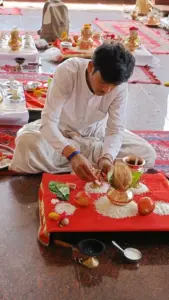
3. Ekodishta Pinda Daan
Three Pindas — balls of cooked rice mixed with black sesame, honey, and ghee — are offered for the deceased, the deceased’s father, and the deceased’s paternal grandfather. At the Barsi, if Sapindikarana has not yet been performed, this is the final Ekodishta offering. The pandit joins the individual Pinda with the three-generation ancestral Pindas in a single gesture — the Sapindikarana merge — with the mantra: Asmin Pindena Sapinditam Astu.
For those performing the Pind Daan ceremony as part of the Barsi, the complete Pinda Daan vidhi applies. At a tirtha, the Pindas are immersed in the sacred river after the ceremony.
4. Tarpan — Water Offering with Sesame
Water mixed with black sesame (kala til) is offered in cupped hands, allowing it to fall from the fingertips over the edge of the palm. The Pitru Tirtha — the base of the thumb on the inner side of the palm — is used for ancestral offerings specifically. For each pour, the pandit recites the deceased’s name and gotra: “[Name], [Gotra]-gotrasya… triptim astu.” The complete Pitru Tarpan vidhi with mantras gives the full text for families wishing to perform this with precision.
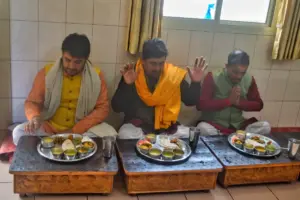
5. Brahmin Bhoj — The Sacred Feast
The Garuda Purana is emphatic on the Brahmin Bhoj at Barsi: “In the 11th and 12th month, many Brahmanas should be feasted, because then the deceased is very hungry.” The feeding of Brahmins is not merely a charitable act — the Puranas explain it as a mechanism of subtle nourishment. Ancestors occupy subtle prana-bodies and cannot directly eat physical food. They enter the sanctified body of an invited Brahmin and receive the food’s essence through him. The more qualified and pure the Brahmin, the more efficiently this transmission occurs.
Traditionally, an odd number of Brahmins is invited — 1, 3, 5, 7, or 11 — depending on the family’s capacity. Each Brahmin is received with respect, his feet washed symbolically, and he is served a full meal before the family eats. For a complete guide to the ceremony itself — how many Brahmins to feed at Barsi, the full prescribed menu, and cost at Prayagraj and Gaya — read our Brahmin Bhoj after death guide. The full scriptural rationale for Brahmin Bhoj deserves its own study.
6. Daan — Prescribed Gifts
At Barsi, certain Daanas (gifts) hold specific merit. The Garuda Purana recommends: a new set of clothing for the Brahmin pandit, Patra Daan (brass or copper utensils), an umbrella (Chhatra Daan), and bedding (Shayyaa Daan). These items represent comforts the soul may require in the ancestral realm and are gifted through the Brahmin as proxy.
What to Cook — Prescribed Foods and Strict Prohibitions
The Vishwamitra Smriti and Garuda Purana both devote significant attention to the food served at Shradh. Getting this right is not optional — the texts state that the merit of the entire ceremony can be diminished by serving incorrect food.
Most pleasing to ancestors (Garuda Purana): Kheer (rice cooked in milk — Payasam), til (black sesame in any form), barley, wheat, ghee, honey, and fresh seasonal vegetables. The Garuda Purana explicitly says Payasam atipritam — “Kheer is extremely pleasing to ancestors.” Sesame is mentioned in seven separate verses as the single most important ingredient because it repels negative energies and ensures the offering reaches the intended soul.
Absolutely forbidden at Barsi and all Shradh:
- Onion (palandu) and garlic (rasona) — mentioned by name in the Manu Smriti as disqualifiers
- Masoor dal (red lentils) and arhar dal (pigeon peas) — Vishwamitra Smriti prohibition
- Black salt (kala namak)
- Brinjal (eggplant), radish, and drumstick
- Meat, fish, and eggs
- Stale food prepared more than one watch (3 hours) earlier
- Food cooked by a menstruating woman or prepared in a ritually impure state
Everything served should be freshly prepared, Sattvic (pure), and prepared with the intention of offering. The cook is considered part of the ceremony — a state of mental calm and physical cleanliness during preparation is expected.
When Sapindikarana Was Already Performed on the 12th Day
If your family performed Sapindikarana on the 12th day after death (as is customary in some communities), the Barsi does not repeat this rite. Instead, the ceremony centres on the Parvana Shradh (collective offering to all three generations), Brahmin Bhoj, and Daan. The pandit will adjust the Sankalpa accordingly. The Barsi in this case is called Varshik Parvana Shradh.
If You Miss the Barsi Tithi — Scriptural Alternatives
Life does not always allow perfect scheduling. A family member may be abroad, the tithi may fall during a period of illness, or logistics may simply not align. The Shastras — practical in their mercy — provide clear alternatives for those who miss the Barsi tithi without recourse.
Sankalpik Shradh: On any day within a few days of the missed tithi, the chief mourner takes a formal Sankalpa declaring that the Barsi rite is being performed with this reduced ceremony in place of the full Shradh. At minimum, one Brahmin is fed and Tarpan offered. The intent encoded in the Sankalpa carries significant weight in the Shastric framework.
Aamanna Daan: Raw provisions — rice, lentils, vegetables, ghee, oil — are given with appropriate Dakshina to a Brahmin pandit, with the prayer that the merit of the gift serve in place of the cooked feast.
Pitru Paksha — The Universal Catch-All: The Garuda Purana guarantees that any Shradh not performed on its appointed tithi during the year can be performed during Pitru Paksha — the 15-day period of ancestral rites in the dark fortnight of Bhadrapada (September–October each year). The Sarva Pitru Amavasya on the last day accepts Shradh for all ancestors regardless of tithi. Many families who miss the Barsi tithi perform a full Pind Daan at Prayagraj or Gaya during Pitrupaksha as recompense.
For an in-depth view of what the Pitrupaksha Tarpan mantras involve, that guide gives the full ritual texts used during this period.
Chautha, Uthala, and Terahvin and Barsi — The Complete Mourning Timeline
The Barsi does not stand alone. It is the culminating ceremony in a precisely structured sequence of post-death rituals that begin the moment the body is cremated. Understanding where the Barsi sits in this sequence helps a family plan their observances correctly.
| Ceremony | Timing | Significance |
|---|---|---|
| Teehvin / Terahvin | 13th day after death | End of Ashaucha (ritual impurity); community feast |
| Masika Shradh | Same tithi monthly (months 1–11) | Monthly nourishment of the Preta body |
| Tripindi Shradh | When ancestral obligations are in arrears | Pacifies three generations of neglected ancestors |
| Barsi (Abdika Shradh) | 12th month, on the Kshaya Tithi | Sapindikarana + elevation to Pitru Gana; closes Ekodishta period |
| Annual Shradh (2nd year onward) | Same tithi every year | Parvana Shradh — collective for all three generations |
The Tripindi Shradh, performed when a family has missed three or more consecutive Shradhs, stands as a corrective ceremony. It is often performed alongside the Barsi at a sacred tirtha if multiple years of accumulated Masika Shradhs were not observed. Families who have neglected this sequence and now face unexplained obstacles — chronic illness, persistent financial difficulty, or conflict without apparent cause — are often advised to perform both the Barsi and a Tripindi Shradh at Prayagraj before resuming the annual cycle.
The complete Hindu death rituals guide covers every stage from the moment of death through to the annual Shradh cycle.
Who Can Perform the Barsi — Eligibility Rules
The default rule in Dharmashastra is that the eldest son performs all Shradh, including the Barsi. But the texts provide a clear hierarchy for situations where the eldest son is absent, deceased, or unable:
- Eldest son
- Any other son (in order of birth)
- Son’s son (grandson through the male line)
- Daughter’s son — specifically called Dauhitra, the grandson through a daughter. Both Manu Smriti and Vishwamitra Smriti identify the Dauhitra as a valid performer of Shradh.
- Sapinda — a male relative within seven generations on the paternal side
- If no male relative is available: the wife of the deceased may perform the rite, with scriptural support in several Smritis
The primary qualification is not gender — it is Shraddha, sincere devotion and the willingness to perform the ceremony with full awareness of its meaning. A family without a son should not feel that the Barsi cannot be performed. Consult a learned pandit who can identify the correct eligible performer from the Shastric hierarchy.
Where to Perform Barsi — Prayagraj, Haridwar, or Gaya?
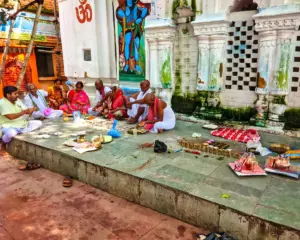
The Barsi can be performed at home with a pandit, but performing it at a Tirtha (sacred pilgrimage site) multiplies its merit many-fold. The Puranas assign specific types of liberation to specific tirthas.
Prayagraj — Triveni Sangam: The confluence of the Ganga, Yamuna, and the invisible Saraswati is described in the Matsya Purana as a tirtha where even a single Pinda Daan carries the merit of a thousand ordinary Shradhs. The combination of Kshaya Tithi Pinda Daan, Tarpan at Triveni Sangam, and Brahmin Bhoj at Prayagraj is considered the most auspicious Barsi for families based in North India. The Shradh in Prayagraj service page has the full package details.
Gaya — The City of Ancestors: The Gaya Mahatmya section of the Vayu Purana states that Pind Daan at Vishnupad Temple in Gaya liberates not only the direct ancestor but one hundred generations on both sides of the family. For a Barsi, this is extraordinary: the soul being released at its one-year mark, combined with the liberation of a hundred generations, makes Gaya the preferred location for families who can travel. The Shradh at Gaya guide covers the Phalgu River sites, the Vishnupad Temple rites, and what to expect.
Haridwar — Kankhal Ghat: Haridwar’s Kankhal Ghat holds a special status for ancestral rites. The Skanda Purana identifies Kankhal as the site where Sati’s arms fell, consecrating the land permanently. Pind Daan and Tarpan at the Ganga here carry the merit of release from the Pitru Rina (debt to ancestors). For families in western and central India, Haridwar is often the most accessible sacred site for Barsi. See the dedicated guide to Shradh at Haridwar for logistics, costs, and booking.
At Home with a Pandit: The Shastras do not require travel. A learned pandit performing the full Barsi Vidhi at home — with proper Sankalpa, Pancha Bali, Pinda Daan, Tarpan, and Brahmin Bhoj — fulfils the scriptural obligation completely. The merit is less than at a tirtha but the ceremony is fully valid.
Barsi Shradh — Recommended Products
- Pind Daan in Prayagraj — Triveni Sangam, includes Pancha Bali, Pinda Daan & Tarpan
- Pind Daan in Gaya — Vishnupad Temple & Falgu River, 100-generation liberation
- Pind Daan in Haridwar — Kankhal Ghat & Har ki Pauri, full Barsi Vidhi
- Online Shradh Poojan at Prayagraj — video-call ceremony for NRI families
Can Barsi Be Done Online or at a Distance?
This is a question many NRI families ask, and the honest answer is: yes, with the right setup.
The Shastric principle here is that the Sankalpa — the sacred vow — is the operative act. Manu Smriti states: “Yatra yatra hi dharmasya sadhanam…” — the fulfillment of Dharma is possible wherever sincere intent is coupled with proper ritual action. When a family abroad authorises a pandit at a sacred tirtha to perform the Barsi on their behalf, and they participate in the Sankalpa via live video, the rite carries full legitimacy.
The procedure for an online Barsi:
- The family shares the deceased’s full name, gotra, tithi of death, and relationship to the chief mourner.
- The pandit at Prayagraj (or Gaya/Haridwar) prepares all materials: Pinda, sesame, darbha grass, water from the sacred river.
- At the scheduled time on the Barsi tithi, a live video call is established. The family participates in the Sankalpa in real time — this is the moment of karmic connection.
- The pandit performs the full Vidhi: Pancha Bali, Pinda Daan, Tarpan, immersion of Pindas in the river. The family watches and silently holds the intention of offering.
- After the ceremony, a photograph of the prasad and a Puja certificate are shared with the family.
For the Brahmin Bhoj component, the family arranges to feed Brahmins locally or sends a Dakshina amount with the instruction that it be used to feed Brahmins at the tirtha on their behalf.
Book Your Barsi Ceremony with Prayag Pandits
Experienced Teerth Purohits at Triveni Sangam, Prayagraj. Full Barsi Vidhi — Sankalpa, Pancha Bali, Ekodishta Pinda Daan, Sapindikarana, Tarpan, and Brahmin Bhoj. In-person and video-call options for NRI families.
Starting at ₹5,100
Barsi on the 2nd, 3rd Year and Beyond
A clarification many families need: from the second year onward, the ceremony on the Kshaya Tithi is no longer called Barsi. It is the Varshik Parvana Shradh — the annual Shradh as part of the Parvana cycle. The structure changes: instead of the individual Ekodishta Pinda directed at one soul, the offering now includes all three generations (deceased, deceased’s father, deceased’s grandfather) in a single Parvana ceremony. The Brahmin Bhoj and Tarpan remain, but the intensity of the annual Barsi is not replicated — that singular weight belongs to the first year alone.
This is also why the second death anniversary is not called Barsi in any Shastric context: the term refers specifically to the first year, the year of Preta avastha, the year that culminates in Sapindikarana. From the second year, the soul has permanently joined the Pitru Gana and is remembered collectively.
Families wishing to understand the full calendar of Shradh observances — when each type of Shradh falls, which tithi applies, and how to plan for Pitrupaksha — will find the Shradh dates and Pitru Paksha calendar guide useful for multi-year planning.
अक्सर पूछे जाने वाले प्रश्न
What should be done on barsi — the first death anniversary?
The Barsi (Abdika Shradh) requires: (1) Sankalpa by the chief mourner on the Kshaya Tithi (lunar death anniversary) in the 12th month; (2) Pancha Bali — five food offerings to cow, dog, crow, devas, and ants; (3) Ekodishta Pinda Daan for the deceased and two preceding generations; (4) Sapindikarana if not already performed — the rite that elevates the soul from Preta state to Pitru Gana; (5) Tarpan with water and black sesame; and (6) Brahmin Bhoj — feeding an odd number of Brahmins a Sattvic meal. Daan in the form of clothing, utensils, umbrella, and bedding is also prescribed. The ceremony is performed at home with a pandit or at a tirtha like Prayagraj, Gaya, or Haridwar for greater merit.
Is the 2nd death anniversary also called barsi?
No. The term Barsi specifically refers to the first death anniversary — the Abdika Shradh of the first year. It is the only annual ceremony that includes Sapindikarana, which marks the soul permanent transition from the Preta state to the Pitru Gana. From the second year onward, the same annual tithi ceremony is called Varshik Parvana Shradh. Its structure also changes: the Ekodishta form of offering directed at one soul ends, and all future Shradhs include the deceased as part of the three-generation Parvana collective. The Garuda Purana makes this distinction clear — the soul has already been elevated and no longer receives individual Ekodishta rites.
Can barsi be done in 3 months if the family needs to?
The Garuda Purana mentions that Sapindikarana — the core rite of the Barsi — can be performed after six months, three fortnights, or on the 12th day in urgent situations. An accelerated Barsi at three months is not standard and requires strong justification. If Sapindikarana was already performed on the 12th day after death (common in some communities), the one-year Barsi becomes a Parvana Shradh without repeating Sapindikarana — fully valid. For non-standard timings, consult a learned Teerth Purohit who can assess the situation against the applicable Smriti tradition of the family.
How is the barsi date calculated — tithi or English calendar?
Barsi is always calculated by the Kshaya Tithi — the lunar tithi on which the person died — not the English calendar date. For example, if a person died on Ashadha Krishna Tritiya, the Barsi falls on the next Ashadha Krishna Tritiya, regardless of the Gregorian date. In a year with an Adhik Maas (leap month), use the second occurrence of that month — the original month, not the added one. If the tithi falls during a severe dosha period, the family Kulapurohit may shift the ceremony to the nearest auspicious tithi within the same lunar month under applicable panjika rules.
Who can perform barsi — only the eldest son?
The eldest son is the default performer under Dharmashastra, but the Shastric hierarchy provides clear alternatives: eldest son, then any other son (by birth order), then grandson through the male line, then Dauhitra (grandson through a daughter — explicitly validated in Manu Smriti and Vishwamitra Smriti), then any male Sapinda relative within seven generations, and finally the wife of the deceased if no male relative is available. The fundamental requirement is sincere Shraddha (devotion) and the willingness to perform the ceremony correctly with a qualified pandit. A family without a son should never leave the Barsi unperformed.
अपना पवित्र अनुष्ठान बुक करें
भारत भर के पवित्र स्थलों पर वेद-प्रशिक्षित पंडितों द्वारा वीडियो प्रमाण सहित प्रामाणिक अनुष्ठान।
2,263+ परिवारों की सेवा
वीडियो प्रमाण शामिल
2019 से
