
अभी तक कोई अनुष्ठान नहीं चुना गया।
पूजा पैकेज देखें →मुख्य बिंदु
इस लेख में

Of all the doshas that a Vedic astrologer may identify in a birth chart, few carry as much weight as Kaal Sarp Dosh. Families come to us at Prayag Pandits after years of unexplained setbacks — a career that refuses to take off despite genuine ability, a marriage delayed again and again with no logical reason, a health condition that responds to every treatment except a permanent cure. When we examine their kundali, we often find the same configuration: all seven major planets — Sun, Moon, Mars, Mercury, Jupiter, Venus, and Saturn — locked between the shadow planets Rahu and Ketu.
In our work performing Kaal Sarp Dosh Nivaran Puja for families across India and for NRI devotees around the world, we have seen firsthand how this dosha manifests and — more importantly — how a properly performed puja at a sacred tirtha can relieve its effects. This guide draws from that experience, from the Vedic texts, and from the specific ritual traditions preserved at the tirthas where this puja holds the most power.
Whether you are trying to confirm whether your kundali carries this dosha, understand which of the 12 types applies to you, or plan a Nivaran Puja at Ujjain or Trimbakeshwar, this guide covers everything you need to know.
What Is Kaal Sarp Dosh?

Kaal Sarp Dosh arises when all seven visible planets in a horoscope are positioned on one side of the Rahu-Ketu axis. In Vedic astrology, Rahu (the North Node of the Moon) and Ketu (the South Node) are always placed exactly opposite each other — six houses apart — in any birth chart. When the Sun, Moon, Mars, Mercury, Jupiter, Venus, and Saturn all fall within the arc that runs from Rahu to Ketu (in the direction of Rahu’s motion), the chart is said to carry Kaal Sarp Dosh.
The word “Kaal” means time — and in some interpretations, death or the force of fate. “Sarp” means serpent. The image is precisely that: the serpent of time consuming everything. Rahu acts as the head of the serpent, relentlessly consuming opportunities, relationships, and prosperity as they approach. Ketu acts as the tail — the emptiness left behind, the feeling that things promised never fully materialise.
The Mythology: Svarbhanu and the Amrit Manthan
The origin of Rahu and Ketu is narrated in the Samudra Manthan episode of the Bhagavata Purana. When the gods and demons churned the cosmic ocean, the physician of the gods — Dhanvantari — emerged carrying the vessel of Amrit (nectar of immortality). A demon named Svarbhanu disguised himself among the gods and swallowed a portion of the nectar before Lord Vishnu, in his Mohini form, noticed the deception. Vishnu immediately severed Svarbhanu’s head with the Sudarshana Chakra.
Because Svarbhanu had already swallowed the Amrit before the cut, both the severed head (Rahu) and the headless body (Ketu) became immortal. They move through the sky as shadow planets, perpetually hungry — Rahu seeking what it can never fully swallow, Ketu bereft of the ability to taste what it holds. When a person is born under their combined grip on the entire chart, this mythological hunger becomes woven into the fabric of their life.
How to Identify It in Your Kundali
To check your birth chart for Kaal Sarp Dosh, look at the positions of all nine grahas. Identify where Rahu and Ketu sit. If every planet — Sun, Moon, Mars, Mercury, Jupiter, Venus, Saturn — falls within the 180-degree arc stretching from Rahu to Ketu (moving in Rahu’s direction), the dosha is present. The specific type depends on which house Rahu occupies, which gives each of the 12 forms of the dosha its distinct name and character.
If even one planet falls outside this arc — on Ketu’s side — the configuration is sometimes called a partial or Anshik Kaal Sarp Dosh, which carries a reduced but still notable effect. A learned Vedic astrologer can distinguish between the full and partial forms during a kundali analysis.
The 12 Types of Kaal Sarp Dosh
Each of the 12 types corresponds to Rahu’s house placement in the natal chart. The type determines which areas of life are most affected and can help a family understand the pattern of challenges they have been experiencing. In our practice at Prayag Pandits, we see some types more frequently than others — Anant, Takshak, and Kulik appear most often among those who reach out to us for the Nivaran Puja.
1. Anant Kaal Sarp Dosh (Rahu in 1st House, Ketu in 7th)
The first house governs the self — personality, appearance, and the overall direction of life. Ketu in the seventh house, which rules partnerships and marriage, creates a persistent tension between self-expression and relationships. People with Anant Kaal Sarp Dosh frequently experience an inferiority complex that belies their actual capabilities. Relationships are unstable; marriage may be delayed significantly, or the native may enter into partnerships only to see them dissolve without obvious cause. Mental anxiety tends to run as a constant undercurrent, flaring during periods governed by Rahu or Ketu in the Mahadasha cycle.
2. Kulik Kaal Sarp Dosh (Rahu in 2nd House, Ketu in 8th)
Rahu in the second house — which governs accumulated wealth, family, and speech — combined with Ketu in the eighth house of sudden events and inheritance creates a particularly difficult financial pattern. Families with Kulik Kaal Sarp Dosh often report that money is earned but never retained; financial losses come from unexpected directions, sometimes through family members. Health issues tend to become chronic rather than acute, and the native’s reputation in their community may suffer through no fault of their own. Accidents and sudden reversals are more common during Rahu-Ketu transits. This type is considered one of the more severe among the twelve.
3. Vasuki Kaal Sarp Dosh (Rahu in 3rd House, Ketu in 9th)
The third house rules courage, communication, and siblings. The ninth house governs dharma, fortune, and the father. With Rahu in the third house, the native may experience high blood pressure and nervousness, particularly in high-stakes situations. Sibling relationships are often troubled. Business losses tend to come through relatives or people in one’s close circle rather than external competitors. Career delays are common, and the support one would normally expect from luck or dharma (the ninth house) feels perpetually withheld.
4. Shankhpal Kaal Sarp Dosh (Rahu in 4th House, Ketu in 10th)
The fourth house governs the home, mother, property, and vehicles. Ketu in the tenth house — career and public standing — brings persistent workplace stress that seems disproportionate to the actual work environment. Those with Shankhpal Kaal Sarp Dosh often change residences frequently, struggle to maintain property, or find that vehicles and household matters consume unusual amounts of time and money. A sense of home instability — emotional as much as physical — runs through their domestic life. Professional recognition is slow to come, even when the native’s performance genuinely deserves it.
5. Padma Kaal Sarp Dosh (Rahu in 5th House, Ketu in 11th)
The fifth house rules romance, children, intellect, and creative expression. Ketu in the eleventh house of gains and social networks compounds the difficulty. Padma Kaal Sarp Dosh is particularly affecting for those hoping to start a family — conceiving may be difficult, and fears around the welfare of children tend to be intense. Love relationships face repeated obstacles. Academic and creative pursuits may produce effort without proportionate results. Social and professional networks, represented by the eleventh house, do not yield the gains they should.
6. Mahapadma Kaal Sarp Dosh (Rahu in 6th House, Ketu in 12th)
Rahu in the sixth house can create enemies through perceived competition, while Ketu in the twelfth house — governing losses, foreign lands, and liberation — brings financial drains that seem to come from multiple directions simultaneously. Inherited diseases, particularly those passed down the maternal or paternal line, often surface. Hidden enemies are more problematic than open opposition. A persistent pessimism or feeling of being surrounded by obstacles characterises this type. However, the sixth house placement of Rahu also gives certain individuals unusual stamina and the ability to outlast their opponents — making the remedy, once performed, particularly effective in turning this dosha into a source of resilience.
7. Takshak Kaal Sarp Dosh (Rahu in 7th House, Ketu in 1st)
This is considered one of the most challenging forms for married life. Rahu in the seventh house of partnership and marriage, with Ketu in the first house of self, creates a fundamental tension in how the native relates to others. Marriage is frequently marked by serious conflicts; in some charts, divorce risk is elevated. Wealth is at risk from addictive behaviour — gambling, speculation, alcohol. The native’s own personality (first house) is undermined by Ketu’s dissolving influence, making it difficult to maintain a consistent sense of identity, which in turn affects all relationships.
8. Karkotak Kaal Sarp Dosh (Rahu in 8th House, Ketu in 2nd)
Rahu in the eighth house of sudden events, transformation, and other people’s resources, with Ketu in the second house of family wealth and speech. Those with Karkotak Kaal Sarp Dosh tend towards a short temper — the explosive reaction that comes when accumulated pressure releases without warning. Sudden financial challenges, rather than slow poverty, are the pattern here. Ancestral property, which would otherwise be inherited, frequently slips away through disputes or circumstances beyond the native’s control. Health issues often relate to the reproductive system or chronic pain conditions.
9. Shankhachood Kaal Sarp Dosh (Rahu in 9th House, Ketu in 3rd)
With Rahu in the ninth house of dharma and fortune, the native’s relationship with luck itself is distorted. What should flow naturally — opportunity, fortunate timing, the support of one’s father or spiritual teachers — arrives fitfully or not at all. Mental anxiety and high blood pressure are common physical manifestations. Education, particularly higher education or professional qualifications, faces repeated obstacles. The sense of being fundamentally unlucky despite one’s efforts is a hallmark of this type. The third house Ketu placement can cause the native to become diffuse in communication — saying much while conveying little — which compounds professional difficulties.
10. Ghatak Kaal Sarp Dosh (Rahu in 10th House, Ketu in 4th)
Rahu in the tenth house brings ambition — sometimes excessive ambition — but Ketu in the fourth house of home and emotional security means that the pursuit of career comes at the cost of domestic stability. Career instability characterises this dosha: positions are achieved and then lost, often through conflicts with authority figures. Legal issues may arise from professional disputes. Emotional disconnection from family is common; the native works tirelessly for worldly success while feeling homeless at the deepest level. This type is also associated with difficulties in the mother’s health.
11. Vishdhar Kaal Sarp Dosh (Rahu in 11th House, Ketu in 5th)
Rahu in the eleventh house of gains and networks creates erratic financial patterns — there are periods of genuine prosperity followed by sharp reversals, with no reliable upward trajectory. Frequent travel, often forced rather than chosen, marks the life pattern. Emotional struggles are rooted in the fifth house Ketu placement, which affects children and creative expression. The native may invest deeply in speculative ventures or children’s welfare and see unexpected losses. Social networks are wide but not deep, and the gains one expects from those connections rarely materialise in proportion to the effort invested.
12. Sheshnaag Kaal Sarp Dosh (Rahu in 12th House, Ketu in 6th)
Rahu in the twelfth house — governing foreign lands, spiritual liberation, and hidden losses — with Ketu in the sixth house of health and daily work. This combination brings litigation and legal entanglements that can be both financially and emotionally draining. Severe debts accumulate, sometimes through no obvious financial mismanagement. Spiritual disturbances — an inability to find peace even through religious practice — are characteristic of this type. Health issues that begin as minor complaints are neglected until they become serious. Sleep is often disturbed. Interestingly, some Vedic scholars note that Sheshnaag can, with proper remediation, propel a native towards profound spiritual attainment — the twelfth house, liberated from Rahu’s distortion, becomes a genuine gateway to moksha.
⚠
A note on severity
Kulik, Takshak, and Ghatak are generally considered the most severe forms of Kaal Sarp Dosh. However, the actual impact depends on the strength of the individual planets within the hemmed arc, the overall balance of the chart, and the Mahadasha period the native is currently running. A qualified Vedic astrologer should assess the complete chart before drawing conclusions.
Common Symptoms of Kaal Sarp Dosh
While a confirmed diagnosis must come from a kundali reading, certain recurring patterns in a person’s life are worth noting. In our years of performing the Nivaran Puja, families describe remarkably similar experiences before they come to us.
Recurring nightmares involving snakes are cited with unusual frequency. These may occur as isolated episodes or as a persistent, years-long pattern. In the Garuda Purana, serpent dreams are associated with disturbances in the Naga plane that can affect the dreamer’s waking life.
Unexplained career stagnation is another consistent marker. The native has the qualifications, works diligently, and yet promotion or recognition is perpetually delayed — arriving late, or arriving briefly before being taken away again. Colleagues with comparable or lesser ability seem to advance without difficulty.
Repeated marriage delays or conflicts occur even in families where marriage is culturally and practically prioritised. Multiple proposals fall through for reasons that seem trivial in retrospect. Existing marriages carry a particular quality of friction that does not respond to normal counselling or effort.
Financial cycles without a baseline — rather than slow, steady accumulation, the native experiences alternating periods of relative comfort and loss, with no real progress over years or decades.
Health patterns that resist treatment. Conditions improve, then recur. Second and third opinions yield different diagnoses. The body seems to resist settling into sustained health.
Generational resonance. One of the more striking observations — and one that aligns with the Vedic understanding of karmic inheritance — is that family members often experience similar patterns across generations. If a grandfather, father, and son all share the same career difficulties or health patterns, Kaal Sarp Dosh in the family lineage is worth investigating. This cross-generational quality also explains why the remedy — performed with Sankalp specifying the full family line — is so important.
Kaal Sarp Dosh Puja: The Remedy
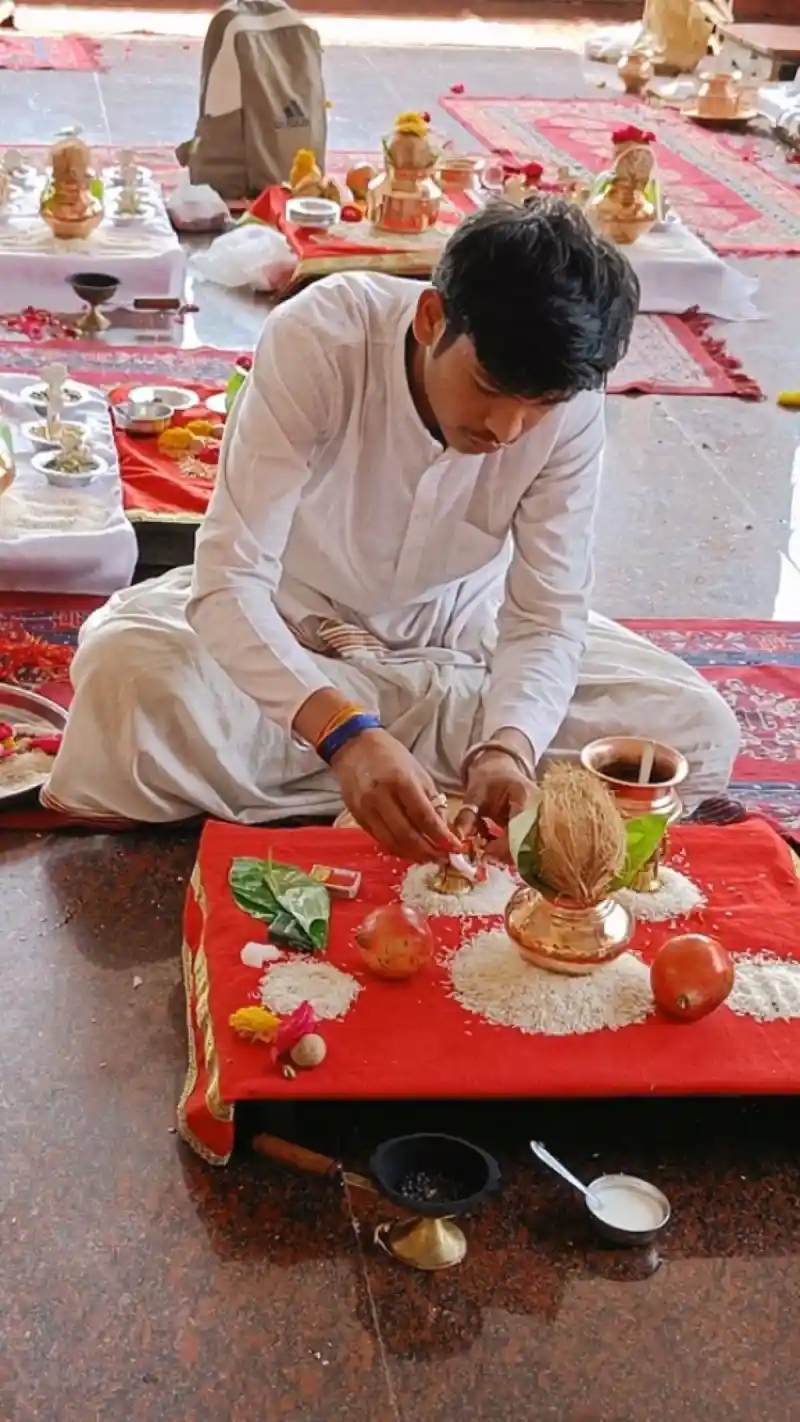
The Kaal Sarp Dosh Nivaran Puja is a structured, multi-part ceremony designed to address the root of the dosha at both the planetary and karmic levels. It is not a one-mantra solution but a complete ritual sequence that engages multiple deities and uses specific samagri (ritual materials) chosen for their association with Rahu and Ketu pacification.
The ceremony begins with Sankalp — the formal declaration of intent, in which the native states their name, gotra (lineage), and the specific purpose of the puja before the assembled deities. This Sankalp is heard across the subtle planes, and its specificity matters: a properly worded Sankalp naming the type of Kaal Sarp Dosh being addressed creates a more focused ritual event.
Kalash Sthapana follows — the establishment of the sacred vessel, representing the presence of all the tirthas and the blessings of the river deities. The Kalash is the formal invitation that converts the ritual space from ordinary ground to a temporarily consecrated tirtha.
Navagraha Puja addresses all nine planetary forces, pacifying them collectively and individually before the primary work on Rahu and Ketu begins. This step is essential: without first stabilising the entire planetary assembly, the specific Rahu-Ketu work lacks a stable foundation.
Nag Devta Worship is the most distinctive element of the Kaal Sarp Dosh Nivaran Puja. Silver, copper, or clay serpent idols are offered milk, black sesame seeds, red flowers, and appropriate mantras. At Trimbakeshwar, this includes the installation of specific Nag idols that remain at the tirtha as an offering. The serpent deity is both the form of the dosha and its remedy — just as the venom of a snake can be used medicinally, Nag Devta’s blessing transforms the dosha’s obstructive energy into protection.
Havan (the fire ritual) forms the ceremony’s core. Specific ahutis (fire offerings) are made with the Mahamrityunjaya Mantra, the Rahu Beej Mantra (Om Bhraam Bhreem Bhraum Sah Rahave Namah), and the Ketu Beej Mantra (Om Sraam Sreem Sraum Sah Ketave Namah). The fire carries these intentions directly to the planetary forces, bypassing the slower channels of karmic adjustment.
Rudrabhishek completes the ceremony at the most powerful locations. The Shiva Linga is bathed in Panchamrit — a five-element mixture of milk, honey, ghee, curd, and Gangajal — while the Rudrashtadhyayi is recited. Since Shiva is the master of time (Mahakaal), a Rudrabhishek performed at a Jyotirlinga location carries particular potency for a dosha that is fundamentally about time’s obstruction.
The full ceremony takes 3 to 4 hours. The person for whom the puja is being performed should ideally be present, though online ceremonies conducted via live video have proven effective for NRI families who cannot travel to India at short notice. It is also beneficial for the spouse or close family members to attend.
Where to Perform Kaal Sarp Dosh Puja
The location of a Nivaran Puja significantly affects its efficacy. Certain tirthas hold a specific energetic relationship with Rahu and Ketu — either through their position in Vedic cosmography, through historical associations with serpent worship, or through the presence of a Jyotirlinga (which carries Shiva’s power over time and fate). We work at four primary locations.
Ujjain — Mangalnath Temple
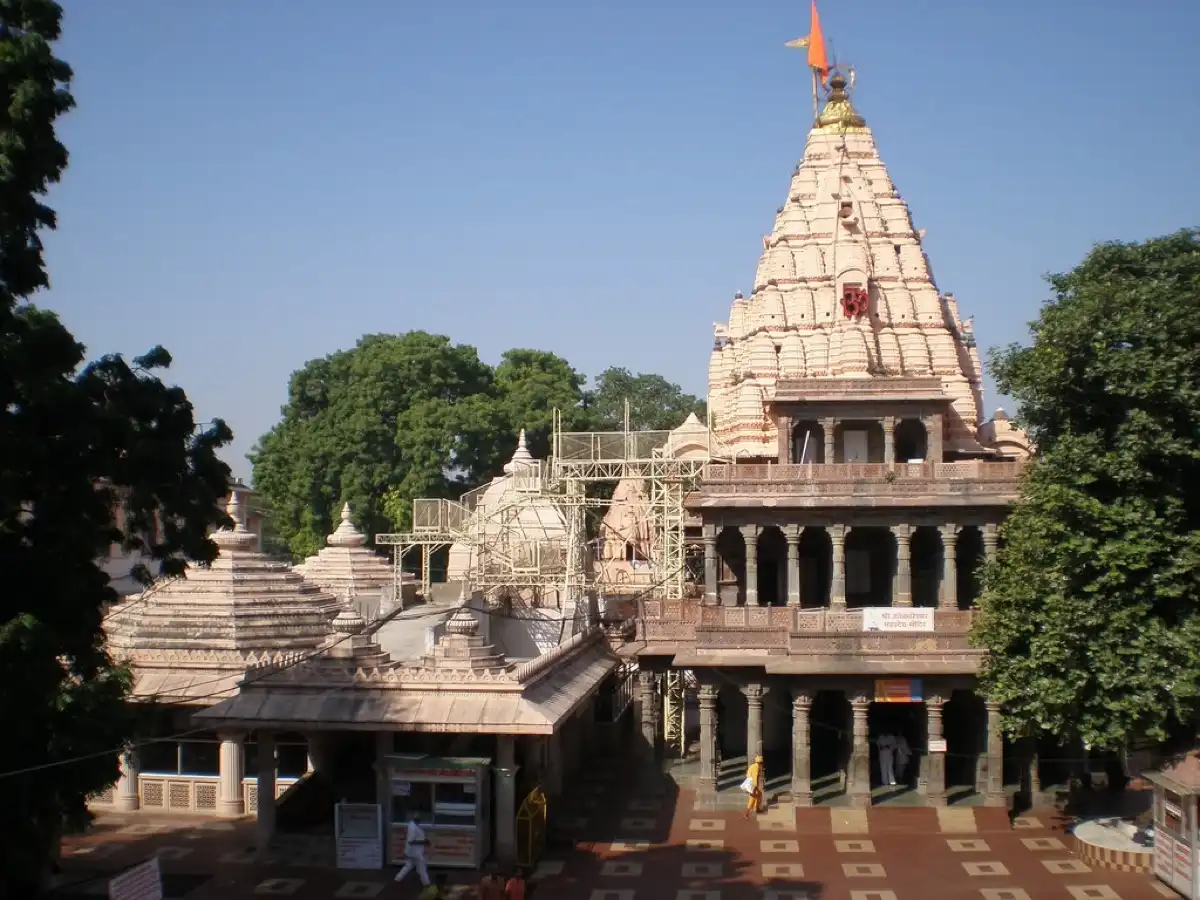
Ujjain holds a unique position in Vedic cosmography: the prime meridian of traditional Indian astronomy ran through Ujjain, making it the city from which all time was measured. Mahakaleshwar — “the lord of time” — is one of the twelve Jyotirlingas, and Ujjain’s intimate relationship with Kaal (time) makes it the natural location for addressing a dosha that is essentially time’s obstruction.
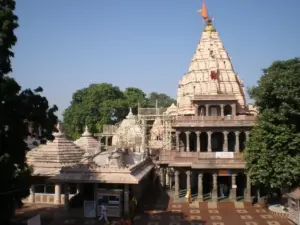
The Mangalnath Temple in Ujjain is specifically associated with Mars (Mangal), which according to Skanda Purana and Matsya Purana is the mythological birthplace of the planet. Mars governs courage, blood, and the capacity to cut through obstacles — making its energy a valuable ally in the Kaal Sarp Dosh Nivaran process.
The puja sequence at Ujjain begins with a sacred bath in the Shipra River, which purifies the native and establishes their ritual eligibility. The main worship includes Ganesha Puja (for removing obstacles and receiving Ganesha’s permission for the ceremony), Shiva Puja at Mahakaleshwar, and dedicated Naga Devta worship. The Havan incorporates the Mahamrityunjaya Mantra alongside the Rahu and Ketu Beej Mantras, and the ceremony concludes with the immersion of the Naga idols in the Shipra River — symbolically releasing the serpent’s hold and allowing it to return to its natural cosmic function. Read more about Ujjain’s sacred heritage before planning your visit.
Trimbakeshwar — Nashik
Trimbakeshwar in Nashik district of Maharashtra is considered by many Vedic scholars to be the single most powerful location for Kaal Sarp Dosh Nivaran. The reason is both mythological and astronomical: Trimbakeshwar’s Jyotirlinga is unique among the twelve in that it bears three faces representing Brahma, Vishnu, and Shiva simultaneously — the complete cosmic trinity. This triple aspect gives the Shiva presence at Trimbakeshwar an unparalleled scope of authority over different planes of existence.
Trimbakeshwar is also the source of the Godavari River, one of India’s most sacred rivers. The Kushavarta Kund — a tank within the temple complex — is where pilgrims take the ritual dip before the puja. This dip, combined with the Sankalp taken at the Kund, formally initiates the ceremony and establishes the native’s karmic eligibility for the remedy.
The distinctive element of the Trimbakeshwar ceremony is the elaborate Nag Devta worship: silver, copper, and clay serpent idols of specific dimensions are prepared according to shastra, and the worship involves an extended milk-offering ritual (Nag Abhishek). This is followed by Pind Daan — relevant here because Kaal Sarp Dosh often has a component of unresolved ancestral karma (the Rahu-Ketu axis is associated with both past-life and ancestral-plane imbalances). Pind Daan offered at Trimbakeshwar addresses both the planetary and ancestral dimensions of the dosha simultaneously. The Rudrabhishek at the Jyotirlinga itself — using milk, honey, ghee, curd, and Gangajal — concludes the ceremony. Many of our devotees choose to combine the Trimbakeshwar Kaal Sarp Puja with the Narayan Bali Puja if ancestral distress is also indicated in the chart.
Prayagraj — Triveni Sangam
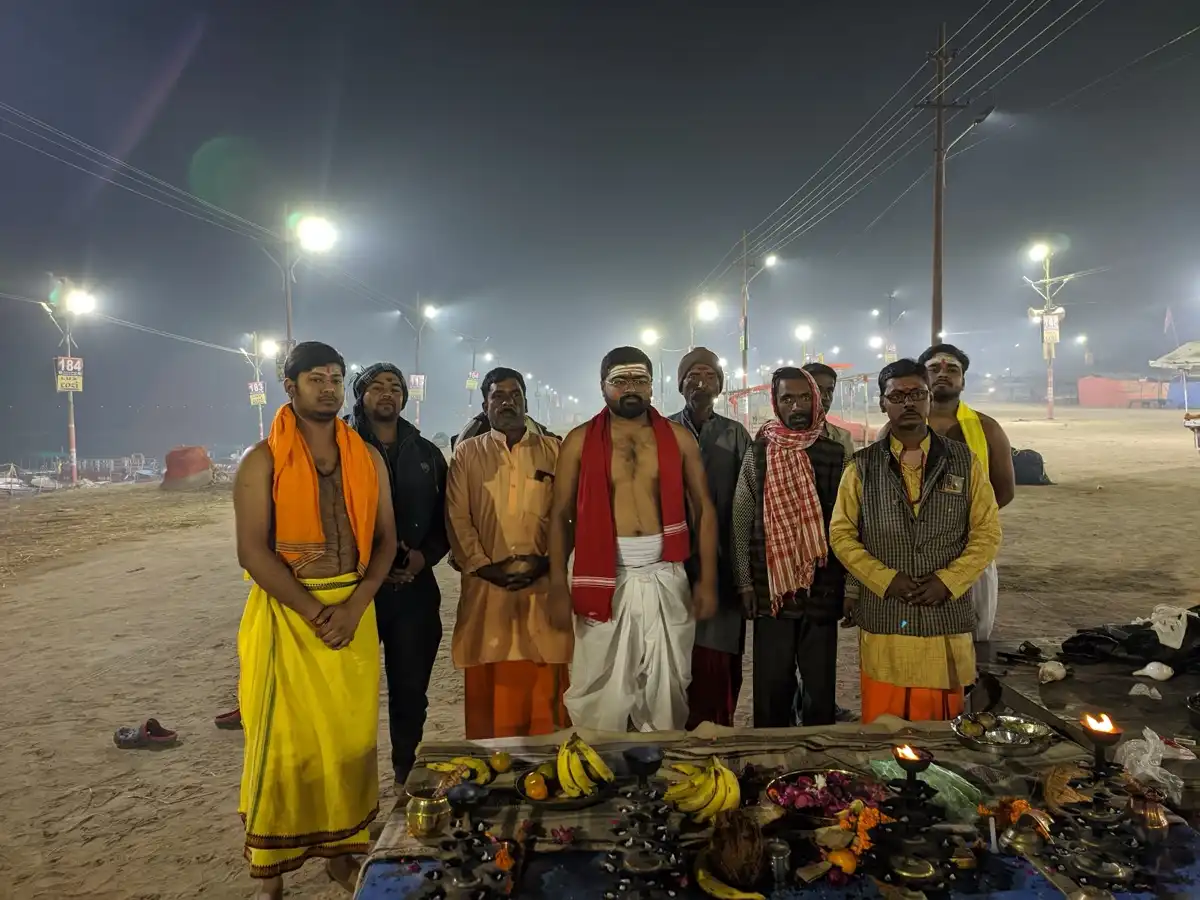
At the Triveni Sangam — the confluence of the Ganga, Yamuna, and the mystical Saraswati — Kaal Sarp Dosh Nivaran Puja is performed alongside Navagraha Shanti, creating a comprehensive planetary pacification ceremony. Prayagraj’s status as Tirtharaj — the king of all tirthas — means that any puja performed here carries the merit of performing it at all tirthas simultaneously. The water of three rivers merging creates a uniquely potent ritual environment, and the Ganga’s current carries offerings directly into the cosmic plane. This is where our own pandits are based, and we perform the Kaal Sarp Puja at Prayagraj with the same ritual precision as at Ujjain.
Haridwar — Har Ki Pauri
Haridwar — where the Ganga descends from the Himalayas into the plains — is described in the Puranas as one of the four sites of the Amrit Manthan’s spilled nectar, which makes it one of the Kumbh Mela locations. The very event that created Rahu and Ketu is mythologically connected to Haridwar’s sacred geography, giving the Kaal Sarp Puja at Haridwar a particular resonance. At Har Ki Pauri — the ghat where Vishnu’s footprint is preserved — the ceremony is performed with the Ganga flowing immediately alongside, and offerings are made directly into the river as the Havan concludes. Haridwar’s spiritual heritage spans thousands of years of continuous ritual tradition.
Kaal Sarp Dosh Puja Cost
Pricing varies by location, the depth of the ceremony, and whether samagri and Pandit Dakshina are included in the package. Below are the standard rates for our services, with clear transparency about what each package includes.
| Location | Package | Price |
|---|---|---|
| Prayagraj (Triveni Sangam) | Full ceremony with samagri, Navagraha Shanti & Havan — in person or online | Rs. 7,100 (sale) / Rs. 11,000 regular |
| Haridwar (Har Ki Pauri) | Full ceremony at Har Ki Pauri with samagri and Havan | Rs. 7,100 (sale) / Rs. 9,100 regular |
| Ujjain (Mangalnath Temple) | Ceremony at Mangalnath with Shipra bath and Mahakaleshwar Rudrabhishek | Rs. 11,000 (enquire for current pricing) |
| Trimbakeshwar (Nashik) | Complete ceremony including Nag Devta worship, Kushavarta Kund dip, Rudrabhishek | Rs. 15,000 to Rs. 25,000 (market range depending on scope) |
All Prayag Pandits packages include:
- Full samagri (ritual materials) including Nag idols, flowers, ghee, sesame, Panchamrit ingredients
- Pandit Dakshina for the officiating priest
- Video documentation for remote/NRI clients
- Post-puja prasad dispatched where possible
- A written confirmation of Sankalp details for your records
For NRI families unable to travel to India, our online ceremony is conducted via live WhatsApp or video call. The Sankalp is taken in the native’s name and gotra, and the video documentation means you witness the complete ceremony in real time. Many NRI families across the USA, UK, Canada, UAE, Singapore, and Malaysia have had the ceremony performed on their behalf with consistently positive feedback. You can also book the puja online directly through our website.
Kaal Sarp Dosh vs Other Doshas
It is quite common for a kundali to carry more than one dosha, and understanding the distinctions matters both for the remedy chosen and for the priority in which they are addressed.
Kaal Sarp Dosh vs Manglik Dosh: Manglik Dosh arises from Mars (Mangal) sitting in specific houses — the 1st, 4th, 7th, 8th, or 12th. Its primary effects are on marriage and relationships, with secondary effects on the native’s temperament. Kaal Sarp Dosh involves the Rahu-Ketu axis and affects a broader range of life areas depending on the type. Both can be present simultaneously: a person may have Rahu in the 7th house (Takshak Kaal Sarp Dosh) alongside Mars in a Manglik position. In such cases, both the Manglik Dosha Puja and the Kaal Sarp Puja are performed — typically the Kaal Sarp Puja first, since it addresses the wider planetary configuration, followed by the Manglik remedy.
Kaal Sarp Dosh vs Pitra Dosh: Pitra Dosh arises from unpaid ancestral debts — specifically from ancestors who did not receive proper last rites, or whose souls remain unsettled in the Preta plane. Its effects also include blocked marriage prospects, childlessness, and financial difficulty, which is why the two doshas are sometimes confused. The diagnostic distinction lies in the kundali: Pitra Dosh is typically indicated by the Sun’s affliction in the chart (particularly Sun-Rahu conjunction or Sun in the 9th house under malefic influence), while Kaal Sarp Dosh requires the specific Rahu-Ketu enclosure of all planets. Many charts carry both, and our recommendation in such cases is to first perform Pind Daan and then proceed with the Kaal Sarp Nivaran Puja, since settled ancestors lend their support to the living. The proper completion of Hindu death rituals for departed family members forms the foundation on which all other astrological remedies rest.
Home Remedies and Daily Practices
The formal Nivaran Puja is the primary and most effective remedy for Kaal Sarp Dosh. However, certain daily practices can support the puja’s effects and provide ongoing protection during Rahu and Ketu Mahadasha or Antardasha periods. These should be understood as supplements to the formal remedy, not replacements for it.
Nag Panchami observance: Nag Panchami, which falls on the fifth day of Shravan Shukla Paksha (typically July-August), is specifically dedicated to Nag Devta worship. Offering milk at a Nag temple or at a Shiva Linga on this day is considered particularly propitious for those with Kaal Sarp Dosh.
Rahu and Ketu Beej Mantras: Reciting the Rahu Beej Mantra (Om Bhraam Bhreem Bhraum Sah Rahave Namah) 108 times on Saturdays, and the Ketu Beej Mantra (Om Sraam Sreem Sraum Sah Ketave Namah) 108 times on Tuesdays, creates a consistent energetic acknowledgment of these forces. The idea is not to suppress Rahu and Ketu — which is impossible — but to enter into a conscious relationship with them.
Monday Shiva Linga offerings: Offering water — preferably Gangajal — or milk to a Shiva Linga on Monday mornings, combined with the recitation of the Mahamrityunjaya Mantra, is a classical Rahu-pacification practice rooted in Shiva’s authority over the shadow planets. Learn more about the subtle energy body and how these practices affect it.
Gemstone therapy: Gomed (Hessonite Garnet) for Rahu and Cat’s Eye (Lehsunia) for Ketu are the classical gemstone remedies. These should never be adopted without explicit advice from a qualified Vedic astrologer who has examined the full chart — the wrong gemstone can amplify rather than pacify a malefic planet’s effects.
Feeding ants with flour and sugar on Saturdays is a traditional folk remedy associated with Rahu. Ants, as creatures that move underground through hidden pathways, are symbolically associated with Rahu’s subterranean quality. The act of nourishing them on Saturday — Rahu’s associated day — is understood as an act of goodwill toward the Rahu principle.
Meditation on the Nava Chakras: For those who are familiar with the chakra system, working with the Ajna Chakra (associated with the third eye and with Rahu’s influence on perception) and Muladhara Chakra (grounding, associated with Ketu’s pull toward dissolution) can provide a subtle but consistent counterweight to the dosha’s distorting effects on the mental and physical planes.
Frequently Asked Questions
What is Kaal Sarp Dosh and how do I know if I have it?
Kaal Sarp Dosh occurs when all seven major planets — Sun, Moon, Mars, Mercury, Jupiter, Venus, and Saturn — are positioned between Rahu (North Node) and Ketu (South Node) in your birth chart. To confirm it, you need a kundali prepared from your exact date, time, and place of birth. A qualified Vedic astrologer will check whether all seven planets fall within the Rahu-to-Ketu arc. If even one planet falls outside this arc, the dosha is absent or partial. Common indicators include persistent career stagnation, unexplained delays in marriage, recurring nightmares about serpents, and financial cycles with no upward trajectory. However, these symptoms can also have other astrological causes — a proper kundali reading is the only definitive method of confirmation.
Which type of Kaal Sarp Dosh is the most severe?
Kulik Kaal Sarp Dosh (Rahu in 2nd, Ketu in 8th) and Takshak Kaal Sarp Dosh (Rahu in 7th, Ketu in 1st) are generally considered the most challenging, with Kulik affecting wealth and health most severely and Takshak most affecting marriage and partnerships. Ghatak (Rahu in 10th) can be severely destabilising for career. However, severity is never determined by type alone — the strength of the planets within the enclosed arc, the Mahadasha the native is currently running, and the overall balance of the horoscope all modify the intensity. A chart with strong Jupiter or Sun despite the Kaal Sarp configuration will manifest the dosha differently than one where all planets within the arc are also weakened by other factors.
Can Kaal Sarp Dosh be completely cured?
The classical Vedic position is that the Kaal Sarp Dosh Nivaran Puja, performed correctly at a powerful tirtha, significantly reduces the dosha’s obstructive effects — often to the point where devotees describe their post-puja lives as operating on an entirely different trajectory. “Complete cure” in the Western medical sense is not the right framework: the kundali’s configuration does not change, but the karmic weight it carries is addressed through the ritual. Most families who perform the puja at Prayagraj, Ujjain, or Trimbakeshwar report improvements in the specific areas most affected by their dosha type within months of the ceremony. The dosha’s intensity also naturally decreases after the age of 45-48 in most charts, as Rahu and Ketu’s influence softens with the completion of certain karmic cycles.
Is Ujjain or Trimbakeshwar better for the puja?
Both are powerful, and the choice often depends on the specific type of Kaal Sarp Dosh, the native’s personal circumstances, and practical travel considerations. Trimbakeshwar is widely regarded as the single most potent location for this puja because its Jyotirlinga bears the three-faced aspect of Brahma, Vishnu, and Shiva, and because the ceremony there can be combined with Pind Daan at the same tirtha — addressing any ancestral karmic component of the dosha simultaneously. Ujjain is preferred when the Kaal Sarp Dosh has a strong Mars connection (Kulik, Karkotak, or any chart where Mars is powerfully placed within the hemmed arc), because of Ujjain’s intimate relationship with the Mars energy through Mangalnath Temple. Our pandits can advise on the more suitable location after reviewing your kundali details.
What is the cost of Kaal Sarp Dosh Puja?
Prayag Pandits offers the Kaal Sarp Dosh Nivaran Puja at Prayagraj from Rs. 7,100 (sale price) and at Haridwar from Rs. 7,100. Both include all samagri, the Navagraha Shanti component, the Havan, Pandit Dakshina, and video documentation for remote devotees. The regular price at Prayagraj is Rs. 11,000 and at Haridwar is Rs. 9,100. For Ujjain, pricing is available on enquiry at approximately Rs. 11,000 for the standard ceremony. Trimbakeshwar ceremonies performed by the traditional Guruji families there range from Rs. 15,000 to Rs. 25,000 depending on the scope. Contact us via WhatsApp at +917754097777 for a detailed breakdown of what is included at each location.
Can the Kaal Sarp Dosh Puja be done online?
Yes — and this is among the most frequently used services for our NRI clients. The online ceremony is conducted via live WhatsApp or video call from Prayagraj or Haridwar. Your pandit performs the complete ritual sequence — Sankalp in your name and gotra, Kalash Sthapana, Navagraha Puja, Nag Devta worship, Havan with Rahu and Ketu Beej Mantras, and Rudrabhishek — while you observe in real time. The Sankalp specifies your full name, place of residence, and the purpose of the puja, which establishes the karmic connection between the ceremony and the person for whom it is performed. Many families across the USA, UK, Canada, UAE, Singapore, Australia, and Malaysia have had this ceremony performed with highly positive outcomes. Book via our NRI Puja Services page.
Is Kaal Sarp Dosh real or superstition?
This question comes up frequently, particularly from younger generations or from families where Western education has created a healthy scepticism about astrological claims. The honest answer is that Kaal Sarp Dosh is a recognised configuration in classical Vedic astrology texts, including the Brihat Parasara Hora Shastra and the Jataka Parijata — though some scholars note that the specific term “Kaal Sarp Dosh” appears more prominently in later commentaries than in the earliest texts. What we observe in practice — after performing this puja for hundreds of families — is that the correlation between the described kundali configuration and the described life patterns is high enough to be worth taking seriously. The puja has a basis in both ancient tradition and the lived experience of the families we serve. Whether you approach it as karmic science, as devotional ritual, or as psychological reframing of life narratives, the ceremony has a documented tradition of bringing relief.
What mantras should I recite for Kaal Sarp Dosh?
For daily practice while awaiting the formal puja, three mantras are classically recommended. The Rahu Beej Mantra — Om Bhraam Bhreem Bhraum Sah Rahave Namah — should be recited 108 times on Saturdays. The Ketu Beej Mantra — Om Sraam Sreem Sraum Sah Ketave Namah — should be recited 108 times on Tuesdays. The Mahamrityunjaya Mantra — Om Tryambakam Yajamahe Sugandhim Pushtivardhanam, Urvaarukamiva Bandhanan Mrityor Mukshiya Maamritat — is recommended for daily recitation as a Shiva-addressed appeal for protection from time’s adverse forces. These mantras support the effects of the formal Nivaran Puja but are most effective once that puja has been performed at a tirtha. We recommend at minimum 40 days of consistent practice after the puja for optimal results.
Book Kaal Sarp Dosh Nivaran Puja
Performed by Experienced Vedic Pandits at Sacred Tirthas
From Rs. 7,100
- Navagraha Shanti + Rahu-Ketu Beej Mantra Havan
- Available at Prayagraj, Haridwar & Ujjain
- Online ceremony with live video for NRI families
- All samagri and Pandit Dakshina included
अपना पवित्र अनुष्ठान बुक करें
भारत भर के पवित्र स्थलों पर वेद-प्रशिक्षित पंडितों द्वारा वीडियो प्रमाण सहित प्रामाणिक अनुष्ठान।
2,263+ परिवारों की सेवा
वीडियो प्रमाण शामिल
2019 से
