


What’s included
Included in your package
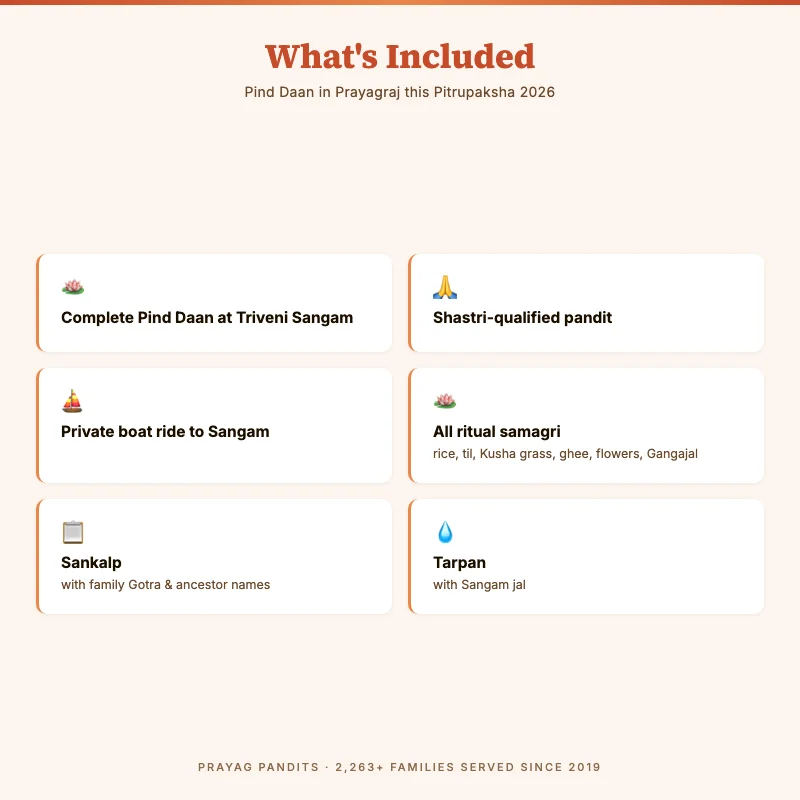
- Complete Pind Daan at Triveni Sangam
- Shastri-qualified pandit
- Private boat ride to Sangam
- All ritual samagri rice, til, Kusha grass, ghee, flowers, Gangajal
- Sankalp with family Gotra & ancestor names
- Tarpan with Sangam jal
- Sangam Poojan
- Fresh Pind preparation per Shastra
- Pitru Stotras & Pitru Sukta recitation
- Pre-ceremony consultation
Not included in your package
- Travel to Prayagraj
- Accommodation in Prayagraj
- Asthi Visarjan / Narayan Bali / Tripindi Shradh (separate ceremonies)
- Multiple family groups in one booking
- Professional photography / videography
- Extra Dakshina/Gifts/Donations made to the Priest/Pandit
This is not a Daswa Pind Daan package.
How it works
Choose your pooja
Review your package and any available additions, then add it to your booking.
Share your preferences
Enter your contact details, preferred date and time. Add ancestral details if you wish.
We coordinate with you
Our team confirms the arrangements and shares your coordinator’s details 24 hours before the pooja.
Participate in your pooja
Follow the participation and joining arrangements described in your package and shared by your coordinator.
What families say after the rite
From families who booked Pind Daan in Prayagraj this Pitrupaksha 2026.
Rated 4.8 out of 5
500+ reviews · Prayag Pandits
This poojarated 4.4 out of 519 reviews
Our pandits






- 2,263+ families served
- Serving since 2019
- GST registered
Families on video
The player loads only when you press play.


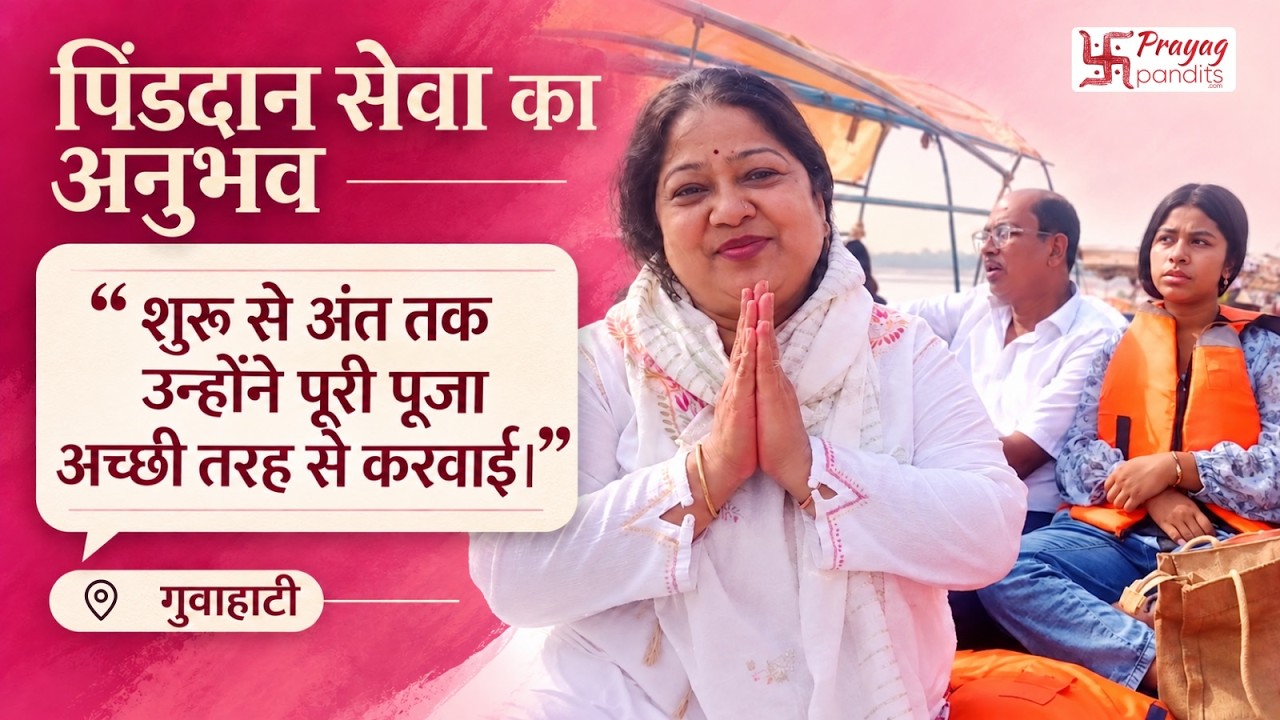
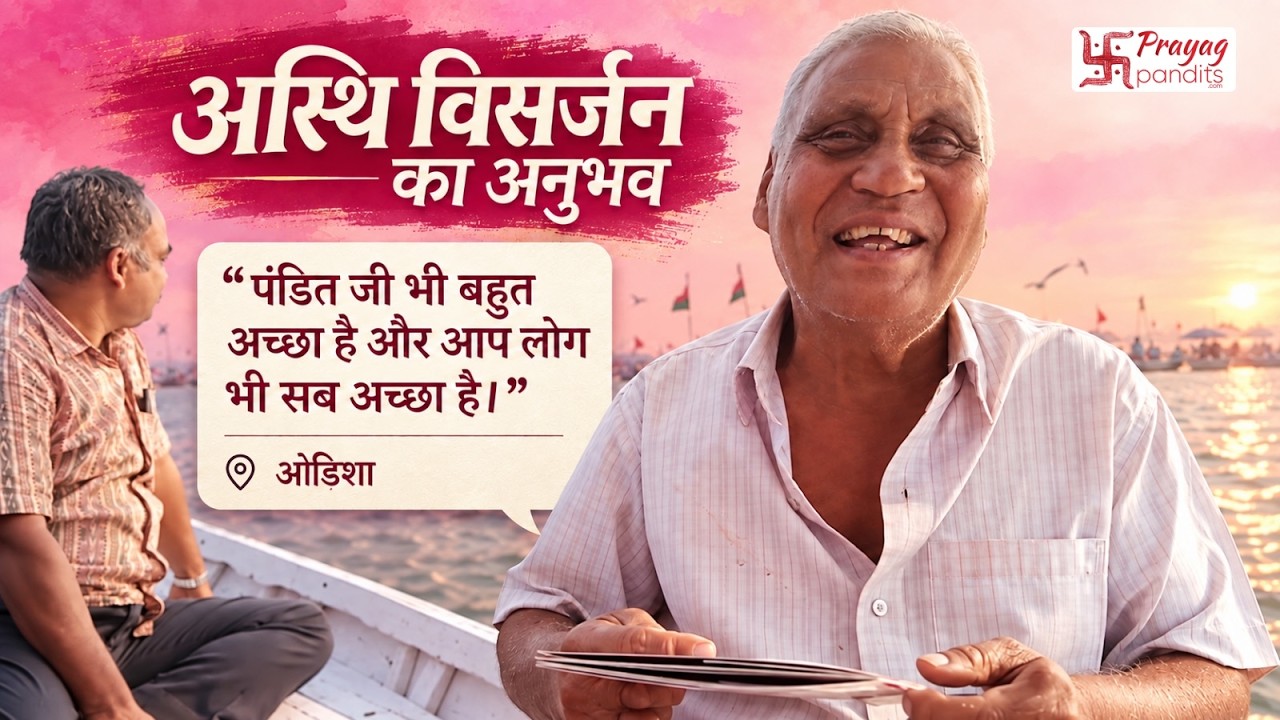

In their words
Quick booking, prompt response, and excellent execution. We were a group of 6 family members and everything was managed well. The pandit was respectful and the ceremony felt genuine. 🙏
Performed Pind Daan here during Pitrapaksha. The entire process was smooth. Pandit ji was very cooperative and explained the mantra meanings. The prasad distribution was also well organized. A truly fulfilling experience. Om Shanti.
We booked Pind Daan for our late father's shradh ceremony. The pandits were very knowledgeable and performed all rituals with proper Vedic mantras. The whole family felt at peace after the poojan. Highly recommended for anyone looking for authentic rituals. Om Shanti.
After losing my father suddenly we needed guidance on the proper rituals. Prayag Pandits team was very compassionate and helped us through every step. The Pind Daan brought us immense peace.
पितृपक्ष में पिंडदान करवाया। पूरी व्यवस्था उत्तम थी। पंडित जी समय पर आए और सभी विधि-विधान पूर्ण भक्तिभाव से सम्पन्न करवाए। प्रसाद वितरण भी अच्छा था। 🙏
We came from Delhi specifically for this puja. The whole process was smooth and the pandit ji guided us patiently. Highly recommend.
Review your ceremony
Pind Daan in Prayagraj this Pitrupaksha 2026
Please check 1 thing
Questions families ask
Prayagraj, earlier known as Allahabad, is considered one of the most sacred places for performing Pind Daan, as it is situated at the holy confluence (Triveni Sangam) of three rivers - Ganga, Yamuna, and the mythical Saraswati. The main ritual is performed on the banks of the Ganga river or at the Triveni Sangam, where many pandits and priests are available to assist.
Some of the famous and important places for Pind Daan in Prayagraj include:
- Triveni Sangam
- Ganga Ghat
- Yamuna Ghat
The ritual starts with a holy dip in the sacred waters of Ganga and Yamuna at the Sangam, followed by the primary rituals and rites performed by the priests on the river banks.
The cost of Pind Daan in Prayagraj can vary depending on the rituals performed, the number of priests engaged, and any additional services opted for.
- On average, a basic Pind Daan ceremony conducted by a single priest can cost anywhere between Rs. 4,500 to Rs. 11,000.
- However, more elaborate ceremonies with additional rituals, offerings, and priests can cost upwards of Rs. 15,000 to Rs. 50,000 or more.
- Many Pind Daan packages are offered by tour operators and online services, which include:
- Priest and ritual fees
- Puja items and offerings
- Transportation and accommodation (in some cases)
- Additional Puja and daan ceremonies like gau daan, vastra daan, bhojanam daan etc.
- For example, our pind daan package for Pind Daan in Prayagraj is priced at Rs. 7,100 including ritual at Triveni Sangam, priest fees, puja items, and a boat ride. View details here.
- We have one other package which includes pindaan puja at triveni sangam, priest fees, puja items, a boat ride and gau daan puja, View details here.
- Online Pind Daan booking services also offer packages where the rituals are performed on your behalf, with prices ranging from Rs. 5,100 to over Rs. 30,000 based on the inclusions.
- It's best to check and compare a few providers, understand the inclusions, and opt for services from reputed and verified organizations for a hassle-free experience.
Pind Daan is a sacred ritual that requires adherence to certain rules and guidelines as per Hindu traditions. Here are some key rules to follow:
- Eligibility: Pind Daan is typically performed by the eldest son or a male relative of the deceased. In the absence of a male heir, the daughter or the wife can perform the ritual.
- Dress code: Wear clean, simple, and preferably white or light-colored clothes. Men should ideally wear a dhoti and kurta, while women can wear a saree or a suit.
- Fasting: The person performing the Pind Daan is expected to fast on the day of the ceremony until the rituals are completed. Some also observe a partial fast the day before.
- Offerings: The main offerings for Pind Daan include black sesame seeds, barley, kusha grass, and water. These are offered along with the pind (rice balls) to the ancestors.
- Rituals: The ceremony may involve multiple rituals such as tarpan (offering water), pind daan (offering rice balls), and shraadh (invoking ancestors). Follow the pandit's instructions carefully during each step.
- Timing: Consult with the conducting organization regarding the timings. Pind daan can be done from early morning up until early evening. Contact us to know more.
- Respect and devotion: Maintain a respectful and devoted attitude throughout the ceremony. Focus on the prayers and the significance of the ritual.
It's important to consult with the pandit or the organization conducting the Pind Daan for any specific rules or customs that need to be followed. Adherence to these rules and performing the Pind Daan with sincerity and devotion is believed to bring peace and salvation to the departed soul.
View our pind daan pooja package here.
Yes, Hindu scriptures allow women to perform Pind daan, especially if they are the eldest in the family or if there is no male heir. However, some traditions suggest that the ritual is more effective when done by a son or close male relative. Widows, daughters, and sisters can also offer prayers and Tarpan for their ancestors at Triveni Sangam.
The most important thing is always a heart full of faith (shraddha) and respect. Materially, for Pind Daan in Prayagraj, you primarily need yourselves, dressed in clean, simple clothes (preferably traditional wear like dhoti/kurta for men, saree/suit for women, avoiding black).
If you are performing rites for a recent demise, bring the details like the departed's name, gotra, and date/tithi of death. Most puja samagri (ritual items) like rice, barley flour, sesame seeds, kusha grass, flowers, etc., can be arranged locally here in Prayagraj, often by the Pandit you engage.
However, carrying a small container of black sesame seeds (til) from home is sometimes done. Just come prepared mentally and spiritually for this important task in Prayagraj.
Yes — both are fully valid Purana-sanctioned ancestral rites, each with its own scriptural authority. The Gaya tradition is rooted in the Vayu Purana and Agni Purana and centers on the Vishnu Pada temple. The Prayagraj tradition draws from the Prayag Mahatmya, the Matsya Purana, the Padma Purana, and the Skanda Purana, which describes Shradh at Prayagraj as equivalent to a thousand Gaya Shraddhas. Neither tradition invalidates the other — they are distinct expressions of the same ancestral duty. Many families perform Pind Daan at both sites over the course of their lifetimes. If you specifically want the Gaya experience, we offer that separately; if Prayagraj is your destination for Pitrupaksha 2026, this ceremony carries the full scriptural weight of the tradition.
This package is an in-person ceremony at the Triveni Sangam — you or a family representative must be physically present at Prayagraj for the Pind Daan. That presence is part of what the tradition requires for this specific rite: the living descendant’s hands in the water, the living voice speaking the ancestor’s name. If traveling to India is not possible for Pitrupaksha 2026, we offer a separate online Pind Daan service where the pandit performs the ceremony on your behalf at the Sangam while you participate via video call. Please inquire about that option separately. For NRI families who are traveling to India specifically for this purpose, we can advise on timing, logistics, and what to prepare in advance during the pre-ceremony consultation call.
No. Pind Daan can be performed at Prayagraj throughout the year, and we offer year-round ceremonies at the Triveni Sangam. However, Pitrupaksha 2026 — September 26 to October 10 — is the period when ancestral rites carry the greatest traditional authority. The Pitru Paksha is the annual sixteen-day period when, according to the tradition, the gates between the realm of the living and the realm of the ancestors are most open and receptive to offerings. Performing Pind Daan at the Triveni Sangam during Pitrupaksha is the optimal combination of time and place. If you cannot be present during Pitrupaksha, a year-round ceremony is fully valid — contact us to arrange a date that works for your family.
There is no fixed limit. The Sankalpa can include as many generations and individual ancestors as the family wishes to name. In practice, most families include three to four generations — parents, grandparents, great-grandparents — on both paternal and maternal sides. Some families include more specific individuals whose names they know; others name the lineage collectively. The pandit will guide you on how to structure the Sankalpa to be both complete and manageable. Please bring the names and Gotras of the ancestors you wish to include to the pre-ceremony consultation call. If you do not know the names of ancestors beyond a certain generation, the collective invocation covers the entire lineage. This booking covers one family group — if two separate families wish to perform the ceremony together, each requires its own booking.
This is one of the most common situations, particularly for families whose records were not maintained carefully or who are performing Pind Daan for ancestors from earlier generations. The tradition provides for exactly this circumstance. Sarva Pitru Amavasya — the final day of Pitrupaksha, October 10 in 2026 — is the universally accepted date for all ancestors regardless of their tithi, including those whose date of passing is unknown. The Sankalpa on Sarva Pitru Amavasya is structured to encompass all ancestors, known and unknown, named and unnamed. Purnima, the opening day of Pitrupaksha (September 26 in 2026), also serves this purpose for ancestors whose tithi is not known. Please mention during the booking consultation that you do not have the ancestor’s tithi — your pandit will advise on the most appropriate date and the correct formulation of the Sankalpa for your situation.
Still have a question?
Ask our team on WhatsApp and we will help you plan the ceremony.
We reply on WhatsApp within 1–2 hours.
Ask a pandit (opens WhatsApp)Know your ceremony
Among all the sacred sites in India where ancestral rites are performed, Prayagraj holds a position that the scriptures describe in language that leaves little room for ambiguity. The Matsya Purana calls it Teerthraj — the king of all pilgrimage sites. The Prayag Mahatmya, an entire text dedicated to extolling the virtues of this city, declares that the merit earned at Prayagraj surpasses the combined merit of all other tirthas. For Pind Daan specifically, the confluence of three rivers — the Ganga, the Yamuna, and the invisible subterranean Saraswati — creates a site of extraordinary spiritual power for ancestral offerings.
Pitrupaksha 2026 runs from September 26 to October 10. This is the annual sixteen-day lunar fortnight during which the gates between the world of the living and the realm of the ancestors are considered most open. Performing Pind Daan during this period is said to carry many times the efficacy of the same rite done at other times of year — and when that rite is done at Prayagraj, at the Triveni Sangam itself, the scriptural promise is that the benefit reaches across seven generations of the family line, both above and below.
This in-person service brings you to the Triveni Sangam at Prayagraj, where our experienced pandit performs the complete Pind Daan ceremony at the exact point where the three sacred rivers converge. You come to the water, you speak your ancestors’ names, and you make the offering with your own hands at the most hallowed confluence in the Hindu world. There is no substitute for that direct, embodied participation — and this package is designed to make that experience as seamless, meaningful, and complete as possible. If you want to understand the full ritual context before booking, our comprehensive Pind Daan guide covers every question in detail.
Why Families Trust Prayag Pandits
Gaya in Bihar is the most famous location for Pind Daan, and the Vishnu Pada temple there carries its own profound authority. But the question families often ask — particularly after losing a parent or grandparent — is whether Gaya is the only option. The answer is unambiguous: Prayagraj is the Purana-sanctioned alternative that carries equal, and in some texts greater, spiritual weight. The Skanda Purana states directly that a Shradh performed in the Prayagraj region yields benefit equivalent to a thousand Gaya Shraddhas. That is not a minor claim — it is a statement about the accumulated spiritual gravity of this confluence.
The Triveni Sangam is not simply where two visible rivers meet. It is where three sacred rivers converge — a meeting described in Hindu cosmology as the union of the three primary streams of divine energy. The Ganga carries the blessings of Shiva and the Himalayas. The Yamuna brings the grace of Krishna and the Vrindavana tradition. The Saraswati, flowing underground from the northwest, carries the power of divine knowledge and learning. At the precise point where these three meet, the water is considered a tirthodaka of the highest order — a sacred liquid drawn simultaneously from three divine sources.
For ancestral offerings, this triple confluence matters because water from three sacred rivers, offered together, is understood to carry the combined potency to reach ancestors across multiple realms and multiple generations. A Pind offered at the Sangam is said to bring liberation not only to the specific ancestor in whose name it is given but to the entire lineage across seven generations both above and below the one performing the rite. During Pitrupaksha, when the gates between worlds are most open, these effects are amplified further. Performing Pind Daan at Prayagraj’s Triveni Sangam during Pitrupaksha 2026 represents the highest expression of this tradition available in a single ceremony.
There is also a practical dimension worth noting for those planning their Pitrupaksha 2026 pilgrimage: Prayagraj is accessible. Major cities like Delhi, Lucknow, Mumbai, and Kolkata all have direct rail connections. The Sangam area is well-organized for pilgrims. Unlike Gaya, which requires more planning for first-time visitors, Prayagraj during Pitrupaksha is a familiar circuit with established infrastructure. For NRI families traveling from abroad, Prayagraj Airport (Bamrauli) accepts direct flights via connecting hubs. For an in-depth comparison, see our guide on who can perform Pind Daan and what the tradition expects from the performer.
Prayagraj during Pitrupaksha is a city in a particular mode of collective intention. The ghats along the Sangam are filled with families from across India — from Maharashtra, Gujarat, Bengal, Tamil Nadu, and all the northern states — each performing Shradh and Tarpan for their own ancestors. There is a shared gravity to the atmosphere during this fortnight that is unlike anything at the Sangam during the rest of the year. The air carries the scent of sesame and sacred smoke. The river itself, in these weeks, seems to receive a quality of attention from the thousands of pilgrims on its banks that gives the ceremonies performed here a particular weight.
The boat ride to the Sangam takes approximately fifteen to twenty minutes each way. The boats used are the flat-bottomed wooden boats traditional to this stretch of the Ganga-Yamuna river system, managed by experienced boatmen who have been working the Sangam for generations. At the confluence, you can see where the Ganga’s grey-green water meets the Yamuna’s darker blue in a visible line on the surface — an actual, observable point where the two rivers become one. It is at this point that the boat anchors and the ceremony begins.
The ceremony opens with the Sankalpa — a formal declaration of intent in which the pandit establishes the time, place, and purpose of the rite in the precise formulation that the tradition requires. This declaration names the performer, their Gotra, their father’s name and Gotra, and then the names and Gotras of the ancestors for whom the Pind Daan is being performed. The Sankalpa is the moment when the ceremony becomes real and specific — when the names spoken aloud enter the sacred space created by the Sangam and the ritual context.
After Sankalpa, the pandit performs Sangam Poojan — a worship of the confluence itself, acknowledging the divine presence of the three rivers and requesting their blessing and participation in the ancestral rite. Then the Pind is prepared: fresh rice flour mixed with sesame seeds, honey, and ghee, shaped by hand into a ball that represents the body of the ancestor and serves as a vehicle for the offering. The Pitru Stotras and ancestral invocations are recited as the Pind is offered into the river. Tarpan follows — water drawn from the Sangam is offered in cupped hands, released into the river with each ancestor’s name spoken clearly. The ceremony closes with prayers for the wellbeing of the departed and blessings for the living descendants. You can learn more about the mantras used during this stage in our guide to Pitrupaksha Tarpan mantras.
Your Pind Daan Ceremony — Step by Step
From consultation to the final Tarpan at Triveni Sangam
Pre-Ceremony Consultation
Our pandit discusses your family’s specific situation — the ancestor’s name, gotra, date of passing, and any particular concerns. This ensures the sankalp and mantras are correctly personalised.
Sankalp at the River
The formal sankalp is taken at the ghat with the family’s name, gotra, and ancestor details. A ritual bath in the Sangam waters purifies the family before the ceremony begins.
Boat to the Sangam
Your family boards a private boat and travels to the exact confluence point where the Ganga, Yamuna, and Saraswati rivers meet. The pandit begins preparatory mantras during the journey.
Pind Daan Offerings
At the Sangam confluence, the freshly prepared pindas (rice balls with sesame, honey, and kusha grass) are offered with full Vedic mantras. Each pinda is offered specifically for the named ancestors.
Tarpan & Closing Sangam Poojan
Tarpan water offerings are made invoking each ancestor by name. The ceremony concludes with Sangam Poojan — flowers, ghee lamps, and incense offered to the confluence. Prasad is distributed to the family.
A well-prepared visit makes for a more focused and meaningful ceremony. The practical details are straightforward, and our pandit will guide you through everything in the pre-ceremony consultation — but there are things worth knowing in advance.
Getting to Prayagraj: The city is well connected by rail — Prayagraj Junction (formerly Allahabad Junction) and Naini Station are the main rail hubs, with direct trains from Delhi (approximately 7-8 hours), Varanasi (2 hours), Lucknow (2.5 hours), Mumbai (24 hours), and Kolkata (11 hours). Prayagraj Airport (Bamrauli, IATA: IXD) receives daily flights from Delhi and Mumbai. During Pitrupaksha 2026, September 26 to October 10, the city sees increased pilgrims — it is advisable to book train tickets at least three to four weeks in advance.
Accommodation near the Sangam: The Civil Lines area offers the widest range of hotels at all price points and is approximately 15 minutes from the Sangam ghats. Daraganj, which is closer to the river, has more basic options. During Pitrupaksha, accommodation fills quickly — book as early as possible. Budget pilgrims can inquire about dharamshalas, which are often available near the Sangam at nominal rates during the fortnight.
What to bring and what to wear: Light, natural-fiber clothing is appropriate. Many families observe white or off-white during Pitrupaksha as a mark of the fortnight’s solemn spirit. Footwear is removed before boarding the boat and at the ghat. Bring your ancestral information — family Gotra (both paternal and maternal if performing for both lineages), names of the ancestors you are honoring, and the tithis of their passing if known. If you do not know the exact date of passing, the pandit will work with what you have — Sarva Pitru Amavasya (October 10) accommodates all ancestors regardless of their tithi.
Ritual preparation: A brief fast before the ceremony is traditional and considered appropriate for the solemnity of the rite. Many families take only water or fruit in the morning before performing Pind Daan. This is a personal choice, not a mandatory condition. It is considered appropriate to take a bath — in the Ganga if possible, or otherwise at your accommodation — before proceeding to the ceremony. The complete ceremony, including the private boat journey, typically takes around two hours.
Pitrupaksha 2026 spans September 26 to October 10. The tradition provides guidance on which day is most appropriate for each family’s specific circumstances, and your pandit will advise during the pre-ceremony consultation. That said, there are three dates within the fortnight that carry particular significance.
Purnima, September 26 opens the fortnight and is considered appropriate for ancestors who passed on a full moon tithi, as well as for ancestors whose date of passing is not known or recorded. Matru Navami, October 4 is specifically dedicated to mothers, maternal grandmothers, and all female ancestors — families who have recently lost a mother or grandmother often choose this date for special significance. Sarva Pitru Amavasya, October 10 is the universally accepted day for all ancestors, regardless of the tithi of their passing. It is the most widely observed day of the fortnight and the most attended at the Sangam — if you can perform Pind Daan on only one day, and you have no specific tithi guidance, Sarva Pitru Amavasya is the answer.
For families performing Pind Daan for multiple ancestors across different generations — parents, grandparents, great-grandparents — Sarva Pitru Amavasya allows all of them to be included in a single ceremony under one Sankalp. Our pandit will help you structure the offerings to be complete, specific, and valid according to the tradition. If you are uncertain whether you qualify to perform Pind Daan yourself, our eligibility guide answers the most common questions about who can perform the rite and on whose behalf.
This is the question that families ask most often, particularly when they are choosing a pilgrimage destination for Pitrupaksha 2026. Both Gaya and Prayagraj are Purana-sanctioned Pind Daan tirthas. The distinction is one of emphasis and access rather than validity.
Gaya is the Vaishnava tradition’s primary ancestral site, associated with Vishnu Pada and the Falgu River. The Gaya Mahatmya in the Vayu Purana and Agni Purana gives Gaya its specific authority for Pind Daan. Prayagraj’s authority comes from a different scriptural foundation — the Prayag Mahatmya, the Matsya Purana, the Skanda Purana, and the Padma Purana — which collectively establish the Sangam as Teerthraj, the site that encompasses and exceeds all other tirthas in accumulated spiritual merit. The Skanda Purana’s direct statement — that a Shradh at Prayagraj equals a thousand Gaya Shraddhas — is as specific as scriptural authority gets.
In practice, many devout Hindu families choose to perform Pind Daan at both sites over the course of their lifetimes, treating them as complementary rather than competitive. For families based in North India, Prayagraj is often more accessible. For those following a Vaishnava family tradition, Gaya may be preferred for the first ceremony. For NRI families traveling from abroad specifically for Pitrupaksha 2026, Prayagraj’s stronger connectivity and infrastructure often makes it the practical choice. We also offer Pind Daan in Gaya for families who wish to honor that tradition specifically.
Our qualified pandit
Ancestral Rites Specialist, Triveni SangamOur qualified pandit has performed ancestral rites at the Triveni Sangam across seven Pitrupaksha seasons and throughout the year. He has guided families from across India and from the Indian diaspora in the UAE, Canada, the UK, and Mauritius through Pind Daan ceremonies that are both traditionally rigorous and accessible to those performing the rite for the first time. His pre-ceremony consultations — conducted by phone or video call — help families arrive prepared, composed, and confident in the sacred work they are about to do.
Book With Our Pandit
We traveled from Pune for my father-in-law’s first Pitrupaksha after losing his mother last year. I had no idea what to expect — whether we would feel out of place, whether the ceremony would feel hurried or commercial. It was none of those things. The pandit called us two days before, asked about my mother-in-law by name, by Gotra, the way she passed. At the Sangam, when her name was spoken over the water, my father-in-law wept — the kind of tears that are a release, not just grief. We came back feeling that something real had happened. That her soul had received something it needed. I cannot put a number on what that is worth.Our Commitment to You
Every family that comes to the Sangam with us deserves a ceremony that is complete, correct, and carried out with genuine care. These are our promises.
- Authentic Vedic ceremony performed exactly as prescribed by Shastra
- Experienced Shastri-qualified pandit with 7+ years at Triveni Sangam
- All samagri and boat arranged — no hidden costs or last-minute extras
- Pre-ceremony consultation to personalise every mantra and sankalp
- Full support for NRI families — English guidance, video call prep, travel advice