Key Takeaways
- 1. The Scriptural Status of Kartik Purnima
- 2. The Myth of Tripurasura: Why This Day Is Called Tripuri Purnima
- 3. Dev Deepawali: When the Gods Celebrate Diwali
- 4. The Significance of Sacred Bathing on Kartik Purnima
In This Article
Among the twelve full moons of the Hindu year, Kartik Purnima holds a position of singular reverence. Called the Dev Deepawali — the Diwali of the Gods — and sometimes referred to as Tripuri Purnima, this sacred night brings together an extraordinary confluence of mythological events, ancestral rites, and devotional traditions that cut across the boundaries of region, caste, and even religion. It is a night when the divine descends visibly into the world, when the Ganges at Varanasi blazes with a million earthen lamps, when Sikhs across the globe celebrate the birth of their founding Guru, and when devout Hindus at every sacred river in India receive the accumulated merit of a lifetime of holy bathing in a single dip.
In 2026, Kartik Purnima falls on Thursday, November 26. This guide presents the complete scriptural background, the mythological events commemorated on this day, the specific rituals and their correct performance, the significance of Deep Daan, the connection to Dev Deepawali and Guru Nanak Jayanti, and the best sacred sites in which to observe this extraordinary occasion.
1. The Scriptural Status of Kartik Purnima
The Kartik month as a whole occupies a position of supreme importance in Hindu sacred time. The Padma Purana, Skanda Purana, and Narada Purana all declare that Kartik is the holiest month of the year — the month in which bathing, fasting, lamp-offering, and charitable acts earn the greatest spiritual reward of any comparable acts performed in any other month.
The Skanda Purana makes a specific statement about the final three days of the Kartik bright fortnight — Trayodashi (13th lunar day), Chaturdashi (14th), and Purnima (full moon) — calling them collectively Ati Pushkarini — supremely sacred. The text states that a being who bathes every day in the Kartik month receives full benefit from those daily baths if he observes these three final tithis before sunrise. The Purnima, as the culmination of this arc, carries the amplified merit of all preceding days.
The Narada Purana further declares that bathing in the Ganges on Kartik Purnima is equivalent to bathing in the Ganges on every single day of the year — the entire year’s worth of sacred bathing merit compressed into one dip on this one day.
2. The Myth of Tripurasura: Why This Day Is Called Tripuri Purnima
The most fundamental mythological event commemorated on Kartik Purnima is Lord Shiva’s victory over the demon Tripurasura. This story, narrated in the Shiva Purana and the Matsya Purana, explains why this day is also called Tripuri Purnima and why it carries Shiva’s particular grace.
The Three Cities of Tripurasura
Tripurasura — whose name literally means “the demon of the three cities” — was not a single being but a collective entity representing the three sons of the demon Tarakasura: Tarakaksha, Vidyunmali, and Kamalaksha. After their father’s defeat, these three performed intense austerities to obtain from Lord Brahma the boon of immortality. Brahma explained that true immortality could not be granted, but he offered them something close: he gave them three indestructible cities — one of gold in the heavens, one of silver in the atmosphere, and one of iron on earth — and the boon that they could only be slain when all three cities aligned perfectly in a single line and were struck simultaneously by a single arrow.
The three demon brothers, secure in what they believed was permanent protection, unleashed terror on all three worlds. Their prayagraj of power extended even to the divine realms. All the gods came together before Lord Brahma in desperation. Brahma directed them to Lord Shiva, for only Shiva — the Mahakala, the master of cosmic time — possessed both the power and the opportunity to execute this impossible shot.
The Cosmic Arrow of Shiva
For the arrow to work, all three cities had to align simultaneously — an event that would occur only once in a thousand years. The gods waited. When the moment approached, they prepared an extraordinary divine chariot for Lord Shiva: the earth itself became the chariot’s body, the sun and moon its wheels, the four Vedas its horses, Mount Meru the bow, the serpent Vasuki the bowstring, Lord Vishnu himself became the arrow, and Brahma served as the charioteer.
As the three cities aligned in Kartik Purnima’s full moon sky, Lord Shiva released his arrow. The three cities of Tripurasura were engulfed in divine fire and consumed in a single instant. The demon was slain, the three worlds were liberated, and the gods burst into joyful celebration. They came to Shivlok — the divine Kashi (Varanasi) — and celebrated Diwali. This celestial Diwali, this Dev Deepawali, is what is celebrated every year on Kartik Purnima.
Lord Vishnu, in recognition of Shiva’s cosmic deed, conferred upon him the title Tripurari — “the destroyer of Tripura” — one of Shiva’s thousand names most frequently invoked in prayer.
3. Dev Deepawali: When the Gods Celebrate Diwali
Dev Deepawali literally means “the Diwali of the Devas (gods).” Human Diwali is celebrated fifteen days earlier, on the new moon of Kartik (Amavasya). Dev Deepawali comes fifteen days after, on the full moon, when the gods celebrate their own lamp festival in honour of Shiva’s victory over Tripurasura.
While Dev Deepawali is observed across India, its most spectacular manifestation is on the ghats of Varanasi. On the evening of Kartik Purnima, all 84 ghats of the Ganges at Varanasi are lined with hundreds of thousands of earthen lamps. Priests conduct a massive, synchronised Ganga Maha Aarti simultaneously at all major ghats, and the reflection of the lamps in the dark water of the Ganges creates one of the most breathtakingly beautiful religious spectacles in the world.
Participation in Dev Deepawali at Varanasi — whether as a worshipper on the ghats, as a devotee floating a lamp on the Ganges, or simply as a witness — is said to carry immense spiritual benefit. The Puranas state that donating a lamp (deep daan) at Kashi on Kartik Purnima liberates one’s ancestors from suffering and brings them peace in their onward journey. Read our detailed guide on Dev Deepawali at Varanasi for everything you need to know about attending this extraordinary event.
4. The Significance of Sacred Bathing on Kartik Purnima
The practice of snan (ritual bathing) in sacred rivers on auspicious days is one of the oldest and most universal traditions in Hinduism. On Kartik Purnima, this practice reaches its annual peak.
The Ganges at Prayagraj
At the Triveni Sangam of Prayagraj — the confluence of the Ganges, Yamuna, and the invisible Saraswati — bathing on Kartik Purnima is considered particularly meritorious. The Prayagraj Mahatmya section of the Padma Purana declares that one bath at the Sangam on Kartik Purnima equals a thousand baths at ordinary tirthas on ordinary days. Thousands of pilgrims gather at the Sangam before dawn on this day, entering the water during the Brahma Muhurta (the sacred hour before sunrise) when the spiritual potency of the water is at its highest.
The Saryu at Ayodhya
The Saryu river at Ayodhya, associated with Lord Rama’s divine city, is another supremely sacred bathing site on Kartik Purnima. The Skanda Purana states that bathing in the Saryu on this day grants the merit of performing the Ashvamedha Yajna — the most potent of all Vedic sacrifices. The ghats at Ayodhya are lit with lamps as part of the city’s own Dev Deepawali celebrations.
Brahma Sarovar at Pushkar
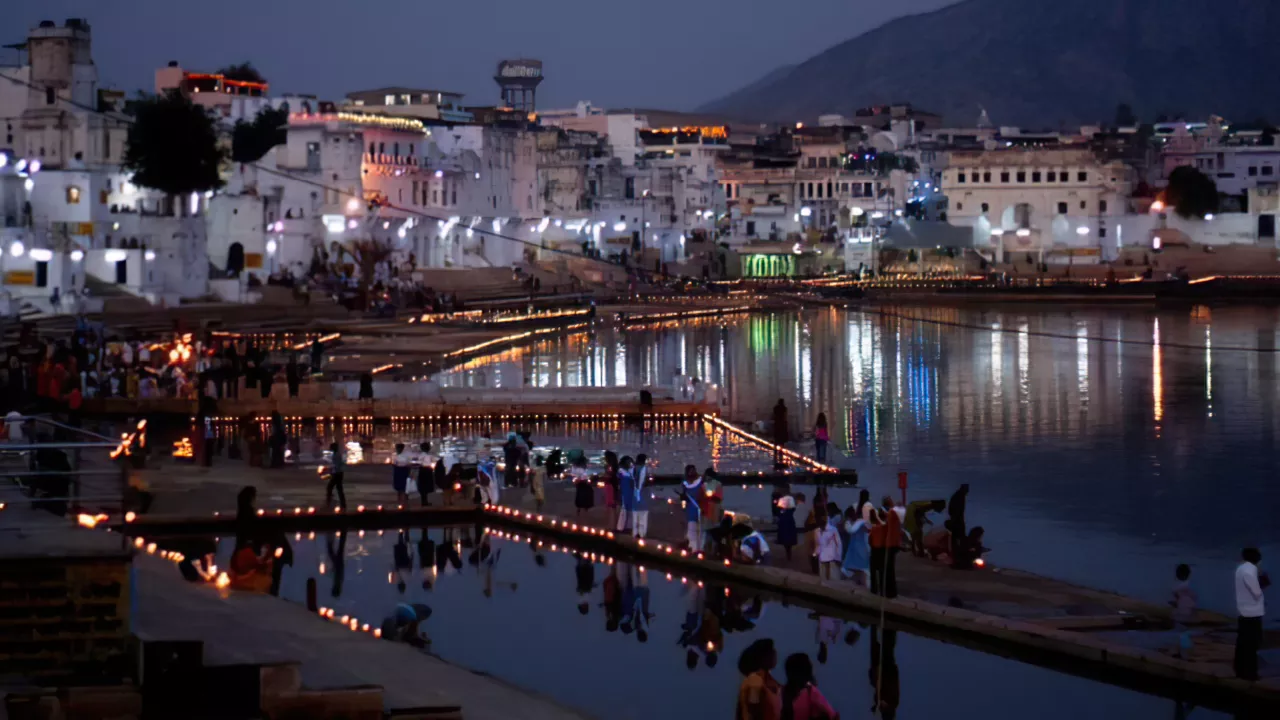
Perhaps the most unique Kartik Purnima bathing site in all of India is the Brahma Sarovar at Pushkar in Rajasthan — the sacred lake where Lord Brahma is said to have incarnated on this very day. The Padma Purana narrates that Brahma descended to Pushkar on Kartik Purnima, making the Pushkar lake the one place in India with a direct divine connection to Brahma himself — extraordinarily rare, since Brahma has virtually no temples dedicated to him anywhere else in the country.
On Kartik Purnima, tens of thousands of pilgrims flood Pushkar for a bath in this lake. The famous Pushkar Camel Fair traditionally coincides with Kartik Purnima, making it one of the most colourful and culturally rich pilgrimages in Rajasthan.
How to Perform the Sacred Bath
The proper approach to Kartik Purnima snan includes:
- Rise during Brahma Muhurta (approximately 90 minutes before sunrise) and begin preparations.
- Speak a sankalpa (statement of intention) stating your name, the day and month, the purpose of the bath (purification, ancestral merit, spiritual elevation), and the deity to whom you dedicate the merit.
- Enter the river facing east (toward the rising sun) and immerse yourself fully three times, each time chanting Om Gangayai Namah or a mantra appropriate to the river you are bathing in.
- Offer tarpan (water offering) to your ancestors — cup the water in your hands and let it flow slowly back into the river while silently naming your ancestors. This is one of the most important aspects of Kartik Purnima bathing.
- Exit the river and offer a ghee lamp or flowers into the water as a concluding offering.
5. Deep Daan on Kartik Purnima: The Lamp That Lights Two Worlds
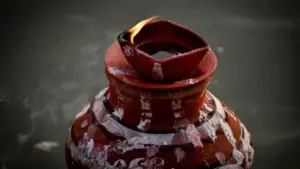
Deep Daan — the offering or donation of a lamp — is one of the most powerful forms of charity described in the Hindu scriptures, and on Kartik Purnima, it reaches its annual peak of spiritual potency.
The Padma Purana states: “He who donates an Akhand (unbroken, never-extinguished) lamp near Lord Vishnu in the month of Kartik is filled with celestial radiance for as many years as the number of minutes that lamp continues to burn.” On Kartik Purnima specifically, the merit of lamp donation is multiplied beyond calculation — the texts describe it as enough to liberate one’s entire lineage from all accumulated karma.
For a complete understanding of the philosophy and practice of Deep Daan, read our dedicated articles on Deep Daan and Its Brilliance and Deep Daan at Ayodhya.
Types of Lamps and Their Significance
- Ghee lamp: Considered the most sacred — associated with Vishnu and Lakshmi. Donating a ghee lamp is the highest form of Deep Daan.
- Sesame oil lamp: Associated with ancestors and specifically recommended for tarpan and ancestral rites on Kartik Purnima.
- Mustard oil lamp: Associated with Saturn (Shani) and considered highly effective for removing planetary obstacles when donated on sacred days.
- Floating lamps (offered on rivers): When a lit diya is set afloat on the Ganges on Kartik Purnima, it is said to carry one’s prayers directly to the ancestors in their realm, since the Ganges connects the worlds of the living and the dead.
6. Guru Nanak Jayanti: Kartik Purnima Across Religions
One of the most moving facts about Kartik Purnima is that it is also Guru Nanak Jayanti — the birthday of Guru Nanak Dev Ji, the founder of Sikhism and one of India’s greatest spiritual teachers. Born in 1469 CE on the full moon of Kartik at Rai-Bhoi-di-Talwandi (now Nankana Sahib in Pakistan), Guru Nanak’s birth on this most sacred of all Hindu full moons is seen by many as itself a cosmic statement — that the light of divine grace arrives at the moment of maximum sacred potency.
Sikhs celebrate Guru Nanak Jayanti (also called Gurpurab or Guru Parv) with morning prayers and akhand path (continuous reading of the Guru Granth Sahib), visits to the Gurudwara, community meals (langar), and evening processions with the sacred scripture on a float decorated with flowers and lights. The parallel of the lamp — central to both Hindu Dev Deepawali and the Sikh celebration — is profound.
In cities like Amritsar, where the Golden Temple glows magnificently on Guru Nanak Jayanti, and Varanasi, where the ghats burn with a hundred thousand earthen lamps for Dev Deepawali, the shared sacred energy of this single full moon night is palpable. It is a reminder that India’s spiritual traditions, despite their profound differences, often converge at the same moments of cosmic auspiciousness.
7. The Matsya Avatar of Lord Vishnu: A Kartik Purnima Mystery
One of the less commonly discussed but scripturally attested events of Kartik Purnima is Lord Vishnu’s manifestation of the Matsya Avatar — his first of the ten primary avatars, in the form of a great fish. The Puranas record that it was on Kartik Purnima that Vishnu first descended in his Matsya form to protect the Vedas and the progenitor Manu from the great deluge that periodically destroys and renews creation.
This event connects Kartik Purnima to the very first act of divine preservation in the current cosmic cycle — the saving of sacred knowledge from destruction. The implication is powerful: Kartik Purnima is not just the celebration of one divine victory (Tripurasura’s defeat) or one divine birth (Guru Nanak) — it is the anniversary of the cosmos’s first rescue. Observing it with devotion is therefore a participation in the most ancient memory of divine protection that exists.
8. Kartik Purnima Rituals: Complete Guide
Here is the comprehensive day’s ritual programme for observing Kartik Purnima:
Before Sunrise: Sacred Bath and Tarpan
- Rise during Brahma Muhurta and take a ritual bath at home if you cannot reach a river.
- Go to the nearest sacred river or sacred tank for the Kartik Purnima Snan.
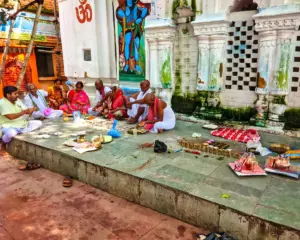
- Offer tarpan to ancestors — this is the primary ancestral rite of this day outside Pitrupaksha.
- Recite Vishnu Sahasranama or Shiva Sahasranama near the river.
Morning: Worship at Home and Temple
- Worship Lord Vishnu (as Lakshmi-Narayan) with the offering of Tulsi leaves — no Vishnu puja is complete without Tulsi.
- Worship Lord Shiva with the Shiva Maha Puja if possible, or at minimum with the Panchakshara mantra: Om Namah Shivaya.
- Read or listen to the Satyanarayana Katha — the Vaishnava scripture specifically recommended for Kartik Purnima and Purnima days generally.
- Visit the nearest Vishnu or Shiva temple for darshan.
Afternoon: Charitable Acts
- Donate food, clothing, or money to those in need — the merit of charity on Kartik Purnima is amplified many times over.
- Donate lamps (diya) to temples — the Skanda Purana specifically mentions that donating lamps to Vishnu temples in Kartik ensures liberation from hell for oneself and one’s ancestors.
- Feed cows, which are sacred to Vishnu — this act earns Go-daan punya without requiring the donation of a cow.
Evening: Dev Deepawali at Home
- Light ghee lamps at all five traditional locations: Tulsi plant, peepal tree or nearest sacred tree, crossroads, temple, and a river or water body.
- Float a lit lamp on the nearest river, pond, or even a large bucket of water in the home courtyard if a river is not accessible — the intention carries the merit.
- Perform the Satyanarayana Aarti and the Kartik Mahatmya Paath (the reading of the significance of the Kartik month) from the Padma Purana.
- Recite the Vishnu Sahasranama or the twelve names of Kartik Purnima: Kartika, Kaumudi, Kushala, Kamala, Kamalini, Kritta, Kritantajayi, Krittikabhava, Kartikeshvara, Kamalaksha, Kevali, Krishnapaksha.
- Fast if possible through the day and break the fast after the evening puja with prasad.
9. Kartik Purnima and Ancestral Rites: The Link to Pitru Tarpan
While Pitrupaksha (the fifteen-day period of ancestral rites) is the primary time for performing Shradh and Pind Daan, Kartik Purnima carries a specific additional significance for ancestral welfare. The Padma Purana states that donating a lamp at Kashi on Kartik Purnima directly alleviates the suffering of one’s ancestors in their post-death state. The combination of tarpan (water offering to ancestors) during the morning Kartik Purnima bath and Deep Daan in the evening creates a complete ancestral ritual that, while not a substitute for Pind Daan, carries significant supplementary merit.
For those who have been unable to perform Pind Daan in Prayagraj or Gaya during Pitrupaksha, observing Kartik Purnima with tarpan and lamp donation at the Triveni Sangam is considered a meaningful and meritorious supplementary act of ancestral piety.
10. Special Observances at Major Sacred Sites
Varanasi (Kashi)
Varanasi is without question the most spectacular place to experience Kartik Purnima. The Dev Deepawali celebrations at Varanasi draw hundreds of thousands of visitors from across the world. The Dashashwamedh Ghat Ganga Aarti, already one of India’s most famous daily ceremonies, becomes a cosmic event on this night. Boats on the river provide the best views of all 84 illuminated ghats simultaneously.
Prayagraj (Triveni Sangam)
At the Triveni Sangam, the sacred bath on Kartik Purnima is observed by massive numbers of pilgrims who camp on the sandbanks the preceding night to be in position for the Brahma Muhurta dip. The Kartik Mela, a month-long fair at the Sangam, reaches its culmination on Kartik Purnima, with the final bathing day drawing the largest crowds of the entire month.
Ayodhya (Saryu Ghat)
Ayodhya’s Deep Daan celebrations on Kartik Purnima at the Saryu ghats are second only to Varanasi in their luminous spectacle. The connection to Lord Rama makes bathing here on this day especially meaningful for devotees of the Vaishnava tradition.
Pushkar (Brahma Sarovar)
Pushkar’s Kartik Purnima fair is the most famous in Rajasthan. The simultaneous occurrence of the Camel Fair and the sacred bathing festival makes Pushkar uniquely colourful — a riot of camels, pilgrims, musicians, and lamps all gathered around one of India’s rarest sacred lakes.
🙏 Book Kartik Purnima Puja at Prayagraj
- Tarpan and Ancestral Rites at Triveni Sangam
- Deep Daan Ceremony by Expert Pandits
- Satyanarayana Katha and Full Puja Package
11. Kartikeya and the Month of Kartik
The very name of this sacred month — Kartik — honours Lord Kartikeya (also known as Murugan, Skanda, or Subramanya), the son of Lord Shiva and commander-in-chief of the divine armies. The Narada Purana declares that visiting or worshipping Kartikeya on Kartik Purnima grants all virtues and ensures victory over one’s enemies.
Kartikeya’s association with this month is also connected to his birthday — while traditions vary on the exact date, many Shaiva traditions celebrate Skanda Sashti (the sixth day of the Kartik month) as Kartikeya’s birth. The entire Kartik month is therefore dedicated to both Vishnu (who awakens in this month) and to Kartikeya (who was born in this month), making it a month of dual divine focus.
12. Reading the Satyanarayana Katha on Kartik Purnima
The Satyanarayana Katha — the story of Lord Satyanarayana (a form of Vishnu who embodies truth and cosmic order) — is specifically recommended for recitation on Purnima days, and on Kartik Purnima most emphatically. The Skandha Purana records five stories of devotees who performed the Satyanarayana Puja and experienced miraculous transformation of their material and spiritual circumstances.
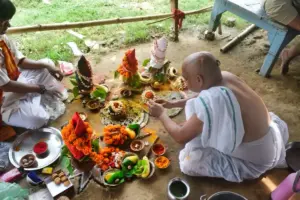
Performing or listening to the Satyanarayana Katha on Kartik Purnima, followed by receiving prasad (which must include panchamrit and preferably fruits and a small amount of shira — sweet semolina pudding), is said to grant the same merit as performing the Ashvamedha Yajna. The ceremony requires a priest, the five forms of panchamrit, five types of fruit, and a small image of Satyanarayana.
Related Services by Prayag Pandits
- 🙏 Deep Daan at Garh Mukteshwar (Kartik Mela) — Starting from ₹2,100
- 🙏 Online Tulsi Vivah Package — Starting from ₹5,100
- 🙏 Ganga Aarti — Starting from ₹3,100
Book Your Sacred Ritual
Authentic ceremonies performed by Veda-trained pandits at sacred sites across India.