Key Takeaways
- Why Language Matters in Ritual Performance
- Services Available with Our Odia-Speaking Pandits
- The Spiritual Significance of Prayagraj for Odia Devotees
- Odia Pandit for Pind Daan in Prayagraj: Procedure and Pricing
In This Article
ଓଡ଼ିଆ ଭାଷାରେ ଧାର୍ମିକ ବିଧି — ritual guidance in the Odia language — is what sets our service apart for families from Odisha visiting Prayagraj. For a devotee from Odisha, performing Pind Daan, Shradh, or any sacred puja in Prayagraj is a deeply personal act of faith. The mantras, the vidhi, the way the purohit addresses your ancestors — it all matters profoundly. When a pandit speaks your mother tongue, Odia, the connection between your prayers and the divine becomes immediate, unmediated by linguistic barriers. At Prayag Pandits, we honour that truth. Our network of verified Odia and Oriya-speaking pandits in Prayagraj ensures that every Odia-speaking family receives rituals performed with full authenticity, in the language and tradition they grew up with.
Prayagraj — the sacred city of Triveni Sangam — holds a position of supreme importance in Hindu tradition. The confluence of the Ganga, Yamuna, and the invisible Saraswati renders this tirth uniquely powerful for ancestral rites. Families from Odisha have journeyed to Prayagraj for generations to perform Pind Daan, Tarpan, Asthi Visarjan, and Shradh karm. With our Odia pandits, those centuries-old traditions are preserved exactly as they should be. For families seeking a complete ritual experience, we offer a dedicated Asthi Visarjan package for Odia families in Prayagraj with Odia-speaking pandits and private boat arrangements.
Why Language Matters in Ritual Performance
Hindu rituals are not merely symbolic. The precise utterance of Sanskrit mantras, the invocation of ancestral names in the correct gotra lineage, the recitation of Odia-language explanations that help the yajaman (the person performing the ritual) understand each step — all of these elements together create the spiritual efficacy of the puja.
When a pandit communicates with you only in Hindi, and you understand primarily Odia, several things happen: you cannot fully participate in the ritual, you may not know when to offer til or jal, and most importantly, the personal connection that makes an ancestral ritual so moving is diluted. This is why Prayag Pandits specifically maintains a roster of pandits who are fluent in Odia.
Our Odia pandits are trained in:
- Odia-language ritual guidance — explaining each step of the vidhi in your mother tongue
- Regional ritual variations — Odia customs for Shradh and Pind Daan differ subtly from mainstream North Indian practices, and our pandits are versed in these nuances
- Correct gotra and ancestral name recitation — ensuring your offerings reach the right ancestors
- Vedic Sanskrit pronunciation — the foundation of all Hindu ritual, maintained regardless of the spoken language used for guidance
Services Available with Our Odia-Speaking Pandits
Our Odia pandit network covers the full spectrum of puja and karmkaand services at Prayagraj. Whether you are visiting for a day or spending several days at the Sangam, we can arrange the appropriate rituals and pandit.
Pind Daan in Prayagraj
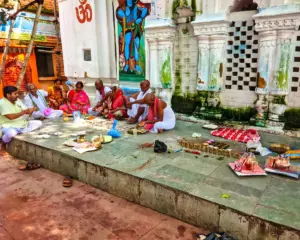
Pind Daan is the most significant ancestral rite performed at Prayagraj. The offering of pindas (balls of rice and barley flour mixed with sesame seeds, honey, and ghee) at the Triveni Sangam is believed to grant moksha to departed souls. Our Odia pandits guide the karta through the complete procedure, including:
- Sankalpa — the formal declaration of intent, with your name, gotra, and ancestral names
- Tarpan — the offering of jal (water mixed with kala til) to the ancestors
- Pinda nirmaan and offering — at the Sangam or at designated ghats
- Brahmin bhoj arrangement — feeding a learned Brahmin as part of the complete rite
Our complete guide to Pind Daan explains the full procedure for families planning this ritual. Triveni Sangam is considered among the most powerful sites for Pind Daan anywhere in India.
Pitrupaksha Shradh at Triveni Sangam
During Pitrupaksha (the 16-day lunar period dedicated to ancestral worship, falling between September 26 and October 10 in 2026), Prayagraj becomes the most important pilgrimage centre in northern India. Tens of thousands of families perform Shradh rituals here every year. Our Odia pandits are available throughout Pitrupaksha to guide Odia-speaking families through every tithi-specific ritual.
Asthi Visarjan
Asthi Visarjan — the immersion of the ashes and bone fragments of a deceased person — is among the most emotionally profound rituals in Hindu tradition. Performed at the Sangam, it is believed to liberate the soul. Our odia pandits handle all arrangements including the boat for the immersion, puja samagri, and the complete mantras. Book our Asthi Visarjan for Odia families (starting ₹5,100) with an Odia-speaking pandit assigned. For families who cannot travel, our NRI puja service allows proxy performance with live video participation.
Narayan Bali and Nagbali
For families whose ancestors died in unusual circumstances (accidental death, suicide, or untimely demise), Narayan Bali puja in Prayagraj is a specialized ritual that provides peace to restless souls. Our experienced Odia pandits conduct this rare and complex rite with proper Vedic procedure.
Other Puja and Karmkaand Services
- Satyanarayan Katha
- Griha Pravesh puja
- Vivah (wedding) vidhi and Sanskrit karmkaand
- Navgraha Shanti puja
- Kaal Sarp Dosh puja
- Rudrabhishek at Allahabad’s temples
- Mundan (first hair-cutting ceremony)
- Janamdin (birthday) puja
The Spiritual Significance of Prayagraj for Odia Devotees
The sacred texts hold Prayagraj in the highest regard among all tirths. The Matsya Purana declares: “Tirthanan uttamam tirtham, Prayagam tirthanayakam” — among all pilgrimage places, Prayagraj is the king of tirthas. For Odia Hindus, who hold Lord Jagannath of Puri as their presiding deity, a pilgrimage circuit that includes Prayagraj carries immense merit.
The confluence at Triveni Sangam is believed to amplify the efficacy of any ritual performed on its banks. The Skanda Purana notes that a single act of Tarpan at Prayagraj equals the merit of a thousand such acts performed elsewhere. This is why Odia families — from the coastal plains to the tribal highlands of Odisha — have traditionally made the journey to Prayagraj at least once in a lifetime.
Our odia pandits understand and share this reverence. When an Odia family arrives at the Sangam, having perhaps travelled for many hours from Bhubaneswar or Sambalpur, they deserve a pandit who meets them with genuine spiritual depth and communicates that depth in their own language.
Odia Pandit for Pind Daan in Prayagraj: Procedure and Pricing
Pind Daan at Triveni Sangam is the most commonly requested ritual among Odia families visiting Prayagraj. Understanding the exact sequence helps the karta (the family member performing the rite) prepare mentally and spiritually.
The ceremony begins at the water’s edge, ideally in the early morning between sunrise and 10 AM, when the Ganga is calmest and the spiritual atmosphere at the Sangam most potent. Your Odia-speaking pandit arrives with all puja samagri already arranged: cooked rice (anna), barley flour (jau ka atta), black sesame seeds (kala til), honey, ghee, kusha grass, a copper lota, and sacred thread.
The procedure, with Odia-language guidance throughout, follows this sequence:
- Snan and Shuchi: The karta bathes in the Sangam and dons clean white or yellow dhoti. The odia pandit guides this in Odia.
- Sankalpa: The formal vow, spoken in Sanskrit but explained line-by-line in Odia. Your name, gotra, village of origin, the tithi, and the names of the ancestors being honoured are recited here. For Odia families, the Sankalpa typically begins: “Mamopatta samasta duritakshaya dwara Sri Parameshwara prityartham…” The odia pandit confirms your exact gotra pronunciation in the Odia Brahmin tradition.
- Tarpan: Water offerings made three times for each ancestor, with kala til (black sesame) mixed in. The odia pandit calls each ancestor’s name as you pour — entirely in Odia, so you know exactly whom you are honouring.
- Pinda Nirmaan: The karta moulds the pindas under the pandit’s guidance. Each pinda represents one generation of ancestors.
- Pinda Arpanam: The pindas are offered at the water’s edge with the final mantras.
- Brahmin Bhoj: Feeding a Brahmin (arranged by us) completes the ritual.
The entire ceremony takes approximately 90 minutes to 2 hours. Our Pind Daan in Prayagraj package starts at ₹7,100 and covers one karta with all samagri included. Families performing Pind Daan for multiple ancestors or requiring extended ceremonies can contact us for a custom quote. Odia-speaking families from Gaya can also book our dedicated Pind Daan at Gaya for Odia pilgrims if combining both sacred sites on the same trip. If you are specifically seeking a hereditary Panda at Gaya who maintains your family’s gotra records, read our detailed guide on Odia Panda at Gaya — the hereditary priest tradition and why it matters for Odia families.
Common Odia Gotras Referenced at Prayagraj
During the Sankalpa — the formal declaration at the start of Pind Daan or Shradh — your gotra (patrilineal lineage name tracing back to a Vedic sage) must be recited correctly. This matters enormously: the ritual is addressed to your ancestors by their gotra, and a mispronounced gotra can cause confusion about which lineage is being honoured.
The most common gotras among Odia Brahmin and Hindu families performing ancestral rites at Prayagraj include:
- Kashyap Gotra — one of the most widespread across Odisha, tracing to Rishi Kashyap
- Bharadwaj Gotra — common among Odia Brahmins, particularly in coastal Odisha
- Vashishtha Gotra — widely held, associated with Rishi Vasishtha of the Ramayana tradition
- Atri Gotra — prevalent among certain Utkala Brahmin communities
- Vishwamitra Gotra — tracing to the royal sage who became a Brahmarishi
- Shandilya Gotra — found across eastern India, Odisha included
- Parashara Gotra — associated with Rishi Parashara, father of Veda Vyasa
- Gautam Gotra — common in both Brahmin and Vaishya Odia communities
- Jamadagni Gotra — associated with Parashurama’s lineage
- Kaushika Gotra — another name for Vishwamitra’s lineage, used in some Odia sub-traditions
- Mudgala Gotra — held by certain scholarly Odia Brahmin families
- Vatsa Gotra — found among Odia communities in Cuttack and surrounding districts
If your family is uncertain of the gotra — a common situation after several generations of migration within India or abroad — our odia pandit can help narrow it down based on your kula devata (family deity) and your ancestral village. In cases where the gotra is genuinely unknown, the pandit uses the customary placeholder “Kashyap gotra” with an explanatory note in the Sankalpa, a practice sanctioned by the Shastras. No competitor offers this level of gotra-specific Odia support at Prayagraj.
For Odia families wishing to also perform Tarpan water offerings as a separate or additional rite, our Pitru Tarpan for Odia families at Triveni Sangam is available as a standalone service.
The Odia Tradition of Shradh: Regional Nuances
While the core Vedic framework of Shradh is common across Hindu traditions, Odia practices carry certain distinctive characteristics that our pandits are specifically trained to accommodate:
The Role of Lord Jagannath
In Odia Hindu tradition, invocations to Lord Jagannath (an aspect of Lord Vishnu) are woven into ancestral rites. The Jagannath Tattva — the philosophical understanding of the divine as formless yet manifest — shapes how Odia families approach concepts like moksha and rebirth. Our pandits acknowledge this and incorporate appropriate invocations where the family wishes.
Odia-Specific Puja Samagri
Certain items used in Odia Shradh rituals differ from the standard North Indian list. For example, specific leaf varieties and local grain preparations may be preferred. Our pandits source appropriate samagri or guide families who wish to bring items from home. All standard Pind Daan samagri — cooked rice, barley flour, black sesame seeds (kala til), kusha grass, honey, ghee, and a copper vessel — is arranged by us.
Gotra Recitation in Odia-Speaking Families
Many Odia families follow the Panchasakhya sect tradition or belong to communities with specific lineage recitation formats. Our pandits are familiar with common Odia gotras and how to correctly invoke ancestors within those lineages during the Sankalpa.
Our Process: Booking an Odia Pandit in Prayagraj
Booking with Prayag Pandits is transparent, simple, and free from the overcharging that pilgrims sometimes encounter at ghats. Here is exactly how it works:
- Contact Us: Reach out via our website, WhatsApp, or phone. Share the ritual you need, the number of family members, and your preferred date.
- Pandit Consultation: We connect you with an Odia-speaking pandit for a brief pre-visit call. He will clarify the vidhi, explain what samagri you need, and advise on auspicious timings (muhurat) for your ritual.
- Transparent Pricing: You receive a fixed, all-inclusive price quote — no hidden charges, no on-the-spot bargaining. Our Pind Daan service at Prayagraj starts at ₹7,100.
- Booking Confirmation: Pay online via UPI, bank transfer, Google Pay, PhonePe, or card. You receive a confirmation with the pandit’s name and contact.
- Ritual Day: Your pandit meets you at the designated ghat or location at the confirmed time. All puja samagri is arranged. The ritual is conducted entirely at your pace, with the odia pandit explaining every step in Odia.
- Post-Puja Support: If you have questions after the ritual — about what was performed, what it means, or any follow-up actions — our team is available to assist.
🙏 Book Your Odia Pandit at Prayagraj
What Our Odia-Speaking Clients Say
The trust of families who have performed ancestral rites with us is our greatest credential. Families from Bhubaneswar, Cuttack, Berhampur, Sambalpur, Rourkela, and across the Odia diaspora in the UAE, the UK, and the United States have used our services. A common thread runs through their feedback: relief and gratitude at finally finding a pandit who could conduct the ritual in their language, with full understanding of their regional customs.
Odia-speaking NRI families particularly appreciate our ability to perform rituals on behalf of relatives who cannot travel to India. Through a secure video call, family members anywhere in the world can participate in real time as the pandit performs Pind Daan or Tarpan at the Sangam and narrates each step in Odia.
NRIs from Odisha: Performing Ancestral Rites from Abroad
For the Odia diaspora, ancestral obligations remain paramount regardless of where you live. When a parent or grandparent passes away, the need to perform Pind Daan, Ekodishta Shradh, or Saabdashik Shradh does not diminish because you are in the UK, Australia, or the USA. Prayag Pandits offers a complete NRI puja service that allows you to fulfil these sacred duties remotely:
- Pre-ceremony call with the pandit to confirm gotra, ancestral names, and ritual specifics
- Live video streaming of the entire ritual at Triveni Sangam, Prayagraj
- Post-ceremony photos and a brief report
- The pandit explains each step in Odia throughout the ceremony
- Prasad dispatch available to Indian addresses for family members who could not attend
The shastra confirms that proxy rituals performed with sincere intent and correct procedure carry full merit. You do not need to be physically present at the Sangam for the ritual to be spiritually efficacious.
Why Choose Prayag Pandits for Your Odia Ritual Services
There is no shortage of pandits at Prayagraj’s ghats. What is rare — and what Prayag Pandits offers — is a service that combines:
- Language authenticity: Verified Odia-speaking pandits, not simply pandits who speak a few Odia phrases
- Ritual expertise: Pandits with formal training in Vedic karmkaand and specific experience with Odia regional customs
- Transparent pricing: Fixed, published prices with a clear cancellation and refund policy. No on-ghat haggling
- Complete logistics support: Our parent organisation, Prayag Samagam, can arrange accommodation, cabs, airport or railway station pickups, and local sightseeing to complement your pilgrimage
- NRI-compatible service: Video-call rituals, international payment acceptance, and English/Hindi/Odia communication support for the diaspora
- Background-verified pandits: Every pandit in our network has been personally vetted for credentials and conduct
We have served pilgrims from every corner of Odisha and from Odia communities in the Gulf, Southeast Asia, Europe, and North America. The relationship we build with your family does not end at the ghat — we remain a resource for all your future ritual needs.
Reaching Prayagraj from Odisha
Prayagraj is well-connected to major Odia cities by rail and road. Planning your journey in advance ensures a peaceful arrival focused on your sacred purpose:
- From Bhubaneswar: Utkal Express (train No. 18477/18478) runs directly to Prayagraj Junction. Journey time approximately 14–16 hours. Book well in advance, especially for Pitrupaksha period.
- From Puri: Puri–Allahabad Express is a popular direct option for pilgrims combining Jagannath Dham and Prayag.
- From Cuttack or Sambalpur: Connect to Bhubaneswar or take a direct train to Prayagraj Junction.
- By air: Prayagraj has its own airport (Bamrauli Airport) with connections from major cities. The nearest large airports are Varanasi (Lal Bahadur Shastri Airport, approximately 120 km) and Lucknow (Chaudhary Charan Singh Airport, approximately 200 km).
- By road: Odisha to Prayagraj is approximately 800–900 km. Bus services operate from major Odia cities, though this journey is long.
Once in Prayagraj, Triveni Sangam is approximately 7 km from Prayagraj Junction railway station. Our team can arrange pickup and drop services on request.
Begin Your Pilgrimage with Confidence
A journey to Prayagraj for ancestral rites is one of the most meaningful acts a Hindu family can undertake. For Odia families, that meaning is deepened immeasurably when the entire ritual — the Sankalpa, the Tarpan, the offering of pindas, the prayers for the departed — unfolds in their own language, with their own regional customs intact.
Prayag Pandits stands ready to make that experience as spiritually profound and logistically smooth as possible. From the moment you contact us to the moment your family departs Prayagraj with the blessings of your ancestors, we are with you.
Contact us today to speak with an Odia-speaking pandit and plan your visit. May the blessings of your Pitrus guide your family forward.
Book Your Sacred Ritual
Authentic ceremonies performed by Veda-trained pandits at sacred sites across India.