Blog

Odia-Speaking Panda at Gaya for Pind Daan: Contact, Cost & Booking Guide

Prakhar Porwal · 18 min read
Key Takeaways
    In This Article

    Odia Panda at Gaya — Key Facts

    • Who is a Panda? A hereditary priest at Gaya who holds your family’s gotra records, often spanning 200–400 years
    • Why Odia families need one: Odia Shraddha Paddhati differs from North Indian customs — Sankalpa must be recited with Odia pronunciation, dashaha customs observed
    • Gaya tradition: 45 vedis (ritual altars) across the Gaya Kshetra, each with specific Panda lineages
    • Service from: Rs 7,100 — Book Odia Pind Daan at Gaya
    • Odia script: ଓଡ଼ିଆ ପରିବାର ପାଇଁ ଗୟା ପିଣ୍ଡ ଦାନ

    In the ancient town of Gaya, there exists a class of sacred intermediaries unlike any you will encounter at other pilgrimage sites in India. They are called Pandas — hereditary priests whose families have held specific ritual responsibilities at Gaya’s 45 vedis (altar sites) for centuries. For Odia families, finding an Odia-speaking Panda at Gaya is not a matter of convenience. It is a matter of ritual correctness.

    The Sankalpa — the formal declaration of intent that opens every Pind Daan ceremony — must be recited with the correct gotra name, the correct ancestral lineage (vamsha), and the correct pronunciation. An Odia family’s Sankalpa includes references specific to Utkala Pradesh (historical Odisha), the Odia month name, and customs that differ meaningfully from the North Indian Shraddha Paddhati followed in much of Gaya. A pandit unfamiliar with Odia traditions may perform a valid ceremony, but a hereditary Odia-familiar Panda at Gaya will perform the ceremony exactly as your ancestors did — because he likely served your ancestors before you.

    This guide explains the Panda tradition at Gaya, why it matters specifically for Odia families, what the step-by-step process looks like when you arrive at Gaya with your family, and how our services at Prayag Pandits in Gaya support Odia families through every stage of this sacred duty.

    Dev Ghat in Gaya at night — arrival point for Odia families performing Pind Daan with Odia Panda

    What is a Panda? The Hereditary Priest Tradition at Gaya Dham

    The word Panda (पंडा, or Pande in some dialects) comes from Sanskrit Pandita — learned one. But at Gaya, the title carries a very specific institutional meaning that has no parallel at most other pilgrimage sites. A Gaya Panda is not simply a learned pandit available for hire. He is a member of a hereditary priestly family that has been assigned custodianship over specific vedis within the Gaya Kshetra — the sacred territory spanning roughly 5 kilometres around the Vishnupad Temple — and over specific regional communities of pilgrims.

    Each Panda family at Gaya is traditionally responsible for pilgrims from a defined geographic region of India. Some Panda lineages serve Marathi families. Others serve Bengali families. Several major Panda lineages specifically serve Odia (Orissan) families — and it is these Odia-community Pandas who have maintained gotra records (bahi-khata) of Odia pilgrims stretching back 200 to 400 years.

    When you arrive in Gaya as an Odia family seeking to perform Pind Daan, your hereditary Panda will typically greet you by name if your family has visited before — because your grandfather or great-grandfather’s visit is recorded in the leather-bound registers he keeps. As described in our article about Gaya’s 300-year-old records, these family registers are perhaps the most detailed non-governmental genealogical records maintained by any community in India.

    The Gaya Bahi-Khata: Your Family’s Ancestral Record Book

    The bahi-khata (बही-खाता) — literally “account book” — kept by Gaya Pandas is one of the most remarkable archives in Hindu religious practice. Each Panda family maintains a series of large, handwritten registers bound in thick leather or cloth. These registers record:

    • The pilgrim’s name and home village or city
    • Gotra (clan lineage) and pravar (the three or five ancestral sages of the gotra)
    • The name of the deceased for whom Pind Daan was performed
    • The tithi (lunar date) of the visit
    • The vedis where rituals were performed
    • In many cases, the names of accompanying family members

    For an Odia family, presenting yourself to a Panda at Gaya and finding your family’s earlier entries in his bahi-khata is an emotionally powerful moment. It means your ancestors sat in this same place, your grandfather made this same journey, and the same priestly lineage has witnessed your family’s devotion across generations. This continuity is part of what makes Gaya Pind Daan distinct from performing ancestral rites at any other tirtha.

    If your family has never visited Gaya before, a new entry will be created in the bahi-khata during your visit — beginning a record that your own descendants may consult generations from now.

    Why Odia Families Specifically Need an Odia-Familiar Panda

    Many pilgrimage sites in India have local pandits who will perform whatever ceremony you require. Gaya is different because the ceremony at Gaya is not a generic ancestral rite — it is a precisely structured sequence of offerings at specific vedis, governed by the Gaya Mahatmya sections of the Vayu Purana, Vishnu Purana, and Brahma Purana. Getting this sequence right matters, and the regional variations in Shraddha Paddhati (ritual tradition) are real.

    The Odia Shraddha Paddhati — What Makes It Distinct

    Odia Shraddha tradition carries several distinctive elements:

    • Sankalpa pronunciation: In Odia tradition, the Sankalpa includes the phrase Utkal Deshe (in the land of Utkala) to identify the family’s region of origin. The month name in Odia tradition uses the Odia Panchanga (almanac), which may differ from the Hindi Panchanga used by North Indian pandits. An odia panda familiar with Odia families recites this correctly without prompting.
    • Dashaha customs: The Odia term dashaha refers to the tenth-day post-death ceremony, which in Odia tradition follows a specific sequence before the family can resume regular activities. Understanding where in the death-anniversary cycle the pilgrim is visiting matters for how certain mantras are recited.
    • Pinda preparation: In Odia tradition, Pindas are made from rice flour mixed with sesame (tila) and sometimes with jau (barley) in specific proportions. The offering sequence for Pindas at the Falgu River bank follows the Odia custom of first invoking Pitru Devata by the name of the specific ancestor.
    • The role of the Udaka Tarpan: Odia Shraddha Paddhati places particular emphasis on the water offering (Tarpan) at the Falgu River. The Tarpan mantras in Odia tradition include specific invocations to Sabara Tirtha and Mahendragiri — sacred sites of Odisha — before the main offering. An Odia-speaking Panda will recite these; a pandit from Gaya unfamiliar with Odia customs will not know to include them.
    • Lord Jagannath invocation: Odia families traditionally begin and close every sacred ceremony with an invocation to Jagannath Mahaprabhu. An Odia-aware Panda includes this as a matter of tradition.

    Practical tip for Odia families arriving at Gaya: Carry a handwritten note with the following in Odia: your gotra name, your pravar (the three or five sages), your home district in Odisha, the name of the ancestor for whom you are performing Pind Daan, and the year of that ancestor’s death. Even if your Panda speaks Odia, having this ready speeds up the Sankalpa recitation and reduces errors.

    The 45 Vedis of Gaya Kshetra and the Odia Circuit

    The Gaya Kshetra contains 45 vedis — sacred altar sites — where Pind Daan can be performed, as enumerated in the Vayu Purana. A complete Gaya Shraddha in the ancient tradition requires visiting all 45, a three-day undertaking. Most modern pilgrims, however, focus on the most important vedis within a one or two-day visit.

    For Odia families, the traditional circuit typically includes:

    • Vishnupad Temple (Vishnupad Vedi): The primary altar, where Lord Vishnu’s 40-cm footprint in basalt rock is preserved. The Vishnupad Temple is the heart of the Gaya Kshetra. Pind Daan performed here is the most meritorious of all vedis according to the Garuda Purana.
    • Phalgu River (Falgu Tirtha): The Falgu River is where water offerings (Udaka Tarpan) and the Pinda immersion take place. Odia tradition places special emphasis on the Tarpan here because the Vayu Purana describes Falgu as “pitru-mukha” — the face of the ancestors.
    • Akshaywat (The Imperishable Banyan Tree): A Pinda offered under this ancient banyan, mentioned in both the Garuda Purana and Skanda Purana, becomes akshaya — imperishable. The merit of this offering is said to be eternal.
    • Pretshila Hill: The Pretshila Hill (literally “hill of spirits”) is where offerings are made for ancestors who died under inauspicious circumstances. Odia families with ancestors who died young or in accidents often specifically include this vedi.
    • Ramshila and Mangala Gauri: These two vedis complete the standard Odia circuit. Ramshila is where Lord Rama himself performed Pind Daan for King Dasharatha, according to the Ramayana. The connection between Rama’s act of filial devotion and the Odia tradition of worshipping Rama at Puri creates a meaningful resonance for Odia pilgrims at Ramshila.

    Step-by-Step: Pind Daan at Gaya with an Odia Panda

    Here is what the process looks like when an Odia family performs Pind Daan at Gaya through Prayag Pandits:

    Step 1 — Pre-Arrival Booking and Coordination

    When you book the Pind Daan at Gaya for Odia Pilgrims service, our team contacts you to collect:

    • Your gotra and pravar details
    • The name(s) of ancestors for whom Pind Daan will be performed
    • Your preferred date and expected arrival time at Gaya
    • Any specific customs your family follows (e.g., whether you follow Purnimant or Amant month calculation)

    This information is shared with the assigned odia panda ahead of your arrival so that the bahi-khata can be located and the ceremony prepared.

    Step 2 — Arrival and Ritual Snan (Purification Bath)

    Upon arriving at Gaya, the family proceeds to Dev Ghat or Brahma Ghat on the Falgu River for the ritual snan (purification bath). This is not optional — the Pind Daan ceremony can only begin after the offerer has bathed in the Falgu. The odia panda or his assistant will be present at the ghat to guide you.

    After the snan, you change into clean white or yellow cotton clothing. Silk is the preferred fabric if available. Leather items — belts, wallets, bags — are set aside for the duration of the ceremony.

    Step 3 — The Sankalpa

    The Sankalpa is the formal declaration of intent. The odia panda leads the ceremony’s principal performer (usually the eldest son, son-in-law, or nearest male relative of the deceased) through the Sankalpa mantra. For Odia families, the correct Sankalpa includes:

    • The lunar year, month, paksha, and tithi according to the Odia Panchanga
    • Utkala Deshe (in the region of Utkala/Odisha) as the geographic identifier
    • The full gotra, pravar, and the name of the performer
    • The name of the deceased ancestor and the relationship to the performer
    • The specific vedi where the ceremony is being performed

    This Sankalpa takes approximately 10–15 minutes when recited correctly with all details.

    Step 4 — Pinda Preparation and Offering

    The Pindas are rice-flour balls mixed with sesame, barley, and honey, shaped into small balls of specific sizes. The odia panda supervises the preparation. At Gaya, three types of Pindas are traditionally made:

    • Sthula Pinda — the coarse offering for the physical body of the ancestor
    • Sukshma Pinda — the subtle offering for the soul’s journey
    • Karana Pinda — the causal offering for liberation from the cycle of rebirth

    The number of Pindas varies by the number of ancestors being honoured and whether this is a first-time offering or a subsequent visit. A single-ancestor ceremony typically involves 7 to 16 Pindas across different vedis.

    Step 5 — Tarpan (Water Offering) at the Falgu

    After the Pindas are offered at the Vishnupad vedi, the family proceeds to the Falgu River bank for the Udaka Tarpan — the water offering. The performer holds water mixed with sesame in cupped palms and allows it to flow from the tips of the fingers while the odia panda recites the Tarpan mantras naming each ancestor individually.

    Odia Tarpan tradition includes invoking the ancestors by their full name and gotra: “Amukagotraya Amuka Sharmane Idam Udakam Tarpayami” — “To [ancestor’s name] of the [gotra] lineage, I offer this water.” The Odia Panda recites the Odia form of this declaration.

    Step 6 — Brahmin Bhoj (Offering to Brahmins)

    At the conclusion of the ceremony, a Brahmin Bhoj — a meal offered to at least one Brahmin — is arranged. The belief, as stated in the Vishnu Purana, is that the ancestors receive spiritual nourishment through the satisfaction of the Brahmin who represents them. The Platinum Package (Product 156) includes one Brahmin Bhoj.

    Step 7 — Prasad and Return

    The ceremony closes with the distribution of prasad (consecrated food) and the odia panda’s blessing for the family. He updates the bahi-khata with the details of your visit before you leave.

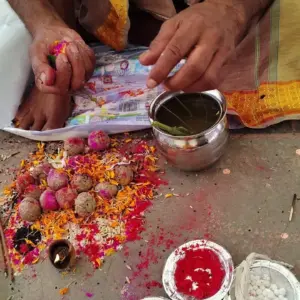
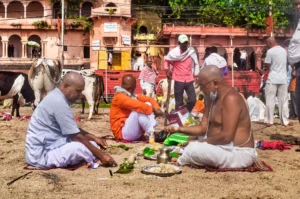
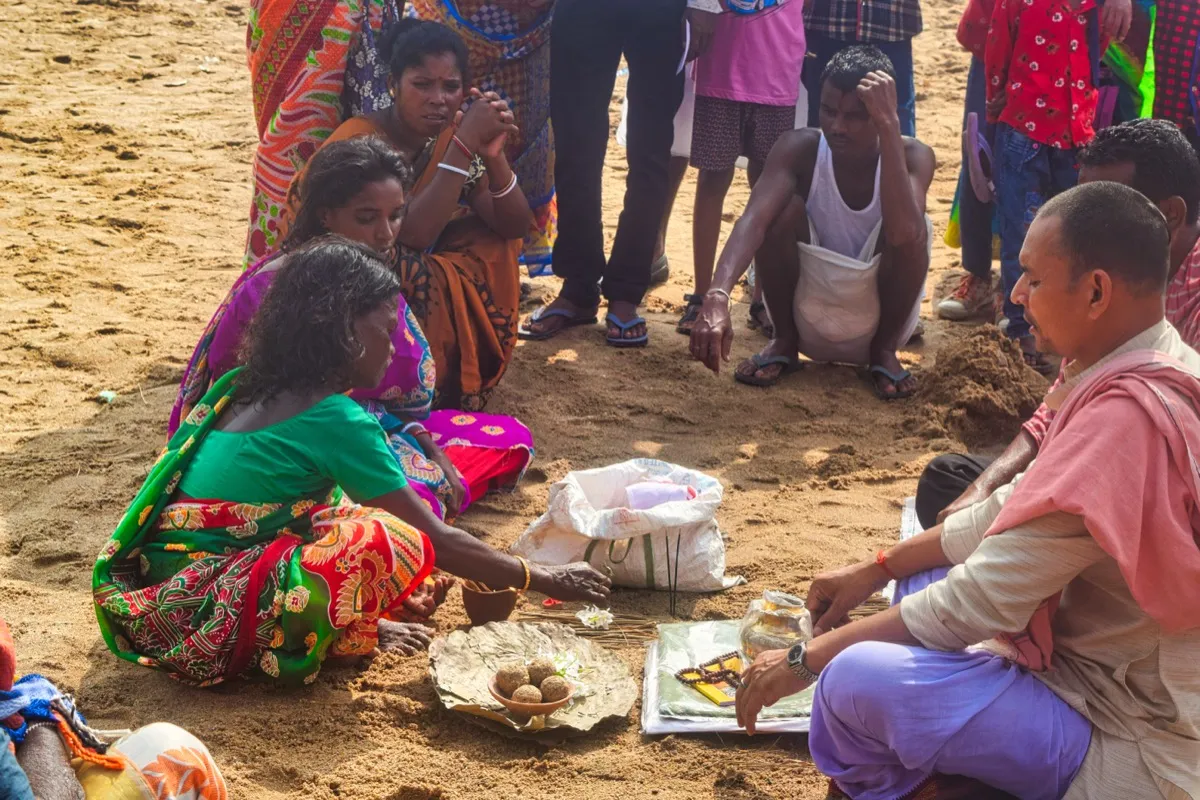
    Devotees performing Pind Daan at Gaya — Odia families follow distinct Shraddha Paddhati with Odia Panda

    Pind Daan at Gaya for Odia Families — Package Options

    Odia Pind Daan Package

    Ceremony at Vishnupad Temple and Phalgu River following Odia Shraddha Paddhati. Odia-familiar pandit, all samagri included, gotra records updated.

    Rs 7,100 Rs 12,999

    Book This Package

    Platinum Package (3 Vedis)

    Complete ceremony at Vishnupad, Phalgu River, and Akshaywat — the sacred trinity of Gaya. Includes one Brahmin Bhoj for maximum ancestral merit.

    Rs 11,000 Rs 15,999

    Book This Package

    3-Day Pitrupaksha Complete

    Comprehensive three-day pilgrimage across all major Gaya vedis during Pitrupaksha. Includes Pretshila, Ramshila, Brahmayoni, Mangala Gauri, and 10+ vedis. Maximum ancestral liberation.

    Rs 31,000 Rs 71,000

    Book This Package

    How to Reach Gaya from Odisha

    Gaya is approximately 600–900 km from the major cities of Odisha. Here are the most practical routes:

    From Bhubaneswar (Approx. 700 km)

    • By train (recommended): The Puri–Patna Express (12801) and the Bhubaneswar–Patna Rajdhani both stop at Gaya Junction. Journey time is approximately 9–11 hours. Book 2AC or 3AC at least 3 weeks ahead, especially during Pitrupaksha (September–October) when berths fill quickly.
    • By road: Via NH-16 and NH-19 through Cuttack–Balasore–Kolkata–Dhanbad. Total drive time is 12–14 hours. Not recommended during Pitrupaksha due to heavy traffic.
    • By air: Fly to Patna (JAY) from Bhubaneswar (BBI), then road transfer to Gaya (approximately 100 km, 2 hours). Flight time is 1.5 hours.

    From Puri (Approx. 730 km)

    • By train: The Puri-Patna Express (12801) departs from Puri Junction and stops at Gaya. This is the most convenient option for Puri families. Journey: approximately 10–12 hours.
    • Combined pilgrimage: Many Odia families from Puri combine Gaya Pind Daan with a visit to Pind Daan at Prayagraj Triveni Sangam in the same trip — visiting Gaya first, then travelling to Prayagraj by train (3–4 hours on the Patna–Allahabad route).

    From Cuttack (Approx. 680 km)

    • By train: Multiple trains from Cuttack Junction pass through or connect to Gaya via the Howrah–Gaya line. The Howrah–Gaya Express and the Puri–Hatia Express both serve this route.

    From Rourkela (Approx. 540 km — Closest Major City)

    • By train: Rourkela is among the closest major Odia cities to Gaya. The route via Hatia or Bokaro reduces the journey to approximately 8–9 hours. The Steel Express (12883) is a reliable connection.
    • By road: Via NH-23 through Jharkhand to Gaya. Approximately 10 hours. Road conditions in Jharkhand vary by season.

    For detailed routing advice, including accommodation options near the Vishnupad Temple, see our guide on How to Reach Gaya.

    Pitrupaksha travel planning (Sep 26 – Oct 10, 2026): Train berths on the Puri–Gaya and Bhubaneswar–Gaya routes sell out 6–8 weeks in advance during Pitrupaksha. Book immediately after the IRCTC Tatkal window opens. Accommodation near Vishnupad Temple fills completely in the final 2 weeks before the fortnight begins. If travelling during Pitrupaksha, confirm your pandit booking and accommodation at least 6 weeks ahead.

    When to Perform Pind Daan at Gaya: Tithi and Timing

    Pind Daan can be performed at Gaya on any day of the year, unlike some tirthas that restrict ceremonies to specific tithis. However, certain dates carry greater merit:

    • Pitrupaksha (Pitru Paksha): The 16-day fortnight from Purnima to Amavasya in the Bhadrapada–Ashwin months. In 2026, this runs from September 26 (Purnima) to October 10 (Sarva Pitru Amavasya). This is considered the ideal time, as the ancestors are believed to be closest to the earth during this period. The Pitrupaksha 2026 guide covers this in full.
    • Death anniversary (Tithi Shraddha): Performing Pind Daan on the exact lunar tithi of an ancestor’s death carries special merit. Many Odia families plan their Gaya visit to coincide with the tithi of a recently deceased parent.
    • Amavasya (New Moon): Every Amavasya is auspicious for ancestral rites. The Purnima Shradh and Amavasya are the monthly windows when Gaya sees an increase in pilgrims from Odisha.
    • Solar and lunar eclipses: The Garuda Purana states that Pind Daan performed during an eclipse earns merit equivalent to ten thousand ordinary ceremonies. However, eclipses require advance planning and specific ritual modifications.
    • Gaya Shraddha outside Pitrupaksha: A family that cannot visit during Pitrupaksha should not delay indefinitely. The Shradh in Gaya is efficacious year-round. Many Odia families visit in winter (October–February) when the weather is pleasant and crowds are smaller.

    The Odia-Speaking Panda vs. General Pandit at Gaya — Understanding the Difference

    When Odia pilgrims arrive at Gaya without a pre-arranged pandit, they are frequently approached by touts near Dev Ghat and Vishnupad Temple who offer to arrange a “pandit” for the ceremony. Some of these arrangements are legitimate; many are not. Understanding the distinction between a hereditary odia panda and a contract pandit available for hire will help you make the right choice.

    AspectHereditary Odia PandaGeneral Local Pandit
    Gotra RecordsMaintains bahi-khata with Odia family records going back 200–400 yearsNo family records; treats each visit independently
    Odia Paddhati KnowledgeTrained in Odia Shraddha Paddhati; recites Odia-specific Sankalpa details correctlyFollows North Indian (Kashi/Gaya general) Paddhati; may omit Odia-specific elements
    LanguageCommunicates in Odia; understands Odia family contextTypically Hindi/Bengali; translation may introduce errors
    Hereditary Right (Adhikara)Has institutional adhikara (right) over specific vedis and specific regional communitiesNo institutionalised vedi-specific rights
    Dashaha CustomsUnderstands Odia dashaha and barsika customs; adjusts ceremony accordinglyMay not be aware of or observe dashaha-specific variations
    ContinuityYour family’s relationship with this odia panda lineage spans generationsOne-time transactional engagement

    At Prayag Pandits, we work with pandits who are specifically trained in Odia Shraddha Paddhati and familiar with the customs and expectations of Odia families. As our team has served over 2,263 families since 2019, including hundreds of families from Bhubaneswar, Cuttack, Puri, Rourkela, and Sambalpur, we ensure that the Odia elements of your ceremony are observed correctly.

    Odia Script Sankalpa Reference — ଓଡ଼ିଆ ପରିବାର ପାଇଁ ଗୟା ପିଣ୍ଡ ଦାନ

    For Odia families who wish to understand what the Sankalpa declaration includes, here is the key Odia-context phrase that distinguishes the Odia Sankalpa from the standard Hindi-medium version used by North Indian pandits:

    Standard Gaya Sankalpa (Hindi medium):
    “Aryavarte Bharatakhande Gangayamahe Uttarabhaage Gayakshetra Madhye Vishnupade…”

    Odia-context Sankalpa addition:
    “Utkala Deshe Puri Mandala Khande / [District Name] Mandala / [Gotra] Gotrasya Pravaraan vitara…”

    In Odia: ଉତ୍କଳ ଦେଶ ଶ୍ରୀ ଗଣ ପୂଜ୍ୟ [ଗୋତ୍ର ନାମ] ଗୋତ୍ର ଶ୍ରୀ [ନାମ] ଶର୍ମଣ। ଅହଂ ଅସ୍ୟ ଗୟା ତୀର୍ଥ ଶ୍ରାଦ୍ଧ ପ୍ରଧାନ [ପ୍ରୟୋଜ୍ଯ ନାମ] ନାମ ପ୍ରେତ ସ୍ୟ ଉଦ୍ଧାର ଅର୍ଥ ପିଣ୍ଡ ଦାନ ଶ୍ରାଦ୍ଧ ଇଦଂ ଅଭ୍ଯୁପ। ।

    This inclusion of Utkala Deshe and the correct Odia district name is what marks the ceremony as specifically honouring the Odia tradition and connects it to the ancestral geography of your family.

    Combining Gaya Pind Daan with Prayagraj Triveni Sangam

    Many Odia families, particularly from Bhubaneswar and Puri, choose to perform Pind Daan at both Gaya and Prayagraj Triveni Sangam in a single pilgrimage journey. This is scripturally supported: the Vayu Purana states that ancestral offerings at Gaya and at the Triveni Sangam (Prayagraj) together ensure the liberation of ancestors from all seven generations in the paternal and maternal lineage.

    The journey between Gaya and Prayagraj takes approximately 3–4 hours by express train on the Patna–Allahabad route. Our Odia-speaking pandit team operates in both locations — families who book through Prayag Pandits can coordinate both ceremonies through a single point of contact.

    Families from Odisha travelling outside India may also benefit from our Odia-speaking pandit service at Prayagraj, which covers the Triveni Sangam ceremony in full.

    Odia NRI Families — Remote and Online Options

    For Odia families based outside India — whether in the UK, USA, Australia, UAE, or elsewhere — performing Gaya Pind Daan in person may not be immediately possible. In such cases:

    • Proxy Pind Daan: The ceremony can be performed on your behalf by a designated representative in Gaya. Scripturally, the kartavya (duty) of Pind Daan can be discharged by the eldest son’s representative when the son himself cannot attend. Our pandit team at Gaya performs the full ceremony with your gotra and family details, and provides a video recording.
    • Online Pind Daan coordination: We can conduct a partial ceremony at Prayagraj Triveni Sangam on your behalf with video documentation while you participate via video call for the Sankalpa recitation from your location abroad. The significance of performing this rite in person at a tirtha is greatest, but a proxy ceremony is considered valid when travel is genuinely impossible.
    • See the general guidance on who is eligible to perform Pind Daan for the complete scriptural basis for proxy ceremonies.
    🍎
    Odia Families — Book Now

    Pind Daan at Gaya with Odia-Familiar Pandit

    Starting from Rs 7,100

    Odia Shraddha Paddhati followed | Gotra records updated | All samagri included

    • Odia-familiar pandit assigned
    • Sankalpa with Utkala Deshe reference
    • Vishnupad Temple + Phalgu River circuit
    • Bahi-khata entry for your family
    • Same-day WhatsApp confirmation

    Book Odia Pind Daan at Gaya

    Or contact us directly: WhatsApp +91 7754097777

    Related Odia Shraddha Traditions at Home and at Tirthas

    Odia families who perform Gaya Pind Daan often have broader questions about their ancestral ritual calendar. The key ceremonies related to Gaya Pind Daan in the Odia tradition include:

    • Shraddha Barsika (Annual Death Anniversary): Performed each year on the lunar tithi of the ancestor’s death. If this falls during Pitrupaksha, performing it at Gaya multiplies the merit significantly. See our guide on Odia Shraddha Paddhati for the complete calendar.
    • Mahalaya Shraddha: Performed on the Mahalaya Amavasya — the last day of Pitrupaksha and a critically important day in Odia tradition. Many Odia families use this day for both the annual Shraddha and for dispatching a representative to Gaya for Pind Daan.
    • Asthi Visarjan in Odisha: Before performing Pind Daan at Gaya, some families first perform Asthi Visarjan at Puri or Jajpur and then proceed to Gaya for the Pind Daan. This sequence is scripturally recommended when the ashes have not yet been immersed.
    • Pitra Dosh remedies: Families where Pitra Dosh is indicated in the birth chart are often advised to perform Pind Daan at Gaya as a primary remedy. The combined efficacy of Gaya’s 45 vedis is considered the most powerful available remedy for Pitra Dosh.

    Frequently Asked Questions

    What is a Panda at Gaya and how is he different from a regular pandit?

    A Panda at Gaya is a hereditary priest from a specific lineage that has been assigned custodianship over particular vedis (altar sites) and particular regional communities of pilgrims for generations. He maintains the family gotra records (bahi-khata) — handwritten registers that record your ancestors visits to Gaya, sometimes going back 200 to 400 years. A Pandit is a learned priest trained in Vedic ritual but without this institutional, hereditary role. Both can perform a valid Pind Daan, but only a hereditary Panda will have your family ancestral records and will know the specific regional customs — including Odia Shraddha Paddhati — that distinguish your ceremony.

    Why do Odia families need an Odia-speaking Panda for Pind Daan at Gaya?

    Odia Shraddha Paddhati (ritual tradition) differs from the North Indian customs followed by most pandits available at Gaya. The Sankalpa declaration must include Utkala Deshe (in the land of Utkala/Odisha) as the geographic identifier, and use the Odia Panchanga month name rather than the Hindi equivalent. The Tarpan mantras in Odia tradition include specific invocations to Sabara Tirtha and Mahendragiri — sacred Odia sites — before the main offering. Dashaha customs (post-death ceremonies) follow Odia sequencing. An Odia-familiar Panda includes Lord Jagannath invocations that are customary in Odia ceremonies. A pandit unfamiliar with these traditions will perform a valid ceremony but will miss these specifically Odia elements.

    How long does Pind Daan take at Gaya with an Odia Panda?

    A single-vedi ceremony at the Vishnupad Temple, including the Sankalpa recitation, Pinda offering, and closing prayers, takes approximately 2 to 3 hours. A complete single-day ceremony covering Vishnupad Temple, Phalgu River Tarpan, and Akshaywat — the three most important vedis — takes approximately 5 to 7 hours including travel between sites. The 3-day Pitrupaksha Special package covers 10 or more vedis across the full Gaya Kshetra and is the most complete option. Come early in the morning (before 8 AM) to begin the snan at the ghat and have sufficient time for the full circuit.

    Can Odia families from outside India perform Pind Daan at Gaya by proxy?

    Yes. When an Odia family outside India cannot travel to Gaya in person, the Pind Daan can be performed by a proxy representative. Scripturally, the Garuda Purana permits a representative to perform the ceremony on behalf of the principal person (usually the eldest son) when the son genuinely cannot attend. Prayag Pandits performs proxy Pind Daan ceremonies with your full gotra details, ancestor names, and Odia Shraddha Paddhati followed correctly. You receive a video recording of the complete ceremony. The Sankalpa is recited in your name and gotra. WhatsApp coordination in Odia is available for NRI families. Contact us at +91 7754097777 to arrange.

    Share

    Book Your Sacred Ritual

    Authentic ceremonies performed by Veda-trained pandits with video proof at sacred sites across India.

    2,263+ families served Video proof included Since 2019
    About the Author
    Prakhar Porwal
    Prakhar Porwal Vedic Ritual Consultant, Prayag Pandits

    Prakhar Porwal is the founder of Prayag Pandits, a trusted platform for Vedic rituals and ancestral ceremonies. With deep roots in Prayagraj's spiritual traditions, Prakhar has helped over 50,000 families perform sacred rituals including Pind Daan, Shradh, and Asthi Visarjan across India's holiest cities.

    2,263+ families served · Operating since 2019
    Share
    Continue where you left off?

    Your Booking

    🙏 Add ₹0 more for priority scheduling

    No rituals selected yet.

    Browse Pooja Packages →
    Need help booking? Chat with us on WhatsApp