अभी तक कोई अनुष्ठान नहीं चुना गया।
पूजा पैकेज देखें →मुख्य बिंदु
इस लेख में
When a family member dies in sudden or violent circumstances — a road accident, drowning, suicide, a snakebite, or any death before the natural end of life — the standard Shraddha and Pind Daan rituals are not sufficient. The Garud Puran, one of the eighteen Mahapuranas of Sanatana Dharma, is explicit on this point: the souls of those who suffer Durmaran (literally, “bad death”) remain trapped in the intermediate plane (antariksha) as wandering spirits. Standard Shraddha offerings dissolve before they can reach such a soul. The specific remedy prescribed by the scriptures is Narayan Bali Puja.
This guide covers everything you need to know — what the ritual is, who needs it, the complete vidhi drawn from authentic Puranic sources, costs across sacred cities, the rules to follow afterward, and how to arrange it through qualified pandits.
What is Narayan Bali Puja?
Narayan Bali Puja is a specialised expiatory rite (Prayashchit karma) prescribed specifically for the moksha of souls who died an unnatural or untimely death. The name contains two layers of meaning: Narayan refers to Lord Vishnu, the preserver and the deity who grants liberation (mukti); and Bali refers to the sacred offering made on behalf of the departed soul.
The Garud Puran states directly: “O Khaga, for those who die from weapon strikes or the touch of untouchables, it is an unnatural death. Without Narayan Bali, any Shraddha offered vanishes in space.” This is not metaphor — it describes a precise spiritual problem requiring a precise ritual solution. The soul is unable to receive nourishment from ordinary Shraddha because its state of being (gati) is suspended. Narayan Bali creates the ritual conditions under which Lord Vishnu’s grace can extend to such a soul and grant it the movement toward a proper rebirth or liberation.
It is closely associated with, but distinct from, Nagbali Puja — a rite performed specifically when a cobra (Nag) was killed, intentionally or accidentally, within the family lineage. In practice, many temples and pandits perform Narayan Nagbali as a combined sequence, especially at Trimbakeshwar in Nashik, which is one of the few sites in India where Nagbali has traditionally been performed. At Prayagraj, Haridwar, and Gaya, the primary rite performed is Narayan Bali.
The ritual belongs to a category of post-death rites that also includes Pind Daan, Tripindi Shradh, and Sapindikarana — but it stands apart in complexity, duration (spanning two to three full days), and the number of qualified Brahmins required. It is, by any measure, one of the most significant and demanding of all Hindu ancestral rites.
Who Should Perform Narayan Bali Puja?
The scriptures give a precise list of circumstances that necessitate Narayan Bali Puja. According to the Manual of Hindu Funeral and Ancestral Rites and the Garud Puran, the rite is required when a person dies due to any of the following causes:
Deaths by Violence or Accident
- Death from a weapon strike — stabbing, shooting, or any form of armed attack
- Burning in fire, whether accidental or deliberate
- Death by drowning — in a river, lake, sea, or any body of water
- Being killed by a wild animal — tigers, bears, elephants, wolves
- Death from the attack of a horned animal — a bull, buffalo, or ram
- Death caused by a snakebite (sarpaghat mrityu)
- Being struck by lightning
Deaths by Supernatural or Ritual Causes
- Death caused by dark magic or sorcery — Maran, Mohan, or Uchchatan kriya
- Death resulting from a Brahmin’s curse (Brahmadand)
- Death of a person who was touched by an untouchable at the moment of dying, making the last rites ritually compromised
- Death of someone killed by a Brahmin (which creates a specific spiritual burden)
Deaths Involving Incomplete Rites
- Cases where the last rites could not be performed at all — for example, when the body was not found
- Cases where Antyesti Samskara (last rites) were performed incorrectly or incompletely
- Deaths during Akal Mrityu — meaning any death that occurs before the natural span of life is exhausted
It is worth understanding the spiritual logic here. In Sanatana Dharma, the purpose of the Antyesti Samskara is to release the soul’s attachment to the gross body and help it transition smoothly through the stages described in the Garud Puran’s account of the afterlife journey. A violent or sudden death disrupts this process. The soul, unprepared and often confused, becomes attached to the place and manner of its death. Without the specific intervention of Narayan Bali Puja, it remains in that condition — neither able to move forward nor to receive nourishment through ordinary Shraddha.
If you are uncertain whether your family situation requires this rite, the traditional guideline is to err on the side of performing it. A qualified pandit can assess the specific circumstances. Many families also perform Narayan Bali out of abundant caution when there is any history of sudden deaths across multiple generations, or when the family is experiencing persistent troubles that may indicate unresolved ancestral karma (Pitru Dosha).
When Shraddha Alone Is Not Enough
If a family member died in an accident, by suicide, by drowning, or in any violent or sudden circumstance, standard Pind Daan and Shraddha cannot fully reach that soul. The Garud Puran specifies that without Narayan Bali Puja, offerings to such a soul dissolve before reaching them. If you are unsure whether this rite is needed, speak with a qualified pandit before the next Pitrupaksha.
Narayan Bali Puja Vidhi — The Complete Ceremony Procedure
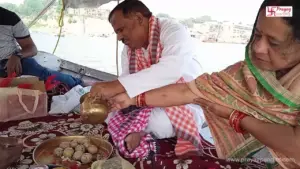
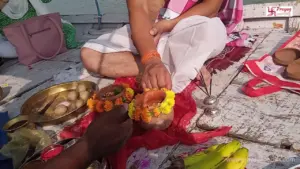
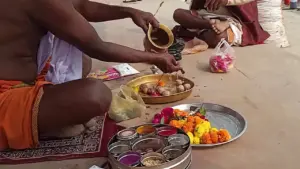
What follows is the authentic procedure as described in the traditional texts. This is the Narayan Bali Puja vidhi as practised by qualified Vedic pandits — not a simplified summary, but a faithful account of each stage of the rite. Understanding what actually happens during this ceremony helps the family prepare mentally and spiritually, and it explains why the ritual demands so much time, expertise, and samagri.
Day One: Purification and Preparation (Shuddhi Karma)
The ceremony begins with the thorough purification of the performer (the karta, the family member conducting the rite). He bathes ritually using mud, cow dung, and panchagavya — the five sacred substances derived from the cow: milk, curd, ghee, cow urine, and cow dung. He then dresses in clean white clothes and faces East.
After drinking panchagavya, tying the shikha (the sacred tuft of hair), and performing Achaman (sipping of water with mantras) and Pranayama (controlled breathing), a Raksha Deep — a protective lamp — is lit. This lamp serves both as an offering to the Divine and as a spiritual boundary that keeps the ritual space protected during what is, in essence, a ceremony that deliberately invokes a troubled soul.
The karta then takes the Sankalpa — the formal vow of intent, naming himself, his lineage, the deceased, and the purpose of the rite. As part of the Sankalpa, he commits to the donation of a cow (Go-daan) or its monetary equivalent (Go-nishkray) to a qualified Brahmin, invoking Lord Vishnu as the presiding deity and witness of the rite.
Panch Sukta Path — The Five Sacred Hymns
This is one of the most distinctive elements of Narayan Bali and the primary reason why a minimum of five Brahmins is required. Five qualified pandits recite simultaneously from five Vedic hymns (Suktas), each addressed to a different deity who governs an aspect of death, dissolution, and liberation:
- Brahma Sukta — invoking the creator, addressing the soul’s origin
- Vishnu Sukta — invoking the preserver and liberator, the central deity of this rite
- Rudra Sukta — invoking Lord Shiva in his aspect as Mrityunjaya, the conqueror of death
- Yama Sukta — invoking the Lord of Death and Dharma, who governs the soul’s journey
- Preta Sukta — directly addressed to the spirit of the deceased, the soul trapped in the intermediate state
The simultaneous recitation of all five creates a complete spiritual architecture — addressing every force and deity that governs what happens after death. This is not ceremonial recitation but precise Vedic application: each mantra is being directed, with full Sankalpa, toward the specific soul for whom the rite is being performed.
Establishment of the Five Kalashas
Five sacred water pots (Kalashas) are established in a line from West to East, each representing a different deity and containing specific grains and cloths that carry symbolic meaning:
| Kalasha | Deity | Grain | Cloth |
|---|---|---|---|
| First | Brahma | Wheat | White |
| Second | Vishnu | Rice | Yellow |
| Third | Rudra (Shiva) | Moong dal | Red |
| Fourth | Yama | Urad dal | Black |
| Fifth | Preta (the soul) | Sesame (til) | Black |
The use of sesame in the Preta Kalasha is particularly significant — sesame (til) is the grain most consistently associated across all Hindu ancestral rites with the nourishment of departed souls. Its use here signals that this offering is directed directly at the soul in its current condition.
Installation of Deity Idols (Murti Sthapana)
Small idols (pratimas) of the four cosmic deities are made from specific metals, chosen for their purifying and symbolic properties:
- Brahma — Silver (chandi): purity and creative power
- Vishnu — Gold (suvarna): the highest purity, liberation, the deity central to this rite
- Rudra — Copper (tamra): transformation, the purifying fire
- Yama — Iron (loha): judgment, the weight of karma
Each idol is bathed in ghee and sacred water (Abhisheka), and Prana Pratishtha — the invocation of divine presence into the idol — is performed with appropriate mantras. The idols are then placed upon their respective Kalashas.
The Havan — Sacred Fire Sacrifice
The ceremony concludes with a Havan (fire sacrifice), the universal concluding element of major Vedic rituals. The sacred fire serves as the carrier of offerings to the divine realm and as the final purifying force for the ritual space. Specific oblations (ahutis) are offered with each mantra, directed toward the liberation of the soul named in the Sankalpa.
Post-Ceremony Rites
Narayan Bali Puja does not stand alone — it is followed by the complete sequence of post-death rites that may have been incomplete or insufficient in the original circumstances. The family then proceeds with:
- Ekadashah Shraddha — the eleventh-day Shraddha rite, which formally closes the mourning period
- Sapindikarana — the rite that integrates the soul with the broader lineage of ancestors (Pitrs), so that it can be nourished through regular annual Shraddha going forward
- Regular Pitru Tarpan on appropriate tithis in subsequent years
This sequencing is important: Narayan Bali prepares the ground, and Sapindikarana completes the soul’s integration into the ancestral web. Together, they constitute the full remedy that the scriptures prescribe.
Narayan Bali Puja Cost — Pricing Across Sacred Cities
The Narayan Bali Puja cost reflects the genuine demands of the ceremony: a minimum of five qualified Brahmins across two to three days, an extensive list of ritual materials (panchagavya, grains, cloths, metal idols, the Havan samagri, sesame, Kalasha vessels, and much more), plus the Go-nishkray (cow donation equivalent) that is part of the Sankalpa. This is not a ceremony that can be condensed or simplified without compromising its efficacy.
Narayan Bali Poojan in Prayagraj — ₹31,000
Prayagraj, revered as Tirtharaja — the King of Tirthas — in both the Agni Purana and the Skanda Purana, is among the most powerful sites in India for any ancestral rite. The confluence of the Ganga, Yamuna, and the invisible Saraswati at the Triveni Sangam amplifies the potency of all Shraddha and Prayashchit rites performed here. Narayan Bali Puja at Prayagraj is conducted over two full days by a team of five Vedic pandits.
What is included:
- Complete Narayan Bali Puja over 2 days
- Five qualified Brahmin pandits for Panch Sukta Path and Havan
- All samagri: panchagavya, grains, cloths, metal idols, Havan materials
- Pandit accommodation and prasad
- Sankalpa in the family’s name with gotra and tithi
- Digital prasad and ceremony photos/video
Book Narayan Bali Poojan in Prayagraj — ₹31,000
Narayan Bali Poojan in Haridwar — ₹31,000
Haridwar, specifically the area of Kankhal near the Daksha Mahadev Temple, has been a traditional site for Narayan Bali Puja for centuries. Known as the Har Ki Pauri — the steps of Lord Shiva — Haridwar’s position on the banks of the Ganga as it descends from the Himalayas gives it a specific sacred quality for all rites aimed at the liberation of the soul. The same five-pandit structure applies here, with the ceremony conducted over two days.
Book Narayan Bali Poojan in Haridwar — ₹31,000
Narayan Bali Poojan in Gaya — ₹35,000
The Vayu Purana identifies Gaya as the most sacred centre for ancestral debt (Pitru Rina). Lord Vishnu’s footprint at the Vishnupad Temple gives Gaya an unmatched connection to the deity who is central to the Narayan Bali rite. The cost at Gaya is ₹35,000, reflecting the three-day structure followed at this site, where Pind Daan across multiple ghats is included alongside the core ceremony.
Please note: In-person Narayan Bali at Gaya is currently unavailable for booking. Please contact us to join the next available dates or consider the online option below.
Online Narayan Bali Poojan in Prayagraj — ₹35,000
For families who cannot travel to India — NRIs, overseas devotees, or those unable to be physically present — we offer a complete Online Narayan Bali Poojan in Prayagraj at ₹35,000. The full ceremony is performed by five pandits on your behalf at Prayagraj, with live streaming so you can observe and participate remotely. The Sankalpa is taken in your name and your family’s gotra. You receive the complete video documentation of the ceremony.
The slight premium over the in-person price accounts for the live stream setup, extended coordination, and the additional pandit time required to ensure full family participation remotely.
Why the Price Reflects Real Value
To understand why Narayan Bali Puja costs what it does, consider what goes into it: five qualified Brahmins for two to three days (this alone is a significant commitment in terms of pandit time and dakshina), metal idols in silver, gold, copper, and iron, extensive Havan samagri, five complete Kalasha sets with grains and cloths, panchagavya preparation, and all the supplementary rites. Families who have searched for cheaper alternatives and received one-hour abbreviated ceremonies have consistently reported that the ritual felt incomplete — because it was.
Rules After Narayan Nagbali Pooja
The rules after Narayan Nagbali Pooja — or Narayan Bali Puja — govern the period of ritual observance that follows the ceremony. These are not arbitrary restrictions but practical guidelines rooted in the understanding that the karta and family have undergone a ritually intense period and the household requires a return to ordinary sacred order.
Dietary Rules (Ahara Niyama)
- During the ceremony days: The karta observes strict vegetarianism. Onion, garlic, non-vegetarian food, and alcohol are prohibited.
- For 11 days after the ceremony: The household maintains vegetarian food. Many families observe this for the full 13-day mourning period if this is the first time these rites are being performed after a death.
- Sattvic diet recommended: Dal, rice, vegetables, milk, and curd. This supports the mental clarity needed during a period of prayer and Tarpan.
Ritual and Spiritual Rules
- Daily Tarpan: For at least 11 days, the karta performs daily water offerings (Tarpan) for the soul in whose name the Narayan Bali was performed.
- No auspicious events: Weddings, mundan ceremonies, griha pravesh (house-warming), and other celebratory rituals should not be performed in the family during the observance period, typically 11 to 13 days.
- No hair cutting or shaving: The karta avoids haircuts and shaving during the ritual period, following the same convention as Shradh observances.
- Daily puja: Regular morning worship of the family deity (Kula Devata) and Vishnu is maintained throughout the period.
- Brahmin Bhoj: On the 11th day (Ekadashah), a meal is offered to qualified Brahmins, completing the cycle of the rite.
After the Observance Period
Once the Sapindikarana rite is performed and the 13-day period concludes, the family returns to normal life. Going forward, the soul is integrated into the family’s Shraddha obligations and should be remembered annually during Pitrupaksha. This annual Shraddha is now both possible and necessary — Narayan Bali has created the conditions for the soul to receive those offerings.
If the Narayan Bali was performed for an ancestor whose death was generations in the past (which is not uncommon — many families only discover the need after observing persistent difficulties), the karta should perform a complete Pitru Tarpan ceremony in the next Pitrupaksha to formally include that ancestor in the family’s annual Shraddha cycle.
Narayan Bali Puja at Home — Is It Possible?
The question of Narayan Bali Puja at home comes up frequently. The honest answer is: technically possible in a limited sense, but not advisable and not equivalent to the full ceremony at a sacred tirtha.
The ceremony’s power derives from two sources: the expertise of the officiating pandits (five qualified Brahmins who know the full Panch Sukta Path and can perform Prana Pratishtha correctly) and the sanctity of the ritual site. While Vedic rites can theoretically be performed anywhere — a Sankalpa can be taken at any location — the traditional understanding is that the combination of sacred geography, the presence of a tirtha, and the proximity to flowing sacred water amplifies the ritual’s reach toward the soul in the intermediate realm.
Assembling five qualified Vedic pandits who know the complete Narayan Bali vidhi in a home setting in most Indian cities is practically very difficult. More commonly, what gets arranged at home is an abbreviated version of the ceremony, which the Garud Puran does not sanction as a substitute for the full rite.
There is also the practical matter of samagri: the metal idols, specific grains, Kalasha equipment, and Havan kund setup are not domestic items. At a properly equipped sacred site, all of this is available as part of the standard setup.
The better alternative: If travelling to Prayagraj or Haridwar is genuinely impossible, the Online Narayan Bali Poojan option allows you to remain at home while the complete ceremony — with all five pandits, all samagri, and full Sankalpa in your name — is performed at Prayagraj on your behalf, with live video. This is both more accessible and far more authentic than an improvised home ceremony.
Best Places for Narayan Bali Puja in India
The scriptures name specific sacred sites where rites for the liberation of souls carry the greatest potency. For Narayan Bali, four sites are traditionally pre-eminent:
Prayagraj (Allahabad) — Tirtharaja
The Agni Purana and Skanda Purana both designate Prayagraj as Tirtharaja — the king among all pilgrimage sites. The Triveni Sangam, where three rivers meet, is considered uniquely powerful for any rite aimed at moksha. The Garud Puran specifically mentions Prayag as a site where rites for those who suffered Durmaran are particularly efficacious. The Prayagraj pilgrimage tradition stretches back to Vedic times — it is described in the Mahabharata as the place where Yudhisthira and the Pandavas performed ancestral rites.
Haridwar — Gateway to Moksha
Haridwar’s name means “Gateway to Hari (Vishnu)” — directly connecting it to the presiding deity of Narayan Bali. The sacred ghats at Kankhal have been the site of ancestral rites for thousands of years. The Ganga here flows directly from the Himalayan snowfields, and the traditional belief is that offering rites at Haridwar ensures that the prayers are carried swiftly toward Vishnu’s realm. The Daksha Mahadev Temple at Kankhal also adds Shaivite potency to rites performed in this area.
Gaya — Seat of Ancestral Liberation
The Vayu Purana identifies Gaya as the supreme site for ancestral debt. Lord Vishnu’s footprint (Vishnupad) at the Vishnupad Temple is unique in all of India — it is the direct mark of the same deity invoked in Narayan Bali. The Falgu River at Gaya has been the site of Pind Daan and Shraddha since the time of Rama, who performed his father’s last rites here according to the Ramayana.
Trimbakeshwar, Nashik — For Narayan Nagbali
If the specific concern is Nagbali (liberation of a soul connected to the killing of a cobra), Trimbakeshwar near Nashik is the traditional and near-exclusive site for this rite. The Trimbakeshwar Jyotirlinga is one of the twelve Jyotirlingas, and the priests here have maintained the specific Nagbali vidhi in an unbroken lineage for centuries.
Most Popular
Book Narayan Bali Puja at Prayagraj
Complete 2-Day Ceremony
₹31,000
per person
Narayan Nagbali Puja Dates 2026 — Auspicious Tithis
Narayan Bali Puja can be performed on any day in principle, but the traditional pandit community identifies specific tithis and periods when the rite carries heightened spiritual potency. For 2026, the following periods are considered most auspicious:
Pitrupaksha 2026 — The Primary Window
The most powerful time for all ancestral rites, including Narayan Bali, is Pitrupaksha 2026: September 26 to October 10. The fortnight of Pitrupaksha (Krishnapaksha of Bhadrapada month) is described in the scriptures as the period when the ancestors are closest to the earthly plane and when rites performed for them carry maximum impact. Sarva Pitru Amavasya on October 10 is particularly powerful for performing rites for souls whose death date is unknown or uncertain — precisely the situation that often applies to Narayan Bali.
Amavasya Tithis (New Moon Days) in 2026
- January 29 — Mauni Amavasya (exceptionally auspicious for ancestral rites)
- February 28
- March 29
- April 27
- May 27
- June 25
- July 24
- August 23
- September 21
- October 10 — Sarva Pitru Amavasya (Pitrupaksha concludes)
- November 9
- December 8
Other Auspicious Periods
- Maghi Purnima (February 12): The full moon of Magh — considered one of the most sacred days of the year at Prayagraj, when the Triveni Sangam carries heightened spiritual power
- Ekadashi tithis: Particularly Ekadashi tithis in the months of Kartik and Ashwin are associated with Vishnu and are traditional days for Narayan Bali
- Gaya-specific dates: During Pitrupaksha, specific ghats at Gaya are assigned particular days for the Pind Daan sequence — the Narayan Bali there follows a fixed 3-day schedule that coincides with this
If you are planning to travel for this ceremony, Pitrupaksha is the recommended time. Spots fill quickly — families from across India and NRIs from abroad travel specifically during this fortnight. We recommend booking at least 4–6 weeks in advance for Pitrupaksha dates.
Book Narayan Bali Puja with Prayag Pandits
Prayag Pandits has been facilitating Narayan Bali Puja and other ancestral rites at Prayagraj and Haridwar since 2019, serving more than 2,200 families across India and abroad. Our pandits are trained in the complete Narayan Bali vidhi — not an abbreviated version, but the full two-day ceremony with Panch Sukta Path, five Kalashas, metal idols, Prana Pratishtha, and Havan.
We understand that the decision to perform Narayan Bali often comes with grief, uncertainty, and sometimes a sense of urgency. Our team is available to speak with you, assess the specific circumstances of the death in your family, and help you understand what the ritual involves and what to expect. There is no pressure to book — ask your questions first.
Choose Your Location and Format
Narayan Bali — Prayagraj
Full 2-day ceremony at Triveni Sangam with 5 qualified Brahmins. Includes Panch Sukta Path, Havan, Sapindikarana, and all samagri.
Starting at ₹31,000
Narayan Bali & Premature Death →Narayan Bali — Haridwar
Full 2-day ceremony at Brahmakund, Har Ki Pauri with 5 qualified Brahmins. Complete Vedic procedure with all sacred materials.
Starting at ₹31,000
Haridwar Pilgrimage Guide →Related Ancestral Rites
Narayan Bali is often performed alongside other ancestral rites for comprehensive liberation of the departed soul.
From ₹5,100
Browse All Services →You may also consider combining Narayan Bali with Pind Daan in Prayagraj or Shradh at Varanasi for a comprehensive ancestral rites programme — our pandits can coordinate a multi-day itinerary across rites.
1
Contact Us with Your Situation
Reach out on WhatsApp (+91 7754097777) or call (+91 9115234555). Share the circumstances of the death and any family history of Pitru Dosha. Our pandits will assess whether Narayan Bali is the appropriate remedy.
2
Share Ritual Details
Provide the departed person’s name, your gotra, the cause and approximate date of death, and the karta’s name. If you do not know the gotra, we use saamaanya vidhi — fully valid per the tradition.
3
Confirm Date & Payment
We schedule the 2-day ceremony on an auspicious muhurat. Payment by UPI, bank transfer, or international card. Full confirmation with date, time, and pandit details sent to you.
4
Attend or Watch Live
Join in person at Prayagraj or Haridwar, or watch the entire 2-day ceremony live via WhatsApp video. Complete documentation — video recording and photos — delivered within 24 hours.
Book Narayan Bali Puja
Performed by 5 Qualified Brahmins at Sacred Tirthas
From ₹31,000
- 2-day ceremony with Panch Sukta Path by 5 Brahmins
- Available at Prayagraj (Triveni Sangam) and Haridwar
- Online option with live video for NRI families — ₹35,000
- All samagri, Havan materials, and Go-daan included
- Video documentation delivered within 24 hours
For questions, guidance, or to confirm your booking:
Call or WhatsApp: +91 7754097777
We are available 7 days a week, 8 AM to 9 PM IST. For urgent matters, WhatsApp is the fastest way to reach us.
You can also read more about related rites in our guides: Narayan Bali Poojan and Premature Death, understanding Akal Mrityu (Premature Death), and the complete guide to Pind Daan.
अपना पवित्र अनुष्ठान बुक करें
भारत भर के पवित्र स्थलों पर वेद-प्रशिक्षित पंडितों द्वारा वीडियो प्रमाण सहित प्रामाणिक अनुष्ठान।
2,263+ परिवारों की सेवा
वीडियो प्रमाण शामिल
2019 से
