

No rituals selected yet.
Browse Pooja Packages →Key Takeaways
In This Article
Introduction to Triveni Sangam Prayagraj
Triveni refers to the confluence of three rivers. In the Ganges River, near Prayag, there is a point where three rivers come together. The confluence of the Ganga, Yamuna, and Saraswati is the same spot where Sangam and Triveni meet. Saraswati is the name of seven rivers mentioned in the Mahabharata (Salya Parva). The Ganges was joined by the Saraswati River, which flowed alongside the Yamuna. The path of the rivers shifted later when earthquakes occurred.All rivers have their confluences, including the Ganga, Yamuna, Saraswati, Kaveri, Godavari, Krishna, Sindhu, Kshipra, and Brahmaputra. Shiva, Vishnu, and Brahma are Hindu gods, and Parvati, Lakshmi, and Saraswati are Hindu goddesses. Triveni is becoming increasingly important around the world as a symbol of the union of the divine. In the Ganges River, near Prayag, there is a point where three rivers converge in a confluence that has no parallel in the spiritual geography of the Indian subcontinent. The Triveni Sangam is recognised as one of the holiest spots in the entire Hindu pilgrimage tradition.

What Does “Triveni Sangam” Mean?
The word Triveni is a compound of two Sanskrit roots: tri (three) and veni (a braid or a confluence of rivers). Literally, Triveni means “the braiding of three.” Sangam comes from the Sanskrit sangama, meaning meeting or confluence. Together, Triveni Sangam means the sacred meeting point of three braided rivers.In Hindu symbolism, the number three carries profound cosmic significance. The three rivers correspond to the three great deities of the Hindu Trinity: Ganga represents Lord Shiva (from whose matted locks the river descended to earth), Yamuna is associated with Lord Vishnu (she is the daughter of Surya and the sister of Yama, the god of death, and thus bridges the mortal and divine), and Saraswati embodies Brahma and the principle of divine knowledge and speech. At the Triveni Sangam, all three cosmic principles unite — creation, preservation, and dissolution — making this point of water a microcosm of the entire universe.The Prayag Mahatmya, a section of the Matsya Purana and other Puranas, declares the Sangam to be Tirthraj — the King of all Tirthas (sacred pilgrimage sites). Lord Brahma himself is said to have performed the first sacrifice here, consecrating the ground with divine fire and making it eternally sacred. The site is also known as Prayag, from the Sanskrit pra-yaga — the place of the great sacrifice.Which Three Rivers Meet at Triveni Sangam?
This is the question that every first-time visitor to the Sangam asks, and the answer carries more depth than a simple geography lesson. Three rivers meet at the Triveni Sangam — the Ganga, the Yamuna, and the Saraswati — but only two of them are visible to the eye.The Ganga descends from the Gangotri glacier in the Himalayas and flows south-east through the plains of Uttarakhand and Uttar Pradesh. By the time she reaches Prayagraj, the Ganga carries the waters of thousands of tributary streams and the accumulated spiritual merit of every tirtha along her banks. At the Sangam, the Ganga appears lighter in colour — a pale greenish-white that devotees describe as the colour of pure silver.
The Yamuna rises at Yamunotri in Uttarkashi district and flows parallel to the Ganga for much of her course through North India before turning south-east to meet the Ganga at Prayagraj. The Yamuna is visibly darker — a deep blue-green at the Sangam that stands in striking contrast to the lighter Ganga waters. This colour difference is most pronounced in winter (October through February) when the river levels are lower and the flow is steadier. Pilgrims take this visible contrast as direct proof of the meeting of two distinct rivers.
The Saraswati is the third and invisible river. The Matsya Purana’s Prayag Mahatmya section describes her as Gupt Saraswati — the hidden Saraswati — flowing underground to emerge at this exact confluence point. In the Rigveda she is celebrated as “Ambitame, naditame, devitame Saraswati” — the best of mothers, the best of rivers, the best of goddesses. Though she no longer flows openly above the plains, the Puranas state that her divine presence is felt most powerfully at the Triveni Sangam, where her underground waters rise to join her two sister rivers.
Geologically, satellite mapping of paleo-channels has confirmed the existence of an ancient river system running beneath the Indo-Gangetic plain that aligns broadly with the Vedic descriptions of the Saraswati’s course. This subterranean reality, combined with the river’s metaphysical presence as the goddess of knowledge, is why the Triveni Sangam is understood to be a confluence of three — not merely two.
Why Prayag Is Called Tirthraj — The Matsya Purana Verdict
In my years of conducting pujas at this Sangam, pilgrims often ask why Prayagraj holds a rank above even Kashi and Gaya among the great tirthas. The answer lies in a remarkable passage from the Matsya Purana that I find myself citing at every Pinda ceremony on these ghats.The Matsya Purana’s Prayag Mahatmya records a cosmic test: all the holy shrines of the universe — every river, mountain, forest, and pilgrimage site — were placed together on one side of a great balance scale. Prayag was placed alone on the other side. The balance tipped decisively in Prayag’s favour. The pilgrimage sites of the entire world combined could not outweigh this one sacred confluence. This is the scriptural basis for the title Tirthraj — the King of all Tirthas.The Matsya Purana further states the verse: “Tirtha-koti-sahasrani Prayagardhena tat-phalam” — ten thousand crore sacred sites together yield only half the merit of Prayag. That is not poetic exaggeration in the context of these scriptures — it is a precise statement of the spiritual hierarchy of sacred places as understood by the Puranic tradition.This is also why Brahma chose this spot for the original creation sacrifice. The Puranas record that when the cosmos was first formed, Brahma performed ten ashvamedha yagyas (the most powerful Vedic fire sacrifices) right here — which is why the place came to be called Prayag, from pra (foremost) and yaga (sacrifice). No other place in the known universe was considered worthy of the Creator’s first act of worship.Tale of Triveni Sangam
There is, in fact, a profound tale behind the Triveni. The Shrimad Bhagwat Purana tells the story in great detail. In the past, Saraswati flowed through a Golden Land known as Swarnabhoomi, later renamed Swarna Rashtra and eventually evolved into the region known as Saurashtra. In ancient times, Saurashtra included the entire state of Marwar. Saraswati used to flow with great compassion and abundance through this land, and the people worshipped her regularly.As the people of the region grew more familiar with Yavana (foreign) ways of thought and began to drift from their sacred traditions, Saraswati, the goddess of divine knowledge, could no longer reside among them. She departed Marwar and Saurashtra after obtaining permission from Brahma and began flowing toward Prayag. Without the purifying presence of the sacred river, the land transformed into a desert — which is the region known today as Rajasthan.
The Mystery of the Invisible Saraswati
How does an invisible river form part of a visible confluence? This is one of the most profound and enduring mysteries of Hindu sacred geography. The answer lies in both the geological history of the Indian subcontinent and the spiritual understanding of what rivers represent in the Vedic worldview.Another river, Drishadvati, is also mentioned in the Vedic period. It was a tributary of the Saraswati and ran through the region of Haryana. The path of the rivers shifted dramatically when powerful earthquakes caused the mountains of Haryana and Rajasthan to rise from beneath the soil. The upheaval altered the flow of entire river systems. The direction of Drishadvati’s flow shifted, and Saraswati’s above-ground course largely disappeared. Today, this Drishadvati is identified by some scholars as the Yamuna. Its course is said to date back approximately 4,000 years in its present form.
Saraswati in the Vedic and Puranic Literature
Saraswati holds a position in the Vedic tradition that is difficult to overstate. She is simultaneously a physical river and a divine principle — the goddess of knowledge, learning, speech, music, wisdom, and the sacred arts. In the Rigveda, she is invoked in many hymns as the greatest of rivers: “Ambitame, naditame, devitame Saraswati” — “The best of mothers, the best of rivers, the best of goddesses, Saraswati.” This triple superlative places her above all other sacred rivers in the Vedic understanding.Saraswati is known by numerous names in the Mahabharata (Salya Parva), where seven rivers bearing the name Saraswati are identified across different regions of India. The Ganges was joined by the Saraswati River flowing alongside the Yamuna at Prayag. According to Brajmandal folklore, a Saraswati River flowed from the ancient state of Haryana through the Ambika forest near Mathura and into the Yamuna at a ghat known as Saraswati Sangam Ghat, near Gokarneshwar Mahadev. The Puranas mention the Saraswati River and its surrounding Ambika forest as a region of great sanctity.Even today, the old stream of the Saraswati no longer flows regularly in most regions. In its place, a seasonal stream known as the Saraswati runs into the Mahavidya forest — where the present-day Ambika forest is located — and meets the Yamuna. Saraswati Kund is another reminder of this ancient presence. The temple, Kund, and Ghat at Nala preserve the memory of the river’s ancient course. The Braj tradition is thus linked to the primordial period of Swayambhuva Manu.Spiritual Significance of Bathing at Triveni Sangam
- Liberation from sin: The Matsya Purana states that a single bath at the Triveni Sangam erases the accumulated sins of multiple lifetimes. The water of the Ganga is described as possessed of the power to purify even the most persistent negative karma.
- Ancestral liberation: Tarpan (offering of water with sesame and Kusha grass) performed at the Sangam is said to liberate ten generations of ancestors both above and below. This is why Prayagraj is among the premier sites for Pind Daan and Asthi Visarjan.
- Moksha (liberation): The Prayag Mahatmya declares that a person who takes the Kalpavas — residing at Prayag during the Magh month (January-February) while bathing daily, fasting, meditating, and observing celibacy — attains liberation from the cycle of rebirth.
- The merit of all pilgrimages: The scriptures repeatedly state that the merit accumulated from bathing at the Triveni Sangam is equivalent to or greater than the merit of bathing at all other sacred confluences and pilgrimage sites combined.
The Sacred Power of the Sangam at Prayagraj
The scriptures declare: ‘Tirtha-koti-sahasrani Prayagardhena tat-phalam’ — ‘The merit of ten billion sacred sites equals but half the merit of Prayag.’ This is the scriptural basis for calling Prayagraj the Tirthraj — King of all Tirthas. Even a moment of contact with the Sangam waters, taken with faith and sincere intention, is considered by the Puranas to be supremely auspicious.
The Akshayavat: The Immortal Banyan Tree of Prayag
Within the Patalpuri Temple complex, adjacent to the ancient Allahabad Fort, stands the Akshayavat — the immortal banyan tree. This ancient tree, referenced in both the Ramayana and the Mahabharata, is considered one of the most sacred natural objects in all of Hinduism. Akshaya means inexhaustible or imperishable, and the tree is believed to be as old as the universe itself in its current form.The Ramayana records that Lord Rama, Sita, and Lakshmana rested beneath the Akshayavat during their forest exile. According to another legend, the sage Markandeya asked Lord Vishnu what would happen to the Akshayavat at the time of the great dissolution of the universe (pralaya). Vishnu answered that even during the cosmic dissolution, the Akshayavat would remain — and indeed, Lord Vishnu himself would take the form of a divine child sleeping on a leaf of this immortal tree, floating on the primordial waters of the unmanifest universe.According to Ariel Glucklich, a Hinduism and Anthropology of Religion expert, the memoir of the Chinese Buddhist pilgrim Xuanzang (7th century CE) cites devotional practices and the Akshayavat tree near the Sangam. Alexander Cunningham identified Xuanzang’s tree as the Akshayavat. It still existed at the time of Al-Biruni (11th century), who referred to the location as “Prayaga” and noted its position near the confluence of the Ganga and Yamuna rivers.How the Amrit of Sagar Manthan Consecrated Prayag
The spiritual authority of the Triveni Sangam does not rest on myth alone — it is rooted in one of the most dramatic events in the entire Puranic cosmology: the Sagar Manthan, the churning of the cosmic ocean.The Puranas describe how the gods (Devas) and the demons (Asuras) together churned the primordial ocean using Mount Mandara as a churning rod and the serpent Vasuki as a rope. From that great churning emerged the Amrit — the nectar of immortality. When the kumbha (divine pot) filled with Amrit arose from the waters, a struggle broke out between the Devas and the Asuras for possession of it. During this struggle, drops of Amrit spilled from the kumbha and fell to earth at four sacred places: Prayag, Haridwar, Ujjain, and Nashik.The drops that fell at Prayag landed directly at the Triveni Sangam — at the precise point where the Ganga, Yamuna, and Saraswati meet. This event permanently consecrated the waters of the Sangam with divine energy. Every drop of water that flows through this confluence, the Puranas declare, carries the residual potency of that original Amrit. This is the theological foundation of the Kumbh Mela — the great gathering held every twelve years when the planetary positions recreate the conditions of the Sagar Manthan, intensifying the Amrit-energy of the Sangam to its most concentrated point.In my years at the Sangam, I have watched hundreds of thousands of pilgrims step into these waters — some who have travelled for days, some who have come in great physical pain, some who have come with a burden of grief that they could no longer carry alone. What they are seeking, whether or not they name it this way, is that original consecration — the touch of the Amrit that the Puranas say was placed here by the cosmos itself.Sangam Ghat Prayagraj: The Sacred Steps
The physical gateway to the Triveni Sangam is Sangam Ghat — the wide stone steps descending to the river’s edge where pilgrims have gathered since before recorded history. Standing at these steps, you can see the horizon of the Ganga stretching east, the dark waters of the Yamuna joining from the south, and the flat sand of the Mela grounds running for kilometres along the north bank.Sangam Ghat is not a single ghat but a network of connected ghats, each with its own character and ritual function. The main ghats along the Sangam area include:- Sangam Ghat: The central and most crowded ghat, from which most boat rides to the actual confluence point depart. The stone steps here are always busy with pilgrims bathing, performing Tarpan, and offering prayers facing the river.
- Triveni Ghat: Named directly for the three-river confluence, this ghat is a preferred spot for the performance of ancestral rites including Shradh and Pind Daan. Our pandits at Prayag Pandits perform the majority of their rituals here, on steps that have witnessed the same prayers for well over a thousand years.
- Saraswati Ghat: A quieter ghat associated specifically with the invisible Saraswati. Devotees who come to seek the blessings of the goddess of knowledge often bathe here before examining results or undertaking scholarly endeavours.
- Rambagh Ghat and Naini Bridge Ghat: These flank the main Sangam area and are used primarily during the large festival gatherings of the Magh Mela and Kumbh Mela when the central ghats become extremely crowded.

Triveni Sangam Prayagraj Timings and Best Time to Visit
The Triveni Sangam itself has no opening or closing hours — the river flows day and night, and the ghats are accessible at all times. However, the boat services that take pilgrims to the actual confluence point in the middle of the river operate from approximately 6:00 AM to 6:00 PM (earlier closure during the monsoon months of July and August when the current is strong).The best visiting times, broken down by purpose:
- For Snaan (holy bath): Early morning, from sunrise until 9:00 AM, is the most auspicious time. This is when the ghat is quietest and the quality of light on the water is extraordinary. The Prayag Mahatmya states that a bath taken at dawn, when the sun’s first rays touch the Sangam, carries the greatest spiritual merit.
- For Pind Daan and Tarpan: The Kutapa Kala — the period around midday from approximately 11:30 AM to 12:30 PM — is considered the most auspicious time for ancestral rites according to the Dharmashastra tradition. Our pandits always time the Pind Daan ritual to this window when possible.
- For Aarti: Evening aarti on the ghats, around sunset (5:30 to 7:00 PM depending on season), is a deeply moving experience that every visitor should witness at least once.
Seasonal guidance:
- October to February: The best months for visiting. The colour difference between the Ganga and Yamuna is most visible, the weather is cool, and the Magh Mela (January-February) brings the greatest concentration of saints and spiritual energy to the Sangam.
- March to June: Acceptable, but temperatures rise steeply in April-June (up to 44 degrees Celsius). Arrive before 8:00 AM if visiting in summer.
- July to September: The monsoon raises river levels dramatically and boat rides to the confluence may be suspended. Pitrupaksha (late September to early October) marks the transition to the best visiting season.
Rituals Performed at Triveni Sangam
The Triveni Sangam is not merely a site for bathing. A complete range of sacred rites is performed here throughout the year by millions of pilgrims. The Prayag Mahatmya specifically enumerates four categories of ritual acts that are of supreme merit when performed at this confluence:The first is ablution — the holy bath itself. The Matsya Purana’s Prayag Mahatmya is unequivocal: a single bath at the Sangam washes away the accumulated sins of multiple births. The text specifies that this is true even for a person who bathes without faith, as the water’s own potency acts on the bather. This is the meaning of the Puranic statement that the Sangam waters are self-purifying (svayam-siddha) — they do not require the bather to be spiritually advanced to receive their benefit.
The second is tonsure. The Prayag Mahatmya contains a specific verse on the merit of the head-shaving ritual at Prayag: a pilgrim enjoys celestial bliss for as many years as there are hairs shaved from the head. This is why families traditionally bring infants for their first tonsure at the Sangam — the Mundan Sanskar performed here is considered exceptionally auspicious.
The third is the Pinda ceremony. Offering rice-flour balls (Pindas) to departed ancestors at the Sangam is a deeply prescribed act in the Dharmashastra literature. The Puranas state that Pinda Daan at Prayag liberates ancestors across multiple generations — paternal and maternal both — from whatever state they currently occupy. Pind Daan at Prayagraj is the central ritual for which our pandits are most frequently called. We perform it throughout the year, but most intensively during Pitrupaksha in September-October. Book the Pind Daan in Prayagraj package to have this rite conducted by experienced local pandits at the Sangam ghat.
The fourth prescribed act is charity and feeding of Brahman priests — the patronizing of men of piety who have dedicated their lives to preserving the sacred traditions of this place. The Matsya Purana states that charity given at Prayag yields a thousand times the merit of the same gift given elsewhere, and the feeding of even a single learned Brahman at the Sangam is equivalent in merit to feeding thousands at an ordinary location.
Beyond these four, the Sangam is the site of:
- Asthi Visarjan: The immersion of the ashes and bones (asthi) of a deceased person at the Sangam is considered one of the most auspicious acts a family can perform. The waters of the Ganga are believed to dissolve the last physical traces of the deceased and free the soul from earthly bondage. Thousands of families perform this rite at the Sangam every week. Prayag Pandits offers both in-person and online Asthi Visarjan in Prayagraj for families who cannot travel. Those who can visit may consider the Premium Asthi Visarjan package in Prayagraj, which includes full pandit services, ritual materials, and boat arrangements to the Sangam.
- Tarpan and Shradh: The daily or periodic offering of water mixed with sesame, Kusha grass, and barley in the name of departed ancestors. Tarpan at the Sangam is said to satisfy the souls of three generations of paternal and maternal ancestors simultaneously. Prayag Pandits performs Tarpan in Prayagraj on your behalf when visiting in person is not possible. Families wishing to observe the full Pitrupaksha ritual at the Sangam can also book Shradh at Prayagraj, which includes Pind Daan, Tarpan, and ancestral prayers performed by experienced local pandits.
- Kumbh and Magh Mela Snan: The Sangam is the epicentre of the Kumbh Mela — the world’s largest gathering of humanity — which is held every 12 years (Maha Kumbh) and every 6 years (Ardh Kumbh). The Magh Mela, held annually during January-February, draws millions for the auspicious bathing period known as Kalpavas.
- Mundane and Vivah Samskaras: Families bring infants for the first tonsure ritual (mundan) at the Sangam. Some also perform the sacred thread ceremony (upanayana) and wedding rituals (vivah) on its banks to absorb the abundant spiritual merit of the place.
Triveni Sangam Boat Ride: What to Expect
The actual confluence point — where the Ganga, Yamuna, and Saraswati meet — lies in the middle of the river, not at the ghat steps themselves. To reach it, pilgrims must take a boat ride from one of the main ghats. This boat journey is itself considered a sacred act, and for many visitors it is the most memorable part of the Sangam experience.How it works: Boatmen at Sangam Ghat and Triveni Ghat offer rides to the confluence point. The boats are traditional wooden row-boats, typically holding 6 to 12 passengers. The boatman will row you out to the point where the colour difference between the Ganga and Yamuna is visible — a journey of roughly 10 to 15 minutes from the main ghat steps. At the confluence point, the boat is held steady while pilgrims take their holy bath by stepping down into the water directly from the boat. Many pilgrims bring their own ritual materials (sesame, Kusha grass, flowers, diyas) for Tarpan performed from the boat itself.
Cost and duration: Boat rides to the Sangam point are negotiated with individual boatmen at the ghat. A shared boat costs approximately Rs. 50 to 100 per person; a private boat for a family or group runs Rs. 300 to 600 depending on the size of the boat and the season. During Pitrupaksha and Magh Mela, prices are higher due to demand. A round trip — from ghat to confluence and back — typically takes 45 minutes to one hour.
What you will see: The colour contrast between the two rivers is the first thing that strikes every first-time visitor. The Yamuna, running darker and slightly warmer, meets the lighter, cooler Ganga in a visible line that shifts with the season. In December and January, when both rivers are at their clearest, the boundary between the two rivers can be seen for several hundred metres. At the confluence point itself, the water swirls in patterns that pilgrims have been describing in devotional poetry for centuries.
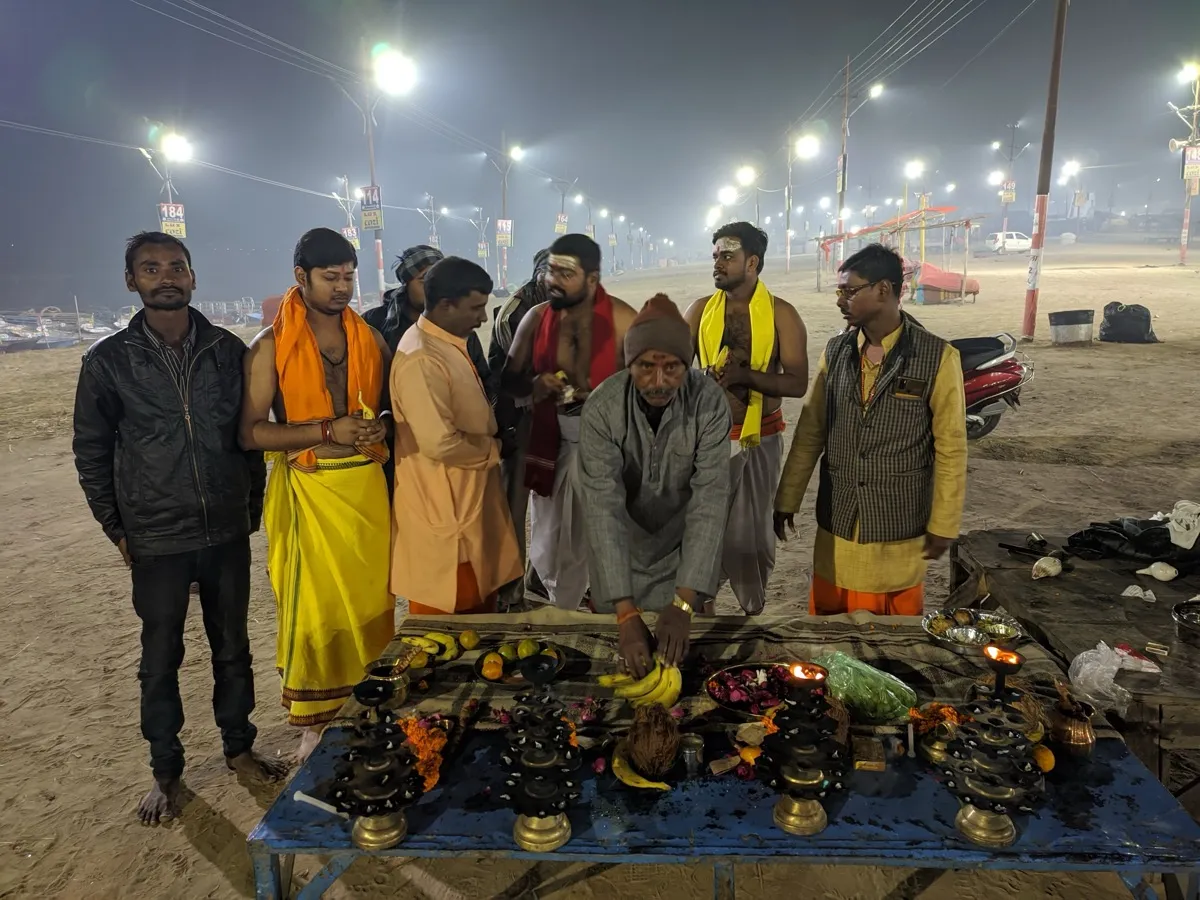
Practical note: If you are coming to perform Pind Daan, Tarpan, or Asthi Visarjan, inform the boatman at the time of boarding. Our pandits at Prayag Pandits coordinate the boat arrangements as part of every in-person ritual package — you will not need to negotiate separately.
How to Reach Triveni Sangam from Prayagraj Station
Prayagraj is well connected by rail, road, and air, and the Sangam is straightforward to reach from any point of entry into the city. Here are the key routes:From Prayagraj Junction (main railway station): The station is approximately 7 km from Sangam Ghat. Auto-rickshaws from the station prepaid booth charge roughly Rs. 80 to 120 for the Sangam. E-rickshaws are available for Rs. 15 to 30 per seat on the shared route. Cab aggregators (Ola, Uber) are active in Prayagraj and the ride takes 20 to 35 minutes depending on traffic. Ask for “Sangam Ghat” or “Triveni Ghat” — both will get you to the main departure point for boats.
From Prayagraj Rambagh Railway Station: This station is closer to the Sangam — approximately 4 km. It is the preferred station for pilgrims travelling specifically to the Sangam area. Auto-rickshaws from Rambagh to Sangam Ghat cost Rs. 40 to 60.
From Prayagraj Airport (Bamrauli Airport, IXD): The airport is approximately 14 km from the Sangam. Pre-paid taxis are available at the airport for roughly Rs. 350 to 500 for the Sangam area. The journey takes 30 to 45 minutes.
By road from other cities:
- Varanasi to Prayagraj: 125 km, approximately 2.5 hours by car on NH19
- Lucknow to Prayagraj: 205 km, approximately 4 hours by car on NH27
- Kanpur to Prayagraj: 193 km, approximately 3.5 hours by car
- Ayodhya to Prayagraj: 165 km, approximately 3.5 hours by car
Within the city: Once in Prayagraj, the most efficient way to navigate to the Sangam is by auto-rickshaw. Drivers universally know the Sangam ghats. Ask for “Sangam Ghat” or “Triveni Sangam” — both are understood by every driver in the city.
For official travel and heritage information about Prayagraj, the Uttar Pradesh Tourism website maintains up-to-date visitor guidance on ghats, accessibility, and local accommodation options.
Visiting the Triveni Sangam: What to Expect
Several thousands of people visit Prayagraj every year to perform Asthi Visarjan, Pind Daan, and to wash away all their sins. Here is what first-time visitors can expect:- Boat rides to the Sangam: The actual confluence point is in the middle of the river, accessible only by boat. Boatmen at the main ghats — Sangam Ghat, Triveni Ghat, and Saraswati Ghat — offer rides to the confluence point where pilgrims can bathe and offer prayers. The boat ride itself is a moving experience as the two rivers with their distinct colours gradually become visible merging into one.
- The visible confluence: At certain times of year, particularly in winter when river levels are lower, the colour difference between the darker Yamuna and the lighter Ganga is clearly visible where they meet. The exact confluence point shifts slightly with the seasons as river levels rise and fall.
- The ghats: The main ghats along the Sangam area include Sangam Ghat, Triveni Ghat, Saraswati Ghat, Rambagh Ghat, and Naini Bridge Ghat. Each has its own character and associated temples.
- Patalpuri Temple: Located within the Allahabad Fort, this ancient underground temple contains the sacred Akshayavat tree and images of numerous deities. It is one of the most visited sites for devotees who come to the Sangam area.
- Veni Madhav Temple: One of the 12 Madhav temples of Prayag, enshrining Lord Vishnu in his form as the presiding deity of the Sangam. The temple is an important stop for pilgrims.
Best Time to Visit the Triveni Sangam
The Triveni Sangam is spiritually active throughout the year, but certain periods concentrate merit and the presence of great saints and sages to an extraordinary degree:- Magh Mela (January-February): The most important regular gathering at Prayagraj. During the month of Magh, when the sun is in Capricorn, the Sangam is considered supremely auspicious. The Kalpavas — a 45-day residential spiritual practice — is observed by tens of thousands of ascetics and devotees who set up camp on the riverbanks.
- Pitrupaksha (September-October): The 16-day fortnight of ancestral rites is one of the busiest periods at the Sangam. Families from across India and the Indian diaspora travel to Prayagraj to perform Pind Daan and Tarpan at the confluence. Pitrupaksha 2026 runs from September 26 to October 10 — early booking is strongly recommended.
- Kumbh Mela (every 12 years): The Maha Kumbh, held at Prayagraj when Jupiter enters Aries and the Sun and Moon are in specific positions, is the single largest religious gathering in the world. Millions bathe at the Sangam during the auspicious Shahi Snan (royal bath) dates.
- Amavasya (New Moon): Each monthly new moon is considered particularly auspicious for ancestral rites at the Sangam. The Somavati Amavasya (new moon falling on Monday) is especially powerful.
Book Now
🙏 Pind Daan & Asthi Visarjan at Triveni Sangam
Starting from
₹5,100
per person
Book Your Sacred Ritual
Authentic ceremonies performed by Veda-trained pandits with video proof at sacred sites across India.
2,263+ families served
Video proof included
Since 2019
