Key Takeaways
- Why Gaya is the Supreme Tirtha for Shradh
- The Sacred Sites of Gaya: Where Shradh is Performed
- Types of Shradh Rituals in Gaya: Choosing the Right One
- Step-by-Step Process for Malaysian NRIs
In This Article
For Malaysian Hindu families who carry the weight of ancestral duty in their hearts, there is one destination that stands apart from every other sacred place on Earth: Gaya. To perform Shradh in Gaya from Malaysia is not merely to complete a religious obligation — it is to unlock the highest form of liberation for your departed ancestors, as guaranteed by the Garuda Purana, the Vayu Purana, and the Mahabharata itself. Whether your family has been away from India for one generation or three, whether your ancestors passed peacefully in old age or were taken suddenly — the rites performed in Gaya carry a power that no other tirtha on Earth can match.
This comprehensive guide is written specifically for Malaysian Hindus planning Shradh in Gaya from Malaysia. It covers the scriptural foundation of Gaya’s unparalleled status, the types of Shradh rituals available, a detailed step-by-step process, travel logistics from Kuala Lumpur, cost breakdowns, accommodation, and the trusted services of Prayag Pandits — your guide for this most sacred of pilgrimages. To understand the deeper philosophical meaning of Shradh and why it is considered one of the most important duties in Hindu Dharma, read our complete guide on Shradh Pooja and the Ancestors’ Debt.
Why Gaya is the Supreme Tirtha for Shradh
India has hundreds of sacred sites where ancestral rites may be performed — from the ghats of Varanasi to the confluence at Prayagraj, from Haridwar to Rameshwaram. Yet none commands the reverence that Gaya commands. The Vayu Purana contains a celebrated verse that has been cited in every generation of Hindu scholarship: “Pitru-tirtheshu sarveshu Gaya-tirtham vishishyate” — Among all pilgrimage sites dedicated to ancestral rites, Gaya stands absolutely supreme. This is not a minor distinction. It is the scriptural consensus of every major Purana, the Mahabharata, and the Ramayana alike.
When you choose to perform Shradh in Gaya from Malaysia, you are following a path walked by millions of devout Hindus across thousands of years — and, according to scripture, by Lord Rama himself, who performed Pind Daan here for his father King Dasharatha. That act established Gaya as the gold standard for all ancestral rites and reaffirmed that no offering carries more weight than one made in this sacred city.
The Legend of Gayasura: Why Every Offering Here Bears Fruit
The sanctity of Gaya is rooted in the story of Gayasura, a demon of extraordinary virtue and devotion to Lord Vishnu. Gayasura performed such intense austerities that his body itself became imbued with divine purity — so much so that anyone who merely touched him or walked near him was instantly liberated from all sins. The gods grew alarmed: if universal liberation was available by simple proximity to Gayasura, the natural processes of karma and spiritual evolution would be bypassed entirely.
The gods approached Lord Vishnu, who descended with all the major deities and requested Gayasura to offer his body as a tirtha for the world. Gayasura — in the highest act of sacrifice — agreed. He lay down and the gods placed the divine Dharmasila (Stone of Virtue) upon him. But the stone trembled, for Gayasura’s body still pulsed with life. Various deities attempted to stabilize it, but none had sufficient divine weight. Finally, Lord Vishnu himself placed his foot upon the Dharmasila. At that moment, Gayasura was fully subdued.
Before departing this world, Gayasura was granted one boon: that any ancestral offering made at this site would forever guarantee liberation for the departed souls. Lord Vishnu granted this boon unconditionally. The divine footprint pressed upon the Dharmasila remains preserved to this day within the Vishnupad Temple — making it the most sacred pind vedi (offering platform) on Earth. This is the foundation upon which every Shradh in Gaya from Malaysia stands. For a deeper exploration of the significance of Pind Daan in Gaya, our authority guide covers the complete history and spiritual meaning.
Four Reasons Gaya Liberates Ancestors Other Tirthas Cannot
- Lord Vishnu’s Personal Blessing: Gaya is the only tirtha where Lord Vishnu — in his form as Gadadhara — resides as the presiding deity specifically for ancestral rites. He is present in the very form of the Pitrus (ancestors), meaning offerings here reach Vishnu directly and through him, your departed family members.
- Akshaya Merit (Imperishable Results): The scriptures declare that whatever is offered in Gaya becomes akshaya — eternal and imperishable. Unlike rites performed elsewhere that may weaken or expire with time, a Gaya Shradh produces results that endure across generations.
- Liberation for All Categories of Souls: Gaya liberates ancestors regardless of how they died — whether through natural causes, sudden accidents, suicide, or untimely death — and regardless of whether proper funeral rites were performed at the time of death. This inclusivity makes Gaya uniquely suited for NRI families who may have lost contact with ancestral rites over generations.
- Removal of Pitru Dosha: For descendants experiencing unexplained suffering, blocked progress in life, or recurring family problems — all of which may indicate Pitru Dosha (ancestral curse or debt) — Gaya Shradh is considered the definitive remedy. The Garuda Purana explicitly names Gaya as the supreme corrective for Pitru Dosha.
The Sacred Sites of Gaya: Where Shradh is Performed
Gaya is home to 45 officially recognized pind vedis — sacred platforms designated for ancestral offerings. For a complete Shradh in Gaya from Malaysia, your ritual will take you through the three most important of these sites. Understanding each one will deepen your experience and your connection to the rites being performed on your behalf.
Vishnupad Temple: The Heart of Gaya Shradh
The Vishnupad Temple is the supreme focal point of all ancestral rites in Gaya. Built on the western bank of the Falgu River, the current eight-story structure was commissioned by Queen Ahilya Bai Holkar of Indore in 1787, though the sanctity of the site dates to the age of the Puranas. Inside the inner sanctum lies the Dharmasila — a basalt rock bearing the 45-centimetre footprint of Lord Vishnu — the very footprint he placed upon Gayasura. Pind offerings made directly upon the Dharmasila are considered the most powerful ancestral offering possible in any Hindu tradition.
Falgu River (Phalgu): The Sacred Waters of Tarpan
The Falgu River — also known as Niranjana — flows through the heart of Gaya and is considered saturated with the essence of Lord Vishnu. All Tarpan rituals (offerings of water mixed with sesame seeds and barley) are performed at the Falgu’s banks. The river holds special significance in the Ramayana: according to the epic, Sita Devi herself performed Pind Daan here for King Dasharatha when Lord Rama was away gathering ritual materials. The sacred significance of the Falgu River in Gaya Shradh is explored in depth in our dedicated guide — a must-read before your pilgrimage.
Akshayavat: The Immortal Banyan Tree
Within the Vishnupad Temple complex stands the Akshayavat — a banyan tree believed to have existed since the age of the Puranas. Akshaya means imperishable, and offerings made under this tree are believed to never decay — symbolizing the eternal liberation granted to your ancestors. According to tradition, this is the tree under which Lord Rama himself sat to perform Pind Daan. Completing the Shradh ritual with offerings at Akshayavat seals the ceremony and ensures its eternal efficacy. Our guide to the vital role of Akshayavat in Gaya Shradh explains its unique spiritual power in detail.
Pretshila Hill: For Souls in Difficult Circumstances
Pretshila (also written Pretasila) is a sacred hill in Gaya dedicated specifically to the liberation of souls that have become preta — spirits trapped in a restless intermediate state due to untimely, violent, or accidental death, or because they died with unfulfilled desires. For Malaysian families who may have lost a family member suddenly or under difficult circumstances, including Pretshila in your Shradh itinerary adds an important dimension of care for such souls. The rites performed here address the specific obstacles to their liberation.
Types of Shradh Rituals in Gaya: Choosing the Right One
Not all ancestral situations are the same, and Gaya offers several categories of Shradh ritual to address different circumstances. When you plan your Shradh in Gaya from Malaysia, your pandit will help you choose the appropriate ritual type based on your family’s specific situation. Here is a clear overview of each.
1. Parvana Shradh (Standard Gaya Shradh)
Parvana Shradh is the standard form of ancestral rite performed at Gaya. It involves Tarpan (water libation), Pind Daan (rice-ball offerings), and Brahmin Bhoj (feeding of priests). This is the appropriate choice when your family has not experienced unusual suffering, when ancestors died under normal circumstances, and when you wish to perform a thorough but focused ceremony. Parvana Shradh can be completed in a single day at Gaya, covering the Falgu River, Vishnupad Temple, and Akshayavat. To understand the full meaning of Shradh and why Hindus perform it, read our detailed post on how Shradh in Gaya gives liberation to the departed.
2. Tripindi Shradh: For Souls Without Peace
Tripindi Shradh is a specialized, more intensive ritual prescribed when a family has been experiencing persistent difficulties — recurring illness, blocked financial progress, troubled dreams, or a feeling that an ancestor’s soul is not at rest. It is also prescribed when Shradh has not been performed for three or more consecutive years (creating an accumulated ancestral debt), or when it is known or suspected that an ancestor died under traumatic or unresolved circumstances.
The “Tripindi” name refers to the three-generation scope of the ritual — it addresses unresolved ancestral issues across three layers of the family lineage. Performed at Gaya’s sacred sites with specific Vedic mantras and extended ritual procedures, Tripindi Shradh is the prescribed solution when ordinary Shradh is insufficient. For Malaysian families who may have had gaps in ancestral rites due to distance from India, Tripindi Shradh in Gaya is often the recommended starting point.
🕉 Tripindi Shradh in Gaya
3. Pitrupaksha Shradh: The Most Auspicious Season
Pitrupaksha is the sixteen-day fortnight in the Hindu month of Bhadrapada (typically September–October) when the ancestral realm is believed to be in closest proximity to the earthly world. During this period, performing Shradh in Gaya from Malaysia carries exponentially greater merit than at any other time of year. The scriptures state that a single Shradh performed during Pitrupaksha at Gaya is equal in merit to a thousand Shradhs performed at ordinary times.
Gaya transforms during Pitrupaksha into a vast spiritual gathering, receiving over one million pilgrims. The atmosphere of collective devotion, the heightened ritual energy, and the concentrated presence of qualified pandits make Pitrupaksha the ideal window for Malaysian families planning their once-in-a-lifetime Gaya pilgrimage.
🙏 Shradh at Gaya — Pitrupaksha Special
4. Pitrupaksha 3-Day Pind Daan: The Complete Gaya Pilgrimage
For families who wish to perform the most thorough and spiritually complete ancestral rites possible, the 3-Day Pitrupaksha Pind Daan in Gaya is the gold standard. Conducted across three consecutive days during Pitrupaksha, this extended programme covers all the major sacred sites in Gaya — Vishnupad Temple, Falgu River, Akshayavat, Pretshila Hill, Ramshila, and Brahmayoni — with dedicated rituals at each.
Day One covers the purification rites and Tarpan at the Falgu River, along with the core Pind Daan at the Vishnupad Dharmasila. Day Two covers the subsidiary sites — Pretshila, Ramshila, Mangalgauri — addressing ancestors in all categories of spiritual circumstance. Day Three concludes with the final offerings at Akshayavat, Brahmin Bhojan, and the closing Visarjan ceremony. This is the traditional full Gaya pilgrimage as described in the Puranas.
⭐ Pitrupaksha 3-Day Pind Daan in Gaya
Step-by-Step Process for Malaysian NRIs
Planning and performing Shradh in Gaya from Malaysia involves careful preparation across several stages. Here is the complete process from the moment you decide to proceed to the completion of the ceremony.
Step 1: Initial Consultation with Prayag Pandits
Your journey begins with a consultation — ideally at least four to six weeks before your planned travel dates. Contact Prayag Pandits via WhatsApp, phone, or the booking form. During this conversation, share the following information: the names of the ancestors for whom Shradh is to be performed, your family’s gotra (ancestral lineage name), the approximate dates of passing (if known), any unusual circumstances surrounding the deaths (untimely, accidental, or without proper funeral rites), and your intended travel window. If you are unsure of your gotra, we will assist you in identifying it.
Based on this information, your pandit will recommend the appropriate ritual type — Parvana Shradh, Tripindi Shradh, or the extended 3-Day programme — and calculate the most auspicious dates for the ceremony. You will also receive a full list of ritual materials to be arranged and a preliminary cost breakdown. For complete information on Shradh package costs from Malaysia, including travel estimates and what is included in each service, refer to our detailed pricing guide.
Step 2: Choose Your Ritual Type and Auspicious Date
Once your family’s situation is understood, confirm your ritual type and lock in the ceremony date. The most auspicious dates for Gaya Shradh are: the Pitrupaksha fortnight (September–October), the Amavasya (new moon) of any month, the death anniversary (tithi) of each ancestor, the days of Mahalaya (the final day of Pitrupaksha, considered the most powerful single day for ancestral rites), and solar eclipses. Your pandit will advise on which date best aligns with your family’s tithi and your travel schedule.
Step 3: Flight Booking — Kuala Lumpur to Gaya
There are no direct flights from Kuala Lumpur (KUL) to Gaya (GAY). All routes require one to two stopovers through a major Indian hub. The most common and efficient routes are:
- KUL → Kolkata (CCU) → GAY: Kolkata is the closest major hub to Gaya (approximately 450 km), with regular IndiGo and Air India domestic connections. Total travel time: 16–22 hours including layover.
- KUL → Delhi (DEL) → GAY: Delhi offers the widest range of connecting domestic flights (IndiGo, Air India, SpiceJet). Total travel time: 18–24 hours.
- KUL → Bengaluru (BLR) → GAY: AirAsia and Batik Air operate this route. Less frequent domestic connections to Gaya via Kolkata. Total travel time: 18–26 hours.
- KUL → Chennai (MAA) → GAY: Air India Express operates KUL–Chennai, with connecting domestic flights. Total travel time: 16–24 hours.
Book flights at least 6–8 weeks in advance during Pitrupaksha season, as seats fill rapidly. Use platforms like MakeMyTrip, Skyscanner, or AirAsia to compare options. Prayag Pandits can also assist with travel coordination through our partner network.
Step 4: Arrival and Coordination in Gaya
Gaya Airport (Bodh Gaya Airport / GAY) is located approximately 12 km from the city centre and Vishnupad Temple. Upon your arrival, a Prayag Pandits representative will coordinate your onward travel to your accommodation. On the day before the ritual, you will meet your assigned Gayawal Pandit for a detailed briefing: the pandit will explain the sequence of rituals, the significance of each step, which materials are required (most are provided as part of the package), and the dress code (traditional white or cream-coloured attire is recommended for the ceremonies).
Step 5: The Day of the Ritual — A Detailed Walkthrough
On the day of your Shradh in Gaya, you will typically rise before sunrise to observe a brief fast and purification bath. The full ritual sequence unfolds as follows:
- Sankalpa (Sacred Declaration of Intent): The ceremony begins with the Sankalpa — a formal declaration made before your pandit in which you state your name, gotra, the names of your ancestors, and the purpose of the ritual. This establishes the spiritual contract of the offering and ensures every rite is directed precisely to the souls you intend to benefit.
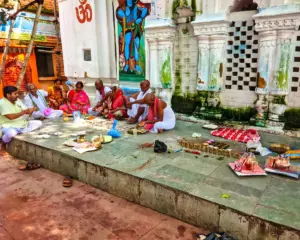
- Tarpan at the Falgu River: You will stand at the banks of the sacred Falgu River and offer Tarpan — libations of water mixed with black sesame seeds (til) and barley (yava), poured while chanting the names of your ancestors across three generations. This sacred water nourishes and satisfies the spiritual thirst of the departed souls.
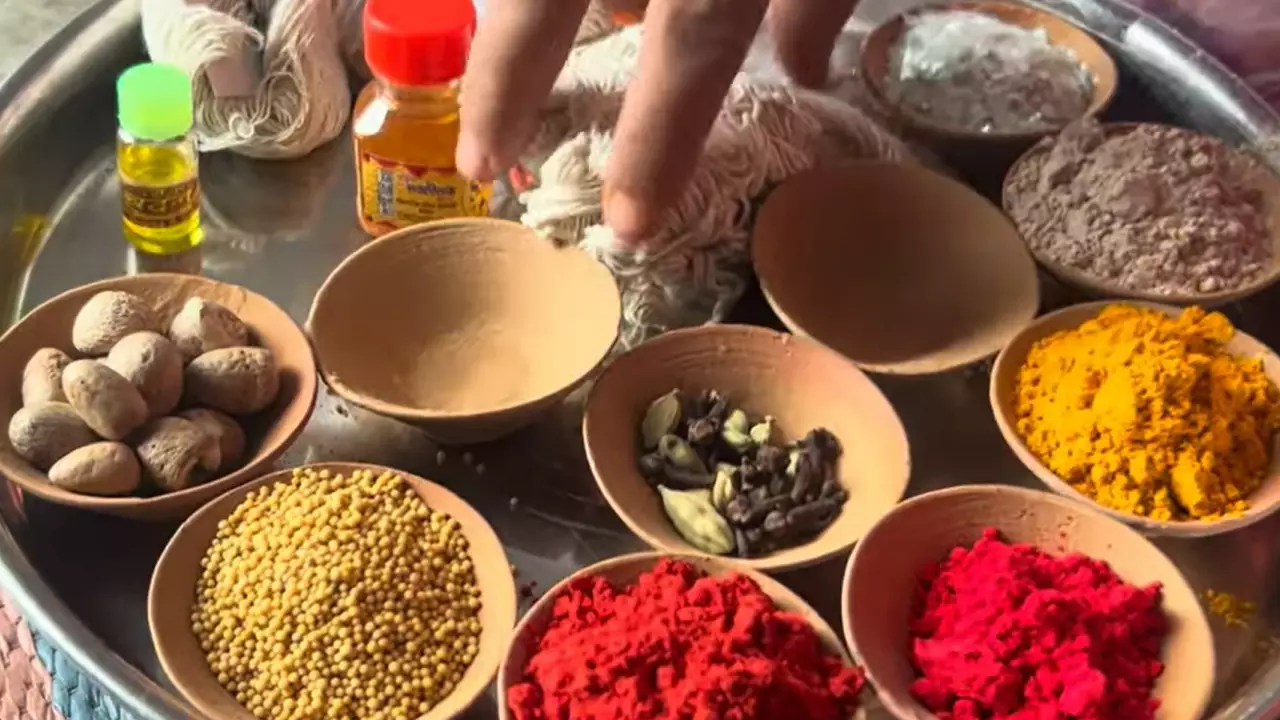
- Preparation of Pind: Under the guidance of your pandit, the pind — balls of cooked rice or barley flour mixed with black sesame seeds, cow’s milk, honey, and ghee — are carefully prepared. Each pind is consecrated with Vedic mantras and assigned to a specific ancestor or group of ancestors in your lineage.
- Pind Daan at Vishnupad Dharmasila: This is the central act of the entire pilgrimage. You will enter the inner sanctum of the Vishnupad Temple and place the prepared pind directly upon the Dharmasila — the sacred footprint of Lord Vishnu. Your pandit will guide you through the specific mantras, the offering sequence, and the prayers for your ancestors’ liberation. The spiritual power concentrated in this act is, according to scripture, unmatched anywhere in the world.
- Offerings at Akshayavat: The ceremony continues at the Akshayavat — the immortal banyan tree within the temple complex — where final pind offerings are made with prayers that seal the liberation of the souls. These offerings are believed to become permanent and eternal.
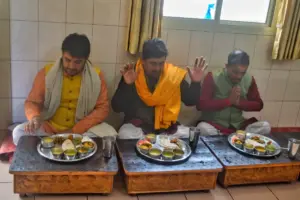
- Brahmin Bhoj (Feeding of Priests): The ritual concludes with feeding qualified Brahmins, offering them food, cloth, and dakshina (monetary offering). The spiritual satisfaction of the Brahmins is directly transferred to the ancestors, completing the full circuit of the ceremony.
- Visarjan (Immersion): The final pind are immersed in the Falgu River with closing prayers for the ancestors’ liberation and onward journey. With this act, the Shradh ceremony is formally complete.
Step 6: Post-Ritual Practices
After the ceremony, your pandit will advise on post-ritual observances: maintaining a vegetarian diet for a specified period, observing certain restrictions on celebrations for a brief time after the rites, and the optional practice of donating specific items (cow, sesame, cloth, silver) for additional merit. You may also wish to visit the Mahabodhi Temple in nearby Bodh Gaya — the site of the Buddha’s enlightenment — as many pilgrims combine these two sacred destinations in a single trip. Our complete resource on how to perform Pind Daan in Gaya from Malaysia covers additional details on the Pind Daan component of this journey.
Online Shradh in Gaya for Malaysian NRIs Who Cannot Travel
We understand that not every Malaysian Hindu family can make the journey to Gaya — whether due to health, work commitments, immigration restrictions, or financial constraints. For families in this situation, Prayag Pandits offers a fully authentic Online Shradh at Gaya service, conducted entirely in person at the sacred sites while you participate via live video call from Malaysia.
Your assigned Gayawal Pandit performs all the rituals — Tarpan at the Falgu River, Pind Daan at the Vishnupad Dharmasila, and offerings at Akshayavat — in your name and on behalf of your ancestors. You participate in real-time via video call, recite your Sankalpa (declaration of intent) directly with the pandit, and witness every step of the ceremony as it unfolds at the sacred sites. The spiritual validity of the ritual is fully maintained: the scriptures support prokta karma (ritual performed by a proxy on behalf of the principal) as equivalent in merit to performing it yourself when physical presence is impossible. For more information on the broader range of Shradh services available from Malaysia, including Varanasi options, see our complete NRI services guide.
📱 Online Shradh at Gaya from Malaysia
Cost Breakdown: Shradh in Gaya from Malaysia
Understanding the full cost of your pilgrimage helps you plan accurately and avoid surprises. Here is a realistic cost breakdown for a Malaysian family of two performing Shradh in Gaya from Malaysia:
- Ritual Package (Prayag Pandits): Starting from ₹7,100 for Pitrupaksha Shradh up to ₹34,999 for Tripindi Shradh. The 3-Day Pitrupaksha Special is ₹31,000 (sale price from ₹71,000 regular).
- Return Flights (KUL to GAY): Approximately RM 1,800–3,500 per person depending on the season and advance booking (2–3 month early booking recommended). Economy class, 1–2 stopovers via Kolkata or Delhi.
- Accommodation in Gaya: Budget guesthouses near Vishnupad Temple: ₹600–1,200/night. Mid-range hotels: ₹2,000–4,000/night. Prayag Pandits can assist with accommodation recommendations based on your budget.
- Local Transportation: Auto-rickshaws and taxis for travel between sacred sites: ₹500–1,500 per day depending on the sites covered.
- Ritual Materials: In most Prayag Pandits packages, all required puja samagri (ritual materials, flowers, pind ingredients, sesame, barley, ghee) is included. Verify with your package details.
- Meals: Budget approximately ₹500–1,000 per day per person for vegetarian meals near the temple area.
For a comprehensive cost analysis including all hidden expenses, seasonal price variations, and a comparison of in-person vs. online Shradh costs, read our dedicated Shradh Package Cost from Malaysia guide.
Accommodation in Gaya: Where to Stay During Your Pilgrimage
Gaya offers a range of accommodation options to suit different budgets. The most convenient area to stay is the neighbourhood surrounding Vishnupad Temple, which gives you walking distance to the main ritual sites and easy access to the river ghats.
- Dharamshalas (Pilgrim Rest Houses): Several dharamshalas operated by trusts and religious organizations are located near Vishnupad Temple. These offer basic but clean rooms at very low cost (₹300–800/night), ideal for those on a tight budget or who prefer a spiritually immersive environment.
- Budget Hotels: Numerous guesthouses and budget hotels cluster around the temple and railway station area. Rates range from ₹800–2,000/night for double occupancy with basic amenities.
- Mid-Range Hotels: Better-appointed hotels are available at ₹2,500–5,000/night, offering air conditioning, reliable Wi-Fi, and in-house dining. The Bodhgaya area (8 km from central Gaya) has more options in this category, suited for Malaysian families who prefer international-standard comfort.
- Heritage Guesthouses: A few heritage properties in Gaya offer culturally immersive stays with traditional architecture and home-cooked vegetarian meals, ideal for families wanting a more personal experience of the pilgrimage city.
Best Time to Visit Gaya for Shradh from Malaysia
One of the unique advantages of Gaya as a Shradh destination is that — unlike most Hindu festivals — the rites can be performed year-round. There is no season when Gaya is “closed” for ancestral rites. However, certain periods carry significantly amplified spiritual merit:
For Malaysian families visiting from abroad, the October window — during Pitrupaksha — is strongly recommended. The weather in Bihar during October is also more comfortable than the peak summer months (April–June), with temperatures in the 25–32°C range. Monsoon season (July–September) brings rain but also a particular spiritual intensity to the river-based rituals at the Falgu.
Frequently Asked Questions: Shradh in Gaya from Malaysia
Begin Your Gaya Pilgrimage: Contact Prayag Pandits Today
The decision to perform Shradh in Gaya from Malaysia is one of the most profound acts of love and devotion you can offer your ancestors. It is a duty that the scriptures describe as the greatest gift a descendant can give — not just to the souls of the departed, but to the living generations who will be freed from the burden of unresolved ancestral debt.
Prayag Pandits has guided hundreds of Malaysian and overseas Hindu families through this pilgrimage with care, scriptural accuracy, and logistical expertise. Our Gayawal Pandits are trained in authentic Vedic procedures, fluent in coordinating with NRI families across time zones, and committed to ensuring that your ceremony is performed with the depth and sincerity it deserves.
Whether you are planning to travel to Gaya in person or require an Online Shradh service, we are here to guide you through every step. Choose your ritual from the options above, reach out via WhatsApp or our booking form, and begin the most important pilgrimage of your family’s spiritual life. Your ancestors are waiting.
🙏 Pind Daan in Gaya — Book Now
Book Your Sacred Ritual
Authentic ceremonies performed by Veda-trained pandits at sacred sites across India.