Key Takeaways
- What Is Tripindi Shradh? (त्रिपिंडी श्राद्ध क्या है)
- Who Needs Tripindi Shradh? Signs of Pitru Dosh
- When Should Tripindi Shradh Be Performed? (कब करना चाहिए)
- Tripindi Shradh Vidhi: The Step-by-Step Ritual Process
In This Article
Among all the ancestral rites prescribed in the Garuda Purana and the Skanda Purana, Tripindi Shradh (त्रिपिंडी श्राद्ध) occupies a singular place. It is not a routine annual ceremony. It is a rescue operation — a carefully structured ritual designed to reach souls who have fallen out of the normal cycle of Shradh and Pind Daan because the circumstances of their death placed them outside it.
In my years performing ancestral rites at Triveni Sangam, I have seen families arrive in profound distress: repeated child deaths with no medical explanation, businesses collapsing despite sincere effort, daughters unable to conceive for years, households gripped by chronic conflict that no amount of compromise resolves. When a jyotishi examines the kundali and identifies Pitra Dosh arising from an ancestor who died by accident, suicide, drowning, fire, or epidemic — Tripindi Shradh is the prescribed response. No other rite can substitute for it.
The Garuda Purana states plainly: “Three pindas offered on kusha grass gratify the manes even when trapped in ghosthood” (Pretasthitam api pitaram tarpayanti trini pindaani durva-nishthasya) — a promise that the preta state, however entrenched, is not permanent. This guide covers everything you need to know: the theology, the vidhi, the samagri, the right location, and the 2026 costs.
What Is Tripindi Shradh? (त्रिपिंडी श्राद्ध क्या है)
Tripindi Shradh is a specialized form of Shradh prescribed exclusively for ancestors who have not received proper rites after death, particularly those who died in circumstances classified as durmarana (unnatural, premature, or violent death). The word comes from Sanskrit: tri (three) + pindi (rice balls) + Shradh (ancestral rite performed with shraddha, or faithful devotion).
There are two interpretations of what the three pindas represent, both found in classical texts, and both worth understanding:
Interpretation 1 — The Three Gunas (Kashi Mahatmya tradition): The three pindas represent Sattva, Rajas, and Tamas — the three fundamental qualities of prakriti (nature). An ancestor trapped in preta yoni is understood to be held by the rajasika and tamasika tendencies associated with the manner of their death — rage, fear, sudden severance from the living world. The three-pinda offering addresses all three dimensions of the departed soul’s spiritual state simultaneously, creating a comprehensive liberation rather than a partial one.
Interpretation 2 — Three Generations (Parvana Shradh tradition): In the broader Parvana Shradh framework, three pindas typically represent the father, grandfather, and great-grandfather — corresponding to the Vasu, Rudra, and Aditya deities respectively. This framework is the basis for regular annual Shradh. Tripindi Shradh uses this same three-pinda structure but adds the specialized mantras and the five-Brahmin configuration needed for souls trapped in the preta state.
The Vedic generation-deity framework is integral to understanding why Tripindi Shradh works. In regular Parvana Shradh, the father is associated with the Vasus (eight deities of material existence), the grandfather with the Rudras (eleven manifestations of divine dissolution), and the great-grandfather with the twelve Adityas (solar deities of cosmic order). Each generation requires different offerings, different mantras, and different vessels. When an ancestor dies unnaturally, this orderly system breaks down — the soul does not receive the Shradh rites timed to its proper death, and it becomes separated from this generational chain.
This is why Tripindi Shradh is considered a “last resort” ritual — not because it is dangerous or extreme, but because it addresses a state that no ordinary Shradh can reach. Regular Pind Daan and Shradh nourish ancestors who have already transitioned through the normal death process. Tripindi Shradh is specifically for those who have not.
The Garuda Purana is explicit on this point, stating that for ancestors who died by violence or accident and were not given proper rites at the time of death, the regular pindas offered at Pitrupaksha are “consumed by rakshasas before they reach the soul.” Tripindi Shradh uses specific preta suktas and the five-vessel kalash configuration to bypass this obstruction and deliver the offering directly to the trapped soul.
To understand the full range of Shradh types and why each serves a different purpose, see the complete guide to Shradh Karm which covers all sixteen classical forms of Shradh prescribed in the Vishwamitra Smriti.
Who Needs Tripindi Shradh? Signs of Pitru Dosh
The Garuda Purana provides a detailed diagnostic list for identifying when Tripindi Shradh is needed. These are not vague spiritual symptoms — they are specific patterns that indicate ancestral disturbance from unnatural death:
- Barrenness in the family — inability to conceive despite medical clearance, or repeated miscarriages with no identified cause
- Repeated child deaths — infants or young children dying at the same age or under similar circumstances across generations
- Sudden financial collapse — businesses that were doing well suddenly failing, inherited wealth disappearing without explanation
- Chronic household quarrels — persistent conflict between spouses or between family members that resists all attempts at resolution
- Unexplained fires or accidents — recurring accidents in the home or workplace, particularly involving the same family members
- Foul diseases — chronic, hard-to-diagnose illnesses that move through the family without clear cause
The critical trigger is the manner of the ancestor’s death. The following circumstances are specifically listed in the Garuda Purana as creating the preta state that Tripindi Shradh addresses:
- Death by accident (vehicle, fall, machinery)
- Death by murder or homicide
- Death by suicide, including medically-assisted death
- Death by drowning
- Death by snake or animal bite
- Death by fire or electrocution
- Death by epidemic or mass casualty event (including pandemic death)
- Death during war or civil unrest
- Death during childbirth (for both mother and child, in some traditions)
- Death where the body was not found or where proper last rites were not performed
The second major trigger is a jyotishi’s diagnosis based on kundali analysis. Pitra Dosh — the planetary affliction associated with ancestral debt — has specific configurations in the horoscope, particularly involving the Sun, the Moon, and Rahu or Ketu in the 9th house (house of the father and dharma). When a jyotishi identifies this combination and traces it to an ancestor who died in one of the above circumstances, Tripindi Shradh is prescribed as the primary remedy, often alongside Narayan Bali.
For families with Pitra Dosh, understanding which type of Pitra Dosh is present determines whether Tripindi Shradh is needed alone or alongside other rites. The consequences of premature death and akal mrityu for the departing soul are documented in detail in the Garuda Purana — Tripindi Shradh is the prescribed response when those consequences fall on the living family.
When Should Tripindi Shradh Be Performed? (कब करना चाहिए)
The Skanda Purana prescribes a specific tithi for Tripindi Shradh: Chaturdashi (the 14th day of the Krishna Paksha), the dark fortnight of any month. This is not the Amavasya (new moon), which is the tithi for regular Mahalaya Shradh. The distinction matters.
Chaturdashi is the tithi most closely associated with Lord Shiva and with the dissolution of karmic knots. In the Shiva Purana, the Chaturdashi tithi is described as the day when Shiva’s energy is most accessible for resolving matters that have become spiritually entangled — and a soul trapped in preta yoni from violent death represents exactly this kind of entanglement. The proximity to Amavasya (only one day before) means the lunar energy is already concentrated toward the pitru realm, but the Chaturdashi retains the dissolution energy of Shiva rather than the completion energy of the new moon.
The Pitrupaksha fortnight (16 days in Bhadrapada-Ashvin, usually September) is the most auspicious period for Tripindi Shradh. During Pitrupaksha 2026, which runs from October 6 to October 21, the Chaturdashi falls on October 19. This is the single most powerful day of the year for Tripindi Shradh. Pitrupaksha 2026 dates and muhurat should be confirmed with your pandit before booking.
However, Tripindi Shradh is not restricted to Pitrupaksha. When a jyotishi prescribes it urgently — following a diagnosis of severe Pitra Dosh or after a recent unnatural death in the family — it can be performed on any Chaturdashi throughout the year, on Amavasya, or on any day during the Pitrupaksha fortnight. The prescription takes priority over ideal timing.
An important prohibition from the Garuda Purana: Regular Parvana Shradh must NOT be performed for an ancestor who died a bad death (durmarana). The text states that pindas offered through the regular Parvana procedure for such souls are “destroyed in the air” or “taken by rakshasas” before they can reach the departed. This is why families sometimes perform Shradh annually for decades and see no relief — they are performing the wrong ritual. Tripindi Shradh, or Narayan Bali, must come first. The sequence of Pitrupaksha rituals explains how to structure this correctly.
Tripindi Shradh Vidhi: The Step-by-Step Ritual Process
The complete Tripindi Shradh vidhi takes approximately eight to ten hours. Below is a summary of the seven phases as performed at Prayagraj, following the Garuda Purana prescription with the Skanda Purana additions specific to the Chaturdashi tithi.
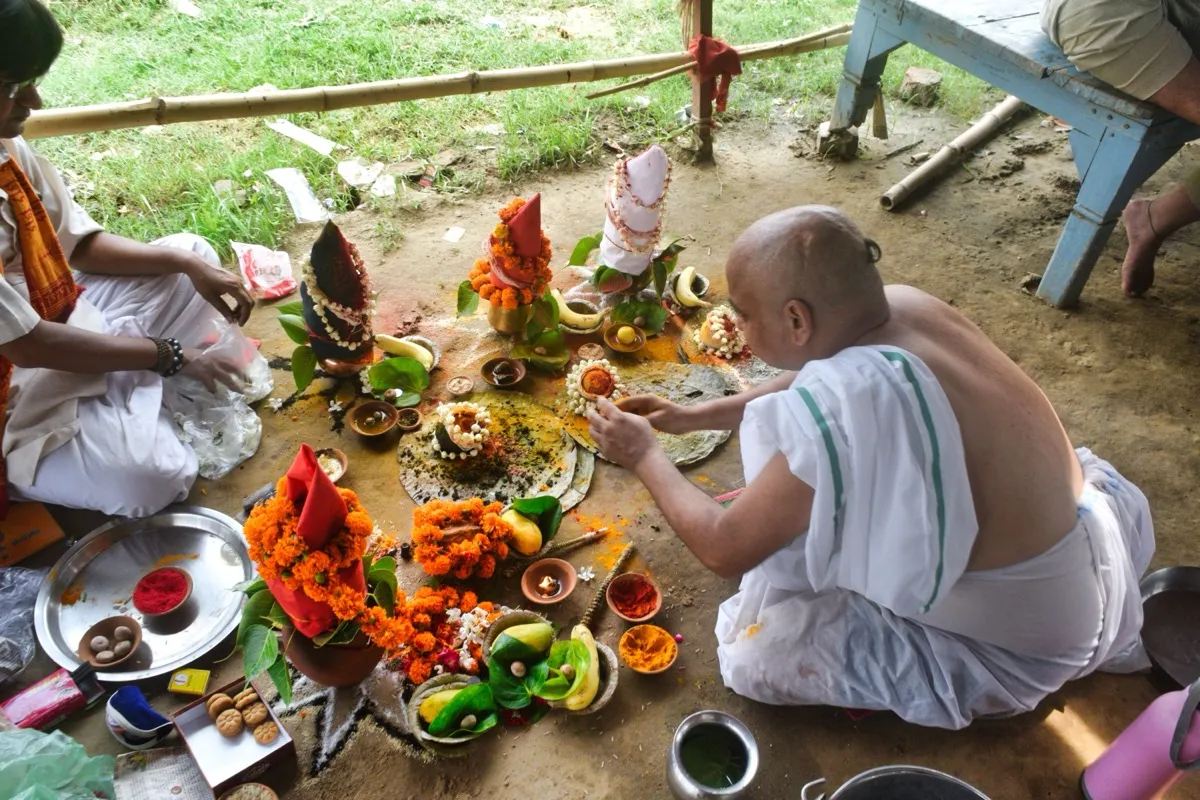
Phase 1 — Purification (Shodhana)
The performer (kartaa) and all attending family members bathe with Panchagavya — a purifying mixture of five cow-derived substances: cow’s milk, curd, ghee, cow dung (processed), and cow’s urine. This is distinct from an ordinary bath. The Panchagavya bath is prescribed in the Garuda Purana as the specific purification required before Tripindi Shradh because the ritual involves direct interaction with the preta realm, which carries a heightened spiritual intensity.
After the bath, only white or off-white clothing is worn. Kusha (Desmostachya bipinnata) grass rings, called pavitra, are worn on the ring finger of the right hand by all participants. The yajnopavita (sacred thread) is worn in the apasavya position — over the right shoulder rather than the usual left — throughout the ritual, because the apasavya position is prescribed for all Shradh rites. The family faces south throughout, as south is the direction of Yama and the pitru realm.
Phase 2 — Sankalpa (the Sacred Vow)
The Sankalpa is not a formality. It is the binding declaration that activates the entire ritual. The kartaa states, in Sanskrit: the current tithi, the gotra (lineage) of both the kartaa’s family and the deceased, the full name of the deceased, the cause of death, the manner in which the soul became trapped (if known), and the explicit intention of the ritual.
This specificity matters. The Garuda Purana prescribes that the Sankalpa must name the ancestor by name and by their death circumstance. An ancestor who died by drowning requires slightly different specific language in the Sankalpa than one who died by fire. The presiding pandit guides the kartaa through this, but the family must come prepared with accurate information about the ancestor’s death.
Phase 3 — Kalash Sthapana (Installation of the Five Vessels)
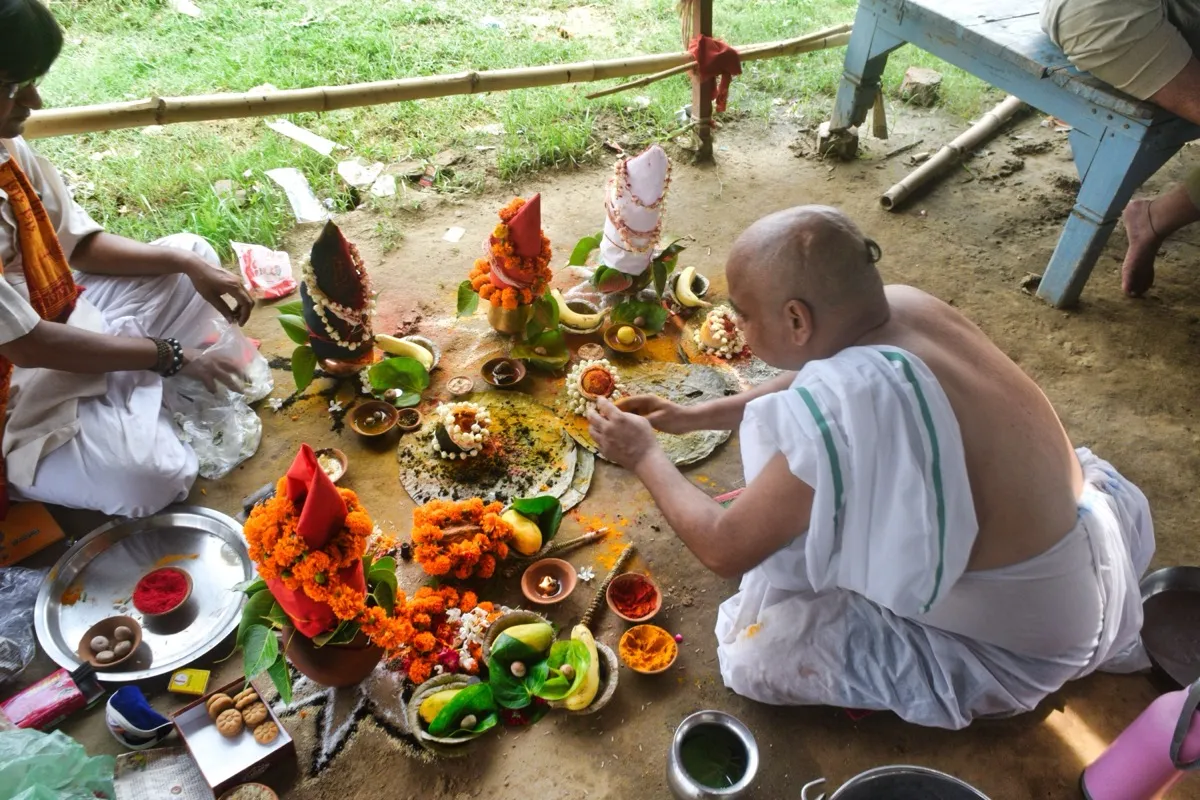
Five kalash (water vessels) are established in a specific geometric arrangement. Each kalash represents one of five presiding deities of the Tripindi Shradh: Brahma (creator, associated with the soul’s origin), Vishnu (preserver, who holds the soul in balance), Rudra (Shiva as dissolver, who releases the preta state), Yama (the lord of dharma and death), and Preta (the departed soul itself, represented symbolically).
Each kalash is filled with water from the sacred tirtha, wrapped in a specific color of cloth (white for Brahma, yellow for Vishnu, red for Rudra, black for Yama, grey for Preta), and marked with a specific metal — gold, silver, copper, iron, and clay respectively. The arrangement is not arbitrary; it mirrors a specific cosmological map of the soul’s journey from death to liberation as described in the Garuda Purana.
Phase 4 — Five Suktas and Five Brahmins
This is the defining characteristic of Tripindi Shradh and the reason it requires a minimum of five Brahmins. Five suktas (Vedic hymn-sequences) are recited simultaneously, each addressed to one of the five presiding deities:
- Brahma Sukta — addressed to Brahma, requesting the soul be recognized as belonging to the creation and entitled to ancestral rites
- Vishnu Sukta — requesting Vishnu’s protective energy to prevent the offerings from being intercepted by hostile forces
- Rudra Sukta (the Sri Rudram, specifically) — invoking Shiva’s power to dissolve the preta state and release the trapped energy
- Yama Sukta — addressed to Yama as the lord of dharmic order, requesting that the soul be correctly classified and directed to the appropriate realm
- Preta Sukta — specific mantras addressed directly to the trapped soul, inviting it to receive the offering and be released
The simultaneous recitation by five separate Brahmins creates what classical texts describe as a mantra-kavaca (protective mantra shield) around the ritual space, allowing the offerings to reach the trapped soul without interference. This is why single-pandit Tripindi Shradh is considered incomplete and insufficient — the five-sukta structure requires five voices.
Phase 5 — Tarpan (Water Offerings)
Tarpan in Tripindi Shradh differs from regular Pitrupaksha Tarpan. Here, the water is mixed with krishna tila (black sesame seeds) and offered through the Pitru Tirtha — the space between the thumb and index finger, with the hand in the position specifically designated for ancestral offerings.
The mantras used during Tarpan are the durmarana-specific mantras from the Garuda Purana, which address the soul in its preta state rather than as a regular pitru. Regular Tarpan mantras end with “…triptim aayaatu” (may he be satisfied). The durmarana Tarpan mantras include an additional line: “…preta-bandhanam mochaya” (release from the bondage of the preta state). This is not a minor variation — it is a fundamentally different invocation.
Phase 6 — Three Pindas
The three pindas are prepared from rice cooked in milk (no salt), mixed with ghee, honey, and black sesame seeds. They are shaped by hand into ovoid balls the size of a large amla (Indian gooseberry), as specified in the Bhavishya Purana. They are placed on kusha grass arranged in a specific pattern: two blades pointing south (toward the pitru realm) and one pointing east (toward the living world), symbolizing the bridge between the two.
Each pinda is offered with a specific mantra addressed to one of the three gunas or three generations, depending on the tradition being followed. Ghee is poured over each pinda as it is placed. The presiding pandit recites the preta-specific mantra invoking Yama to facilitate the soul’s acceptance of the offering.
Phase 7 — Havan and Completion
A small havan (fire ritual) is performed using the fire established at the beginning of the ceremony. Oblations of ghee and charu (cooked rice mixed with ghee and curd) are offered with specific Vedic mantras. The havan serves to transform the physical offerings into a form the soul can receive — fire being the universal transformer between the physical and the subtle realms.
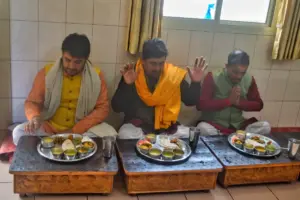
After the havan, a minimum of five Brahmins are fed a full meal (Brahmin Bhoj). This is not optional — the Brahmin Bhoj is the ritual completion of the Tripindi Shradh, as the satisfaction of the Brahmins is equated with the satisfaction of the five presiding deities. Dakshina (monetary gift) is given to each Brahmin. The pindas are then immersed in the sacred waters of the tirtha.
Critical Note on Brahmin Count
Tripindi Shradh performed with fewer than five Brahmins is considered adhura (incomplete) in the classical texts. The five-sukta structure is inseparable from the ritual’s efficacy. If you are arranging Tripindi Shradh independently, verify that your pandit will provide all five officiating Brahmins — this is included in our Prayag Pandits packages.
Tripindi Shradh Samagri — Complete Materials List
The samagri (ritual materials) for Tripindi Shradh is more extensive than for regular Shradh. The following lists are based on the Garuda Purana’s prescription, with the Skanda Purana’s additions for the Chaturdashi tithi.
| Category | Permitted (Vidhi Sammat) | Prohibited (Varjya) |
|---|---|---|
| Vessels | Silver, copper, bronze, clay (earthen) | Iron vessels (iron is associated with malevolent forces) |
| Grass | Kusha (Desmostachya bipinnata) | Any other grass as a substitute |
| Seeds | Black sesame (krishna tila), barley, rice | Masoor dal (red lentils) |
| Cooking medium | Pure cow ghee, honey | Sesame oil as a primary medium |
| Dairy | Cow’s milk, curd, Panchagavya | Buffalo milk or milk of any other animal |
| Flowers | White flowers (jasmine, white marigold, white lotus), sandalwood | Red flowers, black flowers, Ketaki (pandanus), Champa |
| Fragrance | Camphor, sandalwood paste, agarbatti (incense) | Musk, kasturi |
| Kalash items | 5 water pots, 5 colored cloths, 5 different metals | Damaged or chipped vessels |
| Food (for pindas) | Boiled rice, ghee, honey, black sesame | Salt (in the pindas), onion, garlic, eggplant, meat |
| Water | Sacred tirtha water (Ganga, Yamuna, Saraswati) | Well water or tap water alone |
The full samagri list includes approximately 45 items when the havan materials are included. When you book through Prayag Pandits, all samagri is arranged by the pandit team — you do not need to source or carry any materials.
Where to Perform Tripindi Shradh in India
The location of Tripindi Shradh significantly affects its spiritual efficacy. The Garuda Purana states that the same ritual performed at a sacred tirtha yields “hundred-fold fruit” compared to the same ritual performed at home. Among the tirthas, different locations have specific scriptural authority for different types of ancestral rites.
Varanasi — Pishach Mochan Kund (Textually Primary)
Among all sites, the Kashi Mahatmya gives Varanasi — specifically Pishach Mochan Kund — the highest authority for Tripindi Shradh. The name itself means “the kund that liberates from pishach (ghost) state.” According to the Kashi Mahatmya, this is the precise location where Lord Shiva granted the boon that souls released from pishach or preta yoni through ritual performed here would receive immediate liberation rather than having to go through additional cycles.
Pishach Mochan Kund is a sacred tank in the north of Varanasi, and performing Tripindi Shradh here specifically addresses the pishach aspect of the soul’s entrapment — the dimension of the preta state where the soul has become aggressive or disruptive toward the living family. The spiritual geography of Varanasi makes it uniquely powerful for all rites involving the liberation of trapped souls.
Tripindi Shradh at Varanasi — Rs. 31,000
Prayagraj — Triveni Sangam (Most Accessible, Broadly Powerful)
Prayagraj’s Triveni Sangam — the confluence of the Ganga, Yamuna, and the subterranean Saraswati — is the site with the broadest scriptural endorsement for all ancestral rites. The Padma Purana calls Prayagraj “Tirthraj” (king of all tirthas) precisely because the triple confluence amplifies the potency of every ritual performed at its waters.
The Akshayavat (the undying banyan tree at the Patalpuri shrine beneath the Allahabad Fort) is particularly significant for Tripindi Shradh at Prayagraj. The Mahabharata and the Padma Purana both state that pindas offered at Prayagraj under the Akshayavat give “akshaya” (undying, imperishable) merit — meaning the liberation of the ancestor is permanent and not subject to reversal.
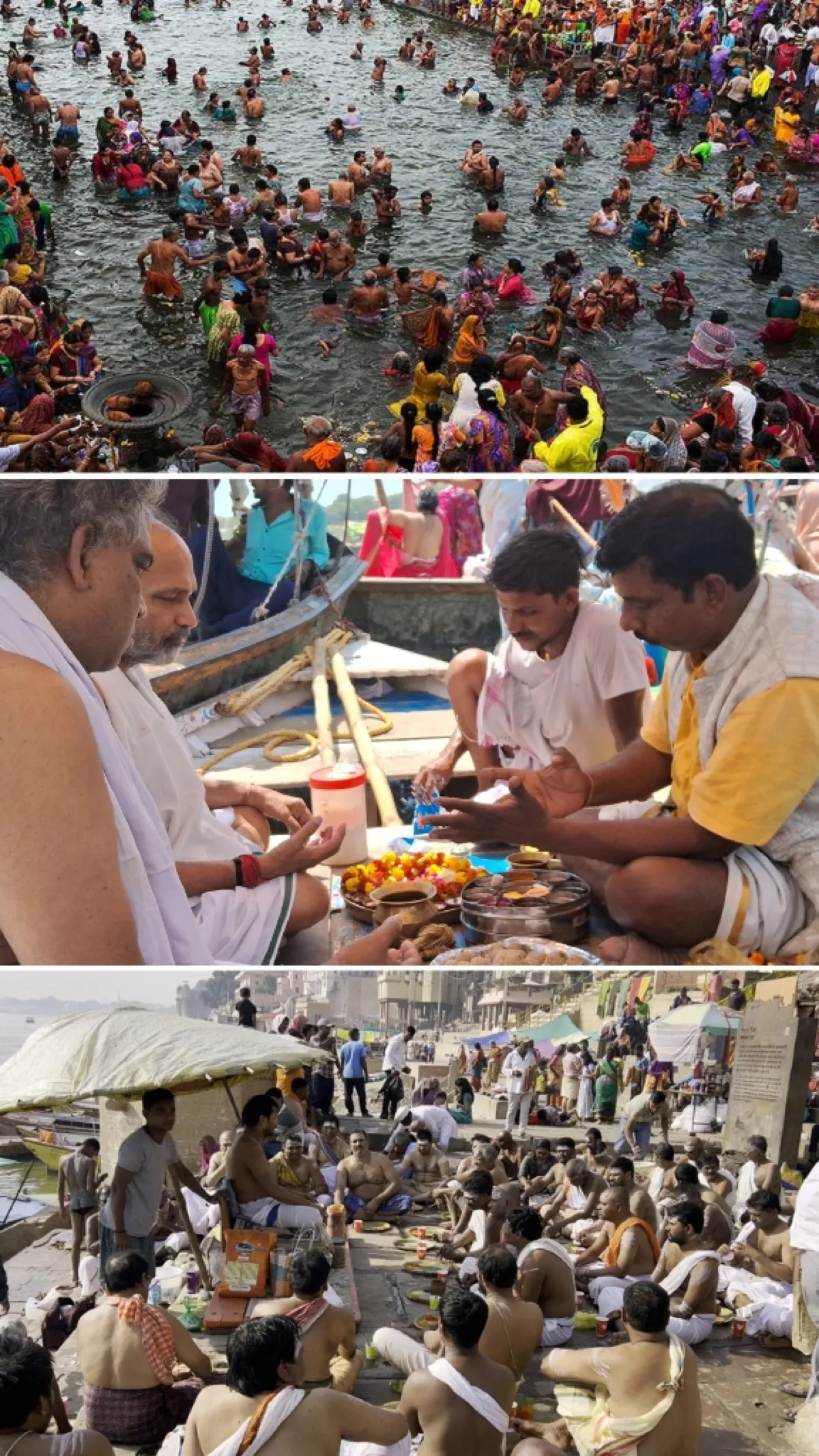
- Tripindi Shradh at Prayagraj (In-Person) — Rs. 31,000
- Online Tripindi Shradh at Prayagraj — Rs. 33,000
Gaya — Vishnupad Temple (Maximum Generational Liberation)
Gaya is specifically designated in the Vayu Purana and the Agni Purana as the most powerful tirtha for liberating ancestors across multiple generations. The Garuda Purana states that pindas offered at Gaya on the Vishnupad (Lord Vishnu’s footprint) liberate “one hundred generations” of ancestors. For families with multiple generations of ancestral disturbance — where Tripindi Shradh is needed for more than one trapped soul — Gaya offers the most comprehensive liberation.
The Gaya pilgrimage for Tripindi Shradh is more elaborate than at other sites, requiring visits to specific sites within the Gaya kshetra including the Falgu River bank, the Vishnupad temple, and the Akshayavat at Gaya. This is why the cost is higher and the duration may extend to two days for families performing Tripindi Shradh for multiple ancestors.
Haridwar — Har Ki Pauri
Haridwar’s Har Ki Pauri ghat on the Ganga is a powerful site for all Shradh rites, though it does not have the same specific Tripindi Shradh scriptural designation as Varanasi’s Pishach Mochan Kund. Haridwar is most recommended when families cannot travel to the other three sites, or when they have already completed Narayan Bali at Haridwar and wish to perform Tripindi Shradh at the same location for continuity.
Tripindi Shradh Cost in 2026 — City-Wise Comparison
The cost of Tripindi Shradh varies by location primarily because of the logistics of arranging five qualified Brahmins with knowledge of all five suktas, the quality and completeness of samagri, the sacred tirtha access fees, and the Brahmin Bhoj preparation. The following table reflects our 2026 packages at Prayag Pandits:
| City | In-Person Cost | Online Cost | Duration | Best For |
|---|---|---|---|---|
| Prayagraj | Rs. 31,000 | Rs. 33,000 | 1 full day | Broadest tirtha power, Akshayavat merit, most accessible |
| Varanasi | Rs. 31,000 | Available on request | 1 full day | Pishach Mochan Kund — textually primary for pishach liberation |
| Gaya | Rs. 39,999 | Rs. 34,000 | 1-2 days | 100-generation liberation, Vishnupad authority |
| Haridwar | On request | On request | 1 full day | Combined with Narayan Bali at Haridwar |
What the cost includes: Pandit dakshina for all five officiating Brahmins, complete samagri arrangement, sacred tirtha access, Brahmin Bhoj for five Brahmins, pinda immersion, photography documentation of the ritual.
What the cost does not include: Travel and accommodation for the kartaa’s family, additional family members’ travel expenses, or optional extensions such as Tarpan at additional tirthas within the same city.
Book Tripindi Shradh — 2026 Packages
Narayan Bali vs Tripindi Shradh — When Is Which Required?
The most common confusion in ancestral rites involves when to perform Narayan Bali Puja versus Tripindi Shradh, and whether both are needed. The answer is clear in the classical texts, though it is often muddied by pandits who recommend one or the other regardless of the family’s specific situation.
| Aspect | Tripindi Shradh | Narayan Bali | Parvana Shradh |
|---|---|---|---|
| Primary purpose | Release soul from preta/pishach yoni to ancestral realm | Satisfy the unfinished life-desire that caused the bad death; provide symbolic last rites | Nourish ancestors already in the ancestral realm |
| Number of pindas | 3 (representing three gunas or three generations) | None (havan-centered, not pinda-centered) | 6, 9, or 12 (depending on the number of generations) |
| Brahmins required | Minimum 5 (one per sukta) | Minimum 5 (similar complexity) | 3 to 9 depending on tradition |
| Textually primary site | Pishach Mochan Kund, Varanasi | Any major tirtha (no exclusive site) | Gaya (preferred), any tirtha |
| When to perform | When soul is confirmed in preta/pishach state | First, when an ancestor died a bad death | Annually, every Pitrupaksha |
| Relation to the other | Often follows Narayan Bali if soul remains trapped | Often performed before Tripindi Shradh as the first step | Can resume after Narayan Bali/Tripindi Shradh are complete |
The Dharma Sindhu (a 16th-century digest of ancestral rite prescriptions) states the correct sequence: when an ancestor has died a bad death, first perform Narayan Bali to provide the symbolic last rites and satisfy the unfulfilled desires that caused the entrapment. If the Pitra Dosh symptoms persist, then perform Tripindi Shradh to directly release the soul from the preta state. In many cases, both are performed in a single visit to a tirtha — Narayan Bali on Day 1 and Tripindi Shradh on Day 2.
Narayan Bali Packages: Narayan Bali at Prayagraj — Rs. 41,000 | Narayan Bali at Gaya — Rs. 41,000
Benefits of Tripindi Shradh (त्रिपिंडी श्राद्ध के फायदे)
The Garuda Purana describes the benefits of Tripindi Shradh in two categories: the benefit to the departed soul and the benefit to the living family. Both flow from the same act — correctly identifying the problem and performing the prescribed remedy.
For the departed soul: Liberation from the preta or pishach yoni, which the Garuda Purana describes as a state of intense longing, confusion, and inability to progress. The soul is “handed over” to Yama for proper assessment and directed to its appropriate next realm — whether that is the ancestral planes, rebirth, or higher liberation depending on the soul’s own accumulated karma. The Tripindi Shradh itself does not grant moksha, but it removes the specific obstruction of the bad-death entrapment that was preventing the soul from progressing.
For the living family: The Garuda Purana lists relief from all the diagnostic symptoms mentioned earlier — restoration of fertility, protection of children, stabilization of finances, resolution of chronic household conflict, improvement in health outcomes. The Markandeya Purana adds that a family that correctly performs Tripindi Shradh when it is needed will be “protected for seven generations” from the recurrence of the same type of ancestral debt.
Family peace and renewed prosperity are commonly reported by families who have performed Tripindi Shradh correctly. This is not the ritual itself producing material outcomes — it is the removal of a genuine spiritual obstruction that was suppressing the family’s natural capacity for wellbeing. The Brahma Purana states: “As a blocked river when unblocked flows freely to the sea, so a family whose ancestral rites are complete flows freely toward its dharma.”
2026 Muhurat for Tripindi Shradh — Key Dates
Tripindi Shradh can be performed year-round, but the following dates in 2026 carry the highest sanctity based on the Panchang:
| Date | Tithi | Significance |
|---|---|---|
| January 12, 2026 | Krishna Chaturdashi (Mauni Amavasya proximity) | Early year ritual, Makar Sankranti period power |
| March 29, 2026 | Krishna Chaturdashi | Pre-Chaitra Navratri window |
| July 26, 2026 | Krishna Chaturdashi, Shravan month | Shravan amplifies Shiva energy — particularly good for Tripindi |
| August 24, 2026 | Krishna Chaturdashi, Bhadrapada | Directly precedes Pitrupaksha; excellent window |
| October 6-21, 2026 | Entire Pitrupaksha fortnight | Peak period; Oct 19 Chaturdashi is the most powerful day |
| November 22, 2026 | Krishna Chaturdashi, Kartik | Post-Pitrupaksha window before year end |
Full Pitrupaksha 2026 muhurat and tithi calendar with exact timings is available for planning your visit.
How to Prepare for Tripindi Shradh — Practical Guidance for Families
Preparation for Tripindi Shradh requires gathering specific information and observing certain practices in the days before the ritual. This preparation is not ceremonial formality — it directly affects the quality and completeness of the Sankalpa, which anchors the entire ritual.
Information to gather:
- The full name of the ancestor for whom Tripindi Shradh is being performed
- The gotra of the ancestor (both maternal and paternal lines if available)
- The cause and approximate circumstances of death (accident, suicide, drowning, etc.)
- The approximate year of death and location
- Whether proper last rites were performed at the time of death (if known)
- The specific Pitra Dosh symptoms being experienced by the family
Practices in the three days before the ritual:
- Avoid meat, alcohol, and foods with tamasika properties (excessive onion, garlic, stale food)
- Maintain celibacy in the days before the ritual
- On the morning of the ritual, take a full bath before sunrise and wear only white clothing
- Do not eat before the ritual begins — the kartaa should perform the Sankalpa on an empty stomach
- Bring all immediate family members who can be present — the collective Sankalpa of the family strengthens the ritual
For NRI families who cannot travel to India, the online Tripindi Shradh package allows the kartaa to be present via live video call while the pandit performs the ritual at the tirtha on their behalf. The Sankalpa is done jointly at the beginning of the ritual, connecting the kartaa’s intent to the physical performance at the sacred site. See the NRI Puja Services guide for details on how this works.
Consult a Prayag Pandits Purohit
Uncertain whether Tripindi Shradh, Narayan Bali, or a combination is needed for your family? Our pandits will review the ancestral circumstances and the Pitra Dosh symptoms before recommending the appropriate rite.
- Pre-ritual consultation included
- Five qualified Brahmins for all packages
- All samagri arranged and included
- Brahmin Bhoj and dakshina included
- of the ritual
- Available at Prayagraj, Varanasi, and Gaya
WhatsApp: +91-77540-97777
Tripindi Shradh for NRI Families — Special Considerations
For families living outside India, performing Tripindi Shradh presents specific challenges that are worth addressing directly. The most common question is whether an NRI can perform Tripindi Shradh without traveling to India.
The answer from the classical texts is nuanced. The Garuda Purana states that the Sankalpa — the kartaa’s binding vow — is the spiritually essential element. The kartaa’s physical presence at the tirtha amplifies the ritual’s efficacy, but the Sankalpa can be made “yatra-kuto va” (from wherever the kartaa is located) when travel is impossible. This has been the classical basis for proxy Shradh performed by pandits on behalf of distant devotees for centuries — it is not a modern compromise.
However, the online format requires greater precision in the Sankalpa because the kartaa is not physically present to confirm details. For NRI families, the following is recommended:
- Provide the pandit with written details of the ancestor and the Pitra Dosh symptoms at least one week before the ritual date
- Schedule the live video call for the Sankalpa portion — this is when your presence (even virtually) is most important
- If possible, have a family member in India present at the tirtha even if you cannot be there yourself
- Request a full written report of the Sankalpa text after the ritual — this serves as documentation of what was performed
For specific guidance by country, see the NRI guides for ancestral rites from USA, UK, Australia, and Canada.
Common Misconceptions About Tripindi Shradh
Several misconceptions about Tripindi Shradh lead families to either over-perform or under-perform the ritual. Addressing them directly saves time, money, and spiritual misdirection.
Misconception 1: “Anyone can perform Tripindi Shradh as a general ritual.”
Tripindi Shradh is prescribed for a specific condition — an ancestor’s entrapment in preta or pishach yoni due to unnatural death or missed rites. Performing it without this condition being present wastes resources and may actually create confusion in the ancestral realm by drawing attention to souls who are already at rest. If your family has not had an unnatural death and you have been performing regular annual Shradh, Tripindi Shradh is not needed.
Misconception 2: “Tripindi Shradh must be performed at Tryambakeshwar.”
Tryambakeshwar (Nashik) is specifically prescribed as the primary site for Narayan Bali per the Dharma Sindhu and the Skandha Purana’s Sahyadri Khanda. It does not have the same scriptural designation for Tripindi Shradh. The Kashi Mahatmya designates Pishach Mochan Kund (Varanasi) as the primary site for Tripindi Shradh specifically. Pandits who insist that Tripindi Shradh must be done at Tryambakeshwar are conflating two different rituals.
Misconception 3: “Tripindi Shradh replaces annual Shradh.”
Tripindi Shradh is a one-time corrective ritual for a specific condition. After it is performed and the soul has been released, the family should resume regular annual Parvana Shradh during Pitrupaksha to continue nourishing the ancestor in their new state. The two rituals serve different purposes and neither replaces the other.
Misconception 4: “Three pandits are sufficient.”
As explained in the Vidhi section, the five-sukta structure of Tripindi Shradh is inseparable from the ritual’s design. Three Brahmins cannot recite five suktas simultaneously. If a pandit offers Tripindi Shradh with only three officiants, the ritual will be missing the Yama Sukta and the Preta Sukta — the two most important components for actually reaching a trapped soul.
Tripindi Shradh and the Garuda Purana — The Scriptural Foundation
The Garuda Purana, spoken by Lord Vishnu in the form of Garuda to the sage Kashyapa, is the primary source for all Shradh prescriptions in the Vaishnava tradition. The section on ancestral rites — the Pretakalpa — covers approximately eight chapters of the text and includes a detailed taxonomy of death types, their consequences for the soul, and the specific rituals required for each.
The Pretakalpa’s prescription for Tripindi Shradh appears in the context of a larger discussion of what happens when a family fails to perform proper Shradh: “The pitru who does not receive Shradh becomes a preta. The preta who is not released by proper ritual becomes a pishach. The pishach who is not released afflicts the living family with all the symptoms of Pitra Dosh. For such souls, neither the regular Shradh of Pitrupaksha nor the Parvana ritual of ordinary life suffices. The Tripindi Shradh alone, performed at a sacred tirtha with the prescribed five Brahmins, can reach them.”
The Skanda Purana adds the specific prescription for Chaturdashi as the tithi: “On the 14th day of the dark fortnight, when Maheshwara’s energy is dominant, the boundary between the living and the dead is thinnest. On this day, the preta who receives three pindas through the Tripindi rite is released from ghosthood and directed by Yama to its proper realm.”
For families looking for a deeper understanding of the scriptural framework around ancestral rites, the Shradh Karm guide covers the full Vishwamitra Smriti taxonomy, and the What Is Shradh complete guide explains the philosophical framework behind why these rites work.
After Tripindi Shradh — What to Expect and What to Do Next
The period following Tripindi Shradh is important for consolidating the ritual’s effect. The Garuda Purana prescribes certain practices in the days after the ritual:
In the three days after Tripindi Shradh: Continue the sattvic diet. Avoid arguments and conflict within the household. Light a lamp (deepa) at the household altar each evening and offer it with the simple prayer: “Pitaro ye gataas teertham, may they be at peace.” Do not visit cremation grounds or places associated with death during this period.
In the month following: Resume or begin regular monthly Mahalaya Shradh if your family tradition includes it. If you have been performing annual Pitrupaksha Shradh but have not been including Tarpan, add Tarpan to your annual observance from now on — it is the simplest ongoing nourishment for ancestors who have now been released to the proper realm.
Annually going forward: Perform Pitrupaksha Shradh during the annual fortnight, including the ancestor for whom Tripindi Shradh was performed. Now that they have been properly released and can receive regular Shradh, include them in your annual ritual with the standard Parvana procedure.
Many families ask whether they will “feel” a change after Tripindi Shradh. The honest answer is: sometimes yes, sometimes no, and neither validates or invalidates the ritual. The Garuda Purana does not promise perceptible immediate results — it promises that the obligation has been fulfilled correctly and that the causal chain of Pitra Dosh has been addressed at its root. Material and practical improvements often follow over months and years as the underlying obstruction is removed, not overnight.
Book Your Sacred Ritual
Authentic ceremonies performed by Veda-trained pandits at sacred sites across India.